
GRB 250702B: The Seven-Hour Gamma-Ray Burst Explained
Explore GRB 250702B, the seven-hour gamma-ray burst, its possible black-hole origins, Webb observations, and the questions astronomers still face.
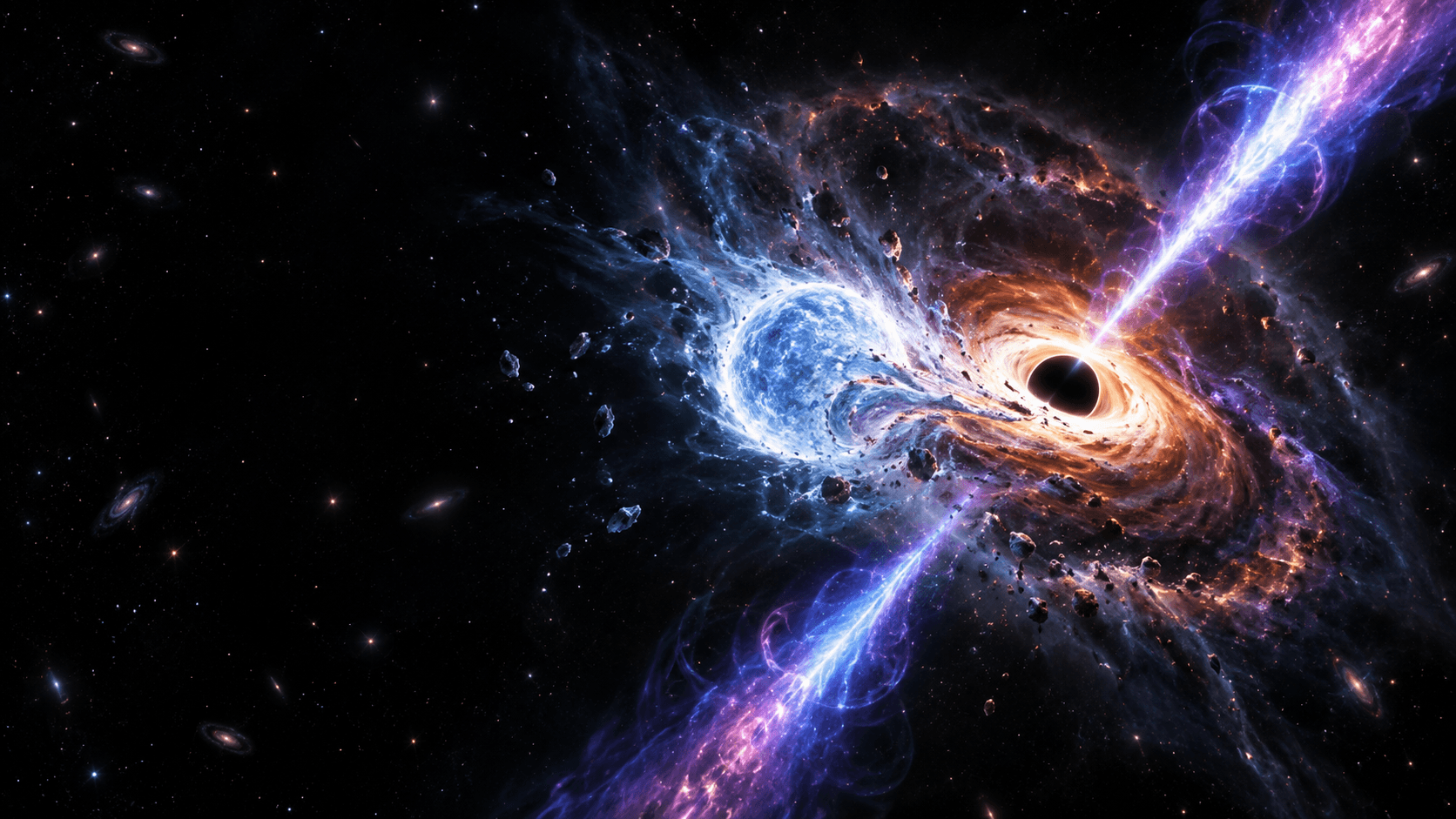
Editorial note. This article summarises what has been published about GRB 250702B as of September 14, 2026. Several of the studies discussed here are preprints on arXiv. Some are undergoing peer review; some have appeared in refereed journals since submission. Where a citation is important, please confirm the latest version. The scientific picture continues to evolve, and later observations may revise the conclusions in this piece.
Chapter 1 — What was the seven-hour signal?
On July 2, 2025, NASA's Fermi Gamma-ray Space Telescope began recording an unusually long burst of gamma rays from a point on the sky in the direction of the Milky Way's disc. That event was catalogued as GRB 250702B. Gamma-ray activity continued, in fits and starts, for roughly 25,000 seconds. Divided by the 3,600 seconds in an hour, that is about 6.94 hours — the source of the popular headline about a "seven-hour signal from space".
The word "signal" in that headline is used in its instrumental sense. In detector science, a signal is any measurable response to incoming radiation. It does not imply a message, a code or an intelligent sender. The instruments on Fermi, and on several other spacecraft that observed the field, recorded high-energy photons. Those photons carried information about the physical system that emitted them, but nothing in the data suggests a deliberate transmission.
Two questions have to be kept separate throughout this article. The first is what astronomers detected. That question has clear, well-supported answers: a prolonged, hard-spectrum, highly variable gamma-ray burst; a fading multi-wavelength afterglow; and a distant host galaxy whose spectrum places the event at a redshift of approximately z = 1.036. The second question is what physical system produced the burst. That question is genuinely open. Several published models fit the data. None has been established beyond serious dispute.
This article follows the evidence from those first detector triggers to the models now competing to explain them. It does not attempt to declare a winner. Where the observations rule out an interpretation, it says so. Where they merely disfavour one, it says so more carefully. The aim is to explain what is well established, what is inferred and what remains genuinely uncertain, in a way that will still make sense long after the headline cycle has moved on.
Chapter 2 — The discovery of GRB 250702B
Gamma-ray bursts are, by convention, named for the date of their discovery in the format YYMMDDx, where x is a letter indicating the sequence of bursts on that date. GRB 250702B is therefore the second gamma-ray burst catalogued on July 2, 2025. Neither the letter B nor the numerical prefix say anything about the burst's physical properties. Those had to be worked out from the data.
The primary discovery instrument was the Fermi Gamma-ray Burst Monitor, or GBM. GBM is a set of twelve sodium iodide detectors and two bismuth germanate detectors mounted on the Fermi spacecraft. Together they cover the entire sky not blocked by Earth. When high-energy photons deposit energy in the crystals, on-board electronics decide whether the count rate has risen significantly above the background. If it has, the spacecraft issues a trigger.
According to NASA's account, GBM issued multiple triggers on July 2, 2025 associated with the same region of sky. Multiple triggers from a single burst are not, by themselves, unusual: instruments often re-trigger when the light curve has separate peaks. What was unusual with GRB 250702B was how long the sequence of triggers extended. Standard analyses expect the gamma-ray activity of a long GRB to be over within a few hundred seconds. Here, the activity extended into hours.
Additional spacecraft followed up. The Neil Gehrels Swift Observatory has an X-ray Telescope (XRT) and an Ultraviolet/Optical Telescope (UVOT) designed to slew to burst positions within minutes and refine the localisation. Swift observations of GRB 250702B contributed both to positional accuracy and to the multi-wavelength light curve. Other high-energy observatories also observed the region, providing an independent record of the gamma-ray and X-ray behaviour.
Once the position was refined to arcsecond precision, ground- and space-based optical and infrared telescopes could search for a fading counterpart. This is a familiar procedure for GRB astronomers. It works by identifying a source that appears in the burst error region and that fades over time in the way expected of a gamma-ray burst afterglow. Because GRB 250702B lay close to the plane of the Milky Way, the field was crowded with foreground stars, and the search required careful attention to reddening and to chance alignments.
A crucial step in the discovery narrative was the spectroscopic identification of the host galaxy. Once a plausible optical or infrared counterpart is identified, deep spectroscopy is used to establish its distance. In this case, NIRSpec on the James Webb Space Telescope obtained a spectrum in which emission lines from the host galaxy indicated a redshift of z = 1.036, placing the event billions of light-years away — well outside the Milky Way, but seen through the Milky Way's foreground stars and dust.
The order in which observations were acquired is not the same as the order in which their meaning became clear. The GBM triggers on July 2 announced that something remarkable had happened. It took days of follow-up to establish that the same event was being seen at other wavelengths. It took additional weeks for spectroscopy to secure the distance. It took months of X-ray and infrared monitoring for the community to converge on a shortlist of viable physical interpretations. In the timeline that follows, dates should be understood as approximate. Where a paper reports a specific date, that date can be taken from the paper itself; where the chronology has been reconstructed from multiple sources, the timing is approximate to within a few days.
A sourced timeline
- July 2, 2025. First Fermi GBM triggers. Public GRB catalogue name GRB 250702B is assigned.
- Days after July 2, 2025. Swift, INTEGRAL and other high-energy observatories provide refined X-ray localisation and additional gamma-ray light-curve coverage. Ground-based follow-up begins searching for an optical/infrared counterpart in the crowded field.
- First weeks after the burst. A candidate host galaxy is identified. Preliminary redshift estimates place the source at cosmological distance, contradicting an early Milky Way interpretation of the sky direction.
- Late 2025 to early 2026. JWST/NIRSpec spectroscopy secures a redshift of z ≈ 1.036 for the host and constrains the presence of any accompanying supernova.
- Early 2026. First interpretation papers appear. Neights and collaborators propose a helium-merger interpretation. O'Connor and collaborators publish X-ray analysis extending over ~0.5 to 65 days post-trigger, discussing an X-ray precursor and inferred engine activity.
- February 2026 (magazine issue) / May 26, 2026 (online). BBC Sky at Night Magazine publishes an interview with Eliza Neights discussing the helium-merger scenario. This is the interview that drew wider public attention to the event.
- Spring 2026. Additional interpretation papers appear from Beniamini and collaborators (micro-tidal disruption), Eyles-Ferris and collaborators (white-dwarf disruption by an intermediate-mass black hole), Granot and collaborators (main-sequence disruption by an intermediate-mass black hole), Sato and collaborators (repeated partial white-dwarf disruption) and Yuan, Jiang and Dai (white-dwarf disruption with X-ray flare).
- June 16, 2026. Sears and collaborators post their JWST/NIRCam follow-up, imaging the host approximately 95 observer-frame days after the burst. They report possible ~3σ faint transient signals in two filters and highlight the need for later template observations.
- September 14, 2026. The state of the field at the time of this article's initial publication.
The important lesson of this timeline is that a headline number — seven hours — rests on a much longer scientific process. The instruments that made the discovery had been designed years earlier for exactly this type of observation. The interpretation continues to be refined by teams that share the same public data but reach different conclusions. Neither the discovery nor its explanation was the work of a single moment.
An additional practical point about the discovery narrative deserves attention. Gamma-ray-burst catalogues are updated as more information becomes available. A burst's provisional properties, reported in near-real-time circulars, can be revised as more careful analyses are performed. The peak flux, the T90, the fluence and the peak energy of GRB 250702B in different reports may not all agree at first, and they need not agree exactly even after settled analyses — different instruments quote numbers in different bands. When a paper cites a number, the citation refers to that paper's methodology and data set. When two numbers appear to disagree, the answer is usually to check the methodology.
The order of team discoveries is also worth understanding. The Fermi GBM team publishes initial trigger information within seconds through the Gamma-ray Coordinates Network. Subsequent "GCN circulars" refine the localisation, report follow-up observations by other instruments and announce any subsequent scientific analyses. The paper trail from GCN circulars to preprints to peer-reviewed papers can span months. The scientific consensus, insofar as one develops, develops gradually across this trail. GRB 250702B has generated a large number of GCN circulars — many of them by teams that had never coordinated before — and reading them in order gives an unfiltered view of how the community processed a novel event in near-real-time.
Chapter 3 — What "seven hours" actually means
Astronomers use several different measures of "how long a burst lasted", and reports that appear to disagree often disagree because they are measuring different things. A responsible treatment of GRB 250702B has to distinguish them.
The most familiar duration measure in the gamma-ray-burst literature is called T90. Formally, T90 is the time interval that contains the central 90 percent of the background-subtracted photon counts detected from the burst, measured in a specified energy band. In practice, T90 is a rough estimate of "how long the burst was above background", and different instruments with different energy sensitivities can report different T90 values for the same event. Long GRBs, by traditional classification, have T90 greater than about two seconds; short GRBs have T90 less than about two seconds. Ultra-long GRBs are those with T90 far exceeding the usual long-GRB range, sometimes thousands of seconds.
The Neights and collaborators paper reports approximately 25,000 seconds of gamma-ray activity from GRB 250702B. That number is what generates the "seven hours" headline. It is best understood not as a single continuous emission but as the extent of a series of gamma-ray episodes recorded by the Fermi GBM and other instruments. The dividing line between "part of the same burst" and "a separate event" is set by the analysts, and different criteria give slightly different totals. Twenty-five thousand seconds is a defensible, published number; it should not be treated as a physical constant of nature.
Alongside the main gamma-ray activity, O'Connor and collaborators report a soft X-ray precursor. A precursor is an emission episode detected before the main burst that appears related to it. Precursors have been reported for a substantial minority of long GRBs, and their physical origin is debated. When O'Connor and collaborators include the precursor in their bookkeeping, the inferred activity of the central engine — the physical system driving the emission — extends to at least roughly three days. That inferred duration is a model-dependent quantity. It is not equivalent to the T90 of the gamma-ray light curve.
The initial ESO announcement about the burst emphasised prolonged high-energy activity extending over roughly a day. Its associated paper stressed the unusual, repeating character of the emission and the extragalactic origin of the source. The apparent disagreement with a "seven-hour" figure is not a contradiction. The main gamma-ray activity spans about seven hours; broader high-energy activity, including softer X-rays, extends longer.
Consider also the afterglow. The afterglow is the emission produced by the outflow as it decelerates against the surrounding medium. It fades slowly, typically as a power law in time, and can be detectable for weeks to months in X-rays and optical/infrared. Sears and collaborators observed the field with JWST/NIRCam approximately 95 observer-frame days after the trigger. That JWST measurement is part of the afterglow record. It is not a measurement of the burst itself.
The confusing quantities are worth listing:
| Quantity | Meaning |
|---|---|
| Gamma-ray activity span | Interval across the observed gamma-ray episodes. About 25,000 s for GRB 250702B. |
| Individual pulse duration | Length of one emission episode within the burst. Seconds to minutes for many episodes. |
| X-ray precursor | Earlier emission detected in a different energy range prior to the main burst. Reported by O'Connor et al. |
| Inferred engine duration | Physical activity time inferred from a model combining observations. At least ~3 days when the precursor is included. |
| Afterglow duration | Interval over which emission from the outflow remains detectable. Weeks to months for GRB 250702B. |
| Observation campaign | Period during which telescopes obtained measurements. Continues, as of writing. |
| T90 | Interval containing the central 90 percent of background-subtracted counts, in a specified band. Very large for GRB 250702B. |
Confusing these quantities is easy. Media coverage regularly reports the afterglow of a distant supernova as though it were the moment of explosion, or treats a light curve's total duration as the operational lifetime of the central engine. In the case of GRB 250702B, one paper's "seven hours" and another paper's "three days" refer to different physical intervals. Both can be right at the same time. The correct interpretation is that different phases and energy bands were active over different, overlapping timescales.
Simple arithmetic sets the scale. Twenty-five thousand seconds divided by 3,600 seconds per hour is 6.94 hours. Rounded up, that is "about seven hours". The rounding is honest; the media convention should not, however, disguise the fact that "seven hours" refers specifically to the gamma-ray activity span reported by Neights and collaborators, not to some universally agreed physical duration of the underlying event.
Source-frame corrections give a further, more physical view. The observer-frame 25,000 seconds corresponds to about 12,300 seconds in the source frame, or roughly 3.4 hours. In the host galaxy's own reference frame, therefore, the burst radiated hard gamma rays for roughly three and a half hours. That is still an extraordinary duration for a compact-object-powered event. The observer-frame duration extension by (1 + z) is a factor of about 2, which is not negligible when comparing durations across bursts at different redshifts.
Similarly, the inferred engine duration of at least three days in the observer frame corresponds to about 1.5 days in the source frame. The soft X-ray precursor's timing, measured relative to the main gamma-ray activity, is stretched by the same factor. Any model that predicts a specific physical duration — for example, the timescale for accreting the bulk of a helium star's mass — has to be compared with the source-frame duration, not with the observer-frame value. Getting the frame right is essential to any quantitative model comparison.
There is one more distinction to keep in mind. The durations discussed above are measured in the observer's frame — the frame of the spacecraft. At redshift z = 1.036, a source-frame interval t_source corresponds to an observer-frame interval t_observer = t_source × (1 + z) ≈ 2.036 × t_source. Equivalently, the observer sees a duration that is a factor of about two longer than the interval measured by a hypothetical clock at rest with respect to the host galaxy. When the article later discusses source-frame quantities, it will say so explicitly.
A short summary of the interpretation dependencies may help. The T90 depends on the instrument and the analysis band. The activity span depends on the criterion used to associate distinct emission episodes. The engine duration depends on the model used to interpret the observations. The afterglow duration depends on how faint an afterglow the instruments can still detect. When two reports quote different numbers, the difference is usually not a factual disagreement about the data but a difference in one of these choices. Reading closely reveals the choices; comparing carelessly can lead to phantom contradictions.
One last note on the seven-hour headline. Popular media coverage often shortens "about 25,000 seconds of gamma-ray activity" to "a seven-hour signal", and shortens further to "a signal lasting seven hours". Each shortening loses information. The most precise short phrase would be "about seven hours of gamma-ray activity from a single distant burst". That phrase makes clear that the seven hours refer to gamma-ray activity, not to any inferred physical process, and that the source is one specific event. Where possible, this article uses similarly precise language.
Chapter 4 — Gamma rays and the electromagnetic spectrum
Light is a stream of packets of electromagnetic energy called photons. Each photon has a wavelength λ and a frequency ν linked by the relation c = λ × ν, where c is the speed of light in vacuum. The energy E of a single photon is proportional to its frequency through Planck's constant h:
E = h ν
where E is measured in joules when h is in joule-seconds and ν is in hertz. A more convenient unit for high-energy astronomers is the electron volt (eV), where 1 eV is the energy an electron gains when accelerated through a potential difference of one volt. Radio photons carry energies well below 10⁻⁶ eV. Visible photons carry a few electron volts. X-ray photons are usually described in kiloelectron volts (keV). Gamma-ray photons run from about 100 keV upward, extending in high-energy astrophysics to teraelectron volts (TeV) and beyond.
Gamma rays are, therefore, the most energetic form of light. Because they carry so much energy per photon, they are also the most damaging to biological tissue and the most difficult to focus. Ordinary mirrors and refracting lenses cannot bring gamma rays to a sharp image because the rays pass through most materials or are absorbed in ways that do not preserve wavefront information. Gamma-ray astronomers must therefore use very different instrument designs from optical astronomers.
This matters for GRB 250702B in two ways. First, the burst's identity as a gamma-ray event tells us about the physical processes that produced it. Gamma rays are emitted when charged particles are accelerated to relativistic speeds — that is, speeds close to the speed of light — and interact with radiation fields or magnetic fields. They are also emitted when high-energy particles collide with matter or when a photon-photon interaction produces energetic radiation. In either case, the underlying source is a very energetic environment. Producing gamma rays for hours is not something the ordinary interior of a star can do.
Second, the burst's gamma-ray identity constrains the follow-up strategy. Because gamma rays are hard to image precisely, the initial position was known only to a fraction of a degree. Precise localisation had to wait for lower-energy instruments — X-ray telescopes that can image with arcsecond precision and optical/infrared telescopes that can pinpoint a source to fractions of an arcsecond. The transition from gamma-ray detection to optical identification is a routine but delicate process. It is also the reason astronomers can talk with confidence about the burst's redshift: the host was identified in visible and infrared light and its distance measured spectroscopically. The gamma-ray photons themselves carry no spectroscopic redshift signature usable at present sensitivities.
Gravitational waves are not electromagnetic radiation. They are ripples in spacetime produced by accelerated massive bodies, and they were first directly detected in 2015 by the LIGO observatories. Gravitational waves and gamma rays are complementary channels: certain kinds of GRB, notably short bursts from compact-object mergers, are expected to produce both signals nearly simultaneously. No coincident gravitational-wave signal has been reported for GRB 250702B, but the event's distance and the sensitivity of current detectors mean a non-detection is not surprising and does not, on its own, rule out any of the compact-object interpretations.
To summarise the vocabulary of this chapter: λ, ν and E describe photons; c sets the relationship between wavelength and frequency; h sets the relationship between frequency and energy; and the electromagnetic spectrum is a continuous ladder from radio waves to gamma rays, ordered by increasing photon energy. GRB 250702B sits near the top of that ladder, with tails extending downward into X-ray, infrared and optical follow-up. The physics that produced it must be capable of accelerating charged particles to extreme energies and sustaining that acceleration, in fits and starts, over hours as seen by our clocks.
It is worth pausing on a common confusion. In everyday language, "gamma rays" often evokes nuclear medicine, radioactivity or science-fiction hazards. In astronomy, the word simply picks out the highest-energy part of the electromagnetic spectrum, defined by the photons' energy rather than by their origin. Gamma rays from the burst are not radioactive matter; they are photons. They carry no residual particles, cannot make matter radioactive at Earth and are dispersed over the entire sky by the enormous cosmological distance the photons have travelled. The prompt gamma-ray flux at Earth from GRB 250702B is a tiny number in absolute units, and only a specialised space detector could register it against the natural gamma-ray background.
Spectral shape also encodes information about the emitter. A thermal source with a definite temperature produces a smooth curve peaking at a wavelength set by Wien's law. A non-thermal source producing gamma rays by synchrotron radiation or inverse-Compton scattering produces a very different spectral shape, usually well described by broken power laws with characteristic break energies. For gamma-ray bursts, the prompt-emission spectrum is often fit by the empirical "Band function", which uses two power laws joined at a peak energy. The peak energy, together with the isotropic-equivalent luminosity, is one of the most commonly quoted observables of a burst, and correlations between them across the GRB population have been widely studied. Whether GRB 250702B lies on those correlations, and how comfortably, is one of the observational questions its dataset is being asked to answer.
There is also a photon-number consideration. Gamma-ray-burst spectra are usually quoted in flux per unit energy rather than in numbers of photons, but for detector design and analysis the photon count is what matters. Each photon at 100 keV carries about 1.6 × 10⁻⁸ erg. For an isotropic-equivalent luminosity of 10⁵⁰ erg/s spread over a spectrum peaking near 100 keV, an instrument at the luminosity distance of GRB 250702B receives an extremely small number of photons per square centimetre per second — enough, however, for a well-designed detector to record a clear signal above the background. Astronomy at high energies is often photon-starved. Interpretations depend on the statistics of small numbers.
A related consideration is spectral evolution. Real GRB spectra evolve during the burst. The peak energy may migrate, the spectral slopes may change and the total luminosity may vary. Analysing time-resolved spectra requires dividing the light curve into intervals and fitting each. For very long bursts like GRB 250702B, the number of independent time intervals is large, and the statistical power for detecting spectral evolution is correspondingly high. Published analyses report time-resolved spectral parameters and discuss how they evolve. Some evolution is expected from the physics of internal shocks, and its observation adds a constraint on the outflow's structure.
One further concept is worth introducing here: the compactness problem. Early observational data on GRBs suggested that they had to be produced in regions large enough for photons to escape without pair-producing on other high-energy photons. The compactness problem was resolved by recognising that the emitting flow is relativistic, so that in the flow's rest frame the photon energies are lower and the pair-production optical depth is smaller. Relativistic bulk motion with Lorentz factors of order 100 or larger is now standard in GRB modelling. GRB 250702B, like other bright GRBs, requires a relativistic outflow with a Lorentz factor of at least order 100 for the compactness problem to be avoided, and this is a further constraint that any progenitor model must satisfy.
Chapter 5 — How spacecraft detect gamma-ray bursts
Earth's atmosphere is opaque to gamma rays. This is fortunate for life and inconvenient for astronomers. It means gamma-ray telescopes must operate above the atmosphere, either from space or, in the case of the very highest energies, indirectly by watching the atmospheric cascades that individual gamma rays produce. For the energies relevant to GRB 250702B, direct detection from orbit is the standard approach.
The Fermi Gamma-ray Space Telescope carries two instruments. The Large Area Telescope, or LAT, uses a pair-conversion tracker to detect high-energy gamma rays in the ~20 MeV to more than 300 GeV range. The Gamma-ray Burst Monitor, or GBM, uses twelve sodium iodide (NaI) scintillators and two bismuth germanate (BGO) scintillators to cover 8 keV to 40 MeV over most of the sky. Scintillators are crystals that emit a small pulse of visible light when a gamma-ray photon deposits energy in them; photomultiplier tubes convert the light pulse into an electrical signal, and on-board electronics count the pulses in fine time bins.
A GRB trigger begins as an unusually high count rate. The GBM computes background rates from recent history and compares the current rate to that background. When the current rate exceeds a threshold — typically several standard deviations above background, over one of a set of pre-defined timescales — a trigger is issued. The trigger records the time, the identifiers of the detectors that saw the increase, and preliminary source coordinates estimated from the relative counts in different detectors. Triggers are transmitted to ground stations and to public alert networks so that follow-up observatories can respond quickly.
The count rates of individual detectors do not by themselves fix a source position. Fermi GBM does not image gamma rays. It estimates position by comparing rates in detectors pointing in different directions. Position uncertainties of several degrees are common in the initial triggers. A gamma-ray position of that precision leaves millions of foreground stars and thousands of possible host galaxies within the error region.
Swift's Burst Alert Telescope (BAT) uses a coded-mask technique, in which a pattern of blocked and open elements over the detector plane casts a shadow whose location depends on the direction of the incoming gamma-ray flux. By comparing the observed shadow to the known mask pattern, the instrument reconstructs positions to a few arcminutes. When Swift slews to a burst position, its X-ray Telescope (XRT) can refine the localisation to a few arcseconds. If the burst has an ultraviolet or optical counterpart bright enough for UVOT, Swift can localise it to fractions of an arcsecond directly.
Other spacecraft contribute to the picture. The INTEGRAL and Konus-Wind experiments provide independent gamma-ray and hard X-ray coverage. Interplanetary spacecraft equipped with gamma-ray detectors — historically forming the "interplanetary network" — can triangulate a burst position by comparing the time of arrival of the gamma-ray front at spacecraft separated by hundreds or thousands of light-seconds. This triangulation is very powerful for events bright enough to be seen at more than one node in the network.
For GRB 250702B, the initial GBM triggers were followed by X-ray localisation and by optical/infrared follow-up in the days after the burst. The X-ray light curve extending from about half a day to sixty-five days after the trigger, discussed by O'Connor and collaborators, was assembled from repeated pointings by Swift XRT and by other X-ray observatories. Any single instrument has coverage gaps: it may be occulted by Earth for parts of every orbit, or it may pass through the South Atlantic Anomaly, or it may be pointed elsewhere. Coverage gaps are important to remember when interpreting a light curve, because a gap is not evidence that the source was quiet.
Detector energy sensitivity also shapes what a light curve shows. Fermi GBM's response peaks somewhere in the tens to hundreds of keV. An X-ray telescope like Swift XRT is sensitive from about 0.3 to 10 keV. Emission that is bright in one band can be faint or invisible in another. When separate reports describe GRB 250702B as brighter or fainter, longer or shorter, in different phases of its evolution, part of the reason is that the reports are drawing on different instruments with different sensitivities. Combining light curves across instruments requires careful cross-calibration.
Finally, background is not constant. It varies with the spacecraft's orbital position, with the Sun's activity, and with the presence of other bright gamma-ray sources in the field. On-board triggers control for this by comparing against recent history; more careful ground-based analyses redo the background estimation with all information available. For a burst as long as GRB 250702B, the background level over which its emission has to be recognised can itself change substantially. This is one of the reasons the reported "activity span" is a defensible number, but not a physical constant.
The instruments that detected GRB 250702B were designed to catch short, sharp flashes and to relay their positions in seconds. That such instruments succeeded in following an event lasting many hours is a mixture of skill and luck. It is also a reminder that our detection systems were not primarily optimised for long, structured bursts — a point the article will return to in the discussion of selection effects.
A second theme deserves emphasis. Detection is a chain. Each link constrains what the next link can do. The first link is the trigger algorithm, which selects a subset of the data stream for further attention. The second link is the position estimate transmitted to ground, which sets how quickly follow-up telescopes can point. The third link is the calibration of the light curve, which determines what physical quantity — flux at what energy, over what time interval — the recorded numbers correspond to. Each link is engineered for a specific expected class of source. GRB 250702B stretched several of these links in ways their designers considered marginal. The success of the follow-up campaign is therefore evidence not only of the burst's intrinsic brightness but of the flexibility of the detection system.
Ground-based follow-up depends on rapid alerts. Modern GRB astronomy relies on the Gamma-ray Coordinates Network (GCN) and other real-time systems to distribute the position of a triggered burst to hundreds of observers within seconds to minutes. Robotic optical telescopes react automatically. Human-scheduled telescopes react as soon as observers approve target-of-opportunity requests. The community of observers, both professional and amateur, is spread around the world; someone is almost always in a position to observe within an hour of a trigger, weather permitting. For GRB 250702B, this rapid-response network provided the first optical constraints and helped narrow the search for a fading counterpart before deeper space-based follow-up was scheduled.
A further consideration is dead time. Every detector has an interval during which it cannot register new events while processing an earlier one. In extremely bright events, dead time can significantly reduce the recorded count rate and distort the inferred light curve. Analyses of bright GRBs routinely correct for dead time, but the correction depends on the detector model. For GRB 250702B, the corrections are within standard ranges, and the derived light curves are considered reliable. Publications quote the fractional corrections when they matter for a specific conclusion.
Interpretability of the data also depends on calibration files that evolve over time. Detectors age. Their responses drift. Calibration teams release updated response files periodically, and re-analysing an event with a newer calibration can slightly change the inferred spectrum and fluence. This is why the same event, discussed in papers submitted in different months, can be quoted with slightly different peak energies or fluences. These differences are usually small — a few percent — but they matter for precision comparisons. Readers curious about apparent contradictions among sources are encouraged to check which calibration and which response file each paper uses.
A further note on the interpretation of gamma-ray-burst detection concerns background subtraction. Every count above the burst's local background comes from a specific event, but the background itself is estimated from data before and after the burst. For a very long burst, the background estimation is more challenging because the burst itself occupies a large fraction of the observing time. Careful analyses use windows adjacent to but not overlapping the burst, and they cross-check with independent estimates from Earth-limb observations and from other detectors. For GRB 250702B, the background estimation has been done consistently in the primary papers we cite, but readers should be aware that background choices contribute to the systematic uncertainty of any reported quantity.
An additional detail is the treatment of overlapping bursts and non-burst variability. On rare occasions, a genuine GRB coincides with a solar flare, a magnetar outburst or another source of variability in the detector's field of view. Analysts filter out such coincidences using cross-references with other observatories and with catalogues of known variables. No such coincidence has been reported for GRB 250702B, but the general procedure is worth mentioning as part of what "detection" involves in modern high-energy astronomy.
Chapter 6 — How astronomers identified the source galaxy
A burst position accurate to a few arcminutes still leaves thousands of stars and dozens of galaxies inside the error region, especially when the burst lies close to the plane of the Milky Way. Turning a gamma-ray flash into an identified host galaxy is therefore a multi-step process. It combines rapid X-ray localisation, deep optical and infrared imaging, careful subtraction of the foreground and, finally, spectroscopy to prove that the candidate host is at the expected redshift. For GRB 250702B, each of those steps was harder than usual.
The complication begins with the geometry. When we look toward the plane of the Milky Way, we look through more stars, more dust and more molecular gas than in almost any other direction. Foreground extinction reddens and dims any background object. Foreground stars can align by chance with the burst position and be mistaken, temporarily, for the counterpart. Colour-selection tricks that work at high galactic latitudes — where the sky is nearly empty of stars — become unreliable close to the disc.
The second complication is the size of the initial error box. Gamma-ray triggers typically arrive with a position uncertainty of degrees. X-ray follow-up shrinks that to arcminutes; deeper X-ray imaging brings it to arcseconds. Only at arcsecond precision does it become feasible to search optical and infrared images for a specific, fading source. Every step that reduces the error box also takes time, and time is limited: the afterglow fades on a power-law schedule that can be steep in the first hours and less steep later on. Missing the first days of afterglow means giving up detailed information about the earliest deceleration of the outflow.
The third complication is the confusion of transients. Near the Galactic plane, variable stars and dwarf novae are common enough that any survey of the field will find things that vary. Distinguishing a burst afterglow from an unrelated variable requires comparing images taken at different times and looking for a source whose position matches the X-ray localisation and whose fading behaviour is consistent with the expected afterglow law. Deep imaging with large ground-based telescopes and, later, with the Hubble Space Telescope and the James Webb Space Telescope, is used to build up this kind of evidence.
Once a candidate optical or infrared source is identified, its association with the burst is tested by comparing its fading with the X-ray light curve, by looking for colour changes over time consistent with cooling synchrotron emission, and by checking that no earlier archival image shows a persistent source at the same position. If all these checks are consistent with a fading transient, the candidate is provisionally accepted as the afterglow.
The identification of the host galaxy is a separate step. The host is not the transient; it is the extended source in which the transient is embedded. In a nearby event, the host might be immediately visible as a resolved galaxy in even shallow images. At the redshift of GRB 250702B, the host is small on the sky and its light is comparable in brightness, at certain epochs, to the fading transient. Careful image subtraction is needed to isolate one from the other.
Spectroscopy then confirms the redshift. Every galaxy contains emission or absorption lines at wavelengths characteristic of specific atomic transitions. When the galaxy is at cosmological distance, those lines are shifted to longer wavelengths by the expansion of the universe. Identifying two or more lines in the spectrum and comparing their observed wavelengths to their laboratory values gives the redshift z with high precision. For GRB 250702B, Gompertz and collaborators used the NIRSpec instrument on JWST to identify emission lines corresponding to a redshift of z = 1.036 ± 0.004. A four-thousandths precision in redshift is a strong constraint; it corresponds to a small percent uncertainty in the luminosity distance and, correspondingly, in inferred luminosities and energies.
An important subtlety concerns the direction on the sky. GRB 250702B lies in a sky direction that, projected on the celestial sphere, falls within the boundaries of a constellation that contains many nearby stars. Constellations are two-dimensional patterns; they say nothing about physical distance. The event's position within a constellation does not mean it belongs to the stars of that constellation or to any structure within the Milky Way. The redshift measurement establishes that GRB 250702B lies at cosmological distance, far beyond every star we can see with the unaided eye.
The chain from initial gamma-ray trigger to spectroscopic host identification typically takes weeks to months to reach a robust redshift measurement. For GRB 250702B, that chain succeeded despite the complicating foreground. The result is that the burst can now be discussed as a specific event in a specific host galaxy at a specific redshift. Everything else — luminosity, energy, physical duration in the source frame — depends on that anchor.
A further complication in identifying hosts near the Galactic plane is that the extinction is not uniform. Dust in the Milky Way is patchy on scales of arcminutes and smaller. Two neighbouring lines of sight can differ substantially in reddening. Standard maps of Galactic extinction, based on infrared emission from dust, provide average estimates but cannot resolve small-scale variations. For a transient near the plane, this uncertainty translates into uncertainty in the intrinsic optical brightness of the afterglow and, therefore, into some slack in the multi-wavelength modelling.
Chance alignments are also a real concern. In a crowded field, the probability of finding an unrelated source within an X-ray error circle is non-negligible. Statistical tests — such as the probability of chance coincidence with a galaxy of the observed magnitude, given the density of similar galaxies on the sky — are used to argue that a candidate host is genuinely associated with the burst rather than being a background object. For GRB 250702B, the chance-coincidence probability with the identified host is small, and the association is considered robust. But it is not zero, and future observations that further tighten the transient's position within the host would strengthen the association further.
A related tool is deep imaging with the Hubble Space Telescope and other high-resolution facilities. Hubble's resolution can resolve the transient's offset from the host's centre of light to within a fraction of a kiloparsec at the redshift of GRB 250702B. Such offsets contribute to classifying the burst against the distributions of offsets observed for long and short GRBs. The current best offset measurements for GRB 250702B place the transient within the host's disc, consistent with a location where recent star formation and older stellar populations both contribute — a broad set of conditions that does not, on its own, favour one progenitor scenario decisively.
Spectral energy distribution fitting of the host, in combination with the transient's position, provides a further constraint. If the transient sits in a young, blue region of the host, the local stellar population is likely dominated by short-lived massive stars, favouring progenitor scenarios involving young stars. If it sits in a redder region, the local population may be older, favouring different progenitor scenarios. For GRB 250702B, the transient's local environment is not resolved with high enough sensitivity to distinguish these possibilities decisively. Deeper future imaging and spectroscopy could sharpen the constraint.
An additional consideration for host identification is the possibility of chance projection. In a crowded field, particularly near the Galactic plane, a transient's line of sight might project onto an unrelated background galaxy without being physically associated with it. The chance probability is quantified by the density of similar galaxies on the sky, and for GRB 250702B it is small but not zero. The consistency of the JWST redshift measurement with the expected properties of a GRB host, and the alignment of the transient's fading with a specific galaxy at that redshift, together make the host association robust. But this reasoning is statistical rather than absolute, and it is worth stating the underlying assumption explicitly.
Chapter 7 — Distance, redshift and cosmic time
Once the host galaxy of GRB 250702B was identified and its redshift measured to be z ≈ 1.036, distance and timing statements about the event acquired a firm cosmological framework. That framework, however, is not intuitive. In cosmology, "distance" is not a single number. Several distances are in common use, they have different physical meanings, and none of them coincides with the everyday concept of "how far away is it".
The redshift z is the fractional change in the wavelength of light between emission and detection:
z = (λ_observed − λ_emitted) / λ_emitted
A redshift of z = 1.036 means each wavelength has been stretched by a factor of 1 + z ≈ 2.036 by the time it arrives at our detectors. The physical process behind cosmological redshift is the expansion of space itself — not a Doppler shift due to motion through space, though the mathematics can look similar at low z.
Redshift also stretches time. A time interval t_source in the frame of the host galaxy is observed on Earth as an interval t_observer given by
t_observer = t_source × (1 + z)
This is cosmological time dilation. For z = 1.036, the stretch factor is about 2.036. The observed "seven hours" of gamma-ray activity for GRB 250702B corresponds to about 3.44 hours in the frame of the host galaxy. Later chapters will use this distinction when comparing to model predictions.
The main cosmological distances are the comoving distance, the luminosity distance and the angular-diameter distance. The comoving distance is the distance today, in the sense that if you could freeze the expansion of the universe at this instant and lay down a chain of rulers, its length would be the comoving distance. The luminosity distance is the distance you would infer from a source of known luminosity and measured flux, using the inverse-square law adjusted for cosmological effects. The angular-diameter distance is the distance you would infer from a source of known physical size and measured angular size, again adjusted. In an expanding universe, these three distances are all different.
For z = 1.036, in a standard flat cosmology with a Hubble constant near 67 km/s/Mpc and matter density parameter about 0.31, the light-travel time is roughly 7.8 billion years; the comoving distance is roughly 11 billion light-years; the luminosity distance is roughly 22 billion light-years. Precise numbers depend on the exact cosmological parameters assumed. When journalists say "the burst is 7.8 billion light-years away", they are usually reporting the light-travel time; when they say "the light has travelled 22 billion light-years", they are almost certainly misapplying the luminosity distance to a light-travel time. This article uses light-travel time when a single number is needed, and it flags the choice explicitly.
A calibrated example is helpful. Consider a gamma-ray photon that arrives at Fermi with 200 keV of energy. That photon was emitted at 200 keV × (1 + z) ≈ 407 keV in the source frame. A characteristic timescale of 100 seconds in the observed light curve corresponds to about 49 seconds in the source frame. An isotropic-equivalent energy of 2.2 × 10⁵⁴ erg reported by Gompertz and collaborators is a source-frame quantity, computed from the observed fluence, the luminosity distance and the assumption of isotropic emission.
Two loose statements about distance are common and misleading. The first is that "the burst happened 7.8 billion years ago and is 22 billion light-years away". Both numbers can appear in valid cosmological calculations, but combining them as though they described a single, everyday spatial concept mixes categories. The second is that "the universe is 13.8 billion years old, so the burst happened when the universe was 6 billion years old". Under standard cosmology this is roughly correct: at z ≈ 1.036, the universe was several billion years younger than today. But that statement is best made with reference to the cosmic age at redshift z, computed from an explicit cosmological model, rather than by subtracting one number from another.
Distance and time also connect to observation strategy. At z = 1.036, the rest-frame ultraviolet emission of the host and afterglow is redshifted to the optical band, and the rest-frame optical is redshifted to the near-infrared. JWST's near-infrared instruments — NIRSpec and NIRCam — probe the rest-frame optical and near-ultraviolet of the source. Ground-based near-infrared observatories can reach similar wavelengths in favourable atmospheric windows. Hubble and other space observatories probe overlapping bands. Interpreting the multi-wavelength data therefore requires a clear map between observed wavelength and rest-frame wavelength, and that map is set by the measured redshift.
The distance also sets what is physically possible. At the luminosity distance of GRB 250702B, an observed flux corresponds to a very large isotropic-equivalent luminosity. If the emission is beamed, the true energy released is smaller than the isotropic-equivalent value by a factor that depends on the jet's opening angle. If the emission is nearly isotropic, the released energy is enormous. Later chapters return to this trade-off.
Cosmology introduces one further complication that is often glossed over in popular accounts: the K-correction. Every observed flux in a given filter corresponds to a range of rest-frame wavelengths shifted by (1 + z). Comparing sources at different redshifts requires converting observed-band fluxes to equivalent rest-frame quantities using an assumed source spectrum. Different assumed spectra lead to slightly different K-corrections and therefore to slightly different inferred luminosities. For GRB 250702B, K-corrections are applied consistently within each of the primary papers we cite, but comparisons between papers require checking how each handled the correction.
Cosmology also enters through the choice of cosmological parameters. Different measurements of the Hubble constant — from the cosmic microwave background versus from the local distance ladder — currently disagree at a level that has been called the "Hubble tension". The disagreement is real but small enough that it changes the inferred luminosity distance to GRB 250702B by a few percent. That is well within the other uncertainties in the burst's energetics and does not affect the qualitative conclusions of this article, but it is worth acknowledging that quoted distances depend on the adopted cosmology.
Finally, the cosmological framework matters because it distinguishes several ways of describing "when" the burst happened. The observer-frame event date, July 2, 2025, is when the photons arrived at Earth. The proper time in the host galaxy since the emission of those photons is the same duration measured by the host's clocks — some 7.8 billion years ago in a standard cosmology. During those 7.8 billion years, the universe expanded significantly, cosmic star formation peaked and declined, and countless other galaxies underwent their own evolution. The burst is a photograph from a much earlier era of the universe, arriving now.
A concrete worked example may clarify the frames. Suppose we observe a light-curve feature at time t_obs = 3 hours after the burst trigger. In the source frame, this feature occurs at t_source = 3 / (1 + z) ≈ 1.47 hours after the source-frame trigger. If a model predicts that a specific physical process occurs at a specific source-frame time, we should compare the model's prediction with the source-frame time, not with the observer-frame time. This point is often glossed over in shorthand comparisons.
Similarly, an observed 100 keV photon corresponds to a 100 × (1 + z) ≈ 204 keV photon in the source frame. When comparing model predictions to observed spectra, the model's spectrum is evaluated in the source frame and then redshifted to the observer frame. Both directions of transformation are used, depending on the analysis. Getting the redshift factor right, and applying it in the correct direction, is a routine but important task in every published analysis.
At cosmological distance, the luminosity distance d_L relates the source's isotropic-equivalent luminosity L_iso to the observed flux F by F = L_iso / (4 π d_L²). For a redshift of 1.036 in a standard flat cosmology, d_L is approximately 6.9 gigaparsecs, or about 2.1 × 10²⁸ cm. The corresponding light-travel time and comoving distance are quoted differently. When popular reports quote a single distance without specifying which one, they typically mean the light-travel time; when a scientific paper quotes a luminosity or a flux comparison, it uses d_L. Confusing the two produces qualitative errors.
Chapter 8 — Energy, brightness and relativistic beaming
Astronomers use several closely related quantities to describe how bright a source is. Flux is the amount of energy per unit area per unit time arriving at the detector. Fluence is the flux integrated over the duration of the event: a total energy per unit area at the detector. Luminosity is the intrinsic power output of the source, in energy per unit time. Total energy is the luminosity integrated over the duration of the event, or equivalently the fluence multiplied by an area equal to four times pi times the luminosity distance squared, on the assumption that the emission is isotropic.
For GRB 250702B, the Gompertz and collaborators paper reports an isotropic-equivalent gamma-ray energy of at least
E_γ,iso ≥ 2.2 × 10⁵⁴ erg
which is roughly 10⁴⁷ joules, or approximately one solar rest-mass energy (Sun's rest-mass energy is about 1.8 × 10⁵⁴ erg). That figure is not a claim about how much matter was converted to radiation. It is a claim about how much energy would have been required if the emission were spread equally in every direction.
Real gamma-ray bursts are not isotropic. Their emission is beamed into a relatively narrow cone of angles by the same relativistic outflow that produces the gamma rays. Consider a simple analogy: a flashlight emits light into a beam of, say, 20 degrees full-angle. From within that beam, the flashlight looks brighter than a bare bulb of the same power radiating into 4π steradians. From outside the beam, the flashlight is invisible. If you measured the flux from within the beam and multiplied by the full sphere's area, you would over-estimate the true luminosity of the flashlight by a factor equal to the ratio of the full sphere to the beam solid angle.
Gamma-ray-burst jets behave in a related but more complicated way. The outflow is relativistic — moving at a substantial fraction of the speed of light — and the radiation is beamed forward in the direction of motion by a combination of aberration and Doppler boosting. For an observer within the beam, the radiation appears much brighter than the emitter's rest-frame luminosity would suggest. The correction from the observed isotropic-equivalent energy to the true energy depends on the jet opening angle, the outflow's bulk Lorentz factor and the geometry of the observer's line of sight.
The flashlight analogy captures the geometric part of this reduction: if the jet full opening angle is 2θ_j, the ratio of the true energy to the isotropic-equivalent value is roughly (1 − cos θ_j), which for small θ_j is approximately θ_j² / 2. A ten-degree half-opening jet gives a correction of about 0.015, so an isotropic-equivalent energy of 2 × 10⁵⁴ erg becomes a true energy near 3 × 10⁵² erg. This is still an enormous release, comparable to the total energy of a bright supernova.
Two cautions apply. First, the jet opening angle for GRB 250702B has not been robustly measured. It is inferred from the shape and timing of a "jet break" in the afterglow light curve, when the deceleration of the outflow makes the geometric beaming ineffective. Different papers give different opening-angle estimates depending on the afterglow model used. Second, the corrections above assume a uniform "top-hat" jet. Real jets may be structured, with faster inner cores and slower outer wings, and a structured jet observed from off-axis can give a different apparent energy without changing the true energy.
Isotropic-equivalent brightness comparisons are common in press coverage. Saying "the burst was as bright as N Suns" typically implies that N is E_iso divided by the Sun's total luminosity times the burst duration. For a burst that radiates 10⁵⁴ erg in ten thousand seconds, the isotropic-equivalent luminosity averages 10⁵⁰ erg/s. The Sun's luminosity is about 3.8 × 10³³ erg/s. The ratio is 3 × 10¹⁶ — the burst is, in the isotropic-equivalent sense, brighter than about ten quadrillion Suns during its active phase. Whether that is a physically meaningful statement or a numerical curiosity depends on how strongly one takes the isotropic assumption.
For the article's purposes, three points are worth emphasising.
First, the observed brightness of GRB 250702B is genuinely extraordinary. Even after beaming corrections, the total energy released is comparable to that of the most energetic supernovae known and larger than most.
Second, the isotropic-equivalent energy is a firm observational quantity in the sense that it depends only on the measured fluence, the redshift and the cosmological distance. Different beaming-corrected energies quoted in different papers reflect different assumptions about the geometry, not different underlying observations.
Third, the isotropic-equivalent energy places demands on the central engine. A stellar-mass black hole accreting at close to its Eddington limit can, in principle, produce the required luminosity over the required duration if the accretion is efficient at converting rest mass into radiation and if the jet is efficient at channelling that radiation into a narrow cone. An intermediate-mass black hole disrupting a compact companion can also, in some scenarios, meet the energy budget. The energy budget itself does not decisively favour one scenario over another; it does rule out low-luminosity, low-efficiency systems.
A useful way to think about the energy budget is in terms of rest-mass equivalents. The rest-mass energy of one solar mass is roughly 1.8 × 10⁵⁴ erg. So an isotropic-equivalent energy of 2.2 × 10⁵⁴ erg is roughly the rest-mass energy of one Sun. Under a top-hat-jet beaming correction with a half-opening angle of a few degrees, the true energy is a few times 10⁵² erg — a small fraction of a solar rest-mass energy. Even that fraction represents an enormous conversion of gravitational binding energy into radiation. It corresponds to what accretion physics can plausibly deliver, but not to what ordinary stellar processes can supply.
Eddington luminosity — the luminosity at which radiation pressure balances gravity for a specific compact-object mass — is another useful reference. For a ten-solar-mass black hole, the Eddington luminosity is roughly 10³⁹ erg/s. GRB 250702B's isotropic-equivalent luminosity is a factor of about 10¹¹ higher than this Eddington limit for a ten-solar-mass central engine. That factor is a warning that isotropic-equivalent numbers are being read too literally. The true luminosity, after beaming corrections, is still enormously super-Eddington, but the number is much smaller. Hyperaccretion — accretion at rates far above the Eddington limit — is possible in certain regimes, particularly when the flow is optically thick and radiation is trapped and advected inward. This is the regime invoked by essentially all leading interpretations of GRB 250702B.
Jet geometry itself is a rich subject. Simple top-hat jets are computationally convenient but probably unphysical. Real jets are likely structured, with faster inner cores and slower outer wings, and the observed light curve depends on the viewer's angle relative to the jet axis. An observer sitting just outside a bright core sees a lower initial brightness that rises as the jet decelerates and the beaming cone widens to include the line of sight. This behaviour is invoked in some models to explain unusual light-curve shapes. For GRB 250702B, whether the observer is on-axis, on-edge or off-axis is not directly measured. Different assumptions lead to different inferred jet parameters, and the community has not yet converged on a preferred geometry.
A subtle but important point concerns the jet's cross-section. The angular opening half-angle θ_j is the standard parameter that measures how narrow the beam is. Typical values inferred for long GRBs range from a few degrees to about 15 degrees. Narrow jets have larger beaming corrections and imply smaller true energies for a given isotropic-equivalent energy. Wide jets have smaller beaming corrections and imply larger true energies. Inferring θ_j from the afterglow requires identifying a "jet break" — a steepening in the light curve at the time when the jet's edge becomes visible to a viewer inside the jet. For GRB 250702B, whether a clear jet break has been identified is a subject of continuing analysis.
An additional geometric complication is precession. If the outflow's axis changes direction over the duration of the burst — for example, because the accretion disk is misaligned with the black hole's spin — the beaming pattern seen from Earth changes over time. This can produce specific light-curve features, including apparent brightening or dimming that is not intrinsic to the source. Precession has been invoked to explain some features of some GRBs. For GRB 250702B, precession is one possibility among several for the observed variability, and it is not currently the preferred interpretation, but it remains part of the model space.
Chapter 9 — How more familiar gamma-ray bursts form
Before turning to the physical models proposed for GRB 250702B, it is worth stepping back to review what is well established about ordinary gamma-ray bursts. That context is essential for understanding why GRB 250702B is difficult to explain and how the leading proposals attempt to meet the challenge.
Gamma-ray bursts were first discovered in the late 1960s by the U.S. Vela satellites, which had been launched to monitor compliance with a nuclear test ban treaty. The Vela satellites recorded brief flashes of gamma rays coming from directions inconsistent with a terrestrial or lunar origin. Systematic study began in the early 1970s. For decades, the bursts' distance scale was unknown. Two hypotheses competed: that they came from within the Milky Way, and that they came from cosmological distances. The debate was settled in the late 1990s, when redshift measurements of host galaxies proved that GRBs are extragalactic and therefore extraordinarily luminous.
Bursts are conventionally divided into two duration classes. Short GRBs have T90 durations of less than about two seconds and typically have harder spectra. Long GRBs have T90 durations of more than about two seconds and typically softer spectra. This bimodality was noticed in early observations and persists in modern statistics, though the boundary between classes is fuzzy and some bursts are ambiguous.
Long GRBs have been convincingly connected to the collapse of some massive stars. When a massive star exhausts its nuclear fuel and its core collapses, the outcome is a stellar remnant — a neutron star or a black hole — surrounded by a rapidly infalling envelope. In some fraction of these collapses, a relativistic outflow is launched along the star's rotation axis. If the outflow can bore through the outer envelope and break out, the resulting emission is seen as a long gamma-ray burst. Observationally, several nearby long GRBs have been accompanied by luminous, broad-lined Type Ic supernovae, providing direct evidence that the burst progenitor was a massive star. This "collapsar" model — a stellar-mass black hole formed at the centre of a rapidly rotating massive star, with an accretion disk feeding a relativistic jet — is well supported for a large subset of long GRBs.
Short GRBs, on the other hand, are widely accepted to arise from the mergers of compact objects: two neutron stars, or a neutron star and a black hole. The strongest evidence came in August 2017, when the LIGO and Virgo gravitational-wave detectors observed a signal from a binary neutron-star merger and Fermi's GBM detected an associated short gamma-ray burst. The event was subsequently followed at every wavelength from radio to X-ray. The gravitational-wave detection proved the identity of the merging system, and the electromagnetic follow-up proved that such mergers can produce short GRBs.
The link between duration class and progenitor class is not absolute. Duration is measured in the observer frame and depends on redshift, instrument and analysis choices. Some short GRBs have extended emission that pushes them near the two-second boundary. Some long GRBs have unusually short prompt phases followed by longer soft emission. Since the mid-2000s, additional physical categories have been proposed to accommodate objects that do not fit cleanly into either box.
The category most relevant to GRB 250702B is the ultra-long GRB. Ultra-long GRBs have T90 durations far exceeding the usual long-GRB range, sometimes thousands of seconds. Several dozen have been reported. They are typically softer than ordinary long GRBs and often have complex, multi-episode light curves. Proposed progenitors include the collapse of unusually large stars — for example, blue supergiants with weak or absent hydrogen envelopes — as well as tidal disruption of stars by black holes.
Two features distinguish GRB 250702B from many ultra-long GRBs. The first is its remarkable hardness combined with its length: many ultra-long GRBs are soft, but GRB 250702B is reported to have a hard spectrum and rapid variability. The second is its enormous inferred energy release, at the top end of the GRB population. These properties push the event outside the parameter space of many previous ultra-long GRB models.
Historical examples of ultra-long GRBs — GRB 111209A, GRB 101225A ("the Christmas burst"), GRB 121027A — provide comparison objects. Each of them has been the subject of detailed modelling, and none of them has led to a single, universally accepted progenitor interpretation. That state of the field is worth remembering when evaluating claims about GRB 250702B. Long-duration high-energy transients have historically been difficult to attribute uniquely to a single class of progenitor.
The historical GRB record includes several landmark events that shaped what astronomers expect. GRB 970228, in February 1997, was the first burst for which an X-ray afterglow was clearly detected, opening the era of multi-wavelength GRB follow-up. GRB 970508, months later, was the first with a measured optical afterglow and redshift, proving that at least one GRB was cosmological. GRB 980425, associated with the nearby Type Ic supernova SN 1998bw, provided the first strong link between long GRBs and massive-star collapse. GRB 030329 and its associated Type Ic-BL supernova strengthened the connection. GRB 130427A demonstrated that some long bursts can be extremely energetic, with isotropic-equivalent energies approaching 10⁵⁴ erg — the same regime as GRB 250702B, but on much shorter timescales.
GW170817, in August 2017, was the first gravitational-wave-detected binary neutron-star merger, with an associated short GRB (GRB 170817A) and a rich electromagnetic follow-up campaign that established the physical picture of kilonovae — the radioactive optical/infrared transients powered by heavy-element synthesis in merger ejecta. For GRB 250702B, no kilonova signature has been reported. The absence is consistent with the leading interpretations, none of which invoke a binary neutron-star merger, but the point is worth stating explicitly to distinguish this event from other classes of multi-messenger transient.
The historical ultra-long GRBs deserve a slightly closer comparison. GRB 111209A had a T90 of about 25,000 seconds — coincidentally, the same order of magnitude as GRB 250702B's activity span — but its spectrum was softer and its inferred isotropic energy lower. It has been variously interpreted as the collapse of a blue supergiant, as a magnetar-powered event and as a tidal-disruption event. GRB 101225A had a complex, multi-component light curve, and its interpretation involved a helium-star merger in some analyses and a Galactic-origin scenario in others; a subsequent redshift measurement settled its extragalactic identity. GRB 121027A shared many features with GRB 111209A. In none of these cases did the field converge decisively on a single progenitor.
What distinguishes GRB 250702B from these earlier ultra-long events is the combination of long duration with hard spectrum, rapid variability and very large isotropic energy. That combination is what the primary papers describe as unprecedented within the currently catalogued sample. It is what forces the community to look beyond the previously discussed ultra-long GRB progenitors and to consider the tidal-disruption and helium-merger models discussed in later chapters.
Chapter 10 — Why this event challenges conventional explanations
Given the standard menu of GRB models, why is GRB 250702B considered a genuine puzzle? The answer lies in the combination of observed properties. No individual property is unprecedented; the combination is.
The first challenge is the duration. About 25,000 seconds of gamma-ray activity, and inferred central-engine activity of at least about three days when the precursor is included, are far too long for the ordinary collapsar model to produce comfortably. In the collapsar model, the accretion of the massive-star envelope onto the central compact object powers the jet. That accretion phase typically lasts tens to hundreds of seconds, not tens of thousands. Extending it to seven hours requires either a much larger envelope or a mechanism to keep the central engine active far longer than usual.
The second challenge is the hardness of the spectrum. Ultra-long GRBs, as a class, tend to be soft. GRB 250702B is not soft. Neights and collaborators emphasise a hard spectrum, rapid variability and substantial energy release: a combination more typical of ordinary long GRBs than of previously known ultra-long GRBs. This shifts the model requirements. The engine must be sustained for hours and it must produce hard-spectrum, highly variable emission throughout.
The third challenge is the substantial energy release. An isotropic-equivalent energy of at least 2.2 × 10⁵⁴ erg is at the top end of the GRB population. Even after beaming corrections, the true released energy is very large. Any progenitor model must have a mechanism for extracting this much energy from its central engine.
The fourth challenge is the multi-wavelength behaviour. The X-ray precursor discussed by O'Connor and collaborators, the flaring in the X-ray light curve over ~0.5 to 65 days, and the possible faint late-time infrared detections reported by Sears and collaborators must all be explained. A model must not only match the prompt gamma-ray properties; it must also predict, at least roughly, the X-ray and infrared behaviour at times ranging from before the burst to months afterwards.
The fifth challenge is the host galaxy. Gompertz and collaborators constrain a sufficiently luminous accompanying supernova but do not exclude every fainter supernova. Carney and collaborators find that optical and infrared observations of the afterglow and host permit several progenitor scenarios. Sears and collaborators report that the June 2026 JWST imaging favours a single, nearly edge-on host with a prominent dust lane. Any model must be consistent with a host of this type at z ≈ 1.036.
The sixth challenge is variability. Rapid variability in the gamma-ray light curve implies a compact emitting region. The variability timescale sets a maximum size for the emission zone through the light-crossing time, and that maximum size in turn constrains the physical location of the emission. For GRB 250702B, the observed variability is inconsistent with a slowly-evolving, extended source; it requires a central engine that can vary on timescales much shorter than the total duration.
A seventh, more subtle challenge is consistency across bands. The multi-wavelength picture must hang together. A model that fits the gamma rays but fails in X-rays, or fits both but predicts an infrared behaviour that is not observed, has serious problems. For GRB 250702B, none of the leading models is trivially consistent with every band at every time. All require some model dependence, some free parameters and some tolerance for observational uncertainties. But some models fit better in some bands than in others, and the community's task is to weigh those partial successes.
An eighth challenge concerns the timing of specific features. The X-ray precursor, if it is real, occurred at a specific time before the main gamma-ray activity. Any model must accommodate that precursor as either an early low-power activity phase, a shock-breakout signature or a separate, related event. Similarly, X-ray flares at specific times after the trigger must be explained. Getting the timing right is a strong constraint on any model that predicts specific timescales.
Together, these constraints eliminate several otherwise natural interpretations. A slow-rotating collapsar cannot sustain hard emission for hours. A soft, long-duration tidal disruption of a low-mass star by a supermassive black hole cannot match the hard spectrum and rapid variability. A short-lived, low-energy event cannot supply the required total energy.
What is left is a smaller menu of possibilities: systems in which a compact object interacts with a companion or a nearby star in ways that sustain a hard-spectrum jet for hours. Several such systems are viable in principle. Distinguishing them is what the community is now attempting to do. The next several chapters describe each in turn, keeping in mind that "consistent with the data" is not the same as "confirmed by the data".
Chapter 11 — Black holes, accretion disks and jets
Every leading interpretation of GRB 250702B involves a compact object accreting matter and launching a relativistic outflow. Before evaluating each interpretation on its own terms, it helps to review the physical picture common to all of them: how matter falls onto a compact object, how the infalling matter organises itself into a disk, and how a disk can drive a jet.
Consider a small parcel of gas at rest with respect to a black hole and at some initial distance. If the gas simply fell straight toward the black hole, it would gain kinetic energy from the gravitational field and cross the event horizon carrying essentially all of that energy inward. Almost none of it would be radiated. This process is not usually what happens, because real gas parcels have some angular momentum with respect to the black hole. A parcel with angular momentum does not fall directly to the centre. It settles into an orbit, and if it has neighbours, it settles into a disk.
Once a disk is formed, viscous stresses transport angular momentum outward and mass inward. Individual parcels spiral gradually toward the centre, giving up energy as they go. The energy released per unit mass in a disk around a non-rotating black hole is proportional to the depth of the gravitational potential well at the innermost stable circular orbit. For a Schwarzschild black hole, that efficiency is about 5.7 percent of rest-mass energy. For a maximally rotating Kerr black hole, the efficiency can be as high as 42 percent. Even the smaller number is enormous compared with nuclear fusion in stars, which converts less than 1 percent of rest-mass energy into radiation.
Most of the released energy is initially in thermal form. The disk becomes hot, and it radiates. In the innermost regions of a disk around a stellar-mass black hole accreting near its maximum sustainable rate, temperatures can reach hundreds of millions of kelvin, and the emitted photons peak in soft X-rays. If the disk is even more compact and more luminous, hard X-rays and gamma rays are produced by inverse-Compton scattering of soft photons off hot electrons.
Jets are the second key ingredient. Not every accreting compact object produces a jet, and the mechanisms responsible for jet launching remain an active area of research. Two broad physical pictures dominate. In the Blandford-Znajek mechanism, magnetic field lines threading a spinning black hole extract rotational energy and channel it into a relativistic outflow along the spin axis. In the Blandford-Payne mechanism, magnetic fields anchored in a rotating disk drive an outflow of disk material. In both cases, magnetic fields, rotation and accretion together produce a collimated flow moving at close to the speed of light.
The relativistic outflow travels outward through the surrounding medium. Internal shocks — collisions between faster and slower shells within the outflow — can accelerate charged particles to relativistic energies. Those particles emit synchrotron radiation in the outflow's magnetic field, and inverse-Compton emission when they scatter off the disk's radiation field. The observed gamma rays of the prompt phase of a GRB are widely thought to arise from these processes. Later, the outflow decelerates against the interstellar medium and produces the afterglow: a decelerating blast wave whose synchrotron emission is initially bright in X-rays and optical/infrared and fades over days to months.
For GRB 250702B, this common picture supplies the energetic engine every interpretation needs. The disagreements are about what makes the disk. In one interpretation, a stellar-mass black hole spirals into and consumes a helium star, generating a large disk that lasts for hours. In another, a stellar-mass compact object partly tidally disrupts a nearby star, sending fallback material into a disk that feeds the black hole intermittently. In a third, an intermediate-mass black hole disrupts a white dwarf or a main-sequence star, producing a longer-lived accretion phase. In each case, the disk-jet system is the source of the radiation. The differences are in the identity and mass of the compact object, the identity and structure of the companion star and the geometry of the encounter.
Two subtleties are worth flagging. First, no matter falls from inside an event horizon. All observable emission comes from processes outside the horizon: from the hot disk, from the jet, from shocks in the outflow and from the shocked ambient medium. When popular accounts describe material "escaping" a black hole, they are being loose; the material that escapes never crossed the horizon. Second, "black hole" and "central engine" are related but not identical concepts. Some GRB progenitor models feature a rapidly rotating magnetar — a young, highly magnetised neutron star — as the central engine instead of or in addition to a black hole. Magnetar central engines can plausibly sustain long-duration emission for some events. None of the leading GRB 250702B papers we discuss here identifies a magnetar as the preferred central engine, but the possibility remains part of the general background of GRB modelling.
A few more physical concepts are worth spelling out. The innermost stable circular orbit (ISCO) is the smallest radius at which a particle can travel in a stable circular orbit around a black hole. For a Schwarzschild black hole, the ISCO sits at six times the gravitational radius. For a maximally rotating Kerr black hole, the ISCO can be as close as one gravitational radius. Because the gravitational binding energy at the ISCO sets the radiative efficiency of thin-disk accretion, a spinning black hole is a more efficient engine than a non-spinning one. Spin therefore matters for jet launching and for the total energy that can be extracted from an accretion event.
Disk thickness also matters. A thin, radiatively efficient disk exists when the accretion rate is moderate and radiation can escape. A slim or thick disk exists at higher accretion rates when radiation is trapped and advected inward, or at very low accretion rates when the flow becomes optically thin and radiatively inefficient. GRB 250702B's central engine, whatever it is, likely operates in the highly super-Eddington regime for at least part of the burst — a regime dominated by hyperaccretion. In this regime, the effective luminosity delivered to the jet can far exceed the standard Eddington limit because the accretion energy is channelled preferentially along the jet axis rather than being uniformly radiated.
The jet also has to "break out" of any surrounding material. If the compact object is embedded inside a star or a dense envelope, the launched outflow has to bore its way through the enclosing material before it can reach the interstellar medium and produce a burst visible to an outside observer. During this breakout phase, the outflow does work on the surrounding material and can lose energy or become laterally spread. Whether the outflow breaks out cleanly, or whether it is choked and produces only a lower-energy transient, is a sensitive function of the outflow's power, the envelope's density profile and the geometry. Different progenitor scenarios predict different breakout properties, and detailed simulations are used to compute expected light-curve signatures.
Chapter 12 — Helium stars and binary evolution
Several of the leading interpretations of GRB 250702B involve a stripped helium star: a star that has lost its outer envelope of hydrogen, exposing the helium-rich layers beneath. To understand how such a star arises, and why it matters for GRB physics, requires a brief tour of stellar evolution in binary systems.
An isolated star of ordinary composition begins its life on the main sequence, burning hydrogen in its core. When the core hydrogen is exhausted, the star expands into a red giant and begins fusing helium. Depending on its mass, it may proceed through further burning stages — carbon, neon, oxygen, silicon — before its inner regions collapse to a neutron star or a black hole. During its post-main-sequence life, the star also loses mass to a stellar wind. For very massive stars, wind mass loss alone can strip the hydrogen envelope entirely, leaving a bare helium core: a Wolf-Rayet star.
Binary evolution offers additional pathways to stripping. Two stars orbiting each other are gravitationally bound in a way that couples their evolution. As the more massive star expands, its outer layers can become gravitationally more attached to the companion than to itself. Mass is then transferred from the donor to the accretor, either through a stream flowing between the stars or through a shared "common envelope" of gas that surrounds both. Common-envelope evolution can strip the donor's hydrogen envelope over a comparatively short interval, leaving the exposed helium core in a close orbit with the companion.
If the accretor in such a system was itself already a compact object — a neutron star or a black hole — the outcome is a compact-object binary with a helium star companion. If the accretor was a normal star that later evolves and forms a compact remnant, the outcome is similar. Either way, the end product is a close binary in which a compact object orbits a stripped helium star. This is a well-known configuration in stellar-evolution catalogues and is the presumed progenitor of several classes of high-energy transient.
Stripped helium stars have several properties important for GRB physics. Their surface abundances are dominated by helium and heavier elements, not by hydrogen. Their outer envelopes are relatively compact and dense compared with those of red supergiants. If a compact object interacts with the envelope of a stripped helium star, the interaction can supply large amounts of material to the compact object in a short time, at densities that can support a very luminous, obscured accretion flow.
Wolf-Rayet stars in particular are usually massive — several tens of solar masses is typical — and have short lifetimes. Their high mass-loss rates strip them further as they age. When such a star is in a binary with a compact companion, the two objects can approach each other closely. Tidal interaction and mass transfer eventually decide whether the system merges, produces a supernova, or dissipates.
Two additional concepts are essential. The first is common-envelope evolution, mentioned above. During a common-envelope phase, both stars are surrounded by a shared envelope, and the compact object drags through it as it orbits, losing orbital energy. The envelope can either be ejected before the compact object reaches the companion's core, or the two can merge inside the envelope. Which outcome occurs depends on the envelope's structure and on how efficient the drag mechanism is.
The second is Roche-lobe overflow. Each star in a binary has a region within which its gravity dominates: its Roche lobe. When one star fills its Roche lobe, matter overflows through the inner Lagrangian point into the other star's territory. In binaries with a compact object, Roche-lobe overflow can feed matter onto the compact object at rates from very low to very high. High mass-transfer rates onto a black hole or neutron star can support long-lived, luminous accretion.
These stellar-evolution concepts are the ingredients that the helium-merger interpretation of GRB 250702B combines into a specific scenario. Common-envelope evolution and Roche-lobe overflow, applied to a compact object and a stripped helium star, can plausibly produce a system in which the compact object spirals into and eventually merges with the helium-rich core of its companion. It is that merger, in the specific version proposed by Neights and collaborators, that is offered as the natural explanation for GRB 250702B's long duration, hard spectrum and substantial energy release.
The timescales in binary stellar evolution matter for what mergers can happen. A stellar-mass black hole and a companion star can be brought into a merging configuration by several mechanisms: a common-envelope phase that ejects the outer envelope and hardens the orbit; residual mass transfer that gradually shrinks the orbit; and, most slowly, emission of gravitational waves, which shrinks the orbit over billions of years for a wide range of separations. For a compact binary consisting of a stellar-mass black hole and a stripped helium star in a close orbit, the gravitational-wave inspiral timescale can be short enough to bring the two objects into contact within the age of the universe. When contact occurs, the merger begins.
The fate of the merging system depends on the details of the encounter. If the helium star's envelope is dense, the black hole may spiral inside it in a common-envelope phase before merging. If the envelope is more diffuse, the black hole may accrete material continuously as the two objects merge. The two limits differ in the details of the resulting accretion light curve but share the general property that a substantial fraction of the helium star's mass is transferred to the black hole over a specific timescale set by the encounter geometry. This transfer is what powers the observed burst in the merger scenario.
An important point of context is that stripped helium stars are not exotic. They are a well-established stage in the evolution of massive stars in binaries. Their masses range from about one to about twenty solar masses. Their radii range from less than a solar radius (for the most stripped) to tens of solar radii (for those with residual envelopes). Their evolution is understood in broad terms even if specific numerical predictions vary across stellar-evolution codes. The helium-merger scenario for GRB 250702B assumes only that a specific helium-star mass range and a specific binary configuration were present in the host galaxy — not a rare or exotic condition.
Chapter 13 — The black-hole–helium-star merger explanation
Neights and collaborators propose that GRB 250702B was produced by the merger of a stellar-mass black hole with a stripped helium star. The scenario draws on standard stellar evolution and on established accretion physics. Its distinctive claim is that a helium-merger event can naturally produce the specific combination of properties — long duration, hard spectrum, rapid variability, substantial isotropic-equivalent energy — that make GRB 250702B unusual.
The proposed sequence begins with a close binary containing a stellar-mass black hole and a companion star. The companion evolves off the main sequence and expands. Common-envelope evolution ensues, during which the black hole and the companion's core spiral inside a shared envelope. Depending on binary parameters, the envelope may be ejected, leaving a tight binary of a black hole and a stripped helium star. From here, several further evolutionary paths are possible. In the version of the story most relevant to GRB 250702B, the helium star and the black hole eventually come into contact, either because the helium star expands or because the orbit shrinks by gravitational-wave emission and by residual interactions.
Once the black hole and the helium star begin merging, the helium-star material accretes onto the black hole through a temporary disk. Accretion of stellar material at rates far above the Eddington limit is possible in this configuration, because the accreting matter is optically thick and the trapped radiation is advected inward instead of escaping. This is the "hyperaccretion" regime that has been proposed as the engine for many long GRBs.
If a relativistic jet is launched from the accreting black hole and can escape the surrounding helium-star material, the jet's emission produces the observed gamma rays. The duration of the observed activity is set by the time required to accrete the bulk of the helium star's material, plus the propagation and breakout timescales of the jet. Neights and collaborators argue that for plausible helium-star masses and orbital configurations, this accretion timescale can easily reach hours as measured in the source frame, corresponding to several hours in the observer frame after cosmological time dilation.
The scenario's strengths are several. It uses only established ingredients: stellar-mass black holes, stripped helium stars, hyperaccretion and relativistic jets. It naturally produces a long-lived engine, without requiring exotic conditions. It is consistent with a hard spectrum, because the jet emission mechanism is the same as in ordinary long GRBs. It naturally accommodates rapid variability, because the accretion flow through the helium star is expected to be turbulent and inhomogeneous. It can produce large amounts of energy over a long time, matching the reported isotropic-equivalent value.
The scenario also has genuine limitations. The exact mass of the black hole, the mass and structure of the helium star, and the orbital geometry at merger are not directly measured. The scenario allows a range of these parameters, and different choices predict slightly different light curves. The predicted signature in later infrared imaging is not sharply distinctive: a stripped helium-star merger might or might not produce a subsequent luminous transient, depending on how much unbound material is ejected. Testing the scenario therefore requires either an unusually detailed characterisation of the burst light curve or observations that specifically probe the presence or absence of an ejected shell.
A further consideration is that the scenario shares many general features with alternative models. Any interpretation that involves a stellar-mass compact object accreting large quantities of material through a disk and driving a relativistic jet will predict something like the observed light-curve family. Distinguishing a helium-star merger from, say, a partial disruption of a nearby star by a stellar-mass compact object requires detailed modelling of the light curve's specific features — the shape of individual pulses, the transition to afterglow, the presence or absence of specific spectral signatures.
Neights and collaborators do not claim to have proved the helium-merger interpretation. They argue that it is a natural, well-motivated explanation whose ingredients are all standard and whose predictions are broadly consistent with the observations. In the BBC Sky at Night interview that popularised the topic, Eliza Neights emphasises this framing: the helium-merger scenario is offered as a plausible, physically grounded explanation, not as a settled conclusion.
The status of the helium-merger interpretation is therefore that of a leading candidate. It has support in the observed properties, but it competes with other interpretations that also have physical merit and observational support. The next several chapters describe those alternatives.
A specific quantitative estimate is useful here. If a stellar-mass black hole of order ten solar masses accretes a helium star of order one to a few solar masses at a rate close to the hyperaccretion limit, the accretion timescale is naturally of order hours in the source frame. Multiplying by (1 + z) ≈ 2 for GRB 250702B gives observer-frame timescales of order hours, matching the reported activity span. The rough consistency of this back-of-the-envelope estimate with the observations is one of the reasons the scenario is taken seriously. It is not a fine-tuned coincidence but a natural consequence of the ingredients.
The helium-merger scenario also has implications for the environment. If the merger is preceded by common-envelope evolution, some fraction of the hydrogen envelope may have been ejected before the merger, forming a shell of expanding gas surrounding the system. If this shell is present, the jet has to break out through it, and the observed light curve can carry signatures of the interaction. Deep radio observations at late times could, in principle, detect the interaction of the outflow with the shell as it decelerates. The absence of any strongly-detected radio flare at intermediate times constrains but does not exclude the presence of such a shell.
A related consideration is the fate of the merged system. After the merger, what remains is a more massive black hole with a spun-up disk. The disk may continue to accrete for some time after the main burst, producing a fading afterglow and possibly late-time flares. The disk's compositional signature — helium-dominated rather than hydrogen-dominated — is a possible discriminator against tidal-disruption scenarios in which the disrupted star is hydrogen-rich. However, spectroscopy of such a faint late-time source at the redshift of GRB 250702B is at the edge of current instrumental capability, and no strong compositional signature has been reported.
Finally, the helium-merger scenario has a natural connection to the broader landscape of GRB progenitors. Black-hole–stripped-star mergers are expected to be one class of merger detectable by gravitational-wave observatories in future observing runs. A statistically significant sample of such mergers, some detected in both gravitational waves and electromagnetic radiation, would eventually establish the rate and properties of the class. If GRB 250702B belongs to this class, it may be the first individual event that lets astronomers characterise the electromagnetic signature in detail. That possibility is a strong incentive to continue observing similar events with as much sensitivity as future missions can provide.
One more feature of the helium-merger interpretation deserves specific mention. The scenario naturally accommodates a diverse set of light-curve morphologies, because the specific accretion history depends on the details of the merger. Different initial orbits, different helium-star masses, and different degrees of pre-merger envelope stripping produce different accretion light curves. This flexibility is both a strength and a weakness: a strength because the scenario can accommodate the observed complexity of GRB 250702B, a weakness because it makes the scenario harder to falsify. The community's task is to identify specific predictions of the scenario that can be tested independently.
One such prediction is that the merger should not, in most cases, produce a bright, canonical Type Ic-BL supernova. Standard collapsar-model long GRBs are typically accompanied by such supernovae. A helium-merger event might produce a much fainter transient with different spectral properties, or no supernova-like counterpart at all. The Gompertz and collaborators constraint on the absence of a bright supernova is therefore broadly consistent with the helium-merger interpretation. It does not, however, distinguish that interpretation uniquely from tidal-disruption scenarios, which also typically lack canonical supernovae.
A further prediction is the possibility of late-time emission from ejected material. If some fraction of the helium-star envelope is ejected during the merger — as opposed to being accreted — the ejecta can be heated by radioactive decay of freshly-synthesised heavy elements and radiate over weeks to months. Such emission has been modelled in various contexts, and its expected brightness at the redshift of GRB 250702B is at or below the detection threshold of current instruments. Deeper future infrared observations could test for this component.
Chapter 14 — Micro-tidal disruption by a stellar-mass compact object
A tidal disruption event, in the broadest sense, is any event in which a star is pulled apart by the gravity of a more compact object. The most familiar tidal disruption events involve a star straying too close to a supermassive black hole at the centre of a galaxy: the star is stretched into a stream of debris, some of which forms an accretion disk around the black hole, producing a luminous transient. Such events are typically slow to rise and slow to decay.
Beniamini, Perets and Granot propose a very different kind of tidal disruption event for GRB 250702B. The disruptor in their scenario is not a supermassive black hole. It is a stellar-mass compact object — most naturally a stellar-mass black hole, but potentially a neutron star. The tidal disruption is therefore a "micro-tidal disruption event", or micro-TDE. Tidal forces are stronger at small distances, and near a stellar-mass compact object the tidal forces on an ordinary star can become large enough to disrupt it if the encounter is close enough.
Micro-TDEs are of interest for several reasons. First, they can occur in a wider variety of environments than classical TDEs: not just galactic centres, but also dense star clusters and unresolved binaries. Second, they can produce shorter and brighter transients than classical TDEs, because the tidal debris organises itself on a shorter timescale near a stellar-mass compact object. Third, they can produce the fallback-driven, long-lived activity relevant for GRB 250702B: after an initial disruption, the debris takes a range of times to fall back to the compact object, and the accretion phase can therefore extend far beyond the initial encounter.
In the Beniamini, Perets and Granot scenario, several encounter pathways are considered. In one, the star is on a nearly bound orbit and undergoes multiple close passages with the compact object before finally being disrupted. Each passage strips more material and the star's core is gradually eroded. In another pathway, the star is disrupted in a single deep encounter, and the debris is highly stretched. In a third, the encounter produces only a partial disruption, leaving a bound core that continues to orbit the compact object and possibly returning for later encounters.
Each of these pathways predicts different signatures. A single deep disruption predicts a smooth accretion timescale, set by the fallback time of the disrupted material. A repeated grazing scenario predicts multiple emission episodes separated by orbital timescales. A partial disruption predicts a bound core with a well-defined orbit and possibly a repeated set of transients over a longer baseline.
For GRB 250702B, several elements are attractive under a micro-TDE interpretation. The observed multi-pulse structure of the gamma-ray light curve is a natural expectation of an accreting disk fed by variable fallback. The long duration is a natural outcome of extended fallback. The hard spectrum can be produced by a relativistic jet from the accreting compact object, similar to the jets in other GRB scenarios. The isotropic-equivalent energy is achievable if a substantial fraction of the disrupted star's mass is accreted efficiently.
Distinguishing a micro-TDE from a helium-merger interpretation is not straightforward from prompt-phase data alone. Both scenarios involve a stellar-mass compact object accreting material at high rate. Both predict a jet. The differences lie in details: the mass and metallicity of the disrupted material (helium-rich in the merger scenario, hydrogen- or metal-rich depending on the disrupted star in the TDE), the spatial extent of the accretion flow, the presence or absence of a bound core after the event, and the predicted long-term behaviour.
Beniamini, Perets and Granot draw attention to observational signatures that could discriminate between scenarios. Long-baseline monitoring for recurrent activity would be one such signature. Detailed spectroscopy of the afterglow, if it were bright enough for high-resolution spectroscopy, could reveal the composition of any surrounding material. Late-time infrared observations could test whether an extended shell of ejected material is present.
The micro-TDE interpretation shares with the helium-merger interpretation the important feature of being physically well motivated, of using established ingredients, and of predicting broadly the observed set of properties. Neither can be dismissed on the basis of the current data. Distinguishing between them, or between these and further alternatives, is one of the main scientific tasks that follow-up observations are designed to accomplish.
The tidal-disruption radius of a star of mass M_star and radius R_star around a compact object of mass M_bh is roughly R_star × (M_bh / M_star)^(1/3). For a Sun-like star (one solar mass, one solar radius) around a ten-solar-mass black hole, the tidal radius is roughly two solar radii — very close to the black hole. Encounters this close are rare, and they require specific dynamical circumstances: a dense stellar environment, a hardening binary, or a chance close pass in a triple system. Rate estimates for micro-TDEs therefore depend on assumptions about stellar dynamics in various environments. Different assumptions give different rates, and the current observational sample is too small to test them strongly.
Fallback dynamics for a fully-disrupted star follow a characteristic time evolution: the most tightly bound debris returns to pericentre first, and the accretion rate onto the compact object initially rises rapidly, reaches a peak and then declines. For a star fully disrupted by a stellar-mass compact object, the peak fallback time is short — minutes to hours — and the late-time decline follows a specific power law (canonically t⁻⁵/³) that is set by the initial energy distribution of the debris. This canonical law is modified by relativistic effects near stellar-mass compact objects and by radiative processes, so real light curves are more complex than the idealised prediction. For GRB 250702B, the fallback-driven interpretation predicts a smooth envelope of activity modulated by variability associated with disk instabilities and jet variability.
Environmental context matters. Micro-TDEs are most naturally expected in globular clusters or in the dense central regions of galaxies, where close stellar encounters are common. If the host galaxy of GRB 250702B has a compact star cluster near the transient position, the micro-TDE scenario gains support. If no such cluster is evident, the scenario requires either a rare dynamical configuration or an unresolved compact source. The Sears and collaborators NIRCam imaging is not, at current sensitivity, able to definitively rule in or out a compact star cluster at the transient position. Deeper future imaging could sharpen this constraint.
A further distinguishing possibility involves neutrinos. Some hyperaccretion scenarios predict detectable high-energy neutrino emission. Current neutrino observatories such as IceCube have set upper limits on high-energy neutrino emission from GRBs. A future correlated detection of a similar burst with high-energy neutrinos would strongly constrain the emission mechanism and possibly the progenitor. For GRB 250702B specifically, no neutrino counterpart has been reported, but the absence is consistent with the burst's distance and with current detector sensitivity.
Chapter 15 — White-dwarf disruption by an intermediate-mass black hole
A different class of interpretation replaces the stellar-mass compact object with an intermediate-mass black hole, or IMBH. Intermediate-mass black holes have masses in the approximate range of 100 to 100,000 solar masses. They sit between the well-established stellar-mass black holes formed by the collapse of massive stars and the well-established supermassive black holes at the centres of galaxies. Their existence is inferred from several lines of evidence, including some tidal disruption events, some ultraluminous X-ray sources, and gravitational-wave detections of black-hole mergers with unusually large component masses. Nonetheless, the population and formation of IMBHs remain active research topics.
Eyles-Ferris and collaborators argue that disruption of a white dwarf by an IMBH remains a viable interpretation of GRB 250702B. Their paper is an important counterpoint to claims that the event must involve a stellar-mass central engine. The essence of the argument is that a compact IMBH disrupting a compact white-dwarf companion can produce a long, hard, energetic transient with fallback-driven variability. The specific parameters — IMBH mass, white-dwarf mass, orbital geometry — required to match the observations can be tuned within physically plausible ranges.
The reason a white dwarf is a natural companion in this scenario is that a white dwarf is compact enough to survive close approaches to an IMBH without being disrupted at large distances. A main-sequence star of the same mass would be pulled apart at a much larger tidal radius, producing a broader accretion flow with different timescales. A white dwarf can approach closer and can be disrupted at a smaller radius. Its disruption releases material at higher density and closer to the disruptor, producing a more compact accretion flow with the potential for higher effective luminosity.
The predicted phenomenology depends on the encounter geometry. A shallow encounter can partially disrupt the white dwarf, leaving a bound core. A deeper encounter can fully disrupt it. In the partial-disruption case, the returning core can be disrupted again in a later encounter, producing a sequence of transient episodes separated by orbital timescales. In the full-disruption case, the fallback rate has a specific time dependence set by the initial energy distribution of the debris, typically declining as a power law.
Sato and collaborators explore in detail a scenario in which a white dwarf undergoes repeated partial disruptions by a black hole. Their model includes changing orbital orientation over successive encounters, which alters the debris geometry and the subsequent emission. In principle, such a model can predict multiple activity episodes with specific timing and possibly with specific polarisation or spectral signatures.
Yuan, Jiang and Dai present another white-dwarf disruption model that connects successive encounters with the prompt gamma-ray activity, an X-ray flare and longer-term emission. Their model attempts to explain the multi-band, multi-timescale behaviour of GRB 250702B within a single framework of white-dwarf disruption by a black hole.
The white-dwarf disruption models have several attractive features. They provide a natural mechanism for very long, structured emission, if repeated encounters are invoked. They can, in principle, produce hard spectra and rapid variability, consistent with the observations. They can achieve high isotropic-equivalent energies if the accretion flow is efficient and the emission is beamed.
They also have limitations. First, the population of IMBH-white-dwarf binaries with orbits capable of producing repeated disruptions is not directly measured. Estimates of the event rate depend on assumptions about the formation of IMBHs, their environments and the delivery of white dwarfs onto suitable orbits. Second, distinguishing this class of model from stellar-mass scenarios requires evidence beyond the light curve, such as the size and mass of the host cluster or nuclear region, or the presence of specific late-time features characteristic of debris disruption. Third, the "repeated partial disruption" scenario predicts specific timing of later activity that has to match, at least approximately, any late-time observations.
At the time of writing, no direct confirmation of the presence of an IMBH near the transient position has been reported. The interpretation remains a legitimate candidate rather than a demonstrated conclusion. It is important for the story because it shows that the observed properties of GRB 250702B do not uniquely require a stellar-mass central engine. Different mass regimes for the disruptor lead to different scenarios, and the data currently do not decisively select among them.
One appealing feature of the IMBH-white-dwarf scenario is that the tidal radius of a white dwarf around an IMBH is close to the black hole's innermost stable circular orbit. For an IMBH of a few thousand solar masses and a white dwarf of about half a solar mass, the tidal disruption happens deep in the black hole's potential well, where relativistic effects are important. This has two consequences. First, the fallback material returns on relativistic orbits, allowing rapid variability and hard spectra. Second, the total available energy per unit mass is high, matching the enormous isotropic-equivalent energies inferred for GRB 250702B.
Sato and collaborators' repeated-partial-disruption model is worth understanding in slightly more detail. In this scenario, the white dwarf survives an initial deep encounter with the IMBH but has some mass stripped and its orbit perturbed. On subsequent close passages, additional mass is stripped, potentially with different geometries. The debris from each encounter can feed the accretion flow, producing episodes of activity separated by orbital times. Because the orbital plane may precess or the debris streams may be perturbed by earlier accretion, the encounters need not produce identical bursts; each can look somewhat different, matching the multi-episode, structured light curve observed.
One of the strongest tests of any repeated-encounter model is temporal: the model predicts specific times at which future emission episodes should occur. If a late-time observation matches such a prediction, the case for the model is strengthened. If no episode occurs at the predicted time, the model must be modified or discarded. As of the September 2026 publication date of this article, the observational baseline is not yet long enough to test detailed repeated-encounter predictions at high confidence. This is one of the reasons future monitoring is scientifically valuable.
A general concern with white-dwarf-disruption interpretations is the required IMBH population. Intermediate-mass black holes are inferred in a few specific systems, but the population as a whole is not yet well characterised. If IMBH-white-dwarf encounters at the required rates require an IMBH population larger than currently supported, the scenario is under statistical pressure. If the required IMBH population is small — for instance, only in dense central regions of specific galaxies — the scenario is compatible with existing constraints. The primary papers we cite discuss these rate considerations, and the reader is referred to them for detailed estimates.
Chapter 16 — Main-sequence disruption and other viable interpretations
Beyond helium mergers and white-dwarf disruptions, additional interpretations of GRB 250702B have been proposed. Granot and collaborators examine a scenario in which an intermediate-mass black hole disrupts a main-sequence star. The inferred black-hole properties in their model depend on the adopted environmental and afterglow model, but plausible parameter choices place the disruptor at a few thousand to a few tens of thousands of solar masses, disrupting an ordinary main-sequence star of one to several solar masses.
Disruption of a main-sequence star differs from disruption of a white dwarf in several respects. A main-sequence star is much larger physically than a white dwarf of similar mass — hundreds of thousands of kilometres versus thousands of kilometres. Its tidal radius around an IMBH is therefore larger, and the disruption happens at a larger physical distance from the black hole. The debris is spread over a wider range of orbits with a wider range of fallback times. The peak accretion rate is somewhat lower than in a white-dwarf disruption of similar total mass, but it is sustained for a longer time. Depending on parameters, the resulting emission can be broadly consistent with the observed characteristics of GRB 250702B.
Distinguishing main-sequence from white-dwarf disruption is possible in principle but hard in practice. The mass of the disrupted star can, in principle, be inferred from the total energy released and from the fallback timescale of the emission. In practice, uncertainties in accretion efficiency, jet opening angle and viewing geometry compound to make such inferences model-dependent. Spectroscopic signatures — for example, absorption or emission lines from hydrogen in a main-sequence disruption, or from carbon and oxygen in a white-dwarf disruption — could distinguish the scenarios directly. No such signature has been reported for GRB 250702B, and the afterglow is likely too faint at late times for high-resolution spectroscopy.
Terminology is a source of confusion in this part of the literature. "Micro-tidal disruption event" is used by Beniamini and colleagues to describe disruption by a stellar-mass compact object. "Milli-tidal disruption event", or "milli-TDE", is used in some papers to describe disruption by an intermediate-mass black hole. The prefixes reflect the ratio of the disruptor's mass to that of a supermassive black hole. The prefixes do not describe the size of the disrupted star or the loudness of the transient. Care is needed to keep these distinctions straight when reading multiple papers.
Beyond IMBH-based scenarios, other proposals have been discussed in the literature. Some involve mergers of neutron stars with unusual companions, such as helium-carbon-oxygen cores; others involve mergers within triple stellar systems, where a third star induces a close approach between two others. These proposals typically remain more speculative and have less quantitative support in the observations of GRB 250702B. This article does not treat them in detail because the primary literature we consulted does not evaluate them systematically against the specific data. Their absence from this article is not an endorsement of the leading models; it reflects the current state of published analysis.
A general lesson from this menu of alternatives is that "black hole eats star" is not a specific physical model. It is a family of models with very different assumptions about the black hole's mass, the star's structure, the encounter geometry and the emission mechanism. Reducing any of these models to that phrase erases the differences that observations are designed to test.
A useful way to organise the alternatives is by the size of the compact object and by the nature of the interaction. The compact object can be a stellar-mass black hole (roughly 3 to 100 solar masses), an intermediate-mass black hole (roughly 100 to 100,000 solar masses), or, less likely for the observed properties of GRB 250702B, a supermassive black hole. The interaction can be a full merger, in which the two objects coalesce, or a tidal disruption, in which the star is stretched and its material accretes. And the disrupted or merged companion can be a main-sequence star, a stripped helium star, a white dwarf, or, in some scenarios, a neutron star. The Cartesian product of these three classifications is a large space of possibilities, and different regions of the space have different published models associated with them.
For GRB 250702B, the leading models occupy specific corners of this space. The helium-merger model of Neights and collaborators corresponds to a stellar-mass black hole merging with a stripped helium star. The micro-TDE model of Beniamini and collaborators corresponds to a stellar-mass compact object partially disrupting a main-sequence or evolved star. The IMBH-WD models of Eyles-Ferris and collaborators, Sato and collaborators, and Yuan, Jiang and Dai correspond to intermediate-mass black holes disrupting white dwarfs. The IMBH-MS model of Granot and collaborators corresponds to an intermediate-mass black hole disrupting a main-sequence star. Each occupies a distinct region of the classification, and each has been developed with the specific observations of GRB 250702B in mind.
One further class of interpretations deserves acknowledgement, even though the primary literature we consulted does not treat it as a leading model for GRB 250702B specifically. Some GRB progenitor models involve magnetars — highly magnetised neutron stars — as the central engine. A magnetar formed in the collapse of a massive star can, in principle, sustain long-duration emission via magnetic-dipole spindown and magnetic reconnection. Magnetar-powered GRB models have been invoked for some ultra-long GRBs. For GRB 250702B, the very hard spectrum and the large isotropic-equivalent energy are difficult to accommodate in standard magnetar spindown models, which is one reason the primary literature focuses on black-hole-based scenarios. However, magnetar contributions to some aspects of the light curve cannot be strictly ruled out and remain part of the broader model space.
A related consideration is that no single progenitor scenario needs to explain every observation of a GRB. Real events can be produced by hybrid systems in which multiple physical processes contribute. For example, a helium-star merger with a stellar-mass black hole might launch a jet whose interaction with a pre-ejected shell produces the X-ray precursor and later flaring. The prompt gamma-ray emission might be dominated by internal shocks in the jet, while late-time infrared emission might have contributions from a small associated ejecta component. Real GRBs can be complicated. Model comparison focuses on the dominant physical picture, but the possibility of hybrid interpretations should not be forgotten.
Also worth noting is that several of the primary papers we cite are preprints on arXiv. Peer-review status changes over time. When a preprint appears in a refereed journal, the peer-reviewed version may include additional analyses, corrections or revised conclusions. Readers writing about the burst should check whether a citation refers to the latest version and whether peer review has been completed. This article treats the preprints as legitimate scientific sources while noting explicitly that some are, at the time of writing, undergoing peer review.
Chapter 17 — What the X-ray observations reveal
X-ray observations are central to the physical characterisation of GRB 250702B. They cover a photon-energy band immediately below the gamma-ray band and, unlike prompt gamma-ray observations, they can be repeated many times over days to months. The X-ray light curve is therefore a comparatively well-sampled record of the source's evolution.
For GRB 250702B, X-ray monitoring was carried out by Swift's X-ray Telescope (XRT) and by other X-ray observatories from about half a day to at least 65 days after the initial trigger, as reported by O'Connor and collaborators. Their analysis of these observations, together with the earlier soft X-ray precursor detected before the main gamma-ray activity, is the main basis for the inferred central-engine activity of at least about three days.
X-ray light curves of GRBs typically show a set of characteristic features. In the first hours after a burst, the X-ray emission is often dominated by continuing prompt emission or by early afterglow. A steep decay may follow, sometimes interpreted as the tail of the prompt emission. A shallow plateau, lasting hours to a day or more, is common; it is often attributed to continued energy injection from the central engine, or to a specific structure of the outflow. A more standard afterglow decay, following a power law close to t⁻¹, then takes over. Flares — episodes of temporary brightening — can appear at any time and are usually attributed to late-time activity of the central engine.
For GRB 250702B, the X-ray light curve shows several of these features and adds unusual complications. The soft X-ray precursor, reported by O'Connor and collaborators, is emission detected before the main gamma-ray activity. Precursors are known for some fraction of long GRBs; their physical origin is debated. Possible interpretations include emission from a stellar-envelope shock breakout, from an early low-power outflow, or from a distinct earlier accretion event that preceded the main phase. In the case of GRB 250702B, the precursor helps extend the inferred timescale of central-engine activity.
X-ray flares reported over hours to days after the trigger are often interpreted as late-time activity of the central engine. In collapsar-based scenarios, they can be produced by the fallback of stellar material at delayed times. In tidal-disruption scenarios, they can be produced by the ingestion of specific mass elements returning to the compact object on longer orbits. Distinguishing between origins requires detailed modelling.
The interpretation of X-ray decay slopes is highly model-dependent. External-shock afterglow theory predicts a set of decay indices depending on the electron energy distribution and on the ambient medium's density profile. Continued central-engine activity can flatten the decay by injecting energy into the outflow. Structured jets can produce a break in the light curve when the observer's line of sight moves outside the jet's brightest region. All these effects have to be considered when translating a light-curve shape into an inference about the underlying physics.
For GRB 250702B, some analyses interpret the X-ray evolution as showing a fairly ordinary afterglow decay superimposed on early complexity. Other analyses argue for a longer-lasting influence of the central engine. The differences are not necessarily incompatible; they reflect different modelling choices applied to overlapping data sets. Where possible, the community relies on multi-wavelength data — combining X-ray, optical and infrared observations — to break degeneracies.
An important corollary is that late-time X-ray data alone cannot uniquely identify the progenitor of a GRB. The X-ray light curve constrains the afterglow properties and the total energetics but is compatible with more than one central-engine scenario. This is why so many independent studies have been undertaken, why they use different combinations of data, and why they arrive at somewhat different conclusions.
For an event as long-lived and multi-peaked as GRB 250702B, the X-ray data are particularly valuable. They fill in the gaps in gamma-ray coverage. They document the transition from prompt to afterglow emission. And they extend the record of central-engine activity beyond the gamma-ray-active window. Yet even they cannot, on their own, settle the progenitor question.
The distinction between externally driven afterglow emission and internally driven central-engine emission is worth spelling out. External-shock afterglow emission arises when the outflow decelerates against the surrounding medium, producing shocks that accelerate electrons and generate synchrotron radiation. Its evolution is smooth and follows well-established power-law forms. Internal-engine emission arises when the central engine continues to launch outflows after the main burst, either through continued accretion of fallback material or through re-activation. Its evolution is more variable and can produce flares that punctuate an otherwise smooth afterglow. Distinguishing these origins in a specific light curve requires careful modelling of the smooth component and identification of any residual variability.
Spectroscopy across the X-ray band adds another dimension. Different physical processes produce different spectral shapes: synchrotron emission from a power-law electron distribution produces a smooth curved spectrum in the X-ray; inverse-Compton emission produces a harder tail; and thermal emission from hot gas produces distinctive line features. For GRB 250702B, the X-ray spectra are generally consistent with non-thermal synchrotron emission, without prominent thermal features. This is what would be expected in a jet-dominated model. The absence of thermal features constrains the amount of hot gas near the source at the time of observation.
X-ray polarimetry, if available, could provide an even sharper distinction between models. Polarised X-rays can carry information about the geometry of the emission region, the orientation of magnetic fields and the anisotropy of the emitting flow. Dedicated X-ray polarimetry missions exist and are producing early results on selected GRBs. A polarimetric measurement of a similar future event would add a new dimension to the discrimination among models.
Energy dependence of variability is another discriminator. If the variability timescale in gamma rays is systematically shorter than in X-rays, this suggests that different energies are emitted at different distances from the central engine, providing constraints on the emission mechanism. Cross-correlation analyses of the light curves in different bands have been performed for GRB 250702B and are discussed in the primary literature. The results are consistent with a picture in which the highest-energy emission originates closest to the central engine and lower-energy emission originates further out.
The hardness ratio — the ratio of counts in a harder to a softer X-ray band — is another observable that carries information. A burst's hardness ratio typically evolves over its duration, softening as the outflow decelerates and cooling processes become more important. For GRB 250702B, the hardness ratio evolution is complex, with periods of hardening and softening. Interpreting this evolution requires disentangling contributions from continuing engine activity, jet cooling and external-shock emission. The complexity of the hardness evolution is one of the features that make the event scientifically rich — it carries more information than a simpler light curve would.
X-ray timing analysis, including power spectrum estimation and searches for periodicities, is another tool. Some tidal-disruption models predict quasi-periodic oscillations at frequencies related to the orbital frequency of debris around the compact object. If detected, such a periodicity would strongly constrain the geometry of the encounter and the mass of the compact object. As of writing, no clean periodicity has been identified in the GRB 250702B X-ray light curve, but the signal-to-noise ratio of the data limits the sensitivity of the search. Continued monitoring could improve this.
Chapter 18 — What infrared observations and Webb reveal
Infrared observations of GRB 250702B come from both ground-based and space-based facilities. Two space-based instruments have been particularly important: NIRSpec and NIRCam on the James Webb Space Telescope. NIRSpec is a near-infrared spectrograph; NIRCam is a near-infrared imaging camera. Both have played specific roles in the characterisation of the burst.
NIRSpec's role, as discussed above, was to obtain a spectrum of the host galaxy sufficient to identify emission lines and to measure the redshift to z = 1.036 ± 0.004. Emission lines from the host galaxy — most naturally hydrogen and oxygen lines characteristic of star-forming galaxies at moderate redshift — provide the fingerprint used to establish the redshift. Without a redshift, the burst's luminosity, energy and physical distances would be uncertain by orders of magnitude. The NIRSpec spectrum therefore anchors every quantitative statement about the burst's energetics.
NIRSpec observations can also, in principle, look for supernova signatures. A supernova accompanying the burst would contribute a broad-line spectrum characteristic of certain stellar explosions. Gompertz and collaborators constrain the presence of any sufficiently luminous accompanying supernova but do not exclude every fainter possibility. This is an important point: the absence of a bright supernova does not, on its own, rule out a stellar collapse or merger, because the collapse or merger might produce a faint transient rather than a canonical bright supernova.
NIRCam's role has been imaging the transient and its environment. Sears and collaborators report NIRCam observations obtained approximately 95 observer-frame days after the burst. These images resolve the host galaxy and constrain the position of any surviving transient relative to it. The imaging favours a single host viewed nearly edge-on, with a prominent dust lane crossing the field of view. The nearly edge-on view has implications for extinction — the transient's line of sight probably passes through more dust than a face-on host would provide.
The Sears and collaborators paper also reports possible faint transient measurements in two filters. These are approximately three-sigma detections: significant enough to be worth reporting, not significant enough to be conclusive. If real, they may indicate a late-time flattening of the light curve, which could be compatible with several interpretations, including a slow-decaying tidal-disruption-event contribution or a subdominant supernova. If treated as upper limits, they remain consistent with an extrapolated power-law afterglow decline.
The paper emphasises that additional template observations — later images with the same instrument in the same filters, when any transient contribution has faded — are needed to test whether the detections are real. Image subtraction is a standard technique for isolating a faint transient against a bright galaxy background: a reference image without the transient is subtracted from a science image containing it. Any structured background — spiral arms, dust lanes, star-forming knots — can complicate the subtraction. For a host viewed nearly edge-on with a dust lane, structured background is expected, and template observations are especially important.
NIRCam and NIRSpec are complementary. Imaging tells us where a source is and how bright it is over broadband intervals. Spectroscopy tells us what atomic transitions are producing the light and, through redshifting, where in the universe it comes from. For GRB 250702B, both kinds of data have contributed to the interpretation, and the case for any specific progenitor scenario rests on their combination.
Ground-based infrared observations have also contributed. Large ground-based telescopes with adaptive-optics-corrected near-infrared imaging can achieve angular resolution approaching that of space telescopes at particular wavelengths. Their observations extend the temporal coverage of the light curve and provide independent cross-checks of the space-based measurements.
An important caveat concerns the description of infrared images. Popular coverage sometimes conflates a JWST NIRCam image with a "photograph" of the burst. NIRCam does not photograph gamma rays or the burst itself. It images the near-infrared light of the host galaxy and of any transient present in the field at the time of observation. The images are important because they place the burst in a specific galaxy and constrain its environment; they do not show the burst as a gamma-ray event.
Similarly, when this article uses the phrase "Webb image", it refers to an infrared image obtained by one of the Webb instruments. When it refers to a spectrum, it says so. Precision about the instrument and wavelength is a small courtesy to readers who want to check the primary sources.
A note on image subtraction is warranted. In modern transient astronomy, faint sources are almost always measured against a bright background — the host galaxy. Image subtraction pipelines align a science image with a reference image, match their point-spread functions, scale their fluxes and subtract one from the other. The result is a difference image in which the transient contribution is isolated against zero background. This technique is powerful, but it is sensitive to sub-pixel misalignments, to differences in the point-spread function across the field, and to structured backgrounds that violate the assumption of a smooth reference. For a host viewed nearly edge-on with a dust lane, all three of these complications can be present.
Because of these subtleties, three-sigma detections in image-subtraction pipelines are considered marginal. A robust detection is usually one at five-sigma or higher, and even those are cross-checked with independent pipelines and with independent imaging when possible. The Sears and collaborators paper describes their detections carefully and notes explicitly that additional template observations are required. This transparency is the community's standard for handling marginal signals.
A further consideration is filter choice. NIRCam has multiple filters, and different filters probe different rest-frame wavelengths at the redshift of GRB 250702B. A source detected in one filter but not in others could indicate a specific spectral feature or a marginal detection at the limits of one filter's sensitivity. Interpreting a two-filter detection therefore involves considering the source's expected spectral shape and how it should appear in filters not used in the observation. The primary paper's discussion of these considerations is worth reading in detail if a specific interpretation is under evaluation.
JWST's angular resolution in the near-infrared is at the arcsecond scale for NIRCam and better for NIRSpec at some settings. At the redshift of GRB 250702B, one arcsecond corresponds to roughly eight kiloparsecs — comparable to the scale of a small galaxy. Sub-arcsecond structure in the host, such as a bulge, a bar or a compact star-forming region, can be resolved. This resolution is important for locating the transient within the host and for testing whether it coincides with a specific structural feature.
Spectroscopy with NIRSpec allows more than just the redshift measurement. If the transient itself is bright enough for spectroscopy, its emission and absorption features can constrain the composition and the physical state of the emitting material. For GRB 250702B, the transient's brightness at the times when spectroscopy would have been most informative was at the edge of NIRSpec's sensitivity, and detailed compositional analysis has not, to our knowledge, been published in the primary literature we consulted. Future events with similar properties, if observed while brighter, could permit such analysis and would significantly constrain progenitor models.
The combination of NIRCam imaging and NIRSpec spectroscopy has been transformative for GRB astronomy generally, and for GRB 250702B specifically. Before JWST, high-redshift GRB hosts were often too faint and too small to characterise in detail. With JWST, host galaxies and afterglows at moderate redshift can be studied with unprecedented depth. GRB 250702B has benefited from this transformation, and future long GRBs will benefit further as observation strategies are refined.
Chapter 19 — What the host galaxy can and cannot tell us
The host galaxy of GRB 250702B is an ordinary galaxy in the sense that it is a normal star-forming system at a redshift where such galaxies are common. What that ordinary host can and cannot tell us about the burst depends on several factors: how well its stellar population, dust content, morphology and star-formation history can be characterised, and how tightly the position of the transient can be pinpointed within the host.
Host-galaxy studies of GRBs have historically constrained progenitor classes in several ways. Long-GRB host galaxies tend to be low-mass, low-metallicity, star-forming galaxies at moderate redshift. This is consistent with an origin in massive-star collapse, since massive stars are short-lived and their formation traces recent star formation. Short-GRB host galaxies show a broader distribution, including both star-forming and quiescent galaxies, consistent with an origin in older compact-object mergers whose progenitors have had time to migrate. The specific host of GRB 250702B is therefore data.
For GRB 250702B, the host is described by Sears and collaborators as being viewed nearly edge-on, with a prominent dust lane. This description constrains the environmental context in specific ways. A high-inclination view means the transient's line of sight to us probably passes through the host's disc, encountering interstellar dust that reddens and dims the light. This has consequences for the interpretation of colours and for the corrections applied to observed magnitudes when computing intrinsic luminosities.
The mass of the host, its metallicity and its recent star-formation history are estimated from spectral energy distribution fits to broadband photometry and from analyses of the spectroscopic data. These parameters constrain what kinds of stars could have formed there. A massive, metal-rich host that has been forming stars steadily for billions of years could plausibly host a wide range of progenitor systems. A young, low-mass host without much recent star formation would be more difficult to reconcile with certain progenitor scenarios, such as those involving the collapse of massive stars whose progenitors formed recently.
The transient's position within the host is a further constraint. Long GRBs from massive-star collapse tend to occur in the bright regions of star-forming galaxies, where young massive stars are abundant. Short GRBs from compact-object mergers can occur further from the host's centre, because the progenitor systems can migrate before merging. Tidal-disruption events by intermediate-mass black holes might occur in specific locations depending on the IMBH's residence — for example, in the nucleus of a small dwarf galaxy or in a dense stellar cluster within a larger galaxy. Locating the transient precisely within the host therefore contributes to distinguishing scenarios.
For GRB 250702B, the current constraints on the transient's position within the host are consistent with several scenarios. The location within the host is not so peripheral as to rule out a stellar-collapse-related interpretation. It is not so central as to demand a nuclear-black-hole interpretation. A more precise localisation, particularly relative to compact star-forming regions or to any bright nuclear point source, would help.
An important caution concerns comparison samples. Statements such as "the host is unusually massive" or "the host is typical of long-GRB hosts" require a reference sample. Different reference samples — different redshift ranges, different selection cuts, different observing strategies — can lead to different apparent conclusions. The primary papers we cite make specific comparisons and explain their choices. This article's default is to describe the host as an ordinary, moderately dusty, moderately star-forming galaxy at z ≈ 1.036, without claiming it is either especially unusual or especially typical in any particular respect.
Host-galaxy studies alone cannot resolve the progenitor question for GRB 250702B. They can, however, weight the plausibility of different interpretations by showing whether the environmental context is consistent with each. They also feed into later comparisons with other bursts and other transients, contributing to the community's evolving understanding of ultra-long, high-energy events.
A further category of host analysis is worth mentioning: the search for a nuclear point source. Intermediate-mass-black-hole scenarios would be strengthened by evidence of a compact, luminous nucleus in the host galaxy near the transient position. Such a nucleus could be identified as an active galactic nucleus (AGN), or as a compact stellar cluster with unusual mass concentration, or as a low-luminosity accretion source. For GRB 250702B, the current NIRCam imaging does not resolve a clear nuclear point source at the transient position. This is neutral evidence: it neither supports nor rules out an IMBH scenario, because an intermediate-mass black hole in a quiescent state may not produce detectable emission at the sensitivities probed.
Carney and collaborators explicitly discuss the range of progenitor scenarios permitted by their optical and infrared observations of the afterglow and host. Their conclusion is important because it separates two different questions: whether a fading transient is present and consistent with expected afterglow decline (yes), and whether the environmental data uniquely identify the progenitor (no). The latter question, they argue, requires additional observations or observations at different wavelengths.
Another contextual comparison concerns the host's star-formation rate. Long-GRB hosts, on average, have modestly elevated specific star-formation rates compared with field galaxies at similar redshifts. If GRB 250702B's host lies within this typical distribution, it is consistent with a range of progenitors including those involving young massive stars. If it lies outside — for example, in a very quiescent galaxy — the constraint would be stronger. The published characterisations we have consulted suggest the host is broadly typical of long-GRB hosts at its redshift, though with the specific feature of a nearly edge-on view and a prominent dust lane. This is one more consistency check that does not decisively favour a single interpretation.
Chapter 20 — How scientists compare competing models
With several viable interpretations on the table, the natural question is how astronomers compare them systematically. The methodology combines qualitative reasoning about the physical ingredients with quantitative fits to specific observations. Neither approach alone is sufficient.
A useful framing is an evidence matrix, in which each row is an observation and each column is a scenario. Cells indicate whether an observation is consistent with a scenario, disfavoured by it, or predicted by it in some specific way. Table below summarises this framing at a high level.
| Observation | Interpretation | Models it supports | Models it challenges | Important assumptions | Remaining uncertainty |
|---|---|---|---|---|---|
| Long gamma-ray activity (~25,000 s) | Sustained accretion at high rate | Helium merger, micro-TDE, IMBH-WD, IMBH-MS | Ordinary collapsar as usually modelled | Hyperaccretion, engine longevity | Which specific mechanism sustains the engine |
| Hard spectrum | Efficient relativistic jet | All jetted scenarios | Purely soft, slowly evolving TDEs | Jet composition and radiative efficiency | Jet opening angle, viewing angle |
| Rapid variability | Compact emitting region | All internal-shock scenarios | Slow-envelope-only scenarios | Variability comes from central engine | Timescale of engine variations |
| Substantial E_iso (~2.2 × 10⁵⁴ erg) | Large accreted mass, efficient conversion | Helium merger, IMBH-WD | Very low-mass encounter scenarios | Efficiency estimates | Beaming correction, true jet energy |
| X-ray precursor | Earlier lower-power activity | Some helium-merger variants, some TDE variants | Simple single-episode scenarios | Precursor is real activity, not systematic | Physical origin of precursor |
| Multi-day inferred engine activity | Long fallback or slow envelope accretion | Helium merger with slow accretion, TDE with extended fallback | Purely rapid-accretion scenarios | Engine duration inferred from X-ray flaring | Model dependence in engine inference |
| Redshift z ≈ 1.036 | Extragalactic origin, moderate distance | All extragalactic scenarios | Galactic interpretations | Standard cosmology | None; solid measurement |
| Host galaxy nearly edge-on with dust lane | Extinction along line of sight | All scenarios with reasonable extinction correction | Scenarios requiring unobscured line of sight | Extinction model | Amount and geometry of dust |
| No luminous supernova detected | Faint or absent SN | Helium merger without bright SN, TDE without SN | Standard collapsar with luminous SN | SN would be similar to Type Ic-BL | Faint SN not ruled out |
| Possible faint late-time IR detections | Slow-decaying component | Helium merger with delayed emission, TDE with fallback | Purely afterglow-only scenarios | Detections are real | 3σ detections require templates |
| Location within host | Consistent with disc position | Multiple scenarios | Nuclear-only scenarios if no nuclear coincidence | Positional accuracy | Exact offset from any nucleus |
The distinction between "supports", "challenges" and "predicts" matters. An observation "supports" a scenario if the scenario naturally accommodates it; it "predicts" the observation if the scenario would have failed without it; it "challenges" the scenario if the scenario has difficulty reproducing it without additional assumptions.
A common misinterpretation is to treat "consistent with" as equivalent to "confirms". Consistency is a weak claim: it says the model does not fail on this observation. Confirmation, in the stronger sense, requires that the model predict something specific that alternatives do not, and that the observation match the prediction. For GRB 250702B, most of the current evidence is at the level of consistency for multiple scenarios. Confirmatory tests remain in the future.
Assigning numerical probabilities to scenarios is tempting but risky. Bayesian model comparison would require priors on each scenario, likelihoods for each observation under each scenario and treatment of correlations. Some published papers include partial statistical analyses, and their results should be quoted with the specific priors and likelihoods they use. In the absence of a comprehensive published statistical analysis, this article prefers qualitative rankings — "consistent with", "somewhat favoured", "disfavoured" — over specific numbers.
The comparison methodology also matters for understanding disagreements between papers. When two papers reach different conclusions about the same event, the difference often lies in which observations they emphasise, which models they compare and which assumptions they adopt. Two competent teams can arrive at different conclusions without either being wrong; they may simply be answering slightly different questions.
Sensitivity of conclusions to inputs is worth quantifying when possible. In the primary literature on GRB 250702B, several papers include tables showing how their preferred parameters shift when a particular input assumption is varied. For example, the inferred jet opening angle depends on the assumed density profile of the surrounding medium. The inferred central-engine activity duration depends on how the X-ray precursor is modelled. The inferred host mass depends on the assumed initial mass function of the stellar population. When two papers give different numerical values for these quantities, the difference can often be traced to explicit differences in input assumptions rather than to fundamental disagreements about the data.
Another source of apparent disagreement is the choice of comparison sample. Comparing GRB 250702B to a sample of long GRBs at similar redshifts and instrumental sensitivities gives different conclusions than comparing it to the entire historical GRB population. The former may show that GRB 250702B is unusual within a narrowly defined sample; the latter may show that it is broadly typical of a rare tail of the distribution. Both statements can be right at the same time. Reading a paper's methodology section is essential to understanding what a comparison actually shows.
A further complication in model comparison is the treatment of correlated observations. Many observations of a single event are not independent. The gamma-ray fluence, the X-ray fluence and the optical flux are linked by the underlying physical spectrum. Ignoring these correlations can lead to overstated statistical significance. Proper likelihood-based analyses build in the covariances explicitly, but this is technically demanding, and the community's published analyses vary in how much of this covariance structure is included.
For readers who wish to develop their own sense of the comparison, a useful exercise is to line up the primary papers side by side and read the discussion sections. The primary papers we cite discuss their strengths and limitations openly, and comparing their discussion sections is illuminating. It is also worth reading how each paper responds to the others, in cases where a later paper explicitly cites and comments on an earlier one. The community's back-and-forth on GRB 250702B is a good example of how scientific consensus is negotiated in real time.
For readers, the practical implication is that the current state of the field on GRB 250702B is not a clean vote in favour of one interpretation. It is a set of viable scenarios, each with strengths and weaknesses, each supported by parts of the data and challenged by other parts. That is not evidence that astronomy has failed. It is what genuine scientific work looks like when the data are novel and rich enough to require careful, patient interpretation.
Chapter 21 — Why exceptionally long events may be missed
One reason GRB 250702B is important is that it forces a reconsideration of how the field has been finding and classifying similar events. The instruments that currently detect gamma-ray bursts were designed with expectations shaped by decades of previous observations. Those expectations biased the sample.
Consider a triggering scheme built to catch short, sharp flashes. Such a scheme looks for a rapid increase in count rate above background over one of several fixed timescales — a few milliseconds, a fraction of a second, a few seconds, tens of seconds. A very long, slowly rising event may never exceed the trigger threshold on any of these timescales. Its accumulated fluence over an hour could be enormous, but its instantaneous count rate above background might remain modest. Such an event could be missed entirely by an instrument that triggers only on short timescales.
For events that are triggered but that last much longer than typical, other selection effects come into play. If the event's multi-hour activity crosses multiple satellite orbits, parts of it may be occulted by Earth. If the event overlaps with a passage through the South Atlantic Anomaly, when the instrument is switched off, portions of the light curve are missing. If the event is very long, the on-board triggering algorithms may re-trigger multiple times, leading to separate cataloguing of what is really the same source. Careful ground-based re-analysis is needed to associate the triggers correctly. This has been a familiar issue for previous ultra-long GRBs.
Even after re-analysis, the very long, structured, hard event may be classified alongside events that share only its long duration. A soft, slowly-varying ultra-long GRB and a hard, rapidly-variable ultra-long GRB might be lumped together as "ultra-long" for statistical purposes, even though their physical progenitors could be quite different. As more events accumulate and finer classification schemes emerge, subsets may separate. Until then, the ultra-long category is a heterogeneous collection.
Selection effects also change the inferred event rate. If long, hard, energetic events like GRB 250702B are being missed by some instruments and mis-catalogued by others, the true rate of such events per volume of the universe per unit time is higher than the naively observed rate. Estimating the true rate requires a detailed model of the detection efficiency of each instrument as a function of the event's properties. Different such models give different estimates.
Comparison to other bursts is essential. If GRB 250702B is genuinely rare — one in ten thousand long GRBs, say — then its progenitor should be a correspondingly rare astrophysical system. Rare progenitors could include mergers of specific binaries, disruptions in specific environments, or collapses of unusually large stars. If GRB 250702B is more common than the observed rate suggests, once selection effects are accounted for, then its progenitor could be a more ordinary system whose signature has been under-recognised.
A single detection does not fix an occurrence rate. Even three or four similar events would not fix a rate, only a rough range. Confident rate estimates require large samples, ideally accumulated by instruments with well-characterised detection efficiencies. Future missions with better sensitivity to long events — for example, instruments with longer trigger timescales and better background monitoring — would help close the loop between physical prediction and observational sample.
An additional selection effect concerns the association of triggers. When a burst's activity extends over hours and produces many separate trigger events, the correct association of those triggers with the same physical source is not automatic. The Fermi GBM's on-board algorithms are designed to catch new bursts, not to link successive triggers over hours. Ground-based reanalysis of the data can associate the triggers correctly, but the reanalysis takes time and effort, and the process depends on the availability of dedicated staff and computing. Some fraction of similar events in the past may have been recorded as separate short bursts rather than as a single long one.
An under-recognised implication of this is that the historical catalogue of long GRBs may under-count events of the GRB 250702B class. The number of such events among archival triggers is not known precisely. Systematic reanalyses of Fermi GBM data with time windows designed to catch long, multi-trigger events are a natural next step. Such reanalyses could reveal similar events in past data that have been mis-catalogued.
For readers, the important takeaway is that the observed rarity of GRB 250702B does not, by itself, tell us the astrophysical rarity of its progenitor. It tells us the rarity of events with these properties detected by these instruments. Those two rates can differ substantially.
Selection effects also intersect with the interpretation of the historical GRB record. The catalogue of known long GRBs is dominated by events detected within the last two decades, by instruments whose triggering criteria and coverage have varied. Comparing modern events with older ones therefore requires care. Instrument-specific selection functions have been computed in the literature, but they are approximate. For long-duration events specifically, the true selection function is not well-characterised because the relevant events are rare and their triggers were often analysed as separate bursts before being reassociated on the ground.
An intriguing possibility is that a re-analysis of the Fermi GBM data with time windows specifically designed to catch long, structured bursts could reveal additional events like GRB 250702B in past data. Such an analysis would test whether the event is truly one of a kind or whether earlier examples were mis-classified. Efforts of this nature are computationally intensive but scientifically valuable. The results, if published, could sharpen the estimated event rate and improve the interpretation.
A closely related consideration is the sensitivity of infrared and optical follow-up to long-duration events. If an event's optical afterglow is faint and slowly varying, ground-based surveys with limited cadence may miss its peak or fail to identify it as distinct from other variables in a crowded field. Improved wide-field imaging with better cadence, such as that provided by the Rubin Observatory, will reduce this specific selection effect for future events. For GRB 250702B, the identification of the host relied on the standard combination of gamma-ray trigger, X-ray localisation and targeted follow-up, and it succeeded.
Chapter 22 — Observations that could resolve the mystery
The community is not without tools for distinguishing the leading interpretations of GRB 250702B. Several categories of future observation could, in principle, discriminate among models.
First, late-time infrared imaging with reference templates. As Sears and collaborators note, the possible faint detections at approximately three-sigma in NIRCam images obtained about 95 days after the burst could indicate a slowly-fading component beyond the extrapolated power-law afterglow. A late-time template — an image obtained after any transient contribution has faded, in the same filters and instrument — would allow image subtraction to test whether the earlier detections were real transients. If real, they would provide a specific constraint on which progenitor scenarios can produce late-time flattening.
Second, long-baseline X-ray monitoring. If a scenario predicts specific late-time X-ray flaring — for example, from recurrent partial tidal disruptions — then continued X-ray observations over months to years could either detect or rule out such flaring. In the absence of such observations, both possibilities remain consistent with the current data. Long-baseline X-ray monitoring is expensive in observing time but scientifically valuable.
Third, radio monitoring of the outflow geometry. Radio observations, particularly at gigahertz frequencies and with instruments capable of resolving the outflow's angular size, can constrain the jet's opening angle and the surrounding medium's density. A jet break in the radio light curve, occurring at a specific time, would directly constrain the beaming correction. Very-long-baseline interferometry, if the source is bright enough at radio frequencies, could resolve the outflow's motion. These measurements do not directly identify the progenitor but they constrain critical parameters in every model.
Fourth, detection or non-detection of specific spectroscopic features. If a fainter supernova is present, deep spectroscopy at appropriate times might detect broad emission lines characteristic of stellar explosions. If specific compositional signatures — helium, carbon, oxygen, hydrogen — could be identified, they would constrain the disrupted or merged material. Such spectroscopy requires the transient to be sufficiently bright at the relevant times, which places demands on scheduling and on instrument sensitivity.
Fifth, improved characterisation of the local environment. Very deep imaging and spectroscopy of the host galaxy near the transient position could identify a compact star cluster, a nuclear point source, or specific stellar populations relevant to interpretation. In the intermediate-mass-black-hole scenarios, the IMBH would most naturally reside in a compact cluster or in a small nucleus. Identifying such structures would support IMBH scenarios; failing to identify them would weaken those scenarios.
Sixth, statistical accumulation of similar events. As more long, hard, energetic bursts are catalogued — some already have been proposed as similar; some will be detected in the future — the community will be able to compare distributions of properties. Multiple events with similar characteristics might collectively constrain progenitor scenarios in ways that no single event can. The Fermi mission, the Neil Gehrels Swift Observatory, and any successor high-energy missions with the ability to catch long events will contribute to this accumulation.
Seventh, gravitational-wave observations of similar future events. Certain compact-object mergers — for example, black-hole–neutron-star mergers — are potential gravitational-wave sources. As detector sensitivity improves in future observing runs, the range at which such mergers can be detected extends further into the universe. A coincident gravitational-wave detection with a similar long GRB in the future would strongly constrain progenitor scenarios for that event and, by extension, illuminate the class GRB 250702B belongs to.
None of these tests is quick or easy. Some require dedicated observing time on high-demand facilities. Some require the accumulation of years of data. Some require instruments that have not yet been built. But each is well defined and has specific expected outcomes. In this sense, the interpretation of GRB 250702B is not stuck — it is a moving target that follow-up observations are actively refining.
Verification of mission schedules and capabilities immediately before publication is important. The mission pages of NASA, ESA and their partner agencies should be consulted for current status. Facilities can be reallocated. Observing programmes can be extended or cut. Predictions about "what future observations could resolve" depend on assumptions about facility availability that are worth checking before repeating them.
A further remark on the philosophy of "observations that could distinguish models" is worth making. In principle, any prediction that a model makes can be tested by an appropriately designed observation. In practice, some predictions are much easier to test than others. Distinguishing whether a source is powered by hyperaccretion onto a ten-solar-mass black hole versus a hundred-solar-mass black hole may require a very precise measurement of energy-dependent variability. Distinguishing whether an accretion event is fed by a helium-rich or hydrogen-rich stream may require spectroscopy at a level of sensitivity that only future instruments will provide. The community focuses first on the tests that current instruments can perform. Tests requiring future missions are important but longer-term.
In the near term, several concrete observational plans have been discussed publicly. Continued monitoring with the Neil Gehrels Swift Observatory, if the source remains detectable, would extend the X-ray light curve. Late-time infrared imaging with JWST NIRCam or with the Hubble Space Telescope, in filters chosen to match the possible late-time detections, would test whether the marginal signals are real. Ground-based near-infrared imaging with adaptive optics, at facilities such as Keck or the Very Large Telescope, could provide independent constraints. Radio observations at gigahertz frequencies could constrain the outflow geometry and the ambient medium. Each of these observations is technically feasible and scientifically motivated. Whether they happen depends on peer-reviewed allocation of observing time.
On a longer horizon, several future missions and instrument upgrades could contribute. Higher-sensitivity X-ray monitors would improve the statistics of long-duration high-energy transients. Wide-field ultraviolet and infrared surveys would catch the earliest phases of any bright transient counterparts. Improved gravitational-wave observatories, in later observing runs, would extend the detection range for compact-object mergers. Each of these facilities will provide, over time, the statistical sample needed to place GRB 250702B in a fuller astrophysical context.
A concrete illustration is useful. Consider the Vera C. Rubin Observatory in Chile, whose Legacy Survey of Space and Time began in 2025. Its wide-field, multi-band imaging will catch many optical transients per night. Some will be classical supernovae; some will be tidal-disruption events; some may be optical counterparts of gamma-ray bursts. The combination of Rubin's survey cadence with high-energy alerts from Fermi and Swift can, in favourable cases, catch the earliest optical afterglow phases and constrain progenitor models with data that older facilities could not provide.
In X-rays, several concepts are under discussion or in development. Wide-field X-ray monitors with sensitivity better than current instruments would catch soft X-ray precursors and long-duration soft emission that would be missed by triggering algorithms designed for short flashes. Focusing X-ray telescopes with higher sensitivity would enable deeper follow-up of specific bursts. Each of these capabilities would improve the odds of catching future GRB 250702B analogues in their early phases.
Radio observations of GRB afterglows have grown enormously in importance with the sensitivity improvements of arrays such as the Karl G. Jansky Very Large Array, and the near-term prospect of new arrays with even better sensitivity is important. Radio observations trace the outflow's energy content and geometry over months to years. For GRB 250702B, the current radio record is being extended, and future observations may provide the strongest constraints on jet opening angle and ambient density.
A concrete plan for the next observing seasons, distilled from the published discussions, includes: (1) NIRCam template imaging with JWST at least a year after the burst, in the same filters used in the June 2026 follow-up, to test whether the possible faint detections are real; (2) continued X-ray monitoring by Swift and, potentially, by more sensitive X-ray telescopes, to search for late-time flaring predicted by some repeated-encounter models; (3) deep radio imaging with the Very Large Array or with the MeerKAT array, at multiple frequencies, to constrain the outflow's late-time behaviour; and (4) deep optical spectroscopy of the host galaxy itself, using large ground-based telescopes, to characterise its stellar populations, metallicity and star-formation history in more detail than has been possible from imaging alone.
Each of these observations has a specific timescale and a specific expected impact. Template imaging can be scheduled at a specific epoch and its result will be either a detection or an upper limit at a defined sensitivity. Continued X-ray monitoring can, over months, either detect predicted flares or set upper limits that constrain models. Radio observations can be repeated and combined to build up a late-time light curve. Host-galaxy spectroscopy is a one-time observation that provides an environmental characterisation independent of the transient's own behaviour.
The cumulative effect of these observations, over the coming year, will likely be a substantial improvement in the community's understanding of GRB 250702B — whether or not it converges on a single, uncontested progenitor scenario. Even if the progenitor question remains open, each of the observations mentioned constrains the parameter space of the leading models and eliminates specific corners.
Chapter 23 — Frequently asked questions and glossary
The frequently asked questions in this section have also been added to the article's structured metadata for readers who arrive via search engines. The extended entries here provide additional context that a search snippet cannot.
What was the seven-hour signal?
It was a gamma-ray burst catalogued as GRB 250702B, first detected on July 2, 2025. Fermi's Gamma-ray Burst Monitor recorded gamma-ray activity spanning roughly 25,000 seconds — about seven hours — much longer than a typical burst. The event is a real astrophysical detection. The exact physical system that produced it is still under investigation.
When was it detected?
The first triggers were on July 2, 2025. Follow-up X-ray, infrared and optical observations continued for months, and a JWST NIRCam follow-up in June 2026 provided imaging about 95 observer-frame days after the burst.
Was it a radio signal?
No. GRB 250702B was detected in gamma rays, with follow-up at X-ray, infrared and optical wavelengths. It is not a fast radio burst, and it was not a deliberate radio transmission. The word "signal" in headlines refers to instrumental detection, not to communication.
Why do some reports say it lasted a day or several days?
Different reports refer to different quantities. The main gamma-ray activity spans about seven hours. An earlier soft X-ray precursor and later X-ray flaring extend the observed record. Some analyses infer central-engine activity over roughly three days when the precursor is included. Afterglow emission is detectable for weeks to months.
Did it come from inside the Milky Way?
No. Although the position in the sky lies toward the crowded plane of the Milky Way, spectroscopy with the James Webb Space Telescope measured a redshift of z = 1.036 ± 0.004 for the host galaxy. GRB 250702B is an extragalactic event several billion light-years away, seen through the Milky Way's foreground stars and dust.
How is its distance measured?
Redshift is measured by identifying emission lines in the spectrum of the host galaxy and comparing their observed wavelengths with laboratory values. A redshift of z = 1.036 corresponds to a light-travel time of roughly 7 to 8 billion years under standard cosmology, though the exact number depends on which cosmological distance is quoted.
What is a helium merger?
In the proposed helium-merger scenario, a stellar-mass black hole spirals into and merges with the helium core of a companion star whose outer hydrogen envelope has already been stripped by binary interaction or stellar wind. Accretion of the helium-star material onto the black hole can power a long-lasting relativistic jet and produce a prolonged gamma-ray burst.
What is a tidal disruption event?
A tidal disruption event is any event in which a star is pulled apart by the gravity of a more compact object. In some proposed models of GRB 250702B, the disruptor is a stellar-mass compact object; in others it is an intermediate-mass black hole disrupting a white dwarf or a main-sequence star. Each variant predicts slightly different timing and spectroscopic signatures.
Did astronomers see the black hole directly?
No. Black holes are not directly visible. Astronomers detect light emitted by material heated during accretion and by shocks in outflows. In the case of GRB 250702B, the gamma-ray burst, the fading multi-wavelength afterglow and the host galaxy have been observed, but the central engine itself has not been imaged.
Has the origin been confirmed?
No. Several progenitor models are compatible with the observations. As of mid-2026, the community has narrowed the possibilities but has not settled on a single, uncontested explanation. Progress will depend on further observations and, likely, on statistical comparison with similar events in the future.
What did the James Webb Space Telescope add?
JWST/NIRSpec spectroscopy measured the host galaxy's redshift to z = 1.036 ± 0.004 and constrained the presence of a bright accompanying supernova. JWST/NIRCam imaging at approximately 95 observer-frame days after the burst favoured a single, nearly edge-on host with a prominent dust lane. Possible faint late-time detections in two filters are around three-sigma and require additional template observations to interpret confidently.
Why can different models explain similar observations?
Different physical systems can produce similar prolonged, variable, high-energy signals when they share ingredients like a compact object, an accretion disk and a relativistic jet. Observations often constrain some combinations of parameters but leave others degenerate. Distinguishing models usually requires additional data at specific times, wavelengths or angles.
What would count as stronger evidence?
Late-time infrared imaging with a stable reference template, longer-baseline X-ray monitoring, detection or non-detection of specific spectral features expected in a supernova, and radio measurements of the outflow geometry would help distinguish leading progenitor scenarios. Statistical accumulation of similar events over the coming years would further constrain the underlying population.
Was Earth in any danger from GRB 250702B?
No. At a light-travel distance of billions of light-years, GRB 250702B's radiation had already spread over an enormous sphere by the time it reached us. The measured flux at Earth was easily within safe limits. Discussions of gamma-ray-burst radiation hazards apply mainly to hypothetical bursts in our galaxy that happen to be beamed at Earth. GRB 250702B is not such an event.
Could this be alien communication?
No. The observed properties — a gamma-ray burst with a hard spectrum, rapid variability, and complex temporal structure detected across multiple gamma-ray, X-ray and infrared instruments — are consistent with a natural astrophysical source. There is no coding, no recognisable pattern of information transmission and no other indicator that would suggest an intelligent origin. The word "signal" in this context is instrumental jargon.
How is GRB 250702B different from GW170817?
GW170817 was the first observed neutron-star merger to produce both gravitational waves and a short gamma-ray burst, in August 2017. It was relatively nearby and provided an extraordinarily rich multi-messenger dataset. GRB 250702B is much longer, much more energetic in the electromagnetic band, and has no confirmed gravitational-wave counterpart. The two events probably arise from different classes of progenitor system.
Is GRB 250702B related to any famous historical burst?
In duration, it invites comparison with historical ultra-long GRBs such as GRB 111209A, GRB 101225A and GRB 121027A. In hardness and energy, it is closer to bright ordinary long GRBs such as GRB 130427A. The specific combination — long, hard, energetic, structured — sets it apart from any earlier single event, which is why the community regards it as scientifically important.
Why is knowing the redshift so important?
Redshift is the anchor for every quantitative statement about the burst. Without it, luminosities, energies and physical timescales are unknown by orders of magnitude. The precise measurement of z = 1.036 by JWST/NIRSpec is what allows the burst to be discussed in specific physical terms rather than only in observational ones.
Will future missions catch similar events?
Probably yes. Fermi continues to operate, Swift continues to operate, and next-generation X-ray and infrared missions in planning or development will contribute to catching and characterising future long GRBs. Improved gravitational-wave detectors, in future observing runs, will extend the volume in which compact-object mergers can be detected, potentially providing multi-messenger data for events similar to GRB 250702B. Rates depend on assumptions about the underlying astrophysical population.
Where can I read the primary literature?
The Sources section of this article lists the papers cited. Most are available on arXiv as preprints; some appear in peer-reviewed journals. Each paper's abstract is a good starting point, and reading the introductions and conclusions of several papers together gives a fuller picture than any single paper on its own.
What is the significance of a nearly edge-on host?
When a disc galaxy is viewed nearly edge-on, its own dust lane crosses the line of sight to any transient source in the disc. This reddens and dims the transient's light, complicating the measurement of intrinsic brightness. It also means that some of the observed properties, particularly the optical and infrared colours, depend on extinction corrections whose exact values are uncertain. A nearly edge-on view can shift inferred parameters at the 10-30 percent level. For GRB 250702B, this uncertainty is included in the primary literature's error bars.
How reliable are 3-sigma detections?
A 3-sigma detection has a formal chance probability of about 0.3 percent. That may sound small, but if a survey searches many independent positions or filters, the probability of at least one chance 3-sigma detection somewhere in the data grows. For a single, prespecified position and filter, a 3-sigma detection is worth reporting but is not conclusive. The community's standard for definitive detections is typically 5 sigma, and even then reproduction by an independent pipeline or independent observation is desired. The Sears and collaborators paper handles their 3-sigma signals appropriately by discussing them as tentative and calling for further template observations.
Could new physics be involved?
All current interpretations of GRB 250702B use standard physics: general relativity, standard stellar evolution, standard accretion theory, standard synchrotron and inverse-Compton radiation mechanisms. There is no need to invoke new physics to explain the observations. This is not a statement that new physics is ruled out, only that it is not required. If a specific future observation revealed a feature that could not be explained by standard models — for example, an anomalous spectral cutoff or a specific temporal pattern that violates standard predictions — the case for new physics would be worth reconsidering. As of writing, no such feature has been reported.
How does this event compare with fast radio bursts?
Fast radio bursts are millisecond-long transients at radio wavelengths, likely produced by magnetars or by related compact-object systems in distant galaxies. GRB 250702B is a gamma-ray burst lasting hours, with follow-up at X-ray, infrared and optical wavelengths. The two phenomena are physically unrelated — different emission mechanisms, different progenitor systems, different observational signatures — despite occasional confusion in popular coverage. A single event never spans both classes.
What happens next in the community's investigation?
Over the coming months, more observations will accumulate. Papers already in preparation will present additional analyses of the existing data. Future observations — template imaging, X-ray monitoring, radio measurements, deeper host-galaxy studies — will provide new constraints. Community discussions at conferences and workshops will refine which interpretations receive the most support. The pace of investigation is set by the availability of observing time on high-demand facilities and by the peer-review timescale of the resulting papers.
Are amateur astronomers involved?
Professional astronomers lead the analysis of GRB 250702B, but amateur astronomers have contributed to the follow-up of many bright GRBs by monitoring optical afterglows with dedicated networks. For GRB 250702B, the source is too faint for typical amateur equipment to detect with confidence, so professional facilities have carried the observational load. Amateurs interested in GRB astronomy can, however, follow the primary literature and public catalogues to keep up with the field.
Should I be worried about a similar event happening in the Milky Way?
Gamma-ray bursts within the Milky Way that happen to be beamed at Earth are extremely rare. Estimates of their rate are uncertain but consistent with fewer than one such event per hundreds of millions of years. Even if such an event occurred, the resulting radiation dose at Earth would depend strongly on distance, beaming and atmospheric absorption. GRB 250702B, at cosmological distance, poses no danger and cannot be used to argue for or against Galactic risk in any specific way. Discussions of GRB hazards belong in a separate, appropriately sourced discussion.
Why is the article so long?
Because the topic is layered. Every claim in a short summary rests on more detailed evidence and definitions that a reader with genuine curiosity should have the option to explore. Rather than compress the science into headlines, this article aims to give readers who want depth the depth they want, while still allowing quick answers in the FAQ and glossary. If a reader wants only the headline, the first chapter is enough. If a reader wants the science, the rest of the article is there.
Glossary
Accretion. The gravitational infall of matter onto a compact object, usually accompanied by the formation of a disk and by the release of heat and radiation.
Accretion disk. A rotating structure of gas orbiting a compact object, in which viscous stresses transport angular momentum outward and mass inward, releasing energy as radiation.
Afterglow. The fading multi-wavelength emission produced by a GRB outflow as it decelerates against the surrounding medium.
Angular-diameter distance. The cosmological distance inferred from a source's angular size and its known physical size.
Beaming. The concentration of radiation into a narrow cone of directions by relativistic motion of the emitter.
Black hole. A region of spacetime whose gravitational field is so strong that no matter or radiation can escape from within a specific boundary, the event horizon.
Blandford-Payne mechanism. A model in which magnetic fields anchored in a rotating disk launch a relativistic outflow.
Blandford-Znajek mechanism. A model in which magnetic fields threading a spinning black hole extract rotational energy and launch a relativistic outflow along the spin axis.
Central engine. The compact object or system responsible for producing a GRB's outflow and driving its emission.
Collapsar. A model in which the collapse of a massive star produces a stellar-mass black hole and a relativistic jet along the star's rotation axis, powering a long GRB.
Common-envelope evolution. A phase in binary stellar evolution in which two stars share a common envelope of gas, leading to close orbits or mergers.
Comoving distance. The cosmological distance between an observer and a source measured in coordinates that expand with the universe.
Cosmological redshift. The stretching of the wavelength of light as the universe expands during the light's travel time.
Event horizon. The boundary of a black hole, inside which nothing can escape to the exterior.
Fluence. The total energy per unit area of an event integrated over its duration.
Flux. The energy per unit area per unit time arriving at the detector from a source.
Gamma-ray burst (GRB). A brief, extremely energetic flash of gamma-ray emission from a distant astrophysical source.
Gamma-ray Burst Monitor (GBM). An instrument on the Fermi spacecraft that monitors the whole sky for gamma-ray bursts using multiple scintillator detectors.
Hyperaccretion. Accretion onto a compact object at rates far above the Eddington limit, made possible when the flow is optically thick and heat is advected inward.
Intermediate-mass black hole (IMBH). A black hole with mass in the range of about 100 to 100,000 solar masses.
Isotropic-equivalent energy. The energy that would be inferred if the source emitted equally in all directions; typically an overestimate of the true energy for a beamed source.
Luminosity distance. The cosmological distance inferred from a source's flux and its known luminosity, adjusted for cosmological effects.
Magnetar. A young, highly magnetised neutron star.
Micro-tidal disruption event (micro-TDE). A tidal disruption of a star by a stellar-mass compact object.
Milli-tidal disruption event (milli-TDE). A tidal disruption of a star by an intermediate-mass black hole.
NIRCam. The Near Infrared Camera on the James Webb Space Telescope.
NIRSpec. The Near Infrared Spectrograph on the James Webb Space Telescope.
Photon. A quantum of electromagnetic radiation, with energy E = h ν.
Precursor. An earlier emission episode detected before the main burst, apparently related to it.
Redshift (z). The fractional increase in the wavelength of light from a distant source; a proxy for distance and cosmic time.
Relativistic jet. A collimated outflow moving at close to the speed of light, launched by a compact object.
Roche lobe. The region around a star in a binary system within which its gravity dominates.
Solar mass. The mass of the Sun, about 2 × 10³⁰ kg.
Stripped helium star. A star that has lost its outer hydrogen envelope, exposing its helium core.
T90. The time interval containing the central 90 percent of the background-subtracted photon counts from a burst, measured in a specified band.
Tidal disruption event (TDE). The disruption of a star by tidal forces from a nearby compact object.
Ultra-long GRB. A gamma-ray burst with T90 far exceeding the usual long-GRB range, sometimes thousands of seconds.
White dwarf. The compact remnant of a low- or intermediate-mass star at the end of its life.
Wolf-Rayet star. A massive, hot star that has lost its outer hydrogen envelope through stellar wind mass loss.
Chapter 24 — Conclusion: what is known and what remains open
GRB 250702B is not a mystery in the sense of "an unexplained phenomenon with no plausible interpretation". It is a well-observed, exceptionally prolonged high-energy transient whose exact physical origin has not yet been established beyond reasonable dispute. That distinction matters, because the two situations call for very different scientific attitudes.
What is well established can be stated in a small number of sentences. A prolonged gamma-ray burst was detected on July 2, 2025 by Fermi's Gamma-ray Burst Monitor and by several other spacecraft. Gamma-ray activity spanned about 25,000 seconds — approximately seven hours — with hard spectrum and rapid variability throughout. Fainter emission and precursor activity extended the observed record over longer timescales, and X-ray monitoring continued for at least about 65 days after the trigger. The event lies in a star-forming host galaxy at a redshift of z ≈ 1.036, corresponding to a light-travel time of roughly 7.8 billion years under standard cosmology. The isotropic-equivalent gamma-ray energy is at least about 2.2 × 10⁵⁴ erg. Late-time infrared imaging from JWST/NIRCam favours a single host viewed nearly edge-on with a prominent dust lane, and reports possible faint transient signals at approximately three-sigma in two filters.
What is proposed but not yet established includes the specific physical progenitor system. Several published models fit the data. In the helium-merger interpretation of Neights and collaborators, a stellar-mass black hole merges with the helium core of a stripped companion star; the resulting hyperaccretion powers the observed emission. In the micro-tidal-disruption interpretation of Beniamini, Perets and Granot, a stellar-mass compact object partly disrupts a nearby star, and fallback material feeds a relativistic jet. In the white-dwarf-disruption interpretations of Eyles-Ferris and collaborators, Sato and collaborators, and Yuan, Jiang and Dai, an intermediate-mass black hole disrupts a white dwarf, potentially repeatedly, producing structured multi-episode emission. In the main-sequence-disruption interpretation of Granot and collaborators, an intermediate-mass black hole disrupts an ordinary main-sequence star. Each of these scenarios uses established physical ingredients. Each is consistent with substantial portions of the data. None has yet been shown to fit the observations decisively better than the others.
What can be said about future work is more specific. Distinguishing the leading scenarios will require late-time infrared imaging with reference templates, longer-baseline X-ray monitoring, radio observations of the outflow geometry and, if a suitably similar event is detected in the future with a gravitational-wave counterpart, joint multi-messenger analysis. Statistical accumulation of similar events over the coming years, combined with improved modelling, will further refine the progenitor picture. Some of these observations are already in progress; others depend on new observing programmes or future missions.
For readers who came to this article to learn what caused the seven-hour signal, the honest answer is: astronomers have identified a small set of viable natural explanations, none of which is currently ruled out and none of which is currently confirmed. Astronomers know a great deal about what GRB 250702B is — a real, physical, distant gamma-ray burst with specific measured properties — even while continuing to work out what produced it.
That is a more nuanced answer than a headline can carry, but it is the answer the evidence supports. The event's scientific value lies in its ability to constrain models of prolonged high-energy transients and to sharpen the community's understanding of the exotic accretion physics that must operate in its central engine. Its cultural value lies in the reminder that headlines about signals from space, mysteries in astronomy, and possible black-hole origins are rooted in careful observations and thoughtful interpretation. Neither the mystery nor the interpretation is the end of the story. Both are its beginning.
A final synthesis is worth stating plainly. In the years to come, one of three broad outcomes is likely. Either follow-up observations decisively support one of the current leading interpretations and the community converges on that progenitor scenario. Or new observations reveal features not predicted by any current model, and a new class of interpretations is developed. Or GRB 250702B remains, like a few of its ultra-long predecessors, an event on which competing interpretations persist without a clear resolution. Each outcome would be informative in its own right. Convergence would validate a specific physical picture. New features would open a new direction. Persistent disagreement would document a genuine limit of what current data and current theories can resolve, and would set the observational and theoretical priorities for the next generation of experiments.
Whatever the outcome, GRB 250702B has already contributed to the field in specific ways. It has extended the observational range of what long GRB light curves can look like. It has motivated a set of theoretical models that connect stellar evolution, tidal dynamics and relativistic accretion in ways that had not previously been applied to a single event. It has provided a test case for follow-up strategies that combine gamma-ray, X-ray, infrared and, potentially, radio observations across timescales from seconds to years. Each of these contributions has scientific value independent of whether the progenitor question is ultimately settled.
And finally, it has reminded a broader audience that headlines are the beginning of a story rather than the end. The interested reader who follows the science past the headline finds a rich, layered process in which observations are compared with models, interpretations compete on scientific grounds, and gradual progress is made — not through drama, but through patient attention. That process, and the willingness to sustain it, is what separates astronomy as a discipline from astronomy as a spectacle. GRB 250702B, whatever its ultimate progenitor turns out to be, is a fine example of astronomy in the disciplinary sense.
There is one more thought worth ending on. Long-duration high-energy transients like GRB 250702B sit at the intersection of many subfields of astronomy: stellar evolution, binary dynamics, accretion physics, relativistic hydrodynamics, cosmology and observational instrumentation. Each subfield contributes its own methods and its own vocabulary. Reading across them is a genuine intellectual effort, and no single specialist commands all of them fluently. The community that studies events like GRB 250702B is by necessity collaborative, and the interpretations that eventually prevail are those that can be defended in dialogue across the subfields. Individual papers are important, but the picture that emerges is a collective product.
That collective process is not always neat. Different groups approach the same data with different priors and reach different conclusions. Sometimes those conclusions can be reconciled with additional analysis; sometimes they persist because the underlying data cannot distinguish between them. The persistence of competing interpretations is not a failure of the collective process; it is the collective process at work, honestly documenting where the evidence permits ambiguity. In this respect, GRB 250702B is not different from many other well-studied events in astronomy — it is simply a recent, particularly rich example.
Readers who come back to this article in a year, or two, or five, may find it is more of a historical document than a live report. That is expected. The scientific literature will have advanced. Some questions currently open may have been settled. Some conclusions currently favoured may have been revised. The article's core purpose — to explain what a gamma-ray burst is, how one particular event challenges standard models, what interpretations are on the table, and what future observations could distinguish them — will remain useful even as specific details are updated. That is the intent of a piece written to be evergreen even about a subject that continues to evolve.
Editorial and review information
Article title. GRB 250702B: The Seven-Hour Gamma-Ray Burst Explained.
Author. Universe & Planets Editorial.
First published. September 14, 2026.
Last reviewed. September 14, 2026.
Scope. Educational article summarising published research about GRB 250702B for a general audience. Intended for maintenance as further primary literature appears.
Corrections and updates. Readers who identify a factual inaccuracy or a citation that should be updated are invited to contact Universe & Planets via the site's contact page. As new primary literature appears, the article will be revised. Substantive revisions will update the "last reviewed" date and, where necessary, the article's conclusions.
Attribution. This article draws on the primary literature listed in the Sources section. Interpretations expressed here are the editorial synthesis of those sources and do not represent quotations from individual researchers unless explicitly attributed. The article does not describe generated imagery as instrument photographs, and no image in this piece is a direct reconstruction of GRB 250702B's central engine. Where an image is described as an artist's impression, it should be understood as a conceptual visualisation rather than a scientific measurement.
Reading suggestions. Readers interested in the broader context of gamma-ray bursts may benefit from reviews of the collapsar model and its observational tests, of tidal-disruption phenomenology across the compact-object mass spectrum and of ultra-long GRBs as a class. The primary papers cited here contain references to such reviews and can serve as starting points for further reading. Readers interested in JWST's role in transient astronomy may consult the mission's documentation for details on NIRCam and NIRSpec instrument capabilities.
Editorial commitment. Universe & Planets aims to describe astronomy in plain language while respecting the specificity of the underlying science. On complex topics like GRB 250702B, that commitment means acknowledging uncertainty, distinguishing observations from interpretations and citing sources so readers can go further on their own. Corrections and constructive feedback are welcome, and future revisions of this article will incorporate them where they improve accuracy. Readers who follow the science through primary sources will always know more than any summary can convey, and that broader reading is the best possible complement to a single article of this length.
A closing note. GRB 250702B has taught the field new things about what a gamma-ray burst can look like. Whether or not its progenitor is settled soon, the event has already earned its place in the modern record of extreme astronomical transients. Its detection, characterisation and continuing investigation are exemplary applications of the multi-wavelength, multi-messenger observing capabilities that astronomers spent the last several decades developing. That capability, more than any single interpretation, is what makes it possible to say anything at all about a distant flash of gamma rays with confidence.
Frequently asked questions
What was the seven-hour signal from space?
It was a gamma-ray burst catalogued as GRB 250702B, first detected on July 2, 2025. Fermi's Gamma-ray Burst Monitor recorded gamma-ray activity spanning roughly 25,000 seconds — about seven hours — much longer than a typical burst. The event is well established as a real astrophysical signal. The exact physical system that produced it is still under investigation.
When was GRB 250702B detected?
The first triggers were on July 2, 2025. Follow-up X-ray, infrared and optical observations continued for months, and a James Webb Space Telescope follow-up in June 2026 reported new imaging about 95 observer-frame days after the burst.
Was it a radio signal?
No. GRB 250702B was detected in gamma rays, with follow-up at X-ray, infrared and optical wavelengths. It is not a fast radio burst and it was not a deliberate radio transmission.
Why do some reports say it lasted a day or several days?
Different reports refer to different quantities. The main gamma-ray activity spans about seven hours. An earlier soft X-ray precursor and later X-ray flaring extend the observed record. Some analyses infer central-engine activity over roughly three days when the precursor is included. Afterglow emission is detectable for weeks to months.
Did it come from inside the Milky Way?
No. Although the position in the sky lies toward the crowded plane of the Milky Way, spectroscopy with the James Webb Space Telescope measured a redshift of about z = 1.036 for the host galaxy. GRB 250702B is an extragalactic event several billion light-years away.
How is its distance measured?
Redshift is measured by identifying emission lines in the spectrum of the host galaxy and comparing their observed wavelengths with laboratory values. A redshift of z = 1.036 corresponds to a light-travel time of roughly 7 to 8 billion years under standard cosmology, though the exact number depends on which cosmological distance is quoted.
What is a helium merger?
In the proposed helium-merger scenario, a stellar-mass black hole spirals into the helium core of a companion star whose outer hydrogen envelope has already been stripped. Accretion of the helium material onto the black hole can power a long-lasting relativistic jet and produce a prolonged gamma-ray burst.
What is a tidal disruption event?
A tidal disruption event occurs when a star passes so close to a compact object that tidal forces stretch and pull it apart. In some proposed models of GRB 250702B, the disruptor is a stellar-mass compact object; in others it is an intermediate-mass black hole disrupting a white dwarf or a main-sequence star.
Did astronomers see the black hole directly?
No. Black holes are not directly visible. Astronomers detect the light emitted by material heated during accretion and by shocks in outflows. In the case of GRB 250702B, the gamma-ray burst, the fading multi-wavelength afterglow and the host galaxy have been observed, but the central engine itself has not been imaged.
Has the origin been confirmed?
No. Several progenitor models are compatible with the observations. As of mid-2026, the community has narrowed the possibilities but has not settled on a single, uncontested explanation.
What did the James Webb Space Telescope add?
JWST/NIRSpec spectroscopy measured the host galaxy's redshift. A later NIRCam follow-up in June 2026 provided imaging that favors a single, nearly edge-on host with a prominent dust lane. Possible faint late-time detections in two filters are around three-sigma and require additional template observations to interpret confidently.
Why can different models explain similar observations?
Different physical systems can produce similar prolonged, variable, high-energy signals when they share ingredients like a compact object, an accretion disk and a relativistic outflow. Observations often constrain some combinations of parameters but leave others degenerate. Distinguishing models usually requires additional data at specific times, wavelengths or angles.
What would count as stronger evidence for one model?
Late-time infrared imaging with a stable reference template, longer-baseline X-ray monitoring, detection or non-detection of specific spectral features expected in a supernova, and radio measurements of the outflow geometry would help distinguish the leading progenitor scenarios.
Sources
- NASA — GRB 250702B event overview — last verified 2026-09-14
- BBC Sky at Night Magazine — Seven-hour signal from space — last verified 2026-09-14
- BBC Sky at Night Magazine — Interview with Eliza Neights (February 2026 issue, published online May 26, 2026) — last verified 2026-09-14
- Neights et al. — helium merger interpretation of GRB 250702B (arXiv preprint) — last verified 2026-09-14
- ESO — early announcement and paper information for GRB 250702B — last verified 2026-09-14
- O'Connor et al. — X-ray monitoring of GRB 250702B (arXiv preprint) — last verified 2026-09-14
- Gompertz et al. — JWST/NIRSpec redshift and energy of GRB 250702B (arXiv preprint) — last verified 2026-09-14
- Carney et al. — optical and infrared afterglow analysis — last verified 2026-09-14
- Beniamini, Perets & Granot — micro-tidal disruption interpretation — last verified 2026-09-14
- Eyles-Ferris et al. — intermediate-mass black hole / white-dwarf disruption — last verified 2026-09-14
- Granot et al. — main-sequence disruption by an intermediate-mass black hole — last verified 2026-09-14
- Sato et al. — repeated partial white-dwarf disruption model — last verified 2026-09-14
- Yuan, Jiang & Dai — white-dwarf disruption model with X-ray flare and long-term emission — last verified 2026-09-14
- Sears et al. — JWST/NIRCam late-time follow-up of GRB 250702B (June 16, 2026) — last verified 2026-09-14
- NASA Fermi Gamma-ray Space Telescope mission page — last verified 2026-09-14
- Neil Gehrels Swift Observatory mission page — last verified 2026-09-14
- James Webb Space Telescope mission page — last verified 2026-09-14