
Curiosity Rover
A car-size Mars laboratory studying whether Gale Crater ever offered habitable conditions.
Agency
NASA
Destination
Mars — Gale Crater
Launched
November 26, 2011
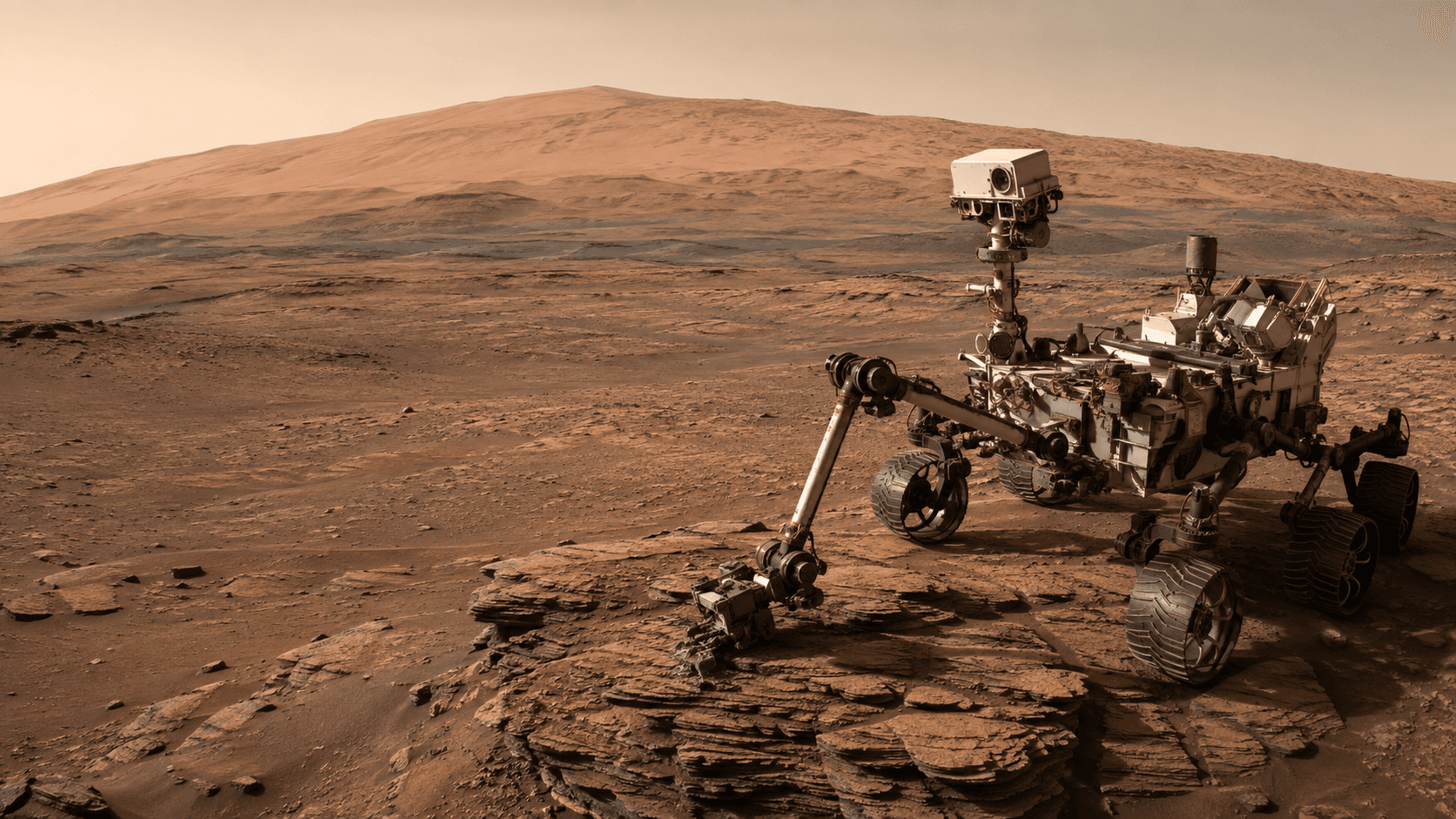
Quick answer: Curiosity is a Mars Science Laboratory rover led by NASA. It launched on November 26, 2011, focused on Gale Crater on Mars, and is best known as a car-size mobile laboratory built to determine whether Mars ever offered habitable conditions for microbes. Its work found ancient lake and stream environments, organic molecules, changing methane, clay minerals and a long record of environmental change.
Curiosity Rover at a Glance
| Question | Answer |
|---|---|
| What kind of mission is it? | Mars Science Laboratory rover |
| Who leads it? | NASA |
| When did it begin? | November 26, 2011 |
| What does it study? | Gale Crater, Mars |
| Current or final status | Active; landed August 6, 2012 |
| Why is it famous? | Car-size mobile laboratory built to determine whether Mars was ever habitable |
What Is the Curiosity Rover?
Curiosity is NASA's Mars Science Laboratory rover. It launched on November 26, 2011 and landed in Gale Crater on August 6, 2012 using the pioneering sky-crane landing system. It is best known as a car-size mobile laboratory built to determine whether Mars ever offered habitable conditions for microbes.
Curiosity's work found ancient lake and stream environments, organic molecules, changing methane, clay minerals and a long record of environmental change. Its success directly enabled the design of the Perseverance Rover.
Why Curiosity Was Created
Before Curiosity, the Viking Program, Spirit and Opportunity had established that Mars once had water and complex geology. Mission planners needed a mobile geochemistry laboratory capable of drilling, sample handling and diverse spectroscopy over a multi-year traverse.
Curiosity Facts at a Glance
| Field | Value |
|---|---|
| Program purpose | Determine whether Gale Crater was ever habitable for microbes |
| Launch | November 26, 2011 |
| Flight strategy | Aeroshell, guided entry, parachute, powered descent and pioneering sky-crane landing |
| Mission status | Active; landed August 6, 2012 |
| Defining importance | Car-size mobile laboratory built to determine Mars habitability |
Landing at Gale Crater
Curiosity's descent — a supersonic parachute, powered descent stage and sky-crane touchdown — became known as "Seven Minutes of Terror." The technique enabled a much larger rover than earlier missions and was reused by the Perseverance Rover.
Spacecraft Design and Instruments
Curiosity carries cameras (MastCam, MAHLI, MARDI, Hazcams), chemistry instruments (ChemCam laser spectrometer, APXS X-ray spectrometer, CheMin X-ray diffractometer, SAM gas chromatograph–mass spectrometer), a radiation detector, weather station and drill.
How the Mission Collects Evidence
Curiosity drives to targets identified from orbital data, images and analyzes rocks, drills samples and delivers them to onboard laboratories. Multiple instruments cross-check each result. Investigators publish uncertainties so other researchers can reproduce or challenge findings.
Major Discoveries
Curiosity found ancient lake and stream environments, organic molecules, changing methane, clay minerals and a long record of environmental change. Rocks along its traverse record a shift from wet, habitable conditions to a drier climate over hundreds of millions of years.
Engineering Challenges
Radiation, dust, temperature cycling, communication delay and limited power constrained the design. The rover's radioisotope power source enables year-round operation and driving in low sunlight. Wheel wear from sharp rocks required updated driving strategies.
People and International Cooperation
Curiosity is primarily a NASA mission but includes instruments contributed by Spain, Russia, France, Germany, Canada and others. That international participation is part of its technical story.
How Curiosity Changed Planetary Science
The car-size mobile laboratory built to determine whether Mars was ever habitable opened observations that had not previously been available. Its instruments, driving techniques, science operations and calibrated archives shaped the Perseverance Rover and continue to influence future missions.
What Curiosity Did Not Prove
Curiosity did not detect life. A measurement compatible with organic chemistry or past habitability is not automatically proof of biological activity. Coverage of Mars is limited to Curiosity's traverse; global questions remain.
Frequently Asked Questions About Curiosity
What is the main purpose of Curiosity?
To determine whether Gale Crater on Mars ever offered habitable conditions for microbes.
When was Curiosity launched?
November 26, 2011. It landed on August 6, 2012.
Who operates Curiosity?
NASA leads the mission with international partners and instrument teams.
What has Curiosity discovered?
It found ancient lake and stream environments, organic molecules, changing methane, clay minerals and a long record of environmental change.
Why is Curiosity historically important?
Because it is the first car-size mobile laboratory built to determine whether Mars was ever habitable.
Is Curiosity still active?
Yes. It continues to operate.
How did Curiosity land on Mars?
Using an aeroshell, guided entry, parachute, powered descent and pioneering sky-crane landing.
Where can Curiosity data be found?
Start with the official MSL Curiosity mission page.
Final Perspective
Curiosity is the most capable mobile laboratory ever operated on another planet. Its defining place — a car-size mobile laboratory built to determine whether Mars was ever habitable — set the technical and scientific groundwork for the Perseverance Rover and beyond.
Authoritative Source
Factual status reviewed: September 4, 2026.
Primary sources
Last verified 2026-01-15. Mission status and dates can change.