
Viking Program
The first fully successful U.S. mission to land and operate on Mars and the first designed to search for life there.
Agency
NASA
Destination
Mars
Launched
August 20, 1975
Ended
November 11, 1982
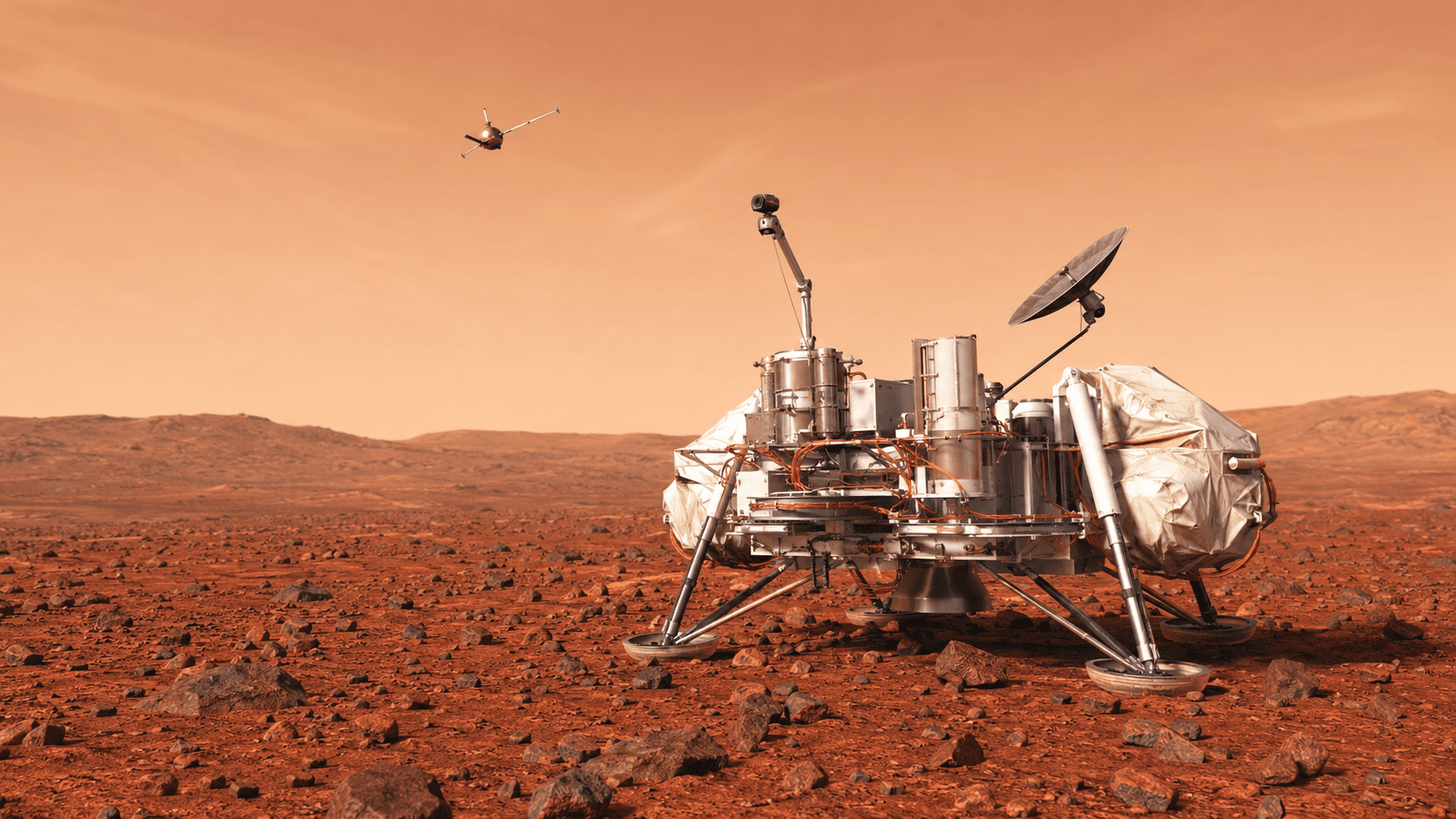
Quick answer: The Viking Program was a Mars orbiter-and-lander program led by NASA. Viking 1 launched on August 20, 1975, focused on Mars, and is best known as the first fully successful U.S. mission to land and operate on Mars and the first mission designed to search directly for life there. Its work returned global imaging, long-lived weather records, soil chemistry, biology experiments and evidence of ancient floods.
Viking Program at a Glance
| Question | Answer |
|---|---|
| What kind of mission was it? | Mars orbiter-and-lander program |
| Who led it? | NASA |
| When did it begin? | Viking 1 launched August 20, 1975 |
| What did it study? | Mars |
| Current or final status | Viking 1 lander ended November 11, 1982 |
| Why is it famous? | First fully successful U.S. mission to land and operate on Mars and the first designed to search for life there |
What Is the Viking Program?
The Viking Program was NASA's Mars orbiter-and-lander program. Viking 1 launched on August 20, 1975 and reached Mars in 1976, followed by Viking 2. Each mission delivered a lander to the surface and left an orbiter above. It is best known as the first fully successful U.S. mission to land and operate on Mars and the first mission designed to search directly for life.
The Viking landers returned global imaging, long-lived weather records, soil chemistry, biology experiments and evidence of ancient floods. Its landing sites and biology results shaped every later Mars mission from Pathfinder through the Curiosity Rover and Perseverance Rover.
Why the Viking Program Was Created
Before Viking, no spacecraft had successfully operated on the Martian surface. Mission planners chose orbiter-plus-lander pairs that could image the surface, characterize the atmosphere and conduct biology experiments in situ.
Viking Program Facts at a Glance
| Field | Value |
|---|---|
| Program purpose | Land on Mars and search for life while mapping the planet |
| Launch | Viking 1 on August 20, 1975 |
| Flight strategy | Two identical orbiter-lander pairs that reached Mars in 1976 |
| Program status | Viking 1 lander ended November 11, 1982 |
| Defining importance | First fully successful U.S. Mars landings and first designed life search |
Launch, Route, and Arrival
Viking 1 launched on August 20, 1975 and reached Mars orbit on June 19, 1976. Its lander touched down on Chryse Planitia on July 20, 1976. Viking 2 followed with a landing on Utopia Planitia on September 3, 1976.
Spacecraft Design and Instruments
Each Viking lander carried cameras, a soil scoop, a gas chromatograph–mass spectrometer, three biology experiments, a seismometer, weather instruments and communications equipment. Orbiters carried imaging systems, water-vapor mappers and thermal mappers.
How the Mission Collected Evidence
Viking scientists calibrated instruments on the ground, ran controls in laboratory analogs of Mars and reported results with uncertainty. Biology experiments were designed to test multiple hypotheses simultaneously — a decision that made the ambiguous results scientifically informative even without a positive detection.
Major Discoveries
Viking returned global imaging, long-lived weather records, soil chemistry, biology experiments and evidence of ancient floods. Its biology experiments returned complex and debated results that did not confirm life; the accompanying gas chromatograph found no organic molecules at the detection limit. Together these results reframed the search for life for decades.
Engineering Challenges
Entry, descent and landing on Mars required protection from re-entry heat, a parachute-and-retrorocket landing system and a robust surface configuration. Long-duration surface operations depended on radioisotope power sources.
People and International Cooperation
Viking was a large multi-institution project inside NASA. Instrument teams, mission controllers, archivists and researchers worked for years before and after the landings.
How Viking Changed Planetary Science
The first fully successful U.S. Mars landings and the first designed life search opened observations that had not previously been available. Its landing systems, biology-experiment lessons, atmospheric measurements and reference imagery guided later missions including the Curiosity Rover and Perseverance Rover.
What Viking Did Not Prove
Viking biology results did not confirm life on Mars. Some findings — for example the reactivity of Martian soil — were reinterpreted years later after new chemistry results. Missing evidence is not always evidence that a process never occurred.
Frequently Asked Questions About the Viking Program
What was the main purpose of the Viking Program?
To land on Mars, search for life and map the planet with orbiter-lander pairs.
When did the Viking Program run?
Viking 1 launched on August 20, 1975. The last operating lander, Viking 1, ended on November 11, 1982.
Who operated the Viking Program?
NASA led the program with instrument teams and scientific institutions across the United States.
What did the Viking Program discover?
It returned global imaging, long-lived weather records, soil chemistry, biology experiments and evidence of ancient floods.
Why is the Viking Program historically important?
Because it was the first fully successful U.S. mission to land and operate on Mars and the first designed to search directly for life.
Is the Viking Program still active?
No. The last lander ended operations on November 11, 1982.
How did Viking spacecraft reach Mars?
Two identical orbiter-lander pairs launched in 1975 and reached Mars in 1976.
Where can Viking data be found?
Start with the official Viking mission page.
Final Perspective
Viking is the foundation on which modern Mars exploration rests. Its defining place — the first fully successful U.S. mission to land and operate on Mars and the first designed to search for life — continues to shape missions like the Curiosity Rover and Perseverance Rover.
Authoritative Source
Factual status reviewed: September 4, 2026.
Primary sources
Last verified 2026-01-15. Mission status and dates can change.