International Space Station
The largest long-duration international research platform assembled in orbit.
Agency
NASA · Roscosmos · ESA · JAXA · CSA
Destination
Low Earth orbit
Launched
November 20, 1998
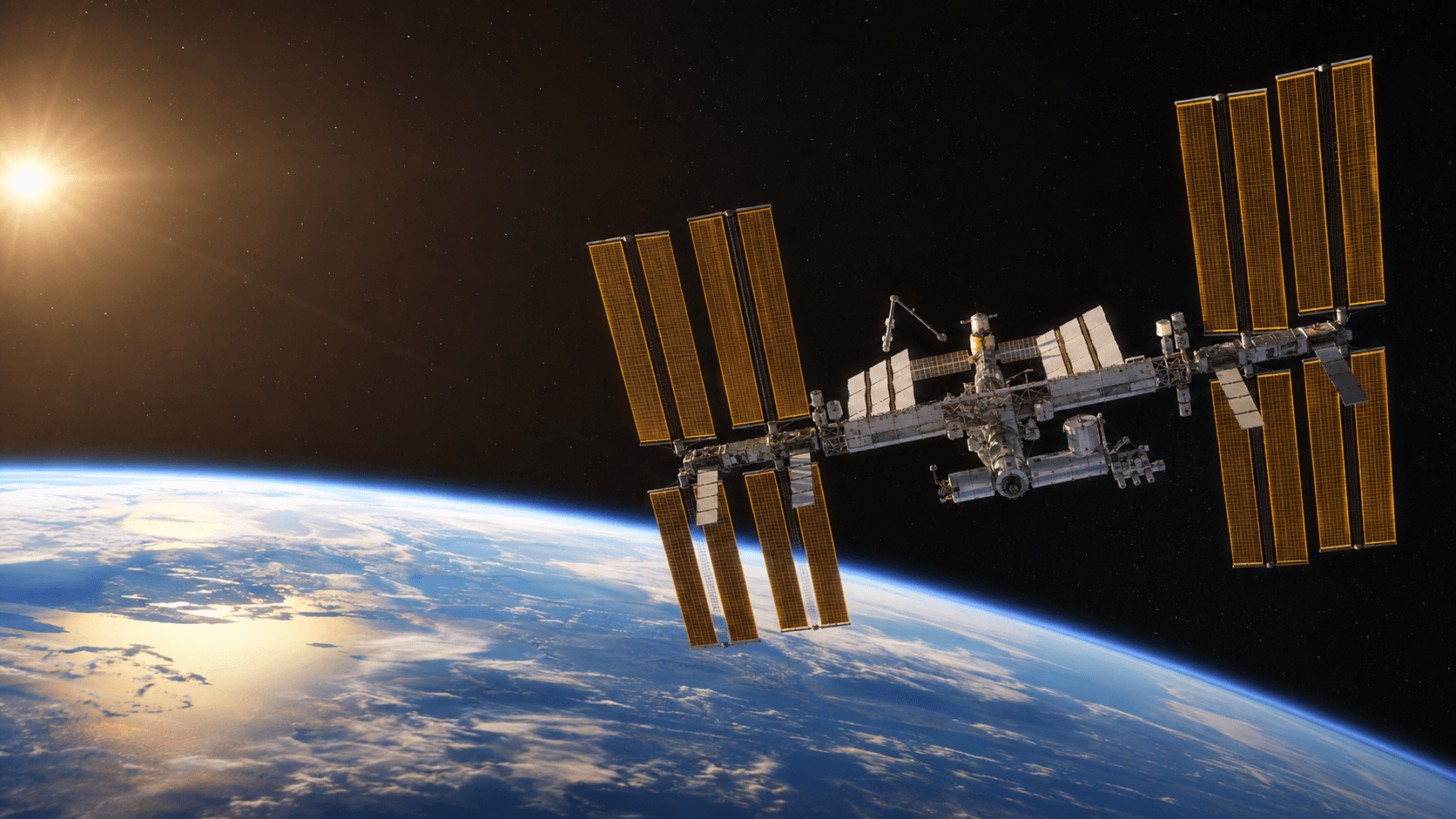
Quick answer: The International Space Station (ISS) is a crewed orbital laboratory led by NASA, Roscosmos, ESA, JAXA and CSA. The first element launched on November 20, 1998. Focused on low Earth orbit, it is best known as the largest long-duration international research platform assembled in orbit. Its work supports thousands of experiments in biology, medicine, physics, Earth science, technology and human spaceflight.
ISS at a Glance
| Question | Answer |
|---|---|
| What kind of mission is it? | Crewed orbital laboratory |
| Who leads it? | NASA, Roscosmos, ESA, JAXA and CSA partnership |
| When did it begin? | First element launched November 20, 1998 |
| What does it study? | Low Earth orbit and experiments in microgravity |
| Current or final status | Active |
| Why is it famous? | Largest long-duration international research platform assembled in orbit |
What Is the International Space Station?
The International Space Station is a crewed orbital laboratory operated jointly by NASA, Roscosmos, ESA, JAXA and CSA. Its first element launched on November 20, 1998, and it has been continuously occupied since November 2000. It orbits Earth at roughly 400 kilometers altitude, completes a lap every 90 minutes, and hosts rotating crews of astronauts and cosmonauts.
The ISS supports thousands of experiments in biology, medicine, physics, Earth science, technology and human spaceflight, and serves as the training ground for future exploration beyond Earth including the Artemis Program.
Why the ISS Was Created
Before the ISS, no continuously occupied research facility of comparable scale existed. Mission planners needed a place to study long-duration human spaceflight, conduct microgravity science and maintain international cooperation in space. Political relationships, launch capacity, budgets and technology all affected the design.
ISS Facts at a Glance
| Field | Value |
|---|---|
| Program purpose | Provide a continuously occupied research platform in low Earth orbit |
| First element launch | November 20, 1998 |
| Flight strategy | Modular assembly over dozens of flights with continuous occupation since November 2000 |
| Mission status | Active |
| Defining importance | Largest long-duration international research platform assembled in orbit |
Launch, Route, and Arrival
The station was assembled in orbit through modular launches on the U.S. Space Shuttle, Russian Proton and Soyuz, and other vehicles. It orbits at approximately 400 km altitude and 51.6° inclination, chosen to be reachable from both U.S. and Russian launch sites.
Spacecraft Design and Instruments
The ISS combines modules, trusses, solar arrays, thermal radiators, robotic arms, docking ports and life-support systems from all partners. Payloads are hosted inside pressurized modules and outside on external attachment points, covering biology, physics, materials science, Earth observation, technology demonstrations and human physiology.
How the Mission Collects Evidence
Experiments follow the same scientific method used on the ground: define measurable goals, calibrate instruments, run controls and report uncertainty. Crew involvement enables adjustments, sample handling and rare unexpected observations that pure robotic missions cannot make.
Major Discoveries
The ISS supports thousands of experiments in biology, medicine, physics, Earth science, technology and human spaceflight. It has advanced knowledge of long-duration human physiology in microgravity, tested closed-loop life support, produced novel materials, imaged the Earth continuously and demonstrated commercial space capabilities.
Engineering Challenges
The low-Earth-orbit environment imposes constraints on radiation, atomic oxygen erosion, thermal cycling, atmospheric drag, communications and crew safety. Unexpected events — leaks, coolant loops, orbital debris — are diagnosed and repaired by the crew and controllers. Reboost maneuvers offset atmospheric drag.
People and International Cooperation
The ISS is the largest continuously running international space cooperation. Shared interfaces, schedules, documentation and decision rules make the partnership work. That institutional history is part of its technical story.
How the ISS Changes Space Exploration
Continuous occupation of a research platform in low Earth orbit demonstrates that humans can live and work in space for extended periods. Its lessons directly inform lunar programs like Artemis and future Mars missions.
What the ISS Does Not Prove
The ISS operates in low Earth orbit, still within Earth's protective magnetic field. Long-duration human missions to the Moon and Mars will encounter conditions the ISS cannot fully replicate.
Frequently Asked Questions About the ISS
What is the main purpose of the ISS?
To provide a continuously occupied international research platform in low Earth orbit.
When did the ISS begin?
The first element launched on November 20, 1998, and continuous occupation began in November 2000.
Who operates the ISS?
NASA, Roscosmos, ESA, JAXA and CSA jointly operate the station.
What has the ISS discovered?
It supports thousands of experiments in biology, medicine, physics, Earth science, technology and human spaceflight.
Why is the ISS historically important?
Because it is the largest long-duration international research platform assembled in orbit.
Is the ISS still active?
Yes. It remains active and continuously occupied.
How was the ISS assembled?
Through modular assembly over dozens of flights with continuous occupation since November 2000.
Where can ISS data be found?
Start with NASA's ISS facts and figures. You can also track it live with our ISS tracker.
Final Perspective
The ISS demonstrates how long-duration cooperation transforms exploration into a routine research enterprise. Its defining place — the largest long-duration international research platform assembled in orbit — is only the beginning of the story.
Authoritative Source
Factual status reviewed: September 4, 2026.
Primary sources
Last verified 2026-01-15. Mission status and dates can change.