
Juno
The first solar-powered spacecraft designed for sustained operations at Jupiter.
Agency
NASA
Destination
Jupiter and selected moons
Launched
August 5, 2011
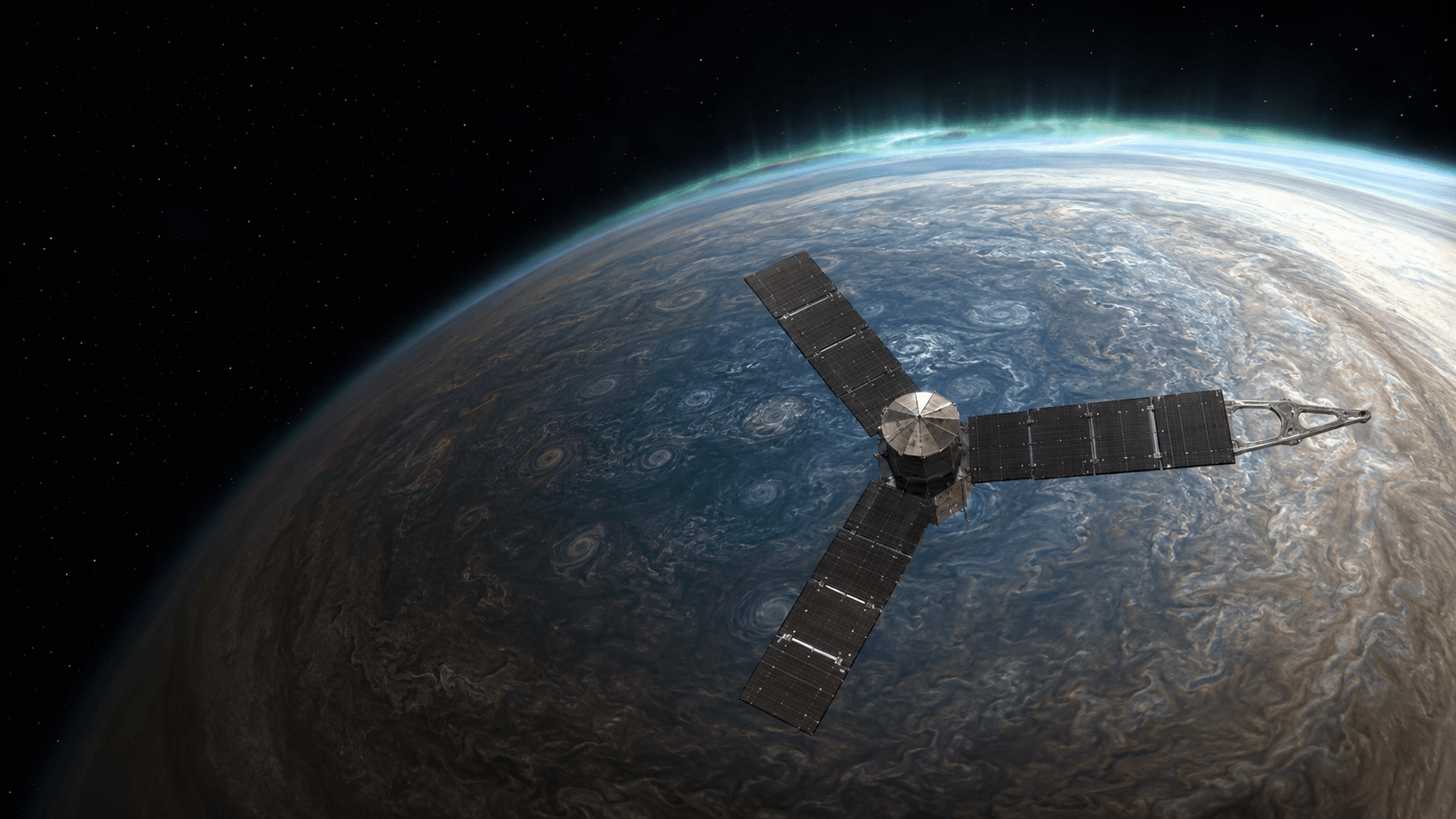
Quick answer: Juno is a polar Jupiter orbiter led by NASA. It launched on August 5, 2011, focused on Jupiter and selected moons, and is best known as the first solar-powered spacecraft designed for sustained operations at Jupiter and the first to repeatedly skim its cloud tops. Its work measures Jupiter's gravity, magnetic field, deep atmosphere, auroras, polar cyclones, interior, rings and moons.
Juno at a Glance
| Question | Answer |
|---|---|
| What kind of mission is it? | Polar Jupiter orbiter |
| Who leads it? | NASA |
| When did it begin? | August 5, 2011 |
| What does it study? | Jupiter and selected moons |
| Current or final status | Active extended mission |
| Why is it famous? | First solar-powered spacecraft at Jupiter; first to repeatedly skim its cloud tops |
What Is Juno?
Juno is NASA's polar Jupiter orbiter. Launched on August 5, 2011, it used an Earth gravity assist in October 2013 and entered Jupiter orbit on July 4, 2016. It is best known as the first solar-powered spacecraft designed for sustained operations at Jupiter and the first to repeatedly skim its cloud tops.
Juno measures Jupiter's gravity, magnetic field, deep atmosphere, auroras, polar cyclones, interior, rings and moons. It has extended its mission with flybys of Ganymede, Europa and Io, complementing earlier work by Galileo.
Why Juno Was Created
Before Juno, Galileo and the Voyagers had characterized Jupiter's outer atmosphere and moons, but Jupiter's interior structure, deep atmospheric composition and detailed magnetic field remained poorly constrained. Mission planners chose a polar orbit and a suite of gravity, magnetic and microwave instruments to probe the planet's interior for the first time.
Juno Facts at a Glance
| Field | Value |
|---|---|
| Program purpose | Determine Jupiter's interior structure, magnetic field, deep atmosphere and origin |
| Launch | August 5, 2011 |
| Flight strategy | Earth gravity assist followed by polar orbital insertion on July 4, 2016 |
| Mission status | Active extended mission |
| Defining importance | First solar-powered spacecraft at Jupiter; first to repeatedly skim its cloud tops |
Launch, Route, and Arrival
Juno launched on August 5, 2011. After an Earth gravity assist in October 2013, it entered a highly elliptical polar orbit around Jupiter on July 4, 2016. That orbit brings the spacecraft close to Jupiter's clouds for a brief high-data-rate window and then swings it out to reduce radiation exposure.
Spacecraft Design and Instruments
Juno carries a microwave radiometer, magnetometer, gravity-science radio link, plasma and particle instruments, ultraviolet and infrared imagers, and the JunoCam public-outreach camera. Three large solar arrays make Juno the first solar-powered spacecraft at Jupiter.
How the Mission Collects Evidence
Each close pass reveals a slice of Jupiter's gravity, magnetic field and deep atmosphere. Over multiple orbits, investigators reconstruct global properties: differential rotation, deep-flow patterns, ammonia distribution and polar cyclone structure.
Major Discoveries
Juno measures Jupiter's gravity, magnetic field, deep atmosphere, auroras, polar cyclones, interior, rings and moons. It has revealed unexpectedly complex polar cyclones, a diffuse core, deep zonal winds and a highly non-dipolar magnetic field.
Engineering Challenges
Jupiter's intense radiation is Juno's dominant engineering challenge. A titanium radiation vault protects the electronics, and the elliptical orbit minimizes exposure. Solar-array design at Jupiter's distance was also a first-of-its-kind achievement.
People and International Cooperation
Juno is a NASA-led mission with international instrument and science-team participation. That institutional history is part of its technical story.
How Juno Changed Planetary Science
The first solar-powered spacecraft at Jupiter and the first to repeatedly skim its cloud tops opened observation modes not available to earlier missions like Galileo. Its interior and magnetic-field data will inform models of giant-planet formation for decades.
What Juno Cannot Prove
Juno's coverage is time-limited by radiation. Some interior properties remain model-dependent. Icy-moon habitability requires dedicated missions with different instrument suites.
Frequently Asked Questions About Juno
What is the main purpose of Juno?
To determine Jupiter's interior structure, magnetic field, deep atmosphere and origin.
When was Juno launched?
August 5, 2011.
Who operates Juno?
NASA leads the mission with international partners and instrument teams.
What has Juno discovered?
It measures Jupiter's gravity, magnetic field, deep atmosphere, auroras, polar cyclones, interior, rings and moons.
Why is Juno historically important?
Because it is the first solar-powered spacecraft designed for sustained operations at Jupiter and the first to repeatedly skim its cloud tops.
Is Juno still active?
Yes. It continues in extended mission.
How did Juno reach Jupiter?
Using an Earth gravity assist followed by polar orbital insertion on July 4, 2016.
Where can Juno data be found?
Start with the official Juno mission page.
Final Perspective
Juno turned Jupiter's interior from a modeled possibility into a measured object. Its defining place — the first solar-powered spacecraft at Jupiter and the first to repeatedly skim its cloud tops — continues to reshape giant-planet science.
Authoritative Source
Factual status reviewed: September 4, 2026.
Primary sources
Last verified 2026-01-15. Mission status and dates can change.