
Galileo
The first spacecraft to orbit Jupiter and to deploy a probe into a giant planet's atmosphere.
Agency
NASA
Destination
Jupiter and its moons
Launched
October 18, 1989
Ended
September 21, 2003
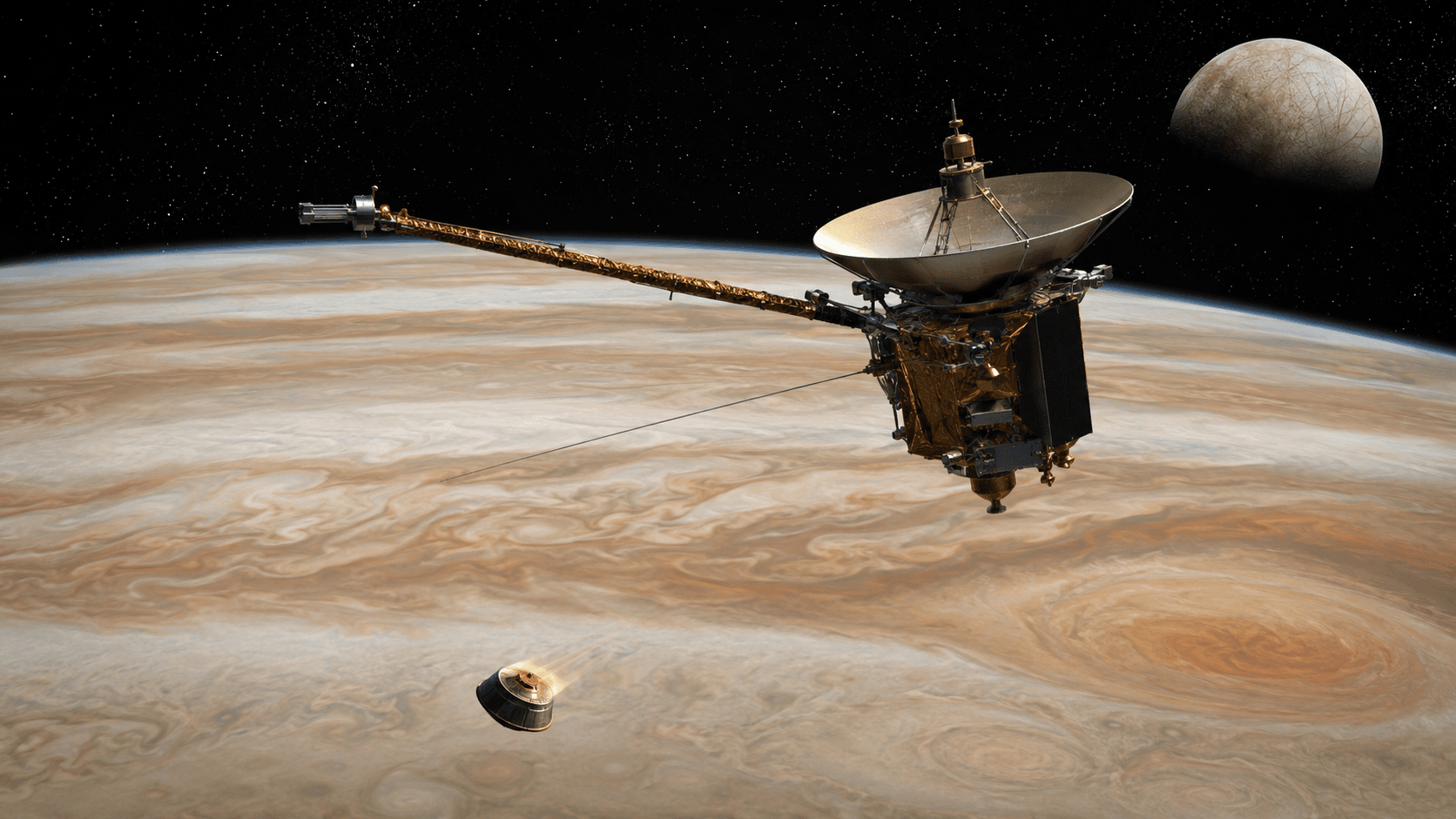
Quick answer: Galileo was a Jupiter orbiter and atmospheric probe led by NASA. It launched on October 18, 1989, focused on Jupiter and its moons, and is best known as the first spacecraft to orbit Jupiter and the first to deploy a probe into a giant planet's atmosphere. Its work found evidence for subsurface oceans, discovered Ganymede's magnetic field, studied Io's volcanism and sampled Jupiter's atmosphere directly.
Galileo at a Glance
| Question | Answer |
|---|---|
| What kind of mission was it? | Jupiter orbiter and atmospheric probe |
| Who led it? | NASA |
| When did it begin? | October 18, 1989 |
| What did it study? | Jupiter and its moons |
| Current or final status | Ended September 21, 2003 |
| Why is it famous? | First spacecraft to orbit Jupiter and first to deploy a probe into a giant planet's atmosphere |
What Is Galileo?
Galileo was NASA's Jupiter orbiter and atmospheric probe. Deployed from Space Shuttle Atlantis on October 18, 1989, it used Venus and Earth gravity assists to reach Jupiter in December 1995. It is best known as the first spacecraft to orbit Jupiter and the first to deploy a probe into a giant planet's atmosphere.
Galileo's work found evidence for subsurface oceans on icy moons, discovered Ganymede's magnetic field, studied Io's volcanism and sampled Jupiter's atmosphere directly with its descent probe. It laid essential groundwork for Juno, Europa Clipper and future Ganymede missions.
Why Galileo Was Created
The Voyagers' fast flybys of Jupiter revealed active moons and complex atmospheric dynamics. Mission planners needed an orbiter capable of extended, close-up observations plus a probe to sample Jupiter's atmosphere directly.
Galileo Facts at a Glance
| Field | Value |
|---|---|
| Program purpose | Orbit Jupiter and study its atmosphere and moons |
| Launch | October 18, 1989 |
| Flight strategy | Venus and Earth gravity assists followed by Jupiter orbital insertion in December 1995 |
| Mission ended | September 21, 2003 |
| Defining importance | First Jupiter orbiter and first giant-planet atmospheric probe |
Launch, Route, and Arrival
Galileo launched from Space Shuttle Atlantis in October 1989. Its VEEGA trajectory — Venus–Earth–Earth Gravity Assist — provided enough energy to reach Jupiter without a booster stage powerful enough to send it there directly. The atmospheric probe entered Jupiter's atmosphere on December 7, 1995, transmitting data as it descended into the deep clouds. The orbiter entered Jupiter orbit the same day.
Spacecraft Design and Instruments
Galileo carried imaging, spectrometry, magnetometer, plasma and dust instruments on the orbiter, plus atmospheric-composition and structure instruments on the probe. A high-gain antenna failure early in the mission required the team to switch to the low-gain antenna and rewrite onboard software to compress and prioritize data.
How the Mission Collected Evidence
Galileo used repeated close flybys of the Galilean moons to build up coverage. Investigators combined magnetometer, imaging and spectroscopy results to test hypotheses — for example, magnetic-induction signatures suggested conductive salty subsurface oceans on Europa, Ganymede and Callisto.
Major Discoveries
Galileo found evidence for subsurface oceans, discovered Ganymede's magnetic field, studied Io's volcanism and sampled Jupiter's atmosphere directly. It also observed impacts of Comet Shoemaker–Levy 9 into Jupiter in 1994 during its cruise phase.
Engineering Challenges
Jupiter's radiation environment, the high-gain antenna failure, tape-recorder anomalies and long communication delays constrained operations. The team's ability to recover science value despite the antenna problem became a landmark engineering story.
People and International Cooperation
Galileo was a NASA-led mission with international participation. Instrument teams, mission controllers, archivists and scientific institutions worked for years before launch and continue analysis today.
How Galileo Changed Planetary Science
The first Jupiter orbiter and first giant-planet atmospheric probe opened observations that had not previously been available. Galileo's work anchors the case for subsurface oceans on the icy Galilean moons and set the stage for Juno and future missions.
What Galileo Did Not Prove
Galileo did not confirm habitability of any icy moon. Direct exploration of subsurface oceans requires future missions with different instruments and, ultimately, subsurface access.
Frequently Asked Questions About Galileo
What was the main purpose of Galileo?
To orbit Jupiter, study its atmosphere and moons and deploy a probe into its atmosphere.
When was Galileo launched?
October 18, 1989.
Who operated Galileo?
NASA led the mission with international partners and instrument teams.
What did Galileo discover?
It found evidence for subsurface oceans, discovered Ganymede's magnetic field, studied Io's volcanism and sampled Jupiter's atmosphere directly.
Why is Galileo historically important?
Because it was the first spacecraft to orbit Jupiter and the first to deploy a probe into a giant planet's atmosphere.
Is Galileo still active?
No. The mission ended on September 21, 2003 with a planned entry into Jupiter's atmosphere.
How did Galileo reach Jupiter?
Using Venus and Earth gravity assists followed by Jupiter orbital insertion in December 1995.
Where can Galileo data be found?
Start with the official Galileo mission page.
Final Perspective
Galileo transformed Jupiter and its moons from a distant flyby target into deeply studied worlds. Its defining place — the first Jupiter orbiter and first giant-planet atmospheric probe — set the technical and scientific stage for Juno and future icy-moon exploration.
Authoritative Source
Factual status reviewed: September 4, 2026.
Primary sources
Last verified 2026-01-15. Mission status and dates can change.