Nancy Grace Roman Space Telescope Launch: Date, SpaceX Rocket and Mission Goals
NASA's Nancy Grace Roman Space Telescope launched aboard SpaceX Falcon Heavy on August 30, 2026. Explore its mission, instruments, dark-energy science and Hubble comparison.
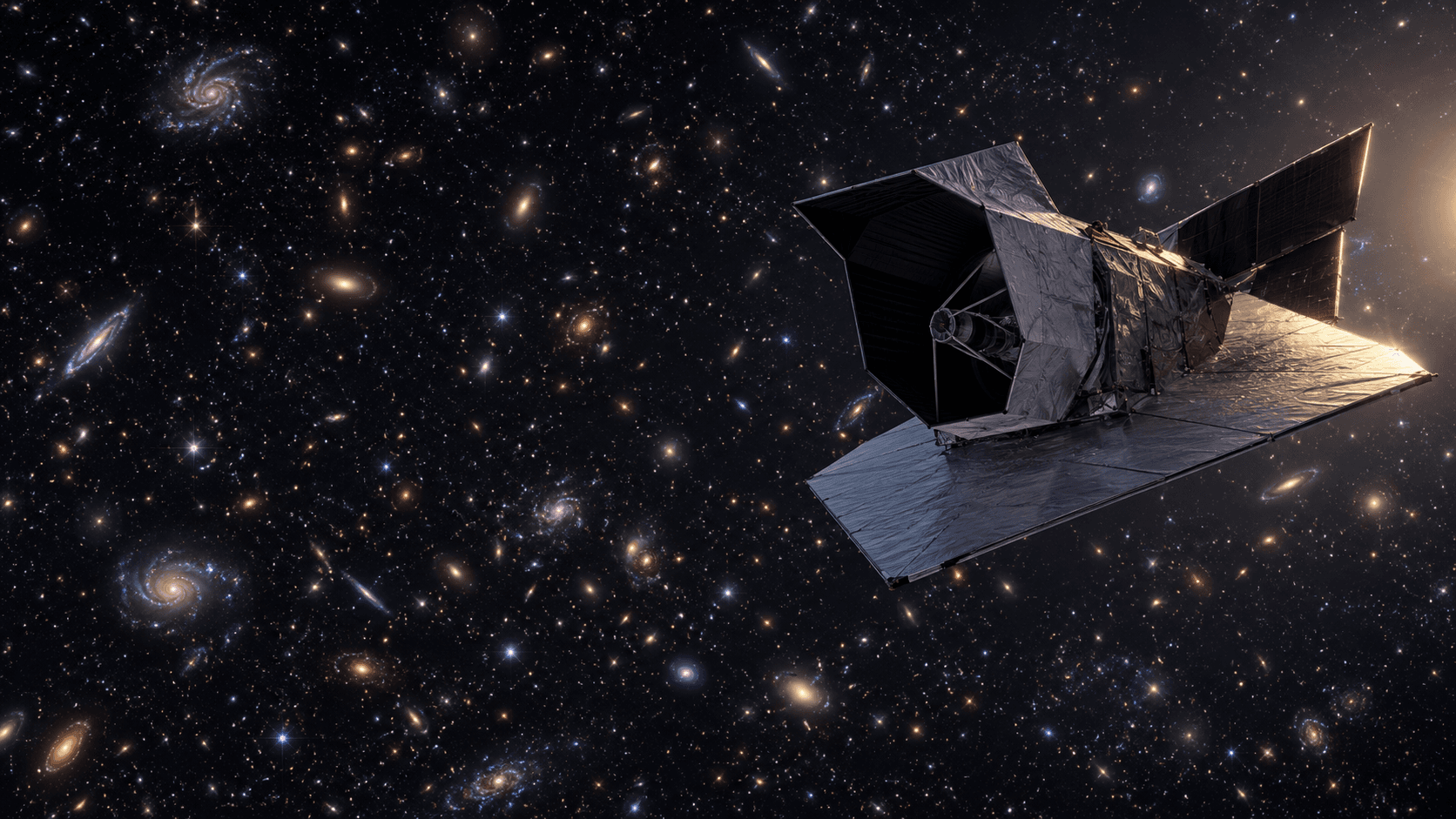
NASA's Nancy Grace Roman Space Telescope launched on August 30, 2026, aboard a SpaceX Falcon Heavy from Launch Complex 39A at Kennedy Space Center. The observatory is beginning its journey and commissioning phase before science operations.
Interest in Nancy Grace Roman Space Telescope launch, NASA Roman telescope 2026 and Roman Space Telescope SpaceX reflects a larger question: what does the newest result actually mean? Fast news summaries can blur the line between a completed event, an approved mission, a research proposal and a debated theory. This guide explains the evidence, context and limits in plain language while keeping the topic useful long after the initial announcement.
Quick answer
NASA's Nancy Grace Roman Space Telescope launched on August 30, 2026, aboard a SpaceX Falcon Heavy from Launch Complex 39A at Kennedy Space Center. The observatory is beginning its journey and commissioning phase before science operations. This article must use post-launch language. Earlier searches and planning pages may call Roman a "2026 launch" or an upcoming telescope, but the launch has now occurred.
Key facts at a glance
| Question | Reliable answer |
|---|---|
| What is the topic? | Roman is a wide-field infrared space observatory built to survey enormous areas of the sky with image sharpness comparable to Hubble across a field roughly 100 times larger. Its major science themes include dark energy, dark matter, the growth of cosmic structure, exoplanet demographics and time-domain discoveries. |
| What is the current status? | NASA's Nancy Grace Roman Space Telescope launched on August 30, 2026, aboard a SpaceX Falcon Heavy from Launch Complex 39A at Kennedy Space Center. The observatory is beginning its journey and commissioning phase before science operations. |
| What is the key timeline? | NASA selected SpaceX's Falcon Heavy as the launch vehicle in 2022. After integration and environmental testing, Roman launched on August 30, 2026. Following deployment, navigation and instrument checkout, the observatory is intended to operate near the Sun–Earth L2 region, about 1.5 million kilometers from Earth. |
| What technology or observations matter? | The observatory has a 2.4-meter primary mirror. Its Wide Field Instrument uses a large focal-plane array for imaging and slitless spectroscopy in visible and near-infrared light. The Coronagraph Instrument is a technology demonstration for suppressing starlight and observing faint material near bright stars. |
| Why does it matter? | Roman will measure the history of cosmic expansion with complementary approaches involving galaxies, supernovae and weak gravitational lensing. It will survey the Milky Way for exoplanets through gravitational microlensing and may detect planets at orbital distances poorly sampled by transit searches. Its rapid, wide observations will also capture supernovae, variable stars, moving solar-system objects and other transient events. |
| What should readers not assume? | This article must use post-launch language. Earlier searches and planning pages may call Roman a "2026 launch" or an upcoming telescope, but the launch has now occurred. |
Understanding the headline
Roman is a wide-field infrared space observatory built to survey enormous areas of the sky with image sharpness comparable to Hubble across a field roughly 100 times larger. Its major science themes include dark energy, dark matter, the growth of cosmic structure, exoplanet demographics and time-domain discoveries.
The headline is a starting point rather than a conclusion. Astronomy often compresses years of engineering, repeated observations and statistical analysis into a few memorable words. A responsible explanation expands those words again. It identifies the instrument or model, explains what was measured and separates direct evidence from interpretation.
That approach is also good search content. A reader asking a short question usually needs several connected answers: the date, mechanism, observing method, comparison with earlier work and the next milestone. Covering those needs naturally allows relevant keywords to appear without repeating the same phrase unnaturally.
Current status and timeline
NASA selected SpaceX's Falcon Heavy as the launch vehicle in 2022. After integration and environmental testing, Roman launched on August 30, 2026. Following deployment, navigation and instrument checkout, the observatory is intended to operate near the Sun–Earth L2 region, about 1.5 million kilometers from Earth.
Dates in astronomy articles require special care. A scheduled launch can slip, a mission concept can remain unselected, an observatory can release engineering imagery before survey operations and a sky event can occur at different local times around Earth. Every date should therefore be paired with a status word such as launched, planned, proposed, observed or predicted.
For evergreen maintenance, place a visible "last reviewed" date in the content record, not invented in the prose. Update the article only after checking the responsible agency, observatory, journal or ephemeris. When a prediction becomes a completed event, revise the headline and verbs rather than leaving readers inside an outdated future tense.
Instruments, spacecraft and observing methods
The observatory has a 2.4-meter primary mirror. Its Wide Field Instrument uses a large focal-plane array for imaging and slitless spectroscopy in visible and near-infrared light. The Coronagraph Instrument is a technology demonstration for suppressing starlight and observing faint material near bright stars.
Modern astronomical discoveries rarely come from a single picture. Images may be calibrated, aligned and combined. Spectra separate light by wavelength. Precision timing reveals motion. Gravity and magnetic measurements probe invisible interiors or environments. Computer models then test which physical conditions can reproduce the data.
Engineering is part of the science. Pointing stability, detector noise, thermal control, optical distortion, communications and software pipelines determine what can be measured. An image released for public viewing may also demonstrate that hundreds of technical subsystems are performing together. Explaining those connections gives readers a more realistic picture of how discovery happens.
The core science
Roman will measure the history of cosmic expansion with complementary approaches involving galaxies, supernovae and weak gravitational lensing. It will survey the Milky Way for exoplanets through gravitational microlensing and may detect planets at orbital distances poorly sampled by transit searches. Its rapid, wide observations will also capture supernovae, variable stars, moving solar-system objects and other transient events.
Scientific significance depends on comparison. A new result becomes powerful when it tests a prediction, exposes a gap in an existing model or provides a kind of measurement that earlier instruments could not make. The goal is not merely to collect spectacular views. It is to turn photons, positions and times into evidence about physical processes.
Uncertainty does not make a result weak. A well-defined uncertainty tells researchers which conclusions are robust and which require more data. Newsworthy astronomy frequently sits at that boundary. The most trustworthy explanation can be enthusiastic about the discovery while still saying clearly what has not been demonstrated.
Comparison with related missions, theories or events
Hubble remains exceptional for detailed targeted observations, while Roman is optimized for panoramic survey work. The telescopes have similarly sized primary mirrors, but Roman's Wide Field Instrument sees a sky area about 100 times larger than Hubble's comparable imaging field in a single exposure. Roman does not simply "replace Hubble"; it answers different questions and can identify targets for detailed follow-up.
Comparisons work best when the measurement is specified. "Bigger," "deeper," "faster" and "better" can refer to aperture, field of view, sensitivity, survey speed, distance, duration or data volume. Two observatories can both be exceptional because they optimize different variables. Two theories can explain part of the same evidence but make different predictions for a future test.
This is why simple winner-and-loser language usually misleads. Astronomy advances through complementary facilities and independent methods. Wide surveys discover populations and rare targets; focused observations reveal detail; laboratory work constrains materials; theory connects local physics to cosmic history.
Why Roman was launched
Astronomers can study a small patch of sky deeply or cover a huge area repeatedly, but doing both is difficult. Roman was designed to bring Hubble-class angular resolution to wide infrared surveys. This combination supports statistical studies involving millions or billions of objects rather than only selected examples.
Astronomers can study a small patch of sky deeply or cover a huge area repeatedly, but doing both is difficult. That point matters because readers often encounter a striking headline before they encounter the measurement behind it. A careful explanation identifies what was directly observed, what was inferred through modeling and what remains a proposal or forecast. This distinction makes the topic more useful for students and helps the page remain accurate after the immediate news cycle.
The wider scientific context also prevents a single image or result from being treated as an isolated curiosity. Astronomers compare observations across wavelengths, dates and instruments; engineers compare expected and actual performance; theorists test whether a mechanism reproduces the measured scale, motion and evolution. When those approaches agree, confidence grows. When they disagree, the disagreement defines the next observation.
Falcon Heavy and the launch profile
Falcon Heavy provided the performance required to send the observatory away from low Earth orbit toward the Sun–Earth L2 region. The rocket's role ended after deployment; Roman must then navigate, cool, stabilize and complete commissioning before routine surveys begin.
Falcon Heavy provided the performance required to send the observatory away from low Earth orbit toward the Sun–Earth L2 region. That point matters because readers often encounter a striking headline before they encounter the measurement behind it. A careful explanation identifies what was directly observed, what was inferred through modeling and what remains a proposal or forecast. This distinction makes the topic more useful for students and helps the page remain accurate after the immediate news cycle.
The wider scientific context also prevents a single image or result from being treated as an isolated curiosity. Astronomers compare observations across wavelengths, dates and instruments; engineers compare expected and actual performance; theorists test whether a mechanism reproduces the measured scale, motion and evolution. When those approaches agree, confidence grows. When they disagree, the disagreement defines the next observation.
Why Roman will study dark energy
The expansion of the universe is accelerating, but the cause remains unknown. Roman will examine how expansion and cosmic structure changed across time. Multiple techniques are essential because agreement among independent measurements is more persuasive than one method alone.
The expansion of the universe is accelerating, but the cause remains unknown. That point matters because readers often encounter a striking headline before they encounter the measurement behind it. A careful explanation identifies what was directly observed, what was inferred through modeling and what remains a proposal or forecast. This distinction makes the topic more useful for students and helps the page remain accurate after the immediate news cycle.
The wider scientific context also prevents a single image or result from being treated as an isolated curiosity. Astronomers compare observations across wavelengths, dates and instruments; engineers compare expected and actual performance; theorists test whether a mechanism reproduces the measured scale, motion and evolution. When those approaches agree, confidence grows. When they disagree, the disagreement defines the next observation.
How Roman will find exoplanets
Roman's Galactic Bulge Time-Domain Survey will monitor crowded star fields. When a foreground star and its planet bend and magnify light from a background star, the temporary microlensing signal can reveal planets that may be difficult to detect by transits.
Roman's Galactic Bulge Time-Domain Survey will monitor crowded star fields. That point matters because readers often encounter a striking headline before they encounter the measurement behind it. A careful explanation identifies what was directly observed, what was inferred through modeling and what remains a proposal or forecast. This distinction makes the topic more useful for students and helps the page remain accurate after the immediate news cycle.
The wider scientific context also prevents a single image or result from being treated as an isolated curiosity. Astronomers compare observations across wavelengths, dates and instruments; engineers compare expected and actual performance; theorists test whether a mechanism reproduces the measured scale, motion and evolution. When those approaches agree, confidence grows. When they disagree, the disagreement defines the next observation.
What the coronagraph will test
The Coronagraph Instrument is designed to demonstrate advanced masks, mirrors and wavefront control. Its value is technological as well as scientific because future observatories seeking Earth-like planets will require extraordinary control of scattered starlight.
The Coronagraph Instrument is designed to demonstrate advanced masks, mirrors and wavefront control. That point matters because readers often encounter a striking headline before they encounter the measurement behind it. A careful explanation identifies what was directly observed, what was inferred through modeling and what remains a proposal or forecast. This distinction makes the topic more useful for students and helps the page remain accurate after the immediate news cycle.
The wider scientific context also prevents a single image or result from being treated as an isolated curiosity. Astronomers compare observations across wavelengths, dates and instruments; engineers compare expected and actual performance; theorists test whether a mechanism reproduces the measured scale, motion and evolution. When those approaches agree, confidence grows. When they disagree, the disagreement defines the next observation.
What remains unknown
Launch milestones and commissioning results should be dated and attributed. First-light or public-image timing can change as engineers test pointing, thermal stability, communications and instrument performance. Do not invent a precise first-science date unless NASA publishes it.
Open questions should be stated as questions, not converted into confident claims for a stronger headline. Readers benefit from knowing whether scientists are waiting for more observations, a published peer review, an agency selection decision, commissioning results or a future alignment. The next decisive test is often more interesting than an exaggerated conclusion.
There is also a difference between "consistent with" and "caused by." Several mechanisms may produce a similar signal. Researchers try to break that degeneracy by finding another measurement on which the explanations disagree. An article can describe the leading interpretation while acknowledging serious alternatives.
How researchers verify the result
Verification begins with calibration and independent checks. Teams examine detector artifacts, background contamination, selection effects and assumptions in the analysis. They compare with archival observations when available and ask whether another instrument or method can reproduce the result.
Peer review evaluates whether the data and reasoning support the claims, but publication is not the end of the process. Other researchers may reanalyze the data, test a different sample or identify a previously overlooked bias. Strong ideas survive increasingly difficult tests. Weak or incomplete ideas are narrowed, revised or rejected.
For the public, the source hierarchy matters. Mission and observatory pages establish operational status. Peer-reviewed papers explain methods and uncertainty. Ephemerides determine location-specific sky geometry. News stories can make the topic accessible, but important factual claims should link back to the primary source.
Why this topic matters for the future of astronomy
Roman will measure the history of cosmic expansion with complementary approaches involving galaxies, supernovae and weak gravitational lensing. It will survey the Milky Way for exoplanets through gravitational microlensing and may detect planets at orbital distances poorly sampled by transit searches. Its rapid, wide observations will also capture supernovae, variable stars, moving solar-system objects and other transient events.
The topic also demonstrates how astronomy connects different scales. A launch vehicle enables a telescope; a detector creates measurements; a survey builds a population; a model interprets that population; and the result changes questions about planets, atmospheres, black holes or the universe. None of those steps stands alone.
Future progress will come from time as much as raw sensitivity. Repeated observations reveal motion and change. Long mission baselines improve statistics. Decades of planning make rare encounters possible. Archives allow new techniques to extract discoveries from data collected for an earlier purpose.
Common misconceptions
The headline proves the strongest possible interpretation
It does not. This article must use post-launch language. Earlier searches and planning pages may call Roman a "2026 launch" or an upcoming telescope, but the launch has now occurred.
One image contains the complete evidence
Images are often only one part of a result. Calibration, timing, spectra, catalogs, models and comparisons may carry most of the scientific argument.
"Latest" means the page will stay current automatically
It will not. Time-sensitive articles need editorial review. Dates, mission status and future milestones should be checked and updated without changing historical facts.
Popularity guarantees accuracy
Search volume shows interest, not truth. A high-volume phrase can contain an incorrect assumption. Good SEO answers the phrase while correcting the premise early and respectfully.
Key takeaways
- NASA's Nancy Grace Roman Space Telescope launched on August 30, 2026, aboard a SpaceX Falcon Heavy from Launch Complex 39A at Kennedy Space Center. The observatory is beginning its journey and commissioning phase before science operations.
- This article must use post-launch language. Earlier searches and planning pages may call Roman a "2026 launch" or an upcoming telescope, but the launch has now occurred.
- Roman will measure the history of cosmic expansion with complementary approaches involving galaxies, supernovae and weak gravitational lensing. It will survey the Milky Way for exoplanets through gravitational microlensing and may detect planets at orbital distances poorly sampled by transit searches. Its rapid, wide observations will also capture supernovae, variable stars, moving solar-system objects and other transient events.
- Hubble remains exceptional for detailed targeted observations, while Roman is optimized for panoramic survey work. The telescopes have similarly sized primary mirrors, but Roman's Wide Field Instrument sees a sky area about 100 times larger than Hubble's comparable imaging field in a single exposure. Roman does not simply "replace Hubble"; it answers different questions and can identify targets for detailed follow-up.
- Time-sensitive details should be checked against the primary sources before later updates.
What to explore next
- Learn how astronomers uncover new worlds in How Astronomers Find Exoplanets.
- Explore Roman's cousin observatories in Missions.
- Dive deeper into the wider cosmos in Stars and Galaxies.
Frequently asked questions
When did the Nancy Grace Roman Space Telescope launch?
Roman launched on August 30, 2026.
Which rocket launched Roman?
A SpaceX Falcon Heavy launched the observatory from Kennedy Space Center.
Is Roman better than Hubble?
That wording is misleading. Roman is far more efficient for wide surveys, while Hubble remains highly capable for targeted observations.
Where will Roman operate?
The mission is designed to operate near the Sun–Earth L2 region, roughly 1.5 million kilometers from Earth.
What will Roman study?
Its principal goals include dark energy, dark matter, cosmic structure, exoplanets and wide-field time-domain astrophysics.
When will Roman release its first images?
Commissioning schedules can change. Use the latest NASA mission update rather than an undated prediction.
Sources
- NASA+ Roman Launch — last verified 2026-09-04
- NASA Roman Mission — last verified 2026-09-04
- Roman at NASA Goddard — last verified 2026-09-04
- Roman at STScI — last verified 2026-09-04