
Mercury Planet: Facts About the Smallest Planet
Explore Mercury planet facts, its distance from the Sun, extreme temperatures, small size, surface, atmosphere, orbit, and space missions.
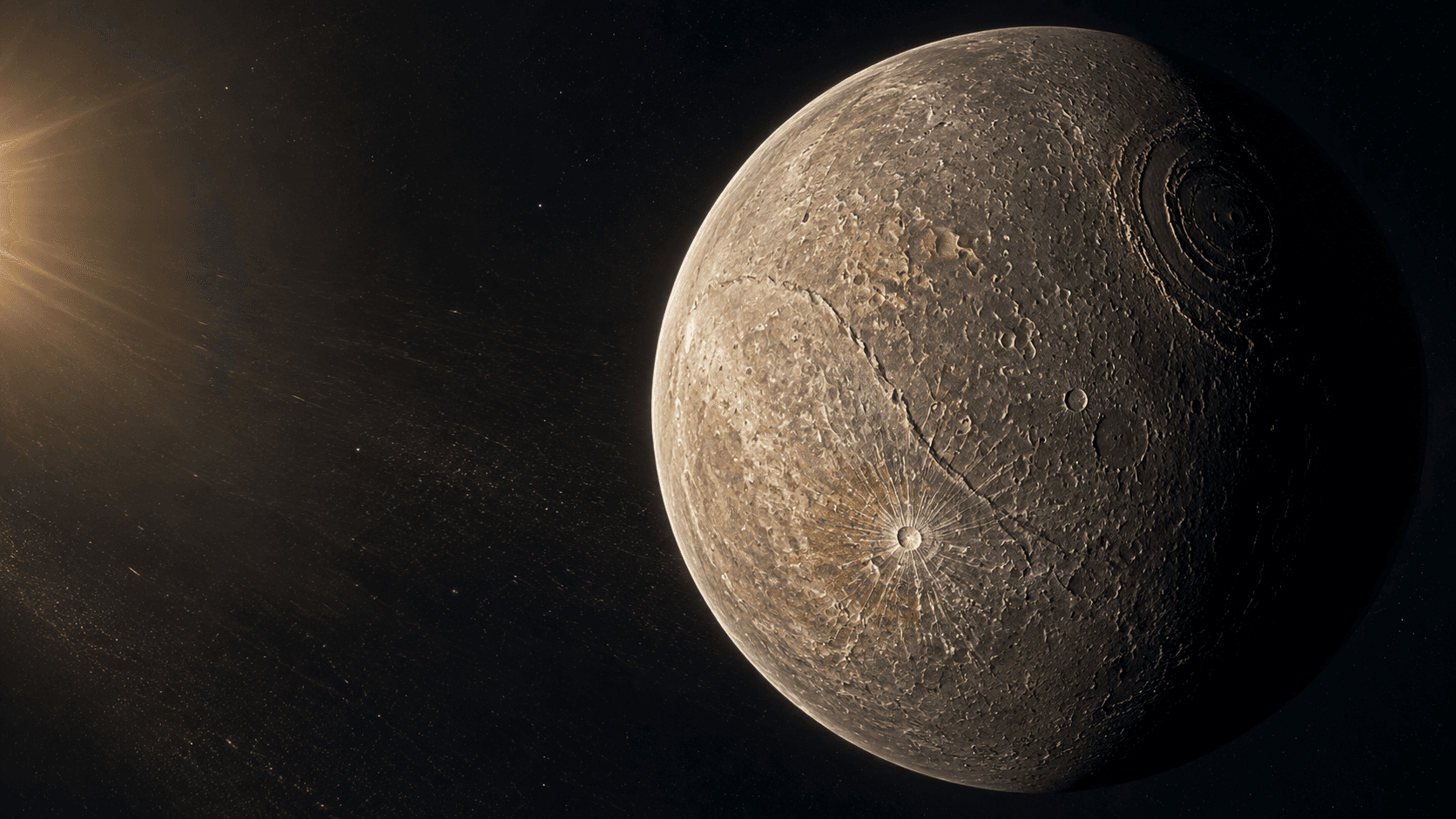
Mercury is the closest planet to the Sun and the smallest planet in the Solar System. This little rocky world moves around the Sun faster than any other planet, completing an orbit in only about 88 Earth days. Despite being our star's nearest planetary neighbor, Mercury is not the hottest planet. That title belongs to Venus. Mercury instead experiences some of the most dramatic temperature changes in the Solar System, shifting from intensely hot days to freezing nights.
At first glance, Mercury can look similar to Earth's Moon because both worlds have gray, heavily cratered surfaces. A closer examination reveals a planet with an unusual history. Mercury contains an enormous metal-rich core, a weak but global magnetic field, long cliffs created as the planet contracted, and water ice hidden inside permanently shadowed craters near its poles. Its orbit and rotation also produce a day-and-year cycle unlike anything experienced on Earth.
Mercury is difficult to observe from Earth and challenging for spacecraft to reach. Even so, missions including Mariner 10, MESSENGER, and BepiColombo have transformed scientific understanding of this small world. Studying Mercury helps researchers investigate how rocky planets formed close to their stars and how planetary surfaces change under intense radiation and solar wind.
Mercury at a Glance
| Mercury fact | Approximate value |
|---|---|
| Position from the Sun | First planet |
| Average distance from the Sun | 57.9 million km (36 million miles) |
| Average distance in astronomical units | 0.39 AU |
| Closest distance to the Sun | 46 million km (28.6 million miles) |
| Farthest distance from the Sun | 69.8 million km (43.4 million miles) |
| Diameter | 4,880 km (3,032 miles) |
| Length of one year | About 88 Earth days |
| Rotation period | About 58.6 Earth days |
| Sunrise-to-sunrise solar day | About 176 Earth days |
| Highest daytime temperature | About 430°C (800°F) |
| Lowest nighttime temperature | About −180°C (−290°F) |
| Moons | 0 |
| Rings | 0 |
| Planet type | Terrestrial or rocky planet |
| Surface gravity | About 38% of Earth's gravity |
These values are rounded. Mercury's distance from the Sun and surface temperature change according to its position, location, and exposure to sunlight. You can also see how Mercury measures up against every other planet using the planet comparison tool.
What Is Mercury?
Mercury is one of the four terrestrial planets, along with Venus, Earth, and Mars. Terrestrial planets are mainly composed of rock and metal and have solid surfaces. Mercury is the innermost member of this group, orbiting closer to the Sun than any other planet.
The planet was known to ancient sky watchers because it can sometimes be seen without a telescope. Its modern English name comes from Mercury, the swift messenger god in Roman mythology. The name fits the planet well because Mercury travels around the Sun at an average orbital speed of roughly 47 kilometers per second, or about 29 miles per second. No other planet completes its orbit as quickly.
Mercury the planet should not be confused with mercury the chemical element. The element is a silvery liquid metal at ordinary room temperature, while the planet is a large, solid world made mainly of rock and metal. The shared name comes from historical traditions rather than a claim that the planet's surface is covered in the element.
Mercury offers scientists a rare look at what happens to a rocky planet close to a star. The planet receives intense sunlight and is constantly struck by particles from the solar wind. Its thin exosphere provides almost no protection, yet its surface preserves evidence from billions of years of impacts, volcanic activity, and internal cooling.
Mercury Facts
1. Mercury is the closest planet to the Sun
Mercury travels around the Sun at an average distance of approximately 57.9 million kilometers, or 36 million miles. Its orbit is more stretched than the orbits of most planets, so the exact distance changes significantly during a Mercury year.
2. Mercury is the smallest planet in the Solar System
Mercury has a diameter of about 4,880 kilometers, or 3,032 miles. It is the smallest of the eight officially recognized planets. Pluto is smaller, but Pluto has been classified as a dwarf planet since 2006.
3. Mercury is only slightly larger than Earth's Moon
Earth's Moon is about 3,475 kilometers, or 2,159 miles, across. Mercury is about 1.4 times wider than the Moon. Images of the two worlds can look similar because both have ancient, crater-covered surfaces, but Mercury is a planet with a much larger metallic core.
4. A year on Mercury lasts about 88 Earth days
Mercury has the shortest year of any planet. Its small orbit and high orbital speed allow it to complete one journey around the Sun in approximately 88 Earth days.
5. Mercury rotates slowly
Mercury takes about 58.6 Earth days to complete one rotation relative to the distant stars. Because the planet is also moving quickly around the Sun, one complete solar day — from one sunrise to the next — lasts about 176 Earth days.
6. Mercury is not the hottest planet
Although Mercury is closest to the Sun, Venus is hotter. Venus has a thick carbon-dioxide atmosphere that traps heat through an intense greenhouse effect. Mercury has almost no atmosphere to hold heat near its surface.
7. Mercury experiences extreme temperatures
Sunlit areas near Mercury's equator can reach approximately 430°C, or 800°F. After sunset, temperatures can fall to around −180°C, or −290°F. The range is far greater than normal temperature changes on Earth.
8. Mercury has no moons or rings
No natural satellites orbit Mercury, and the planet has no ring system. Venus is the only other planet without a moon.
9. Mercury has an unusually large metallic core
Mercury's iron-rich core occupies most of the planet's interior. The core makes up a much larger portion of Mercury than Earth's core does of Earth. Scientists continue to study how such a small planet acquired this unusual internal structure.
10. Mercury has a magnetic field
Mariner 10 discovered that Mercury has a global magnetic field. The field is much weaker than Earth's, but its existence was surprising because small rocky worlds tend to cool internally over time. Evidence suggests that part of Mercury's core remains molten and supports a magnetic dynamo.
11. Mercury has an exosphere rather than a thick atmosphere
Mercury is surrounded by an extremely thin collection of atoms called an exosphere. It includes oxygen, sodium, hydrogen, helium, and potassium. Particles are continually supplied and lost, so the exosphere does not behave like Earth's substantial atmosphere.
12. Mercury's surface is covered with craters and cliffs
Impacts have created craters of many sizes. The planet also has long cliffs, called lobate scarps, that formed as its interior cooled and contracted. In some areas, these cliffs stretch for hundreds of kilometers.
13. Mercury contains water ice
Water ice exists inside permanently shadowed craters near Mercury's poles. Although the planet is close to the Sun, sunlight never reaches the floors of some deep polar craters. These protected areas remain cold enough for ice to survive.
14. The Sun looks much larger from Mercury
Because Mercury is much closer to the Sun than Earth, the Sun would appear more than twice as large in Mercury's sky at some points in its orbit. The sunlight reaching Mercury can be several times more intense than sunlight reaching Earth.
15. Reaching Mercury is surprisingly difficult
A spacecraft traveling inward must lose a great amount of orbital energy while managing the Sun's gravitational pull and intense heat. Missions often use gravity-assist flybys to adjust their speed and path instead of flying directly to Mercury.
How Far Is Mercury From the Sun?
Mercury is, on average, about 57.9 million kilometers (36 million miles) from the Sun. This equals approximately 0.39 astronomical unit, usually written as 0.39 AU. One astronomical unit is the average distance between Earth and the Sun, about 149.6 million kilometers or 93 million miles.
Mercury does not remain at one fixed distance. Its orbit is elliptical, meaning it is shaped more like a slightly stretched circle. At perihelion, the closest point in its orbit, Mercury is approximately 46 million kilometers or 28.6 million miles from the Sun. At aphelion, the farthest point, it is approximately 69.8 million kilometers or 43.4 million miles away.
| Position in Mercury's orbit | Distance from the Sun |
|---|---|
| Perihelion, or closest point | About 46 million km (28.6 million miles) |
| Average orbital distance | About 57.9 million km (36 million miles) |
| Aphelion, or farthest point | About 69.8 million km (43.4 million miles) |
Sunlight takes about 3.2 minutes to travel the average distance from the Sun to Mercury. By comparison, sunlight takes about 8 minutes and 20 seconds to reach Earth. Looking at the Sun from Mercury would therefore mean seeing light that left the Sun only a few minutes earlier.
Mercury also moves faster when it is nearer the Sun and slightly slower when it is farther away. This behavior follows the laws of planetary motion described by Johannes Kepler. The combination of a short orbit and high speed gives Mercury its 88-day year.
Is Mercury the Hottest Planet?
No. Mercury is the closest planet to the Sun, but Venus is the hottest planet in the Solar System. Mercury can become extremely hot during the day, yet it cannot retain that heat after the Sun sets.
The explanation is found in each planet's atmosphere. Mercury has only a very thin exosphere. There is not enough gas to circulate heat efficiently from the daylight side to the nighttime side or to trap much infrared energy near the ground. A sunlit region becomes extremely hot, but the same region cools rapidly when it rotates into darkness.
Venus is different. Its dense atmosphere consists mainly of carbon dioxide and creates a powerful greenhouse effect. Energy from the Sun warms the surface, and the thick atmosphere prevents much of that heat from escaping into space. As a result, the average surface temperature on Venus is around 465°C, or 870°F — hot enough to melt lead and hotter than Mercury's highest commonly cited daytime temperature.
| Feature | Mercury | Venus |
|---|---|---|
| Position from the Sun | First planet | Second planet |
| Atmospheric condition | Extremely thin exosphere | Very thick carbon-dioxide atmosphere |
| Common temperature description | About 430°C by day to −180°C by night | About 465°C average surface temperature |
| Heat retention | Very low | Extremely high |
| Hottest planet? | No | Yes |
This comparison shows why distance alone does not determine planetary temperature. Atmospheric composition, pressure, reflectivity, rotation, and heat circulation also matter. Mercury receives more direct solar energy, but Venus is much better at keeping the heat it receives.
Mercury Planet Temperature: How Hot and Cold Does It Get?
The temperature on Mercury ranges from approximately 430°C (800°F) during the day to −180°C (−290°F) at night. The exact Mercury planet temperature depends on location, local time, surface materials, and distance from the Sun.
Mercury's equatorial regions receive the most intense sunlight. Near midday, an exposed surface can become hot enough to melt some metals. Once darkness arrives, the same general region loses heat to space because almost no atmosphere is present to slow the cooling.
Mercury rotates much more slowly than Earth. A place on Earth moves through daylight and darkness within a 24-hour cycle. On Mercury, one sunrise-to-sunrise cycle lasts about 176 Earth days. Surface locations can therefore experience long periods of heating followed by long periods of cooling.
| Location or planet | Approximate temperature |
|---|---|
| Mercury sunlit equatorial surface | Up to about 430°C (800°F) |
| Mercury nighttime surface | Down to about −180°C (−290°F) |
| Venus surface average | About 465°C (870°F) |
| Earth global surface average | About 15°C (59°F) |
Mercury's polar regions provide an important exception. The planet's rotational axis is tilted only slightly. As a result, sunlight never reaches the floors of some deep craters near the north and south poles. These permanently shadowed locations can remain below approximately −170°C, cold enough for water ice and other frozen compounds to survive for long periods.
The phrase "Mercury's temperature" can therefore be misleading if it suggests one value for the entire planet. Mercury does not have a uniform temperature. Its environment includes extremely hot sunlit surfaces, freezing nighttime terrain, and even colder permanently shadowed areas.
Why Is Mercury the Smallest Planet in the Solar System?
Mercury is the smallest planet in the Solar System because it has a diameter of only about 4,880 kilometers (3,032 miles). Its radius is approximately 2,440 kilometers, or 1,516 miles. Mercury is less than half as wide as Earth and has only about 5.5% of Earth's mass.
Despite its small size, Mercury is larger than Earth's Moon. It is also important to understand that some moons are larger than Mercury. Jupiter's moon Ganymede and Saturn's moon Titan both have larger diameters, but they orbit planets rather than orbiting the Sun as dominant bodies in their orbital regions. Size alone does not decide whether an object is a planet or a moon.
Pluto is smaller than Mercury, but Pluto is classified as a dwarf planet. Under the definition adopted by the International Astronomical Union, a planet must orbit the Sun, be massive enough to become nearly round, and clear the neighborhood around its orbit. Mercury satisfies these requirements. Pluto does not meet the final condition, so Mercury remains the smallest of the eight planets.
Mercury is remarkably dense for its size. Its average density is only slightly lower than Earth's, even though Earth's greater gravity compresses its interior more strongly. This high density indicates that Mercury contains a very large amount of metal. Its core extends through most of the planet, while its rocky outer layers are comparatively thin.
Scientists have proposed several explanations for Mercury's high metal-to-rock ratio. A giant impact early in the planet's history might have removed part of its rocky outer material. Intense heat near the young Sun might also have affected the materials from which Mercury formed. Other models suggest that Mercury developed from metal-rich building blocks in the inner solar nebula. None of these simple explanations alone has resolved every observation, so Mercury's formation remains an active research subject.
Mercury's Orbit and Rotation
Mercury has one of the most unusual day-and-year relationships in the Solar System. A Mercury year lasts about 88 Earth days, but the planet takes about 58.6 Earth days to complete one rotation relative to distant stars.
The apparent conflict disappears when three different ideas are separated:
- Orbital period: the time required to travel once around the Sun — about 88 Earth days.
- Sidereal rotation period: the time required to rotate once relative to distant stars — about 58.6 Earth days.
- Solar day: the time from one sunrise to the next at the same location — about 176 Earth days.
Mercury is locked in a 3:2 spin-orbit resonance. It rotates three times for every two orbits around the Sun. Gravity and Mercury's elliptical orbit helped establish this stable relationship over a long period.
The planet's orbit also played an important role in physics. Astronomers found that the point of Mercury's closest approach to the Sun slowly shifts in a way that classical Newtonian calculations could not completely explain. Albert Einstein's general theory of relativity accounted for the remaining motion. Mercury's orbit became one of the early major tests supporting the theory.
What Is Mercury's Surface Like?
Mercury has a dark gray, rocky surface marked by craters, plains, ridges, and long cliffs. Countless objects struck the planet during the early history of the Solar System. Because Mercury has almost no atmosphere, incoming objects do not burn up in thick air before reaching the ground. Erosion by wind and rain does not erase the resulting scars.
The Caloris Basin is one of Mercury's most recognizable features. This enormous impact structure measures roughly 1,550 kilometers, or 960 miles, across. The collision that created it released tremendous energy and affected terrain far beyond the basin itself.
Mercury also preserves evidence of volcanic activity. Smooth plains cover parts of the planet, and volcanic vents reveal that explosive eruptions occurred in the past. These observations changed an older view of Mercury as only a dead, Moon-like world.
Another distinctive feature is a network of lobate scarps. These long, curving cliffs formed as Mercury's interior cooled and the planet contracted. Imagine the outer surface of a drying fruit wrinkling as the inside shrinks. Mercury's process occurred on a planetary scale, pushing sections of crust over neighboring ground.
MESSENGER images also revealed small, bright depressions called hollows. Hollows may form when volatile materials escape from exposed rocks. Their relatively fresh appearance suggests that Mercury's surface has undergone changes more recently than scientists once expected.
Inside Mercury
Mercury has a crust, mantle, and core, but their proportions are unusual. Its iron-rich metallic core is enormous compared with the planet's overall radius. The rocky mantle and crust form a relatively thin outer shell around it.
Evidence from Mercury's rotation, gravity, magnetic field, and spacecraft measurements indicates that at least part of the core remains liquid. Motion within electrically conductive liquid metal likely creates the planet's magnetic field through a process called a dynamo.
Understanding the core is essential to understanding Mercury's origin. If the planet formed with a more typical mixture of rock and metal, some event may have removed a large portion of its original rocky exterior. If it formed metal-rich from the beginning, conditions in the young inner Solar System must have separated materials more strongly than many basic models predict. Each possibility teaches scientists something different about how planets grow around stars.
Does Mercury Have an Atmosphere?
Mercury does not have a substantial atmosphere like Earth, Venus, or Mars. Instead, it has an extremely thin exosphere made of individual atoms that rarely collide with one another.
Detected components include oxygen, sodium, hydrogen, helium, and potassium. Some particles come from the solar wind. Others are knocked from the surface by micrometeoroid impacts, sunlight, and energetic charged particles. Mercury's weak gravity and intense solar environment make it difficult to hold these particles, so they are continually lost and replaced.
This exosphere cannot provide breathable air, create normal weather, block dangerous radiation, or distribute heat around the planet. It is one reason Mercury can be scorching in sunlight and freezing in darkness.
Does Mercury Have Water?
Mercury has water ice inside permanently shadowed craters near its poles. This discovery may sound impossible on a planet so close to the Sun, but local conditions matter more than the planet's general reputation for heat.
Mercury's rotational axis has very little tilt. Near the poles, the Sun stays close to the horizon. The floors of some deep craters never receive direct sunlight, allowing them to remain extremely cold. Radar observations from Earth indicated that reflective material was present in these areas. NASA's MESSENGER mission later collected additional evidence consistent with water ice, including measurements of hydrogen and the temperatures of polar terrain.
Some ice deposits appear to be covered by a dark insulating layer rich in carbon-bearing material. Comets and water-rich asteroids may have delivered part of the water, although scientists continue to study its origins and history.
Mercury does not have liquid oceans, rivers, or rain. Exposed water would quickly freeze, vaporize, or break apart under the planet's conditions. The known ice survives because it is sealed within natural cold traps that sunlight cannot reach.
Mercury's Magnetic Field and Space Environment
Mercury possesses a global magnetic field, although it is much weaker than Earth's. The field forms a small magnetosphere that interacts directly with the solar wind — the continuous stream of charged particles flowing outward from the Sun.
Because Mercury orbits so close to the Sun, its magnetosphere faces conditions much more intense and variable than those near Earth. Solar eruptions can compress and disturb it. Magnetic interactions guide particles toward the surface and help move material into Mercury's exosphere. A long magnetotail extends away from the Sun.
These conditions make Mercury a natural laboratory for studying how a magnetic field behaves near a star. The results are also useful when scientists consider rocky exoplanets orbiting close to other stars.
Could Humans Live on Mercury?
Humans could not survive unprotected on Mercury. The planet has no breathable atmosphere, offers almost no protection from radiation, and experiences extreme temperature changes. Its surface is exposed to solar particles and micrometeoroids, while the long day-and-night cycle complicates power generation and temperature control.
Any theoretical habitat would require heavy radiation shielding, a sealed life-support system, reliable cooling and heating, imported or locally produced water, and protection from surface impacts. Permanently shadowed polar regions might provide water ice, while locations near a boundary between light and darkness could offer more manageable temperatures. Underground construction could add protection.
These possibilities remain speculative. No crewed mission to Mercury is currently operating, and landing large payloads there would be extremely difficult. Robotic exploration is the practical method for studying Mercury for the foreseeable future.
How Did Mercury Form?
Mercury formed about 4.5 billion years ago from material orbiting the young Sun. Dust and small rocky bodies collided and gradually assembled into larger objects. Close to the Sun, high temperatures favored rock and metal rather than the abundant ices found farther away.
Mercury's oversized core makes its early story difficult to explain. One hypothesis proposes that a massive collision stripped away part of an originally thicker rocky mantle. Another suggests that intense heat from the young Sun vaporized some outer material. A third group of models proposes that the local disk contained metal-rich material from which Mercury grew.
Spacecraft measurements show that Mercury retains volatile elements that might have been lost under the most extreme heating scenarios. That evidence means the planet's history was probably more complicated than a single simple event. BepiColombo's measurements of composition, gravity, magnetism, and the exosphere are designed to help refine the story.
Missions to Mercury
Mariner 10
NASA's Mariner 10 became the first spacecraft to visit Mercury. It made three flybys in 1974 and 1975 after using Venus for a gravity assist. Mariner 10 photographed part of Mercury's cratered surface and discovered that the planet has a magnetic field. Because the flybys occurred under similar lighting, the spacecraft could image only about 45% of the surface.
MESSENGER
NASA's MESSENGER spacecraft provided the first global investigation of Mercury. After a long journey and several flybys, it entered orbit in 2011. The mission mapped the surface, measured chemical composition, studied the magnetic field and exosphere, investigated the interior, and strengthened evidence for polar water ice.
MESSENGER completed more than four years of orbital observations before its fuel was exhausted. In 2015, the spacecraft ended its mission by impacting Mercury as planned. The data continue to support research on the planet.
BepiColombo
BepiColombo is a joint mission of the European Space Agency and the Japan Aerospace Exploration Agency. The mission includes two scientific orbiters designed to study Mercury's surface, interior, magnetic environment, and interaction with the solar wind from complementary perspectives.
Traveling to Mercury requires careful changes in speed, so the mission uses multiple gravity-assist encounters during its long journey. Mission schedules and arrival activities can change; the current flight and orbit-insertion status should always be checked on the official ESA and JAXA mission pages. Once the orbiters begin their main science work, their combined observations are expected to provide the most complete investigation of Mercury so far.
How to See Mercury From Earth
Mercury can be seen without a telescope, but it is often difficult to locate. From Earth, Mercury always appears relatively close to the Sun because its orbit lies inside Earth's orbit. It never travels across the midnight sky like Mars, Jupiter, or Saturn.
The best opportunities generally occur around greatest elongation, when Mercury appears at its largest angular separation from the Sun. During an evening appearance, look low near a clear western horizon shortly after sunset. During a morning appearance, look low in the east before sunrise. Visibility depends on location, season, atmospheric clarity, and the geometry of a particular appearance. The Tonight's Sky viewer can help you check which planets are currently visible from your location.
Safety warning: Never look directly at the Sun. Never aim binoculars, a camera, or a telescope near the Sun unless the equipment has a properly installed solar filter designed for that exact purpose. Unfiltered sunlight can cause permanent eye damage almost instantly.
Mercury Compared With Earth
| Feature | Mercury | Earth |
|---|---|---|
| Average distance from the Sun | 57.9 million km | 149.6 million km |
| Diameter | 4,880 km | 12,742 km |
| Mass compared with Earth | About 5.5% | 100% |
| Surface gravity compared with Earth | About 38% | 100% |
| Length of year | About 88 Earth days | About 365.25 days |
| Rotation period | About 58.6 Earth days | About 23 hours, 56 minutes |
| Solar day | About 176 Earth days | About 24 hours |
| Moons | 0 | 1 |
| Outer gas layer | Extremely thin exosphere | Substantial atmosphere |
| Common surface temperature description | About 430°C to −180°C | Global average about 15°C |
| Global magnetic field | Yes, weak | Yes, stronger |
The two planets are both rocky, differentiated worlds with metallic cores, but their surface environments are dramatically different. Earth's atmosphere and oceans distribute heat and support life. Mercury's exposed surface records the effects of impacts, radiation, and extreme changes between daylight and darkness. Try the planet weight calculator to see how the difference in gravity would affect you on Mercury, or the planet age calculator to convert your Earth age into Mercury years.
Why Mercury Matters
Mercury may be small, but it holds major clues about the formation of rocky planets. Its unusually large core challenges simple models of planetary growth. Its surface preserves billions of years of impacts and geological change. Its magnetic field allows scientists to examine an active planetary dynamo inside a small world, while its exosphere reveals how a surface interacts directly with sunlight and solar wind.
Mercury also corrects several common misconceptions about the Solar System. The closest planet to the Sun is not automatically the hottest. A small planet can have a global magnetic field. Water ice can survive near the Sun when local terrain creates permanently cold shadows. A planet can have a year shorter than its sunrise-to-sunrise day.
Mariner 10 and MESSENGER revealed a complex world rather than a simple scorched rock. BepiColombo is positioned to extend that scientific story with new observations of Mercury's surface, interior, exosphere, and magnetic environment. Each discovery will improve understanding not only of Mercury, but also of Earth-like planets around the Sun and other stars.
Frequently asked questions
What is Mercury?
Mercury is a small, rocky planet and the closest planet to the Sun. It is the first of the eight planets in the Solar System and completes one orbit in about 88 Earth days. Mercury has a solid, cratered surface, a large metal-rich core, a weak magnetic field, and an extremely thin exosphere.
How far is Mercury from the Sun?
Mercury is about 57.9 million kilometers, or 36 million miles, from the Sun on average. Its elliptical orbit carries it as close as approximately 46 million kilometers and as far as approximately 69.8 million kilometers from the Sun.
Is Mercury the hottest planet?
No. Venus is the hottest planet because its thick carbon-dioxide atmosphere traps heat through a powerful greenhouse effect. Mercury can reach about 430°C during the day, but its lack of a substantial atmosphere allows the surface to become extremely cold at night.
What is the temperature on Mercury?
Mercury's sunlit surface can reach approximately 430°C, or 800°F, while nighttime temperatures can fall to about −180°C, or −290°F. Permanently shadowed polar craters can be even colder and can preserve deposits of water ice.
Why is Mercury the smallest planet?
Mercury is the smallest of the eight recognized planets because its diameter is approximately 4,880 kilometers, or 3,032 miles. Pluto is smaller but is classified as a dwarf planet. Planetary classification depends on orbital and physical characteristics, not size alone.
How big is Mercury compared with the Moon?
Mercury is about 1.4 times wider than Earth's Moon. Mercury's diameter is approximately 4,880 kilometers, while the Moon's is approximately 3,475 kilometers. Their cratered surfaces look similar, but Mercury has an unusually large metallic core and its own global magnetic field.
How long is a year on Mercury?
A year on Mercury lasts approximately 88 Earth days. Mercury has the shortest year of any planet because it follows the smallest planetary orbit and travels around the Sun faster than the other planets.
How long is a day on Mercury?
Mercury rotates once relative to distant stars in about 58.6 Earth days. However, because it moves around the Sun while rotating, a complete sunrise-to-sunrise solar day lasts approximately 176 Earth days.
Does Mercury have moons?
No. Mercury has no known natural moons. Its proximity to the Sun and small gravitational reach would make it difficult for the planet to maintain a stable moon over long periods.
Does Mercury have rings?
No. Mercury has no known rings. Ring systems consist of orbiting particles, and none have been detected around the planet.
Does Mercury have an atmosphere?
Mercury does not have a thick atmosphere. It has an extremely thin exosphere containing atoms such as oxygen, sodium, hydrogen, helium, and potassium. This exosphere cannot retain much heat, produce normal weather, or provide meaningful protection from radiation.
Is there water on Mercury?
Yes, water ice exists in permanently shadowed craters near Mercury's poles. These crater floors never receive direct sunlight and remain extremely cold. Mercury does not have surface oceans, rivers, or rain.
Can humans live on Mercury?
Humans cannot live unprotected on Mercury. Any habitat would need to supply air and water, regulate extreme temperatures, and shield residents from solar radiation and micrometeoroids. No crewed Mercury mission or settlement is currently planned as an active operation.
Why is Mercury difficult to explore?
Spacecraft traveling to Mercury must lose a large amount of orbital energy while falling toward the Sun. They must also survive intense sunlight and heat. Gravity-assist flybys help adjust speed gradually, but they make journeys longer and operationally complex.
Can Mercury be seen from Earth?
Yes. Mercury can sometimes be seen with the unaided eye shortly after sunset or before sunrise. Because it always stays near the Sun in Earth's sky, it appears low near the horizon and can be hidden by twilight, clouds, trees, or buildings.
Sources
- NASA Science: Mercury — last verified 2026-09-04
- NASA Solar System Exploration: Planet Comparison — last verified 2026-09-04
- NASA Science: MESSENGER Mission — last verified 2026-09-04
- European Space Agency: BepiColombo — last verified 2026-09-04
- JAXA: BepiColombo and Mio — last verified 2026-09-04