
Neptune Planet: Complete Guide to the Windy Blue Ice Giant
Explore Neptune facts, its powerful winds, blue atmosphere, distance, size, temperature, rings, Triton, and how to see Neptune tonight.
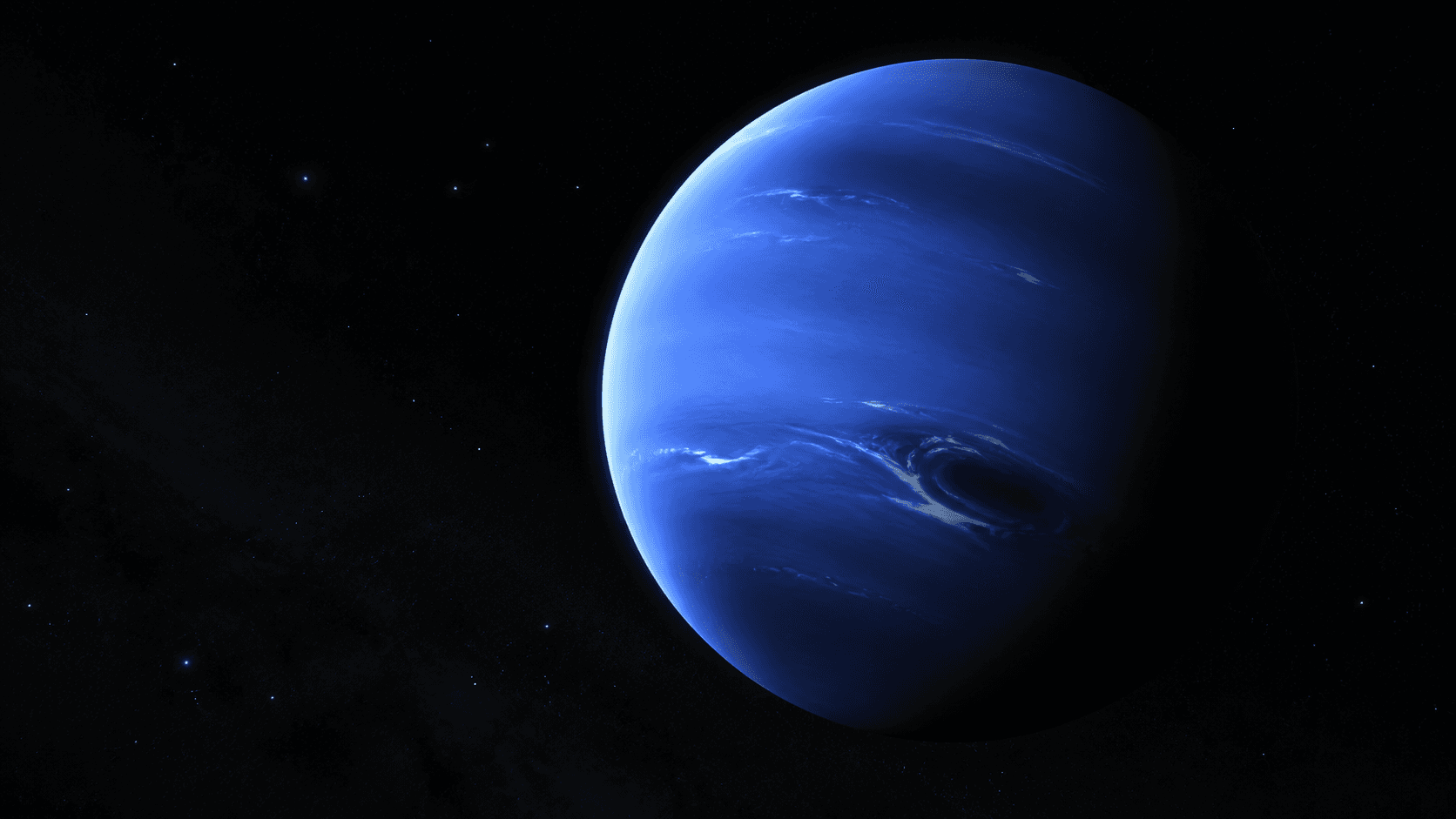
Neptune is the eighth planet from the Sun and the outermost major planet in the Solar System. An ice giant like Uranus, Neptune is a deep-blue world with the fastest winds ever measured on any planet, a system of thin dark rings, and a family of moons dominated by the unusual, backward-orbiting Triton.
Neptune was discovered in 1846 through mathematical prediction rather than direct observation. Urbain Le Verrier calculated where an unknown planet had to be to explain irregularities in Uranus's motion, and Johann Galle spotted Neptune close to that position the same night. It was the first planet found by calculation before it was seen.
This guide covers Neptune's size, structure, weather, rings, moons, missions, and place in the Solar System. It also compares Neptune with Earth and points to tools for exploring its properties.
Neptune at a Glance
| Fact | Approximate value |
|---|---|
| Position | Eighth planet |
| Average distance from Sun | 4.5 billion km, 30.1 AU |
| Diameter | 49,244 km |
| Mass | 17.1 Earths |
| Year | About 165 Earth years |
| Day | 16 h 6 min |
| Axial tilt | 28.3° |
| Cloud-top temperature | About −214°C (−353°F) |
| Main atmospheric gases | Hydrogen, helium, methane |
| Moons | 14 known |
| Rings | Thin, dark, with arcs |
What Is Neptune?
Neptune is an ice giant. Its outer envelope of hydrogen, helium, and methane surrounds a hot, dense mantle rich in water, ammonia, and methane in fluid form under enormous pressure. In planetary science these substances are called "ices" because of their chemical class, not because they are frozen solid inside the planet. A small rocky-ice core may lie at the center.
Neptune has no solid surface. What appears in photographs as its "surface" is the top of a deep cloud layer. Methane absorbs red light and reflects blue, contributing to Neptune's deep blue color. Neptune appears more vividly blue than Uranus, possibly due to differences in haze layers or trace compounds that scientists are still working to identify.
Neptune is named for the Roman god of the sea, chosen to match its bright blue appearance in early telescopic observations.
Neptune Facts
Neptune has the fastest winds measured on any planet, reaching more than 2,000 kilometers per hour in some cloud systems. Its atmosphere is highly active, with bright methane-ice clouds, dark storms, and rapid changes between observations.
Neptune radiates more than twice the energy it receives from the Sun. Internal heat drives active weather even at its huge distance from the Sun, and helps explain why it is more dynamic than Uranus, which emits very little internal heat.
Neptune's magnetic field is tilted and offset from the planet's center, producing a complex, rotating magnetosphere. Auroras occur, but their patterns differ from those on Earth or the other giant planets.
Neptune has 14 known moons and a system of thin rings. Triton is unusual because it orbits Neptune in a direction opposite the planet's rotation, called a retrograde orbit. This suggests that Triton did not form in place but was captured from the outer Solar System.
How Far Is Neptune From the Sun?
Neptune orbits at an average distance of about 4.5 billion kilometers (2.8 billion miles), or 30.1 AU. Its slightly elliptical orbit ranges from about 4.46 billion kilometers at perihelion to about 4.54 billion kilometers at aphelion. Sunlight takes about 4 hours 10 minutes to reach Neptune.
At Neptune's distance, sunlight is roughly 900 times weaker than at Earth. Daylight on Neptune's cloud tops looks like Earth's deep twilight, and internal heat plays a bigger role in atmospheric dynamics than at closer worlds.
How Far Is Neptune From Earth?
Distance between Neptune and Earth changes with orbital geometry. Near opposition, when Earth passes between Neptune and the Sun, they are closest, around 4.3 billion kilometers apart. Near solar conjunction, they can be about 4.7 billion kilometers apart.
| Situation | Approximate distance |
|---|---|
| Near opposition | About 4.3 billion km |
| Near solar conjunction | About 4.7 billion km |
Radio signals take roughly 4.0 to 4.4 hours one way. Real-time control is impossible, and any spacecraft must operate autonomously.
Neptune's Size and Structure
Neptune's diameter is about 49,244 kilometers, roughly 3.9 times Earth's. It is slightly smaller than Uranus but noticeably more massive at about 17.1 Earths. Its interior is thought to consist of an outer hydrogen-helium-methane atmosphere over a hot, dense mantle of water, ammonia, and methane in fluid form, with a possible small core of rock and ice.
Rapid rotation gives Neptune a modest oblate shape. Interior conditions may include exotic states of matter, including "superionic" water at extreme pressure and temperature, though direct evidence remains indirect.
Neptune's Atmosphere and Weather
Neptune's atmosphere is dominated by hydrogen and helium with a few percent methane and traces of other compounds. Layers include high hazes, methane-ice clouds, and deeper, warmer cloud decks.
Neptune's weather is unusually active for a planet so far from the Sun. Voyager 2 observed a large dark storm called the Great Dark Spot in 1989, comparable in size to Earth. By the time Hubble looked years later, it had disappeared, and other dark storms have appeared and faded since. Bright methane-ice clouds high in the atmosphere accompany many of these storms.
Wind speeds are extraordinary. Some jets flow in the direction opposite the planet's rotation, and equatorial regions move differently from poles. Powerful convection driven by internal heat helps sustain this activity.
Neptune's Rings
Neptune has a system of thin, dark rings, confirmed during the Voyager 2 flyby in 1989. Named for astronomers involved in Neptune's study, the main rings include Galle, Le Verrier, Lassell, Arago, and Adams. The outermost Adams ring contains bright arcs — regions where ring material clumps more densely — likely held in place by gravitational interactions with the small moon Galatea.
The rings are dark, similar to those of Uranus, and probably contain fine dust and organic material. Their long-term stability is not fully understood, and some ring arcs have changed since Voyager 2.
Neptune's Moons
Neptune has 14 known moons. By far the largest is Triton, which contains most of the mass in Neptune's satellite system. Triton is nearly as large as Earth's Moon and orbits Neptune in a retrograde direction, meaning opposite the planet's rotation. Retrograde orbit is highly unusual for a large moon and strongly suggests Triton did not form around Neptune. Instead, Triton is likely a captured Kuiper Belt object.
Voyager 2 discovered active nitrogen geysers on Triton and saw a young surface with few craters. Triton's tenuous atmosphere contains nitrogen. Because Triton's orbit is decaying slowly, it is expected to spiral inward and eventually break apart, either forming a ring around Neptune or crashing into it, though only after billions of years.
Nereid is Neptune's third-largest moon and has one of the most eccentric orbits of any known moon in the Solar System. Small inner moons, including Proteus and Larissa, orbit close to Neptune, and outer irregular moons follow distant, inclined paths that suggest capture.
Neptune Compared With Earth
| Feature | Neptune | Earth |
|---|---|---|
| Diameter | 49,244 km | 12,742 km |
| Mass | 17.1 Earths | 1 Earth |
| Day | 16 h 6 min | 24 h |
| Year | 165 years | 1 year |
| Moons | 14 known | 1 |
| Rings | Thin, dark, with arcs | None |
| Atmosphere | Hydrogen-helium-methane | Nitrogen-oxygen |
| Solid surface | None | Yes |
Use the planet comparison tool to explore Neptune alongside other worlds.
Missions to Neptune
Voyager 2 is the only spacecraft to have visited Neptune, flying past in August 1989. It returned the first detailed images of the planet, discovered new moons and rings, revealed the Great Dark Spot, and imaged Triton up close. Its measurements remain a large fraction of what is known about Neptune.
Since Voyager 2, all further study has come from ground- and space-based telescopes. Hubble and JWST continue to track long-term weather, and improved adaptive optics have supported dedicated observing campaigns. Planetary science communities have proposed a dedicated Neptune orbiter, sometimes paired with a mission to Uranus. Any specific future mission's status and schedule should be verified on official agency pages before publication.
Can You See Neptune Tonight?
Neptune is too faint to see with the unaided eye. Binoculars or a small telescope reveal it as a small blue-gray point. Charts and planetarium software help pinpoint it in the sky.
Use the Tonight's Sky viewer to check whether Neptune is above the horizon from your location right now, along with rise time, set time, and direction.
Why Neptune Matters
Neptune completes the tour of major planets in the Solar System and provides an example of a highly active ice giant. Its powerful winds, dark storms, thin ring arcs, and unusual moon Triton offer clues about planet formation, migration, and capture of small bodies from the outer Solar System.
Neptune's structure and weather also help interpret many exoplanets. A large fraction of known worlds around other stars are between Earth and Neptune in size, and Neptune is the nearest deeply studied example. A future dedicated mission would greatly expand knowledge that today largely rests on a single 1989 flyby.
Frequently asked questions
Why is Neptune blue?
Methane in Neptune's upper atmosphere absorbs red light and reflects blue back to space. Additional unknown compounds or scattering may make Neptune appear a deeper blue than Uranus.
How big is Neptune?
Neptune has a diameter of about 49,244 kilometers, roughly 3.9 times Earth's diameter.
How far is Neptune from Earth?
The distance varies from roughly 4.3 billion kilometers at close approach to about 4.7 billion kilometers when the planets are on opposite sides of the Sun.
How far is Neptune from the Sun?
Neptune orbits at an average distance of about 4.5 billion kilometers, or 30.1 astronomical units.
How was Neptune discovered?
Neptune was discovered in 1846 based on mathematical predictions from irregularities in Uranus's orbit. Urbain Le Verrier calculated its position, and Johann Galle observed it that same night.
How many moons does Neptune have?
Neptune has 14 known moons. Triton is by far the largest and follows a retrograde orbit.
Does Neptune have rings?
Yes. Neptune has a system of thin, dark rings. Some parts appear as arcs of denser material within otherwise faint rings.
How long is a day on Neptune?
About 16 hours 6 minutes, based on Voyager 2 measurements.
How long is a year on Neptune?
About 165 Earth years.
How cold is Neptune?
Cloud-top temperatures are near −214°C (−353°F). Neptune emits more internal heat than it receives from the Sun.
How fast are Neptune's winds?
Neptune has the fastest winds measured on any planet, reaching more than 2,000 kilometers per hour (1,300 mph) in some cloud systems.
Is Neptune visible tonight?
Neptune is not visible without optical aid. Binoculars or a small telescope reveal it as a tiny blue point. Visibility depends on current geometry, weather, and location.
Sources
- NASA Science: Neptune — last verified 2026-09-04
- NASA Science: Neptune Facts — last verified 2026-09-04
- IAU Minor Planet Center — last verified 2026-09-04