
Europa's Hidden Ocean: What We Know
Multiple lines of evidence indicate that Jupiter's moon Europa contains a global salty ocean beneath an icy shell, possibly holding about twice as much water as Earth's global ocean.
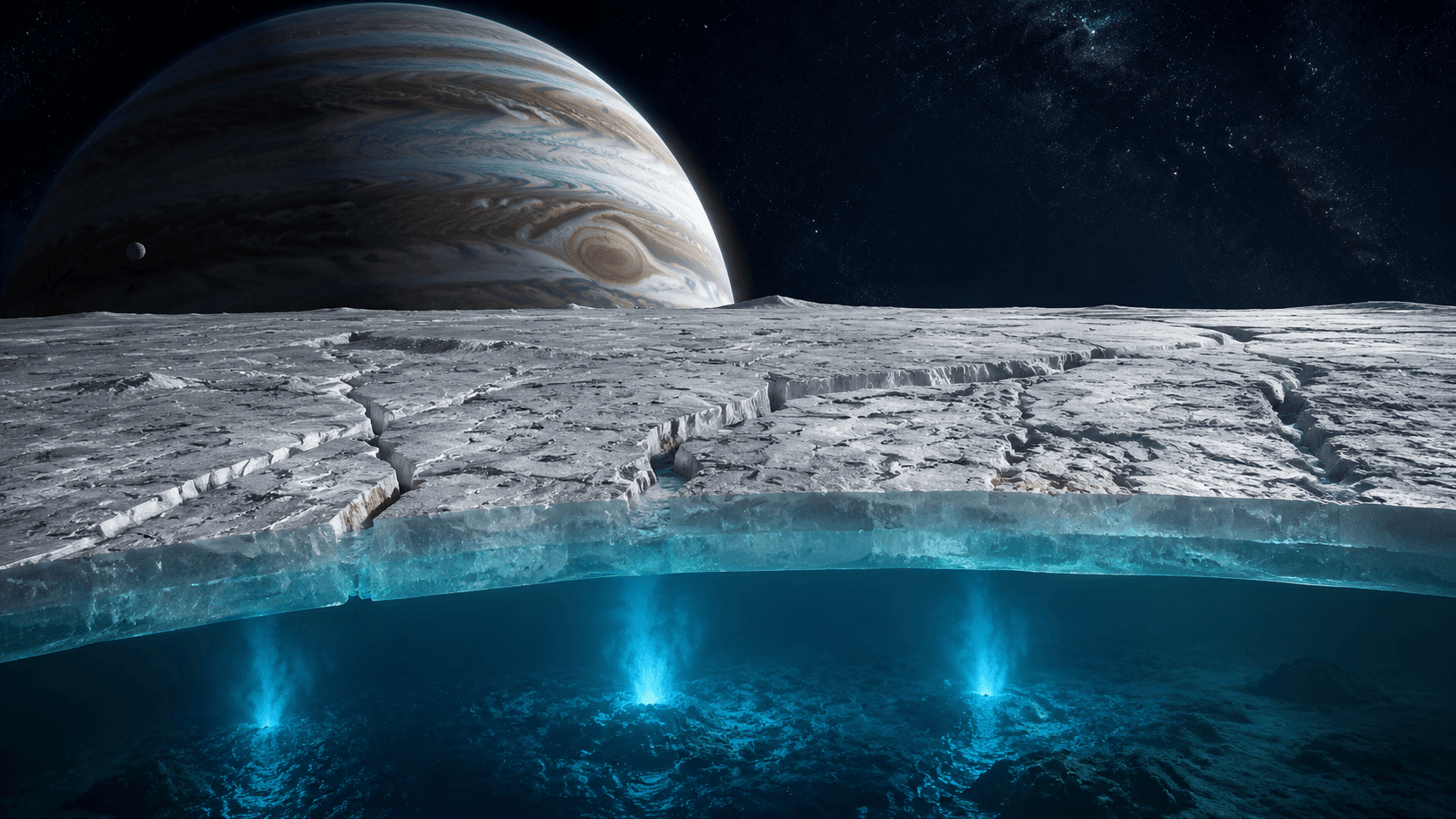
Quick answer: Multiple lines of evidence indicate that Jupiter's moon Europa contains a global salty ocean beneath an icy shell, possibly holding about twice as much water as Earth's global ocean.
Europa's Hidden Ocean at a Glance
| Topic | Explanation |
|---|---|
| Definition | Global salty ocean beneath Europa's icy shell. |
| Physical setting | Jupiter's tidal flexing produces internal heat that keeps subsurface water liquid. |
| Key evidence | Surface geology, induced magnetic response measured by Galileo, thermal and compositional observations, and models. |
| Why it matters | Europa may provide liquid water, useful chemistry, and energy — three broad requirements for habitability. |
| Important caution | No life has been detected. Ice thickness is uncertain, and possible plume detections are still being investigated. |
What Is Europa's Hidden Ocean?
Multiple lines of evidence indicate that Jupiter's moon Europa contains a global salty ocean beneath an icy shell. Europa is slightly smaller than Earth's Moon and is covered mainly by water ice. Its young-looking surface has bands, ridges, disrupted terrains, and relatively few large impact craters. Jupiter's gravity flexes Europa during its orbit, producing tidal heating that can help keep subsurface water liquid.
The Essential Science
The ocean case combines surface geology, Europa's induced magnetic response measured by Galileo, thermal and compositional observations, orbital dynamics, and models of an ice shell over liquid water and rock. No spacecraft has drilled through the ice or directly sampled the ocean.
Important Facts
Europa may provide liquid water, useful chemistry, and energy — three broad requirements considered in habitability studies. Habitability is not the same as inhabited, and no life has been detected. Europa Clipper is designed to assess whether environments beneath the surface could support life.
How Astronomers Study Europa
The Galileo spacecraft revealed magnetic-induction evidence for a conductive layer (salt water) at Europa. Hubble and other telescopes searched for plumes. Europa Clipper will make repeated close flybys with imaging, radar, and mass spectrometry.
What Telescopes and Spacecraft Actually Measure
Magnetometers detect the induced magnetic response of subsurface conductive layers. Radar can sound the ice shell. Imaging spectroscopy characterizes surface composition. Direct sampling requires future mission architectures.
Origin and Development
Europa formed alongside Jupiter and its Galilean moons. Its ocean is maintained by tidal heating from Jupiter and by radiogenic heat in the rocky mantle.
Structure and Physical Conditions
From outside in: an icy shell (perhaps 10–30 km thick), a global liquid-water ocean (perhaps 100 km deep), a rocky mantle, and a metallic core. Boundaries are inferred, not directly imaged.
Energy, Gravity, and Motion
Tidal flexing dissipates energy that keeps the ocean liquid. Ocean-rock interactions could support chemistry relevant to habitability.
Connections to Other Cosmic Objects
Europa is one of several ocean worlds in the outer Solar System, alongside Ganymede, Callisto, Enceladus, and Titan. Comparisons help refine habitability studies across Jupiter and Saturn systems.
What Is Known and What Remains Uncertain
Ocean existence is well supported. Ice thickness, rock–water chemistry, and plume reality remain uncertain. Direct sampling would resolve many questions.
Common Misconceptions
Europa has not been shown to have exposed open oceans, confirmed life, or a precisely measured ice thickness. Possible plume detections are still under investigation.
How Europa Fits Into Solar-System Exploration
Europa is a primary target of the coming decade's astrobiology-motivated missions, including Europa Clipper.
Best Ways to Explain Europa's Ocean to Students
Use a cutaway diagram of ice, ocean, mantle, and core. Explain magnetic-induction reasoning: a conductive shell reacting to Jupiter's changing field must contain salty water.
Why Europa's Ocean Matters
It is one of the most promising nearby places to search for habitable environments beyond Earth.
A Responsible Summary
Multiple lines of evidence support a global salty subsurface ocean on Europa, maintained by tidal heating. The upcoming Europa Clipper mission will test habitability without asserting that Europa is inhabited.
Detailed Search Questions
What does "Europa ocean" mean?
A global liquid-water layer beneath Europa's icy shell, supported by tidal heating.
What evidence supports the current picture?
Magnetic induction from Galileo, surface geology, and modeling together anchor the case.
How is Europa different from other worlds?
Its combination of a young icy surface, induced magnetic signature, and tidal heating make it especially promising for astrobiology.
Why does Europa matter?
It offers liquid water, chemistry, and energy — the key habitability ingredients.
What remains unknown?
Ice thickness, ocean chemistry, and plume activity are all being investigated by Europa Clipper.
How is evidence interpreted?
Multiple independent techniques must agree; single-instrument results are provisional.
What role do gravity and energy play?
Tidal flexing supplies the energy that keeps the ocean liquid; gravity structures the moon's interior.
Authoritative Source
Scientific content reviewed September 5, 2026.
Frequently asked questions
Does Europa have an ocean?
Multiple lines of evidence indicate that Jupiter's moon Europa contains a global salty ocean beneath an icy shell, possibly holding about twice as much water as Earth's global ocean.
How do we know?
The ocean case combines surface geology, Europa's induced magnetic response measured by Galileo, thermal and compositional observations, orbital dynamics, and models of an ice shell over liquid water and rock.
Has life been detected on Europa?
No. Europa may provide liquid water, useful chemistry, and energy — three broad requirements considered in habitability studies — but habitability is not the same as inhabited.
Are Europa's plumes confirmed?
Possible plume detections remain an active area of investigation. Some observations are consistent with plumes, but the evidence is not yet definitive.
Sources
- NASA — Europa Clipper — last verified Sat Sep 05 2026 00:00:00 GMT+0000 (Coordinated Universal Time)