
Apollo Program
The crewed lunar program that first landed humans on the Moon.
Agency
NASA
Destination
The Moon
Launched
May 25, 1961
Ended
December 19, 1972
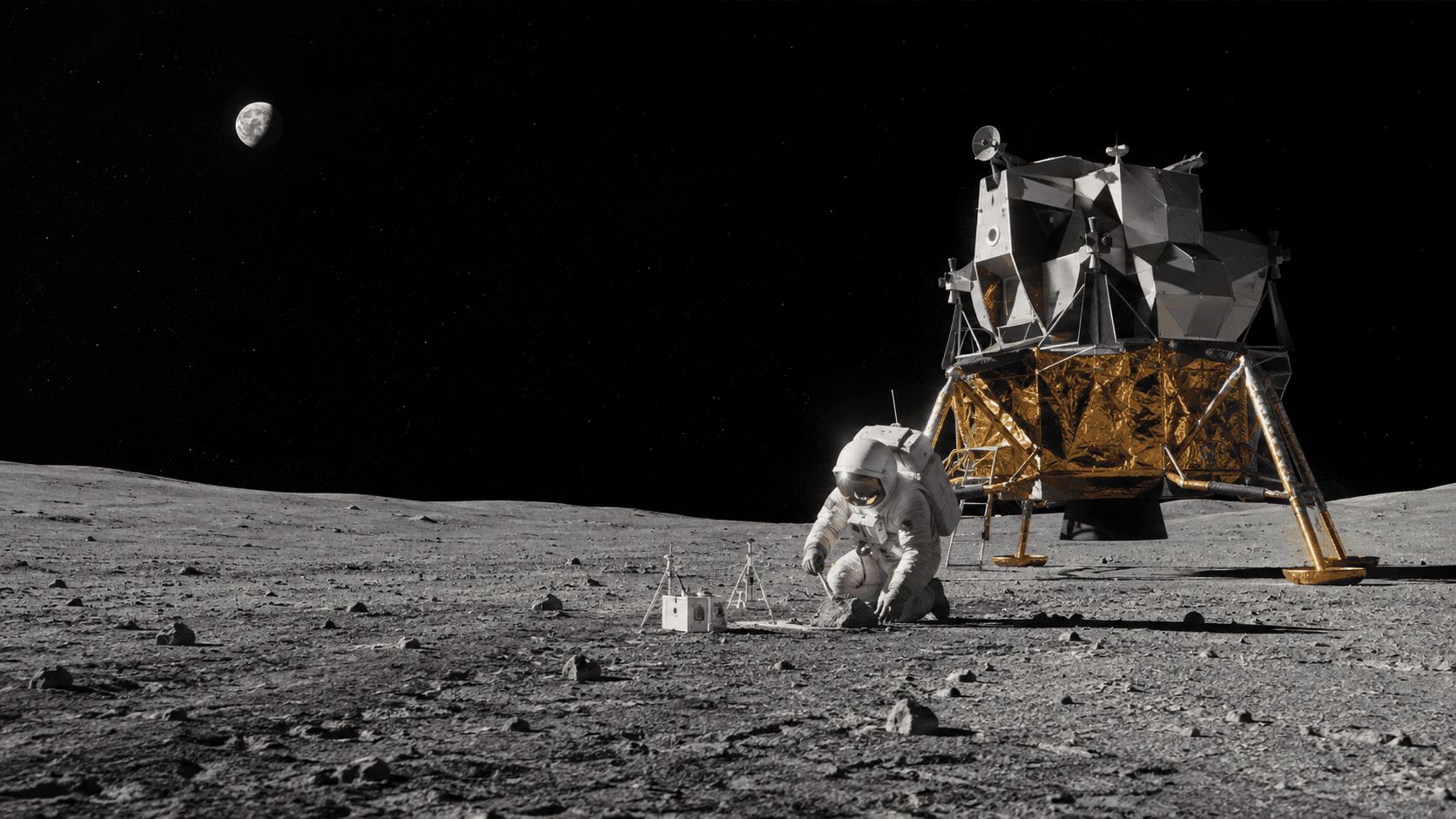
Quick answer: The Apollo Program was a crewed lunar exploration program led by NASA. It began in 1961, focused on the Moon, and is best known as the program that first landed humans on the Moon. Its work landed six crews, enabled 12 astronauts to walk on the Moon, returned 382 kilograms of samples, and transformed lunar science.
Apollo Program at a Glance
| Question | Answer |
|---|---|
| What kind of mission was it? | Crewed lunar exploration program |
| Who led it? | NASA |
| When did it begin? | 1961 |
| What did it study? | The Moon |
| Current or final status | Ended 1972 |
| Why is it famous? | First landed humans on the Moon |
What Is the Apollo Program?
The Apollo Program was NASA's crewed lunar exploration effort. Announced in 1961 and running until 1972, it landed six crews on the Moon, enabled 12 astronauts to walk on its surface, returned 382 kilograms of samples, and transformed lunar science. Apollo 11 achieved the first crewed landing in July 1969.
The program's samples, seismic data and photography remain the deepest crewed record of any world beyond Earth and inform the Artemis Program today.
Why the Apollo Program Was Created
Apollo emerged from Cold War competition and a scientific need for direct lunar exploration. Political priorities, launch vehicles, budgets, international relationships and technology all affected the design. That balance explains why Apollo carried a specific set of instruments and followed progressive Earth-orbit, lunar-orbit and landing missions using Saturn launch vehicles and Apollo spacecraft.
Apollo Program Facts at a Glance
| Field | Value |
|---|---|
| Program purpose | Land humans on the Moon and return them safely |
| Program launch | 1961 |
| Flight strategy | Progressive Earth-orbit, lunar-orbit and landing missions using Saturn launch vehicles and Apollo spacecraft |
| Program ended | 1972 |
| Defining importance | First crewed landings on the Moon |
Launch, Route, and Arrival
The program began in 1961. Reaching the Moon required progressive Earth-orbit and lunar-orbit missions before the first crewed landing in July 1969. Saturn V, the most powerful rocket flown at the time, delivered each crewed lunar mission. Trans-lunar injection, mid-course correction, lunar orbit insertion, descent to the surface, ascent, rendezvous and Earth return were each rehearsed by earlier missions.
Spacecraft Design and Instruments
The Command and Service Module (CSM) and Lunar Module (LM) formed the core Apollo architecture. Each subsystem — life support, thermal control, navigation, communications, guidance computers, structures, propulsion and scientific instruments — had to be human-rated. Later missions carried the Lunar Roving Vehicle and the Apollo Lunar Surface Experiments Package (ALSEP).
How the Mission Collected Evidence
Apollo scientists selected landing sites for geological interest and safety, trained crews in field geology, and returned samples cataloged with precise location and context. Continuing analysis of returned samples and archived data produces new results decades later.
Major Discoveries
Apollo landed six crews, enabled 12 astronauts to walk on the Moon, returned 382 kilograms of samples, and transformed lunar science. The samples anchored the giant-impact hypothesis for the Moon's origin, revealed the Moon's ancient volcanic history and refined the age of the inner Solar System. ALSEP instruments returned years of seismic, magnetic and heat-flow data.
Engineering Challenges
Human spaceflight to another world required navigation to a moving target, life support in vacuum, thermal control in extreme sunlight and shadow, precision landing, ascent, and reliable return. The Apollo 1 fire, the Apollo 13 near-loss and countless smaller anomalies demonstrated how difficult the endeavor was. Recovery from these events shaped later crewed programs including the International Space Station.
People and International Cooperation
Apollo depended on hundreds of thousands of engineers, technicians, scientists, controllers and managers. Its institutional history — including relationships between NASA and contractors — is part of its technical story.
How Apollo Changed Planetary Science
The first crewed landings on the Moon opened observations that had not previously been available. Apollo samples remain the reference material for lunar geochemistry, and its methods informed later robotic and crewed programs including the Viking Program and today's Artemis Program.
What Apollo Did Not Prove
Apollo did not sample every region of the Moon, and the six landing sites cannot represent the entire body. Later robotic missions map global chemistry and topography and inform future crewed exploration.
Frequently Asked Questions About the Apollo Program
What was the main purpose of the Apollo Program?
To land humans on the Moon and return them safely to Earth.
When did the Apollo Program run?
From 1961 to 1972.
Who operated the Apollo Program?
NASA led the program with contractors and scientific institutions across the United States.
What did the Apollo Program discover?
It landed six crews, enabled 12 astronauts to walk on the Moon, returned 382 kilograms of samples and transformed lunar science.
Why is the Apollo Program historically important?
Because it was the program that first landed humans on the Moon.
Is the Apollo Program still active?
No. The program ended in 1972. Its successor for lunar return is the Artemis Program.
How did Apollo reach the Moon?
Using progressive Earth-orbit, lunar-orbit and landing missions on Saturn launch vehicles with Apollo spacecraft.
Where can Apollo data be found?
Start with NASA's Apollo Program page and its linked archives.
Final Perspective
Apollo is one of the largest engineering and scientific efforts ever completed. Its defining place — the program that first landed humans on the Moon — is the beginning of a story that continues today with Artemis.
Authoritative Source
Factual status reviewed: September 4, 2026.
Primary sources
Last verified 2026-01-15. Mission status and dates can change.