
BepiColombo
A two-orbiter joint European–Japanese mission to Mercury, the most comprehensive Mercury investigation planned.
Agency
ESA · JAXA
Destination
Mercury
Launched
October 20, 2018
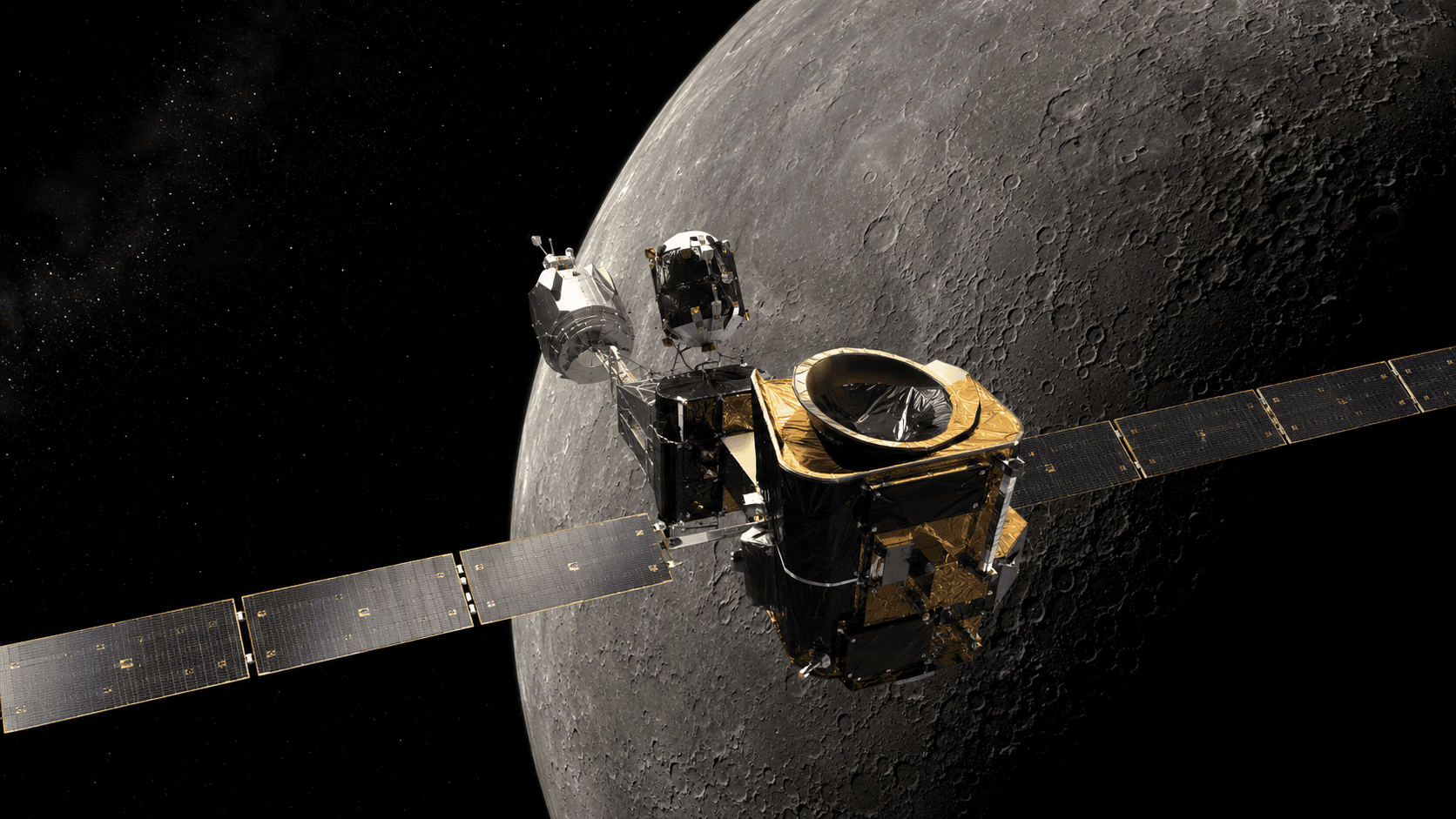
Quick answer: BepiColombo is a two-orbiter Mercury mission led by ESA and JAXA. It began on October 20, 2018, focused on Mercury, and is best known as Europe and Japan's first mission to Mercury and the most comprehensive Mercury investigation planned. Its work will study Mercury's surface, interior, exosphere, magnetic field, and solar-wind environment with ESA's MPO and JAXA's Mio.
BepiColombo at a Glance
| Question | Answer |
|---|---|
| What kind of mission was it? | Two-orbiter Mercury mission |
| Who led it? | ESA and JAXA |
| When did it begin? | October 20, 2018 |
| What did it study? | Mercury |
| Current or final status | Active; Mercury arrival phase in 2026 |
| Why is it famous? | Europe and Japan's first mission to Mercury and the most comprehensive Mercury investigation planned |
What Is BepiColombo?
BepiColombo is the joint European–Japanese two-orbiter Mercury mission. It launched on October 20, 2018, focused on Mercury, and is best known as Europe and Japan's first mission to Mercury and the most comprehensive Mercury investigation planned. Its work will study Mercury's surface, interior, exosphere, magnetic field, and solar-wind environment with ESA's Mercury Planetary Orbiter (MPO) and JAXA's Mercury Magnetospheric Orbiter (Mio).
The mission builds on the observations of Mariner 10 and MESSENGER and expects to deliver a step-change in Mercury science.
Why BepiColombo Was Created
Before BepiColombo, major uncertainties remained about Mercury even after MESSENGER. Two coordinated orbiters permit simultaneous measurements of the planet and its magnetosphere that a single spacecraft cannot provide. Political priorities, launch vehicles, budgets, international relationships and technology all affected the final design.
BepiColombo Facts at a Glance
| Field | Value |
|---|---|
| Program purpose | Explore Mercury with two coordinated orbiters |
| Launch | October 20, 2018 |
| Flight strategy | Multi-flyby cruise using Earth, Venus, and Mercury gravity assists |
| Mission status | Active; Mercury arrival phase in 2026 |
| Defining importance | Europe and Japan's first mission to Mercury and the most comprehensive planned |
Launch, Route, and Arrival
The mission began on October 20, 2018. Reaching Mercury required a multi-flyby cruise using Earth, Venus, and Mercury gravity assists. Trajectory correction maneuvers refined the path after launch. Solar-electric propulsion supplemented gravity assists to shed energy against the Sun's gravity.
Spacecraft Design and Instruments
Every subsystem supports coordinated observations of Mercury. Cameras and imaging sensors establish geological and atmospheric context; other instruments examine composition, particles, fields, temperature or gravity. The Mercury Transfer Module carries both orbiters until arrival.
How the Mission Collected Evidence
Investigators define measurable goals, select instruments capable of answering them and calibrate them for the intense thermal environment. Repeated observations, overlapping instrument coverage, comparisons with laboratory data and models of Mercury help eliminate weak interpretations.
Major Discoveries
BepiColombo will study Mercury's surface, interior, exosphere, magnetic field and solar-wind environment with ESA's MPO and JAXA's Mio. These results will replace broad assumptions with measurable constraints and allow scientists to test ideas about planetary formation, magnetism and space weather at the innermost planet.
Engineering Challenges
Mercury's proximity to the Sun imposed severe constraints on temperature, radiation and lighting. Designers selected protective materials, radiators and operating modes for those conditions. Mission survival depends on margins: enough energy, thermal capacity, pointing accuracy, data storage and communication time to complete priority objectives.
How BepiColombo Will Change Planetary Science
Simultaneous measurements from two coordinated orbiters will open observation modes that were not available to Mariner 10 or MESSENGER. A mission's legacy includes hardware designs, navigation methods, operational lessons, calibrated archives and trained scientific teams that influence later projects.
What BepiColombo Cannot Prove
A measurement compatible with water, organic chemistry, habitability or a possible biosignature is not automatically proof of life. Scientific conclusions include uncertainty. Coverage may be incomplete, instruments may have limited resolution, and local measurements may not represent an entire world.
Frequently Asked Questions About BepiColombo
What was the main purpose of BepiColombo?
To study Mercury using two coordinated orbiters, addressing gaps in scientific knowledge left after MESSENGER.
When was BepiColombo launched?
BepiColombo began on October 20, 2018. Mercury orbital insertion is expected in the arrival phase in 2026.
Who operates BepiColombo?
ESA and JAXA jointly operate the mission with the scientific and engineering organizations identified in official program records.
What will BepiColombo discover?
It will study Mercury's surface, interior, exosphere, magnetic field and solar-wind environment with MPO and Mio.
Why is BepiColombo historically important?
Because it is Europe and Japan's first mission to Mercury and the most comprehensive Mercury investigation planned.
Is BepiColombo still active?
Yes. It is active, with Mercury arrival phase in 2026.
How does BepiColombo reach Mercury?
Using a multi-flyby cruise with Earth, Venus, and Mercury gravity assists.
Where can BepiColombo data be found?
Start with the official mission page and its linked science archive.
Final Perspective
BepiColombo demonstrates how international cooperation extends exploration through coordinated measurements. Its defining place in history — Europe and Japan's first mission to Mercury and the most comprehensive Mercury investigation planned — is only the beginning of the story.
Authoritative Source
Factual status reviewed: September 4, 2026.
Primary sources
Last verified 2026-01-15. Mission status and dates can change.