
MESSENGER
The first spacecraft to orbit Mercury, mapping the planet and confirming polar water ice.
Agency
NASA
Destination
Mercury
Launched
August 3, 2004
Ended
April 30, 2015
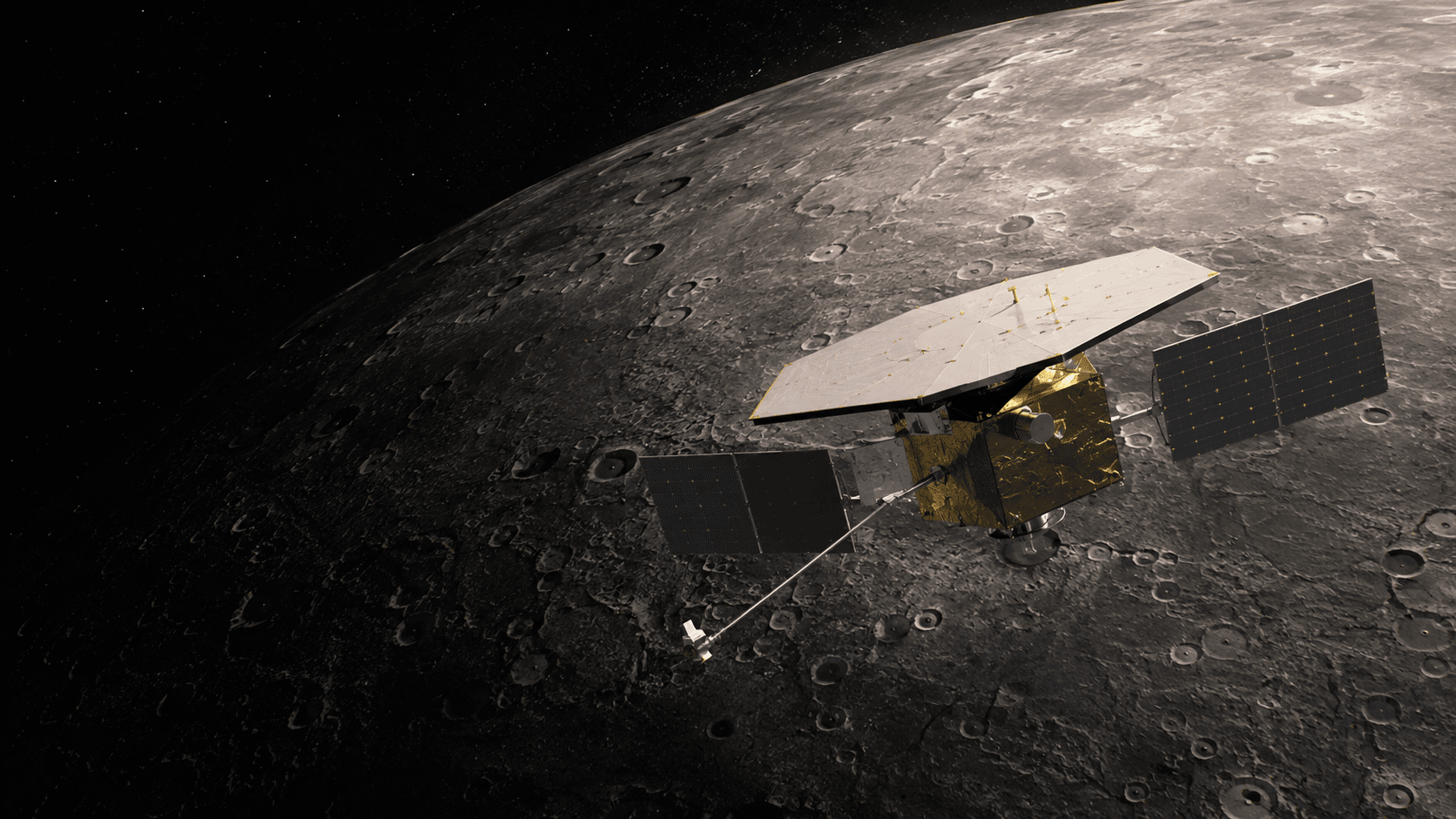
Quick answer: MESSENGER is a Mercury orbiter led by NASA. It began on August 3, 2004, focused on Mercury, and is best known as the first spacecraft to orbit Mercury. Its work mapped Mercury globally, confirmed polar water ice, measured surface chemistry, and studied its magnetic field and exosphere.
MESSENGER at a Glance
| Question | Answer |
|---|---|
| What kind of mission was it? | Mercury orbiter |
| Who led it? | NASA |
| When did it begin? | August 3, 2004 |
| What did it study? | Mercury |
| Current or final status | Ended April 30, 2015 |
| Why is it famous? | The first spacecraft to orbit Mercury |
What Is MESSENGER?
MESSENGER — MErcury Surface, Space ENvironment, GEochemistry, and Ranging — was NASA's Mercury orbiter. It launched on August 3, 2004, focused on Mercury, and is best known as the first spacecraft to orbit the innermost planet. Its work mapped Mercury globally, confirmed polar water ice, measured surface chemistry, and studied its magnetic field and exosphere.
Researchers used MESSENGER to move beyond the partial coverage returned by Mariner 10. The resulting evidence changed how scientists described Mercury and shaped questions for BepiColombo.
Why MESSENGER Was Created
Before MESSENGER, telescopes and Mariner 10 could answer only part of what researchers wanted to know about Mercury. Mission planners needed observations from a useful location, at suitable wavelengths, and over enough time to separate permanent features from changing conditions. The project translated those gaps into testable objectives and instrument requirements.
Political priorities, launch vehicles, budgets and technology all affected the final design. That balance explains why MESSENGER carried a particular set of instruments and followed one Earth, two Venus, and three Mercury gravity assists before orbital insertion.
MESSENGER Facts at a Glance
| Field | Value |
|---|---|
| Program purpose | Explore Mercury with an orbiter |
| Launch | August 3, 2004 |
| Flight strategy | One Earth, two Venus, and three Mercury gravity assists before orbital insertion |
| Mission ended | April 30, 2015 |
| Defining importance | First spacecraft to orbit Mercury |
Launch, Route, and Arrival
The mission began on August 3, 2004. Reaching Mercury required one Earth, two Venus, and three Mercury gravity assists before orbital insertion in 2011. Trajectory correction maneuvers refined the path after launch. Tracking stations measured range and radio-frequency shifts, allowing navigators to estimate position and velocity.
Spacecraft Design and Instruments
Every subsystem supported observations of Mercury. Cameras established geological context; other instruments examined composition, particles, fields, temperature or gravity. A protective sunshade shielded the spacecraft from the intense heat close to the Sun.
How the Mission Collected Evidence
Investigators defined measurable goals, selected instruments capable of answering them, calibrated those instruments and preserved the returned data with documentation. Images reveal shape and context, while spectrometers identify materials, magnetometers measure fields, radiometers examine heat and radio tracking exposes gravity and interior structure. The strongest conclusions usually combine several independent measurements.
Major Discoveries
MESSENGER mapped Mercury globally, confirmed polar water ice, measured surface chemistry, and studied its magnetic field and exosphere. These results allowed scientists to compare Mercury with Venus, Earth and Mars and to test ideas about planetary formation, volatile delivery and magnetic environments.
Engineering Challenges
Mercury's proximity to the Sun imposed severe constraints on temperature, radiation and lighting. Designers selected protective materials and operating modes for those conditions. Mission survival depended on margins: enough energy, thermal capacity, pointing accuracy, data storage and communication time to complete priority objectives.
How MESSENGER Changed Planetary Science
The first spacecraft to orbit Mercury opened a kind of observation that had not previously been available. Later researchers could design hypotheses around actual global measurements rather than relying only on remote estimates. A mission's legacy includes hardware designs, navigation methods, operational lessons, calibrated archives and trained scientific teams that influence later projects like BepiColombo.
What MESSENGER Did Not Prove
Scientific conclusions include uncertainty. Coverage may be incomplete, instruments may have limited resolution, and local measurements may not represent an entire world. Later missions often revisit earlier interpretations with better tools.
Frequently Asked Questions About MESSENGER
What was the main purpose of MESSENGER?
To study Mercury using an orbiter, addressing important gaps in scientific knowledge.
When was MESSENGER launched?
MESSENGER began on August 3, 2004 and ended on April 30, 2015.
Who operated MESSENGER?
NASA led the mission with scientific and engineering organizations identified in official program records.
What did MESSENGER discover?
It mapped Mercury globally, confirmed polar water ice, measured surface chemistry, and studied its magnetic field and exosphere.
Why is MESSENGER historically important?
Because it was the first spacecraft to orbit Mercury.
Is MESSENGER still active?
No. The mission ended on April 30, 2015.
How did MESSENGER reach Mercury?
Using one Earth, two Venus, and three Mercury gravity assists before orbital insertion.
Where can MESSENGER data be found?
Start with the official mission page and its linked science archive.
Final Perspective
MESSENGER demonstrates how exploration advances through carefully designed measurements, patient operations, transparent uncertainty and continued analysis. Its defining place in history — the first spacecraft to orbit Mercury — is only the beginning of the story. The deeper value comes from the evidence it produced, the engineering knowledge it created and the new questions it made possible for BepiColombo and follow-on Mercury science.
Authoritative Source
Factual status reviewed: September 4, 2026.
Primary sources
Last verified 2026-01-15. Mission status and dates can change.