
Venera Program
The Soviet program that achieved the first successful landing and first surface images from another planet.
Agency
Soviet Union
Destination
Venus
Launched
February 12, 1961
Ended
June 21, 1984
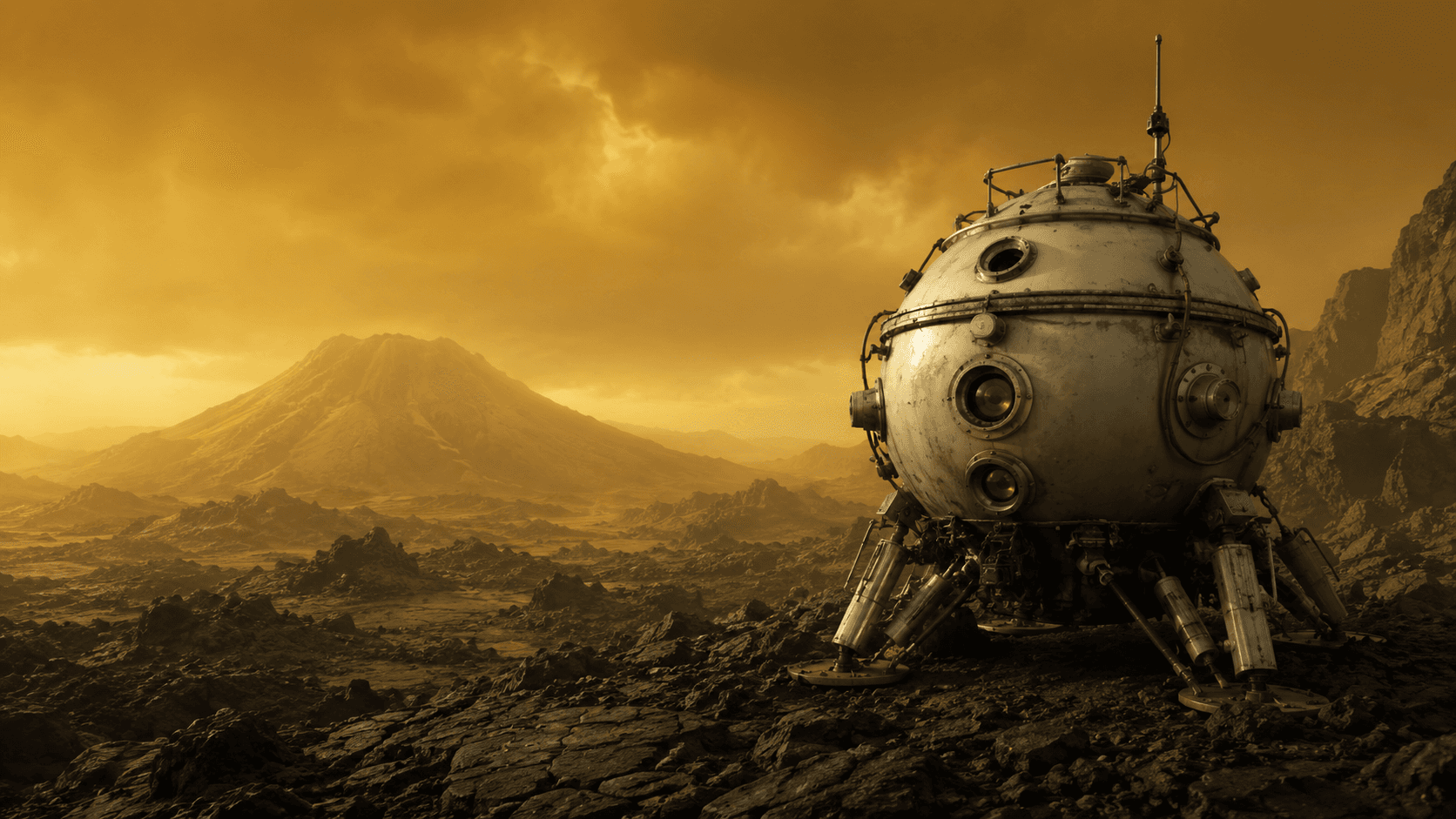
Quick answer: The Venera Program was a Soviet Venus exploration program. It began in 1961, focused on Venus, and is best known as the program that achieved the first successful landing and first surface images from another planet. Its work measured Venus's extreme atmosphere and surface, returned panoramas, analyzed soil, and radar-mapped the cloud-hidden planet.
Venera Program at a Glance
| Question | Answer |
|---|---|
| What kind of mission was it? | Soviet Venus exploration program |
| Who led it? | Soviet Union |
| When did it begin? | 1961 |
| What did it study? | Venus |
| Current or final status | Ended 1984 |
| Why is it famous? | First successful landing and first surface images from another planet |
What Is the Venera Program?
The Venera Program was the Soviet Union's Venus exploration effort. It began in 1961, focused on Venus, and is best known as the program that achieved the first successful landing and first surface images from another planet. Its work measured Venus's extreme atmosphere and surface, returned panoramas, analyzed soil, and radar-mapped the cloud-hidden planet.
Venera 4 measured Venus's atmosphere in 1967. Venera 7 achieved the first soft landing on another planet in 1970. Venera 9 returned the first images from the surface of another world in 1975. Venera 13 and 14 returned the first color surface panoramas in 1982.
Why the Venera Program Was Created
Before Venera, Venus was hidden behind opaque clouds and its surface conditions were only inferred. Mission planners needed direct measurements of atmosphere, pressure, temperature and surface material. Political competition with the United States during the Space Race, available launch vehicles, budgets and technology all affected the design. Each Venera generation built on lessons — and failures — from the previous one.
Venera Program Facts at a Glance
| Field | Value |
|---|---|
| Program purpose | Explore Venus with flybys, atmospheric probes, landers and radar orbiters |
| Program launch | 1961 |
| Flight strategy | Progressive series of flybys, atmospheric probes, landers and radar orbiters |
| Program ended | 1984 |
| Defining importance | First successful landing and first surface images from another planet |
Launch, Route, and Arrival
The program began in 1961. Reaching Venus required a series of flybys, atmospheric probes, landers and radar orbiters spanning more than two decades. Trajectory correction maneuvers refined each mission's path after launch, and successive designs added heat shields, parachute-drag brakes, pressure hulls and cooling systems capable of surviving Venus.
Spacecraft Design and Instruments
Each generation of Venera spacecraft carried instruments matched to a specific problem: entry probes for atmospheric composition and pressure profiles, landers for surface temperature, pressure, imaging and soil chemistry, and radar orbiters (Venera 15/16) for surface mapping through the clouds.
How the Mission Collected Evidence
Venera missions had to survive brutal conditions long enough to return data. Landers lasted from minutes to about two hours on the surface. Investigators calibrated instruments in the lab, corrected for lighting and haze in image data, and combined multi-mission observations to build a coherent picture.
Major Discoveries
The Venera Program measured Venus's extreme atmosphere and surface, returned panoramas, analyzed soil, and radar-mapped the cloud-hidden planet. It confirmed the crushing surface pressure (about 90 times Earth's), the roughly 460 °C surface temperature and the composition of the cloud layer. Radar mapping revealed volcanoes, tessera terrain and impact craters later refined by Magellan.
Engineering Challenges
The Venus environment imposed constraints on temperature, pressure, chemistry, communications and distance. Designers used titanium pressure hulls, radiators, sealed optics and short mission timelines. Mission survival depended on margins that were often exceeded only after multiple failures.
How Venera Changed Planetary Science
The first successful landing on another planet and the first surface images from another world opened a kind of observation that had not previously been available. Venera turned Venus from an inferred world into a directly measured one, influencing every later Venus mission including Magellan and Akatsuki.
What Venera Did Not Prove
Venera's coverage was incomplete, and short surface lifetimes limited what any single landing could reveal. Later missions revisit interpretations with better tools. Updating an explanation when evidence improves is a strength of science, not a failure.
Frequently Asked Questions About the Venera Program
What was the main purpose of the Venera Program?
To study Venus directly using flybys, atmospheric probes, landers and radar orbiters.
When did the Venera Program run?
From 1961 to 1984.
Who operated the Venera Program?
The Soviet Union led the program with its scientific and engineering institutions.
What did the Venera Program discover?
It measured Venus's extreme atmosphere and surface, returned panoramas, analyzed soil, and radar-mapped the cloud-hidden planet.
Why is the Venera Program historically important?
Because it achieved the first successful landing and first surface images from another planet.
Is the Venera Program still active?
No. It ended in 1984.
How did Venera spacecraft reach Venus?
Using a series of flybys, atmospheric probes, landers and radar orbiters.
Where can Venera data be found?
Start with the NASA imagine page and linked archives.
Final Perspective
The Venera Program is the deepest early record of Venus and remains a reference for anyone studying the planet's climate, geology and history. Its defining place — first successful landing and first surface images from another planet — set the stage for Magellan, Akatsuki and future Venus missions.
Authoritative Source
Factual status reviewed: September 4, 2026.
Primary sources
Last verified 2026-01-15. Mission status and dates can change.