
Akatsuki
Japan's Venus climate orbiter, its first successful planetary orbiter beyond Earth.
Agency
JAXA
Destination
Venus
Launched
May 21, 2010
Ended
September 18, 2025
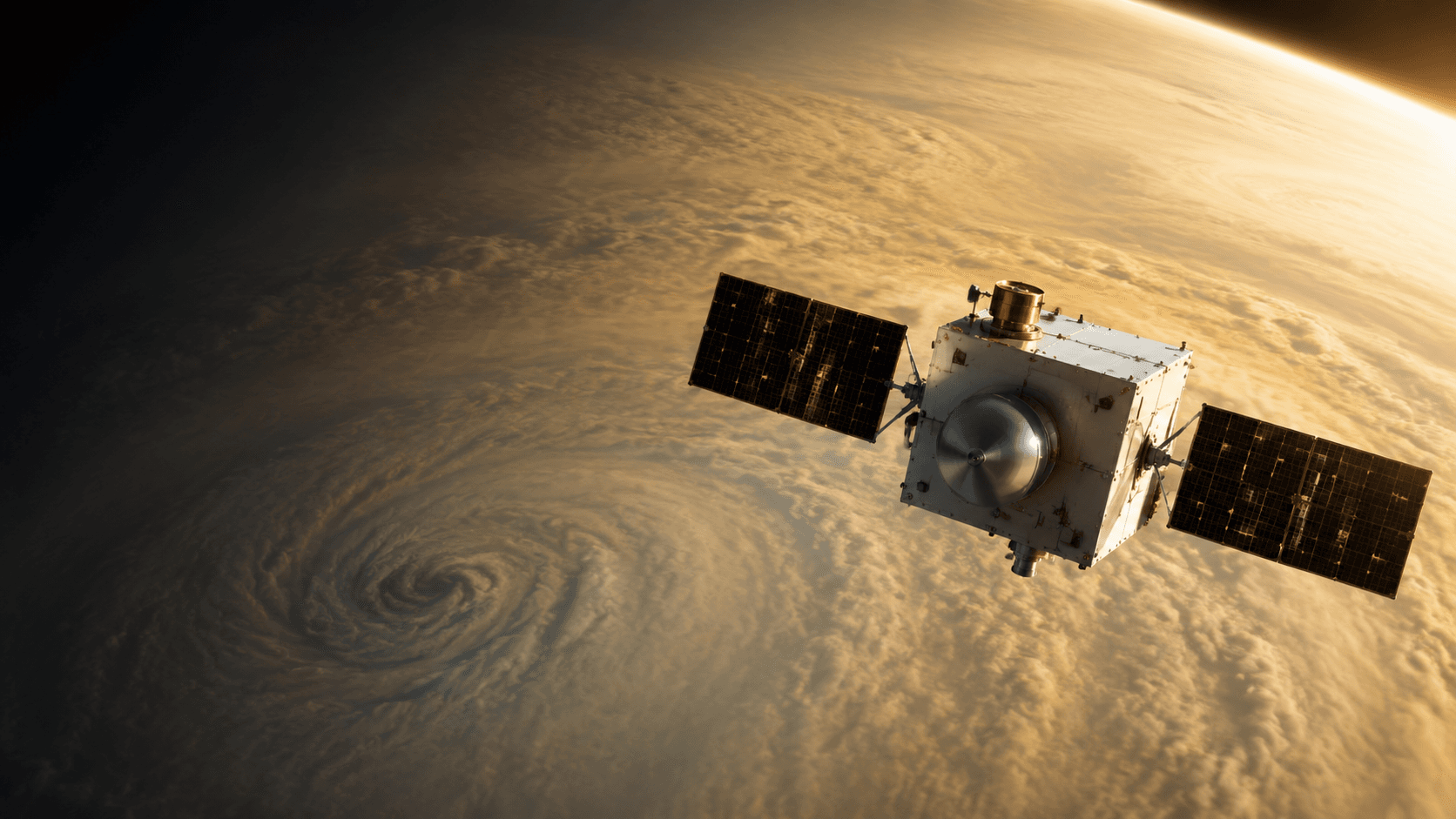
Quick answer: Akatsuki was a Venus climate orbiter led by JAXA. It began on May 21, 2010, focused on Venus, and is best known as Japan's first successful planetary orbiter beyond Earth after recovering from a failed 2010 orbit insertion. Its work tracked atmospheric circulation, cloud waves, thermal patterns, and Venusian super-rotation across multiple wavelengths.
Akatsuki at a Glance
| Question | Answer |
|---|---|
| What kind of mission was it? | Venus climate orbiter |
| Who led it? | JAXA |
| When did it begin? | May 21, 2010 |
| What did it study? | Venus |
| Current or final status | Operations completed September 18, 2025 |
| Why is it famous? | Japan's first successful planetary orbiter beyond Earth, after recovering from a failed 2010 insertion |
What Is Akatsuki?
Akatsuki — also called Planet-C or the Venus Climate Orbiter — was JAXA's Venus climate orbiter. It launched on May 21, 2010, focused on Venus, and is best known as Japan's first successful planetary orbiter beyond Earth after recovering from a failed 2010 orbit insertion. Its work tracked atmospheric circulation, cloud waves, thermal patterns, and Venusian super-rotation across multiple wavelengths.
Akatsuki extended Venus climate studies pioneered by the Venera Program and ESA's Venus Express, complementing the surface work of Magellan.
Why Akatsuki Was Created
Before Akatsuki, Venus's atmospheric dynamics — particularly the four-day super-rotation of the upper atmosphere — remained poorly explained. Mission planners chose a set of cameras covering ultraviolet through infrared to track different atmospheric layers simultaneously.
Akatsuki Facts at a Glance
| Field | Value |
|---|---|
| Program purpose | Study Venus's atmosphere and climate |
| Launch | May 21, 2010 |
| Flight strategy | Five-year solar orbit after failed 2010 insertion, then successful Venus orbit insertion in December 2015 |
| Mission status | Operations completed September 18, 2025 |
| Defining importance | Japan's first successful planetary orbiter beyond Earth |
Launch, Route, and Arrival
The mission began on May 21, 2010. The first Venus orbit insertion attempt in December 2010 failed when the main engine damaged itself. Engineers used attitude thrusters over the next five years to keep the spacecraft in solar orbit and set up a second insertion attempt, which succeeded in December 2015.
Spacecraft Design and Instruments
Akatsuki carried five imagers observing at ultraviolet, visible and infrared wavelengths, plus a lightning-and-airglow camera and a radio-science system. Each wavelength probes a different altitude, allowing coordinated 3D reconstruction of atmospheric layers.
How the Mission Collected Evidence
Akatsuki's elliptical orbit provided both wide global views and closer looks. Investigators combined multi-wavelength images with radio-occultation temperature profiles to reconstruct wind fields, cloud structure and thermal patterns.
Major Discoveries
Akatsuki tracked atmospheric circulation, cloud waves, thermal patterns and Venusian super-rotation across multiple wavelengths. Notable results include the detection of a stationary large-scale bow-shaped gravity wave in the cloud tops and detailed mapping of super-rotation variability.
Engineering Challenges
The failed 2010 insertion is the mission's most cited engineering challenge. The recovery — using attitude thrusters and precise trajectory planning to buy time and set up a second insertion — became an operational lesson for later missions.
How Akatsuki Changed Planetary Science
Akatsuki's success extended Japan's planetary exploration capabilities. It provided a decade-scale multi-wavelength climate record of Venus that complements surface data from Magellan and lander data from the Venera Program.
What Akatsuki Did Not Prove
Akatsuki did not settle every question about Venus's super-rotation or cloud chemistry. Coverage was uneven due to the elliptical orbit and instrument availability.
Frequently Asked Questions About Akatsuki
What was the main purpose of Akatsuki?
To study Venus's atmosphere and climate using an orbiter.
When was Akatsuki launched?
Akatsuki began on May 21, 2010. Operations were completed on September 18, 2025.
Who operated Akatsuki?
JAXA led the mission with the scientific and engineering organizations identified in official program records.
What did Akatsuki discover?
It tracked atmospheric circulation, cloud waves, thermal patterns and Venusian super-rotation across multiple wavelengths.
Why is Akatsuki historically important?
Because it was Japan's first successful planetary orbiter beyond Earth after recovering from a failed 2010 orbit insertion.
Is Akatsuki still active?
No. Operations were completed on September 18, 2025.
How did Akatsuki reach Venus?
A five-year solar orbit after the failed 2010 attempt, followed by successful Venus orbit insertion in December 2015.
Where can Akatsuki data be found?
Start with the JAXA press page and linked archives.
Final Perspective
Akatsuki is a story of recovery as much as discovery. Its defining place — Japan's first successful planetary orbiter beyond Earth after recovering from a failed 2010 insertion — is only the beginning. The deeper value comes from its multi-wavelength climate record of Venus.
Authoritative Source
Factual status reviewed: September 4, 2026.
Primary sources
Last verified 2026-01-15. Mission status and dates can change.