Voyager 2
The only spacecraft to visit Uranus and Neptune and the only probe to fly past all four giant planets.
Agency
NASA
Destination
Interstellar space
Launched
August 20, 1977
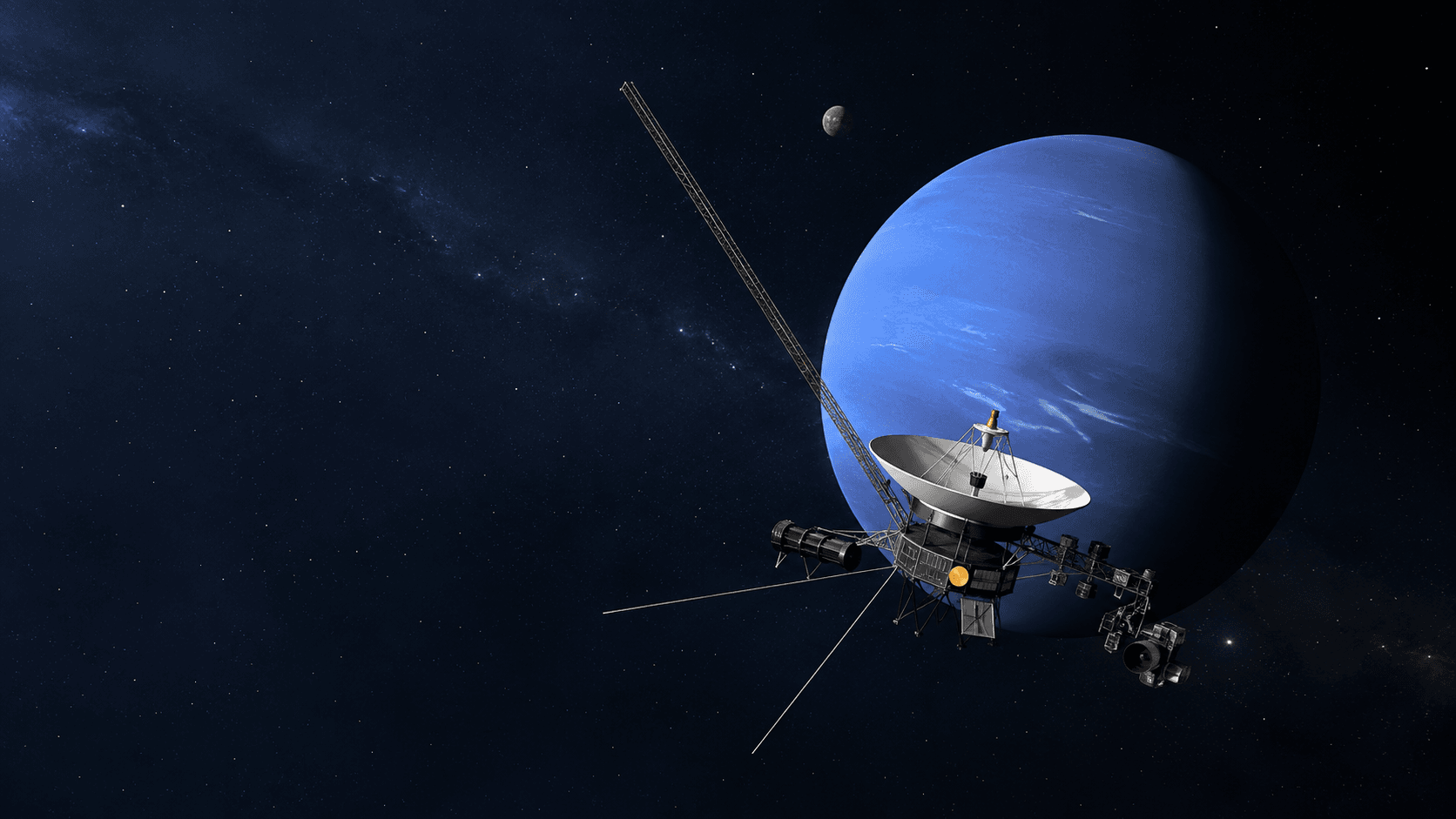
Quick answer: Voyager 2 is a grand-tour and interstellar probe led by NASA. It launched on August 20, 1977, focused on Jupiter, Saturn, Uranus, Neptune and interstellar space, and is best known as the only spacecraft to visit Uranus and Neptune and the only probe to fly past all four giant planets. Its work discovered new moons and rings, measured giant-planet atmospheres and magnetic fields, observed Triton and now samples interstellar space.
Voyager 2 at a Glance
| Question | Answer |
|---|---|
| What kind of mission is it? | Grand-tour and interstellar probe |
| Who leads it? | NASA |
| When did it begin? | August 20, 1977 |
| What does it study? | Jupiter, Saturn, Uranus, Neptune and interstellar space |
| Current or final status | Active extended mission |
| Why is it famous? | Only spacecraft to visit Uranus and Neptune; only probe to fly past all four giant planets |
What Is Voyager 2?
Voyager 2 is NASA's grand-tour and interstellar probe. Launched on August 20, 1977, it flew past Jupiter in 1979, Saturn in 1981, Uranus in 1986 and Neptune in 1989. It is best known as the only spacecraft to visit Uranus and Neptune and the only probe to fly past all four giant planets.
Voyager 2's work discovered new moons and rings, measured giant-planet atmospheres and magnetic fields, observed Triton and now samples interstellar space, which it entered in 2018.
Why Voyager 2 Was Created
A rare planetary alignment enabled a four-planet Grand Tour using gravity assists. Voyager 2 followed a trajectory that made all four flybys possible; Voyager 1 took a faster path visiting only Jupiter and Saturn.
Voyager 2 Facts at a Glance
| Field | Value |
|---|---|
| Program purpose | Explore all four giant planets and continue into interstellar space |
| Launch | August 20, 1977 |
| Flight strategy | Rare gravity-assist alignment enabling a four-planet Grand Tour |
| Mission status | Active extended mission |
| Defining importance | Only spacecraft to visit Uranus and Neptune |
Launch, Route, and Arrival
Voyager 2 launched on August 20, 1977 — before Voyager 1 but on a slower trajectory. Its Jupiter flyby directed it to Saturn, then to Uranus in 1986 and Neptune in 1989. It reached interstellar space in 2018.
Spacecraft Design and Instruments
Voyager 2 carries cameras, spectrometers, magnetometer, plasma-wave instruments, cosmic-ray detectors and a plutonium-238 radioisotope thermoelectric generator. It also carries a copy of the Golden Record.
How the Mission Collects Evidence
Voyager 2 combined imaging, spectroscopy, magnetometry and radio science at each flyby. Post-encounter analysis over years reveals structure — for example refined ring architectures — that a single flyby alone could not confirm.
Major Discoveries
Voyager 2 discovered new moons and rings, measured giant-planet atmospheres and magnetic fields, observed Triton and now samples interstellar space. Its Uranus and Neptune flybys remain the only close-up observations of those planets, making its archive essential for Uranus and Neptune science.
Engineering Challenges
Radiation at Jupiter, decreasing sunlight, slowly falling power output and long communication distances constrain operations. Ground teams have progressively turned off instruments to extend the mission.
People and International Cooperation
Voyager depended on NASA teams, JPL, contractors and international ground stations. The Deep Space Network continues to track both Voyagers today.
How Voyager 2 Changed Planetary Science
The only spacecraft to visit Uranus and Neptune and the only probe to fly past all four giant planets provided a template for outer-planet exploration. Its instruments, mission-planning methods, calibrated archives and trained science teams shaped Galileo, Cassini–Huygens, Juno and future Uranus and Neptune orbiter concepts.
What Voyager 2 Did Not Prove
Voyager 2's coverage was limited to fast flybys. Orbital missions to Uranus and Neptune would be needed to answer many outstanding questions.
Frequently Asked Questions About Voyager 2
What was the main purpose of Voyager 2?
To explore all four giant planets and continue into interstellar space.
When was Voyager 2 launched?
August 20, 1977.
Who operates Voyager 2?
NASA leads the mission with JPL and partner ground stations.
What has Voyager 2 discovered?
It discovered new moons and rings, measured giant-planet atmospheres and magnetic fields, observed Triton and continues to measure the interstellar environment.
Why is Voyager 2 historically important?
Because it is the only spacecraft to visit Uranus and Neptune and the only probe to fly past all four giant planets.
Is Voyager 2 still active?
Yes. Its extended mission continues, though instruments are gradually being powered down.
How did Voyager 2 reach interstellar space?
Using a rare gravity-assist alignment for a four-planet Grand Tour, followed by continuing travel beyond the heliopause.
Where can Voyager 2 data be found?
Start with the official Voyager 2 mission page.
Final Perspective
Voyager 2 remains the only close-up record of Uranus and Neptune. Its defining place — the only spacecraft to visit Uranus and Neptune and the only probe to fly past all four giant planets — will anchor outer-planet science for decades to come.
Authoritative Source
Factual status reviewed: September 4, 2026.
Primary sources
Last verified 2026-01-15. Mission status and dates can change.