Saturn Planet: Complete Guide to the Ringed Planet
Explore Saturn facts, its rings, size, moons, temperature, distance, atmosphere, Titan, Cassini mission, and how to see Saturn tonight.
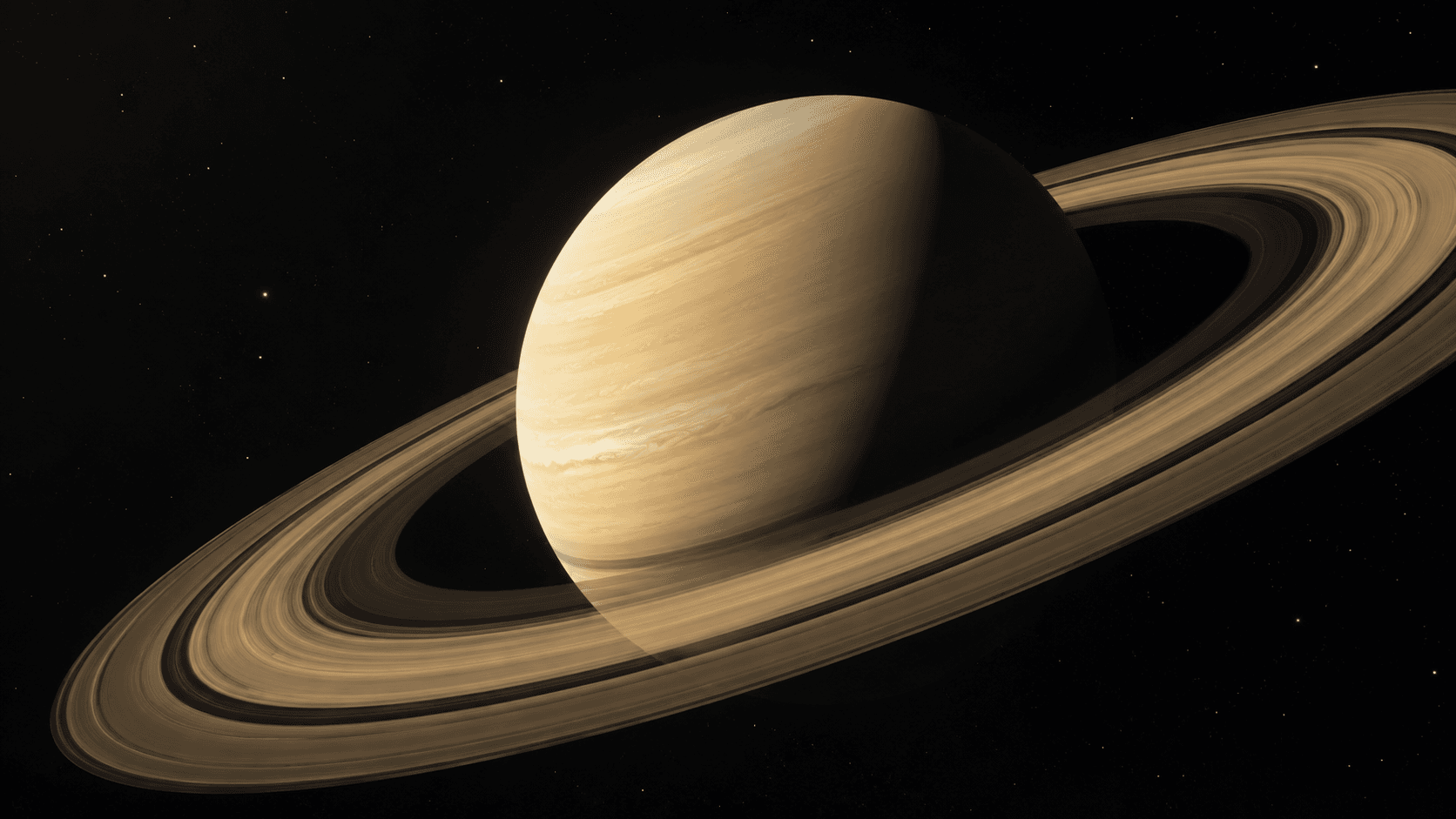
Saturn is the sixth planet from the Sun and the second-largest planet in the Solar System, after Jupiter. A gas giant of hydrogen and helium, Saturn is best known for its brilliant ring system, one of the most striking sights available to a small telescope. Alongside the rings, Saturn hosts a large family of moons, including cloud-shrouded Titan and geologically active Enceladus.
Named for the Roman god of agriculture and time, Saturn has fascinated observers since ancient times. Galileo saw its odd shape in 1610, and Christiaan Huygens correctly identified the rings decades later. Modern spacecraft, especially Cassini, have transformed knowledge of Saturn, its rings, and its worlds.
This guide covers Saturn's size, structure, weather, rings, moons, missions, and place in the Solar System. It also compares Saturn with Earth and points to tools for exploring its properties.
Saturn at a Glance
| Fact | Approximate value |
|---|---|
| Position | Sixth planet |
| Average distance from Sun | 1.43 billion km, 9.5 AU |
| Diameter | 116,460 km |
| Mass | 95 Earths |
| Volume | 764 Earths |
| Year | 29.5 Earth years |
| Day | 10 h 34 min |
| Axial tilt | 26.7° |
| Cloud-top temperature | About −178°C (−288°F) |
| Main atmospheric gases | Hydrogen, helium |
| Moons | Very many, including Titan |
| Rings | Bright, extensive |
What Is Saturn?
Saturn is a gas giant with no solid surface. Its outer layers of hydrogen and helium transition smoothly downward through progressively denser gas and liquid, eventually reaching a region of liquid metallic hydrogen and a dense central core enriched in heavier elements. What appears as Saturn's "surface" in photographs is the top of a cloud deck.
Saturn radiates more energy than it receives from the Sun. Slow gravitational contraction and helium raining out of higher layers contribute internal heat. This heat drives cloud circulation and shapes weather visible from space.
Saturn is famous for its low overall density. Its bulk density is less than that of water, a curiosity often described by saying Saturn "would float." Because a body of water large enough to test the idea does not exist, the description is a memorable size-and-mass comparison rather than something possible in nature.
Saturn Facts
Saturn is more than 95 times the mass of Earth and about 9 times its diameter. Its rapid rotation flattens it noticeably at the poles. Wind speeds high in the atmosphere reach hundreds of meters per second, faster than most storms on Earth.
The rings extend far beyond Saturn's cloud tops but are extremely thin, in most places only tens of meters thick. They are made mostly of water ice with some rocky and dusty material. Saturn has a strong magnetic field, less powerful than Jupiter's but still significant, and produces auroras at its poles.
The moon family is remarkable. Titan is larger than the planet Mercury and has a dense nitrogen atmosphere with hydrocarbon lakes. Enceladus sprays water from a subsurface ocean through cracks near its south pole. Mimas, Tethys, Dione, Rhea, Iapetus, and many small icy bodies fill out the system. Additional tiny moons continue to be confirmed.
How Far Is Saturn From the Sun?
Saturn orbits the Sun at an average distance of about 1.43 billion kilometers (886 million miles), or 9.5 AU. Its elliptical orbit ranges from about 1.35 billion kilometers at perihelion to about 1.51 billion kilometers at aphelion. Sunlight takes roughly 80 minutes to reach Saturn.
At Saturn's distance, sunlight is about 100 times weaker than at Earth. Solar heating alone would leave the planet colder than it is; internal heat contributes to atmospheric activity.
How Far Is Saturn From Earth?
Distance between Saturn and Earth changes as both planets orbit the Sun. Near opposition, when Earth passes between Saturn and the Sun, the two are closest, around 1.2 billion kilometers apart. Near solar conjunction, when Earth and Saturn are on opposite sides of the Sun, they can be as far as 1.7 billion kilometers apart.
| Situation | Approximate distance |
|---|---|
| Near opposition | About 1.2 billion km |
| Near solar conjunction | About 1.7 billion km |
Radio signals take roughly 67 to 94 minutes one way. Real-time control is not possible over such delays, and spacecraft must operate on preloaded commands.
Saturn's Size and Structure
Saturn's equatorial diameter is about 116,460 kilometers, roughly 9 times Earth's. Its mass is 95 Earths, and about 764 Earths could fit inside its volume. Yet Saturn's average density is only about 0.687 g/cm³, less than water, because its interior is dominated by lightweight hydrogen and helium.
The interior is layered. Molecular hydrogen fills the outer region. Deeper, hydrogen is compressed into metallic form and conducts electricity, generating Saturn's magnetic field. A denser core contains heavier elements and may be partially mixed with surrounding hydrogen rather than sharply bounded.
Rapid rotation flattens Saturn's shape. Its equator is measurably wider than the pole-to-pole distance. This oblateness affects the appearance of the disk and the dynamics of its atmosphere.
Saturn's Atmosphere and Weather
Saturn's atmosphere is dominated by hydrogen and helium with traces of methane, ammonia, water vapor, and other compounds. Cloud decks include ammonia ice near the top, ammonium hydrosulfide clouds beneath, and probable water clouds deeper still.
Saturn shows bands and zones similar to Jupiter but softer in appearance because higher-altitude hazes blur the pattern. Powerful jet streams run around the planet at different latitudes. A striking hexagonal jet stream circles the north pole, produced by stable atmospheric dynamics rather than any external influence.
Large storms appear occasionally. The Great White Spot is a giant northern hemisphere outbreak that has recurred roughly once per Saturnian year, producing bright cloud systems visible from Earth. Cassini observed a giant storm complete a full loop around the planet in 2010–2011.
Saturn's Rings
Saturn's rings are named alphabetically in order of discovery, not distance. From inner to outer, the main rings are D, C, B, A, F, G, and E. The A and B rings are the brightest and most easily seen. The Cassini Division, a wide gap, separates them.
The rings are mostly water ice with small amounts of rocky and organic material. Particles range from micrometer-sized dust to boulders several meters across. Gravitational interactions with nearby moons shape gaps, edges, and waves, and small "shepherd" moons keep some ring boundaries sharp.
The age and origin of the rings are still debated. Some evidence suggests the main rings are relatively young in geological terms, perhaps only a few hundred million years old, likely formed when a small moon or icy body was disrupted near Saturn. Other analyses argue for older origins. Ring material is slowly falling into Saturn's atmosphere, so the rings will not last forever, but their remaining lifetime remains an open question.
Ring appearance from Earth changes with Saturn's tilt over its 29.5-year orbit. Sometimes the rings appear wide open, and at other times they are nearly edge-on and can seem to vanish through small telescopes.
Saturn's Moons
Saturn has a very large family of confirmed moons, and new discoveries continue to be reported as tiny outer satellites are confirmed by the IAU Minor Planet Center. The moons form a range of worlds, from tiny irregular objects to Titan.
Titan is Saturn's largest moon and the second-largest moon in the Solar System. It is larger than the planet Mercury and has a dense nitrogen atmosphere thicker than Earth's at the surface. Lakes and seas of liquid methane and ethane occupy polar regions, and a subsurface water ocean may lie beneath its icy crust. Cassini's Huygens probe landed on Titan in 2005, returning the first surface images from an outer Solar System moon.
Enceladus is much smaller but astonishingly active. Geysers erupt from cracks called "tiger stripes" near its south pole, ejecting water vapor, ice, salts, and organic molecules into space. This material feeds Saturn's E ring and provides samples of a subsurface ocean that may be habitable.
Mimas is famous for a giant impact crater giving it a Death Star appearance and, more recently, evidence suggesting it may also hide an internal ocean. Rhea, Dione, Tethys, and Iapetus are large icy moons with distinctive geology. Iapetus has one hemisphere much darker than the other, an appearance that puzzled observers for centuries.
Numerous small moons orbit within and near the rings, shaping their edges and gaps. Many outer irregular moons orbit at large distances and steep inclinations, likely captured over Saturn's history.
Saturn Compared With Earth
| Feature | Saturn | Earth |
|---|---|---|
| Diameter | 116,460 km | 12,742 km |
| Mass | 95 Earths | 1 Earth |
| Day | 10 h 34 min | 24 h |
| Year | 29.5 years | 1 year |
| Moons | Very many | 1 |
| Rings | Bright, extensive | None |
| Atmosphere | Hydrogen-helium | Nitrogen-oxygen |
| Solid surface | None | Yes |
Use the planet comparison tool to explore Saturn alongside other worlds.
Missions to Saturn
Pioneer 11 flew past Saturn in 1979 and returned first close-up data. Voyager 1 and Voyager 2 followed in 1980 and 1981, revealing detail in the rings, discovering new moons, and taking the first clear images of Titan's hazy atmosphere.
Cassini, a joint mission of NASA, ESA and the Italian Space Agency, orbited Saturn from 2004 to 2017. Cassini transformed knowledge of the rings, moons, atmosphere, and magnetic environment. Its Huygens probe landed on Titan in 2005. Cassini also discovered active plumes at Enceladus and traced their water and organic content. The mission ended with a controlled entry into Saturn's atmosphere to protect potential habitable environments on its moons.
Future mission plans, including Dragonfly to Titan, continue to be developed. Current status and schedules should be verified on official agency pages before publication.
Can You See Saturn Tonight?
Saturn is visible to the unaided eye as a steady, cream-colored point. Even a small telescope reveals the rings, an experience that has inspired observers for generations. Larger telescopes may show cloud bands, the Cassini Division, and Titan as a nearby dot.
Use the Tonight's Sky viewer to check whether Saturn is above the horizon from your location right now, along with rise time, set time, and direction.
Why Saturn Matters
Saturn is a natural laboratory for studying giant planets, ring systems, and diverse moons. Its rings illustrate the physics of small particles in orbit, and its moons include some of the most promising places in the Solar System for astrobiology. Titan's chemistry and Enceladus's ocean both attract intense scientific interest.
Studying Saturn also helps interpret similar systems around other stars and refines models of how gas giants form, evolve, and lose or gain material. The ringed planet remains one of the most rewarding worlds to observe and one of the richest destinations for exploration.
Frequently asked questions
How big is Saturn?
Saturn has a diameter of about 116,460 kilometers, roughly nine times Earth's. It is the second-largest planet after Jupiter.
How far is Saturn from Earth?
The distance varies from roughly 1.2 billion kilometers at close approach to about 1.7 billion kilometers when the planets are on opposite sides of the Sun.
How far is Saturn from the Sun?
Saturn orbits at an average distance of about 1.43 billion kilometers, or 9.5 astronomical units.
Why does Saturn have rings?
The rings are made of countless ice and rock particles left over from small moons, comets, or asteroids torn apart by tidal forces and impacts. Their exact origin and age are still debated.
What are Saturn's rings made of?
Mostly water ice with small amounts of rocky and dusty material. Particles range from micrometers to meters across.
How many moons does Saturn have?
Saturn has a very large family of confirmed moons, and new small satellites are added as observations are verified. Titan is by far the largest.
What is Titan?
Titan is Saturn's largest moon, bigger than Mercury. It has a dense nitrogen atmosphere, lakes of liquid methane and ethane, and a possible subsurface ocean.
How long is a day on Saturn?
About 10 hours 34 minutes based on measurements of Saturn's magnetic field and atmosphere.
How long is a year on Saturn?
About 29.5 Earth years.
How cold is Saturn?
The cloud tops are near −178°C (−288°F). Deeper layers are much warmer because Saturn radiates more heat than it receives from the Sun.
Can Saturn float on water?
Its average density is less than water, but a real ocean large enough to hold Saturn does not exist. The 'floating' description is a size and density comparison, not a physical possibility.
Is Saturn visible tonight?
Often. Visibility depends on current geometry, weather, and location. Consult a current sky chart for accurate information.
Sources
- NASA Science: Saturn — last verified 2026-09-04
- NASA Science: Saturn Facts — last verified 2026-09-04
- NASA Cassini Mission — last verified 2026-09-04
- IAU Minor Planet Center — last verified 2026-09-04