
Uranus Planet: Complete Guide to the Sideways Ice Giant
Explore Uranus facts, its sideways rotation, rings, moons, size, distance, temperature, blue-green color, and how to see Uranus tonight.
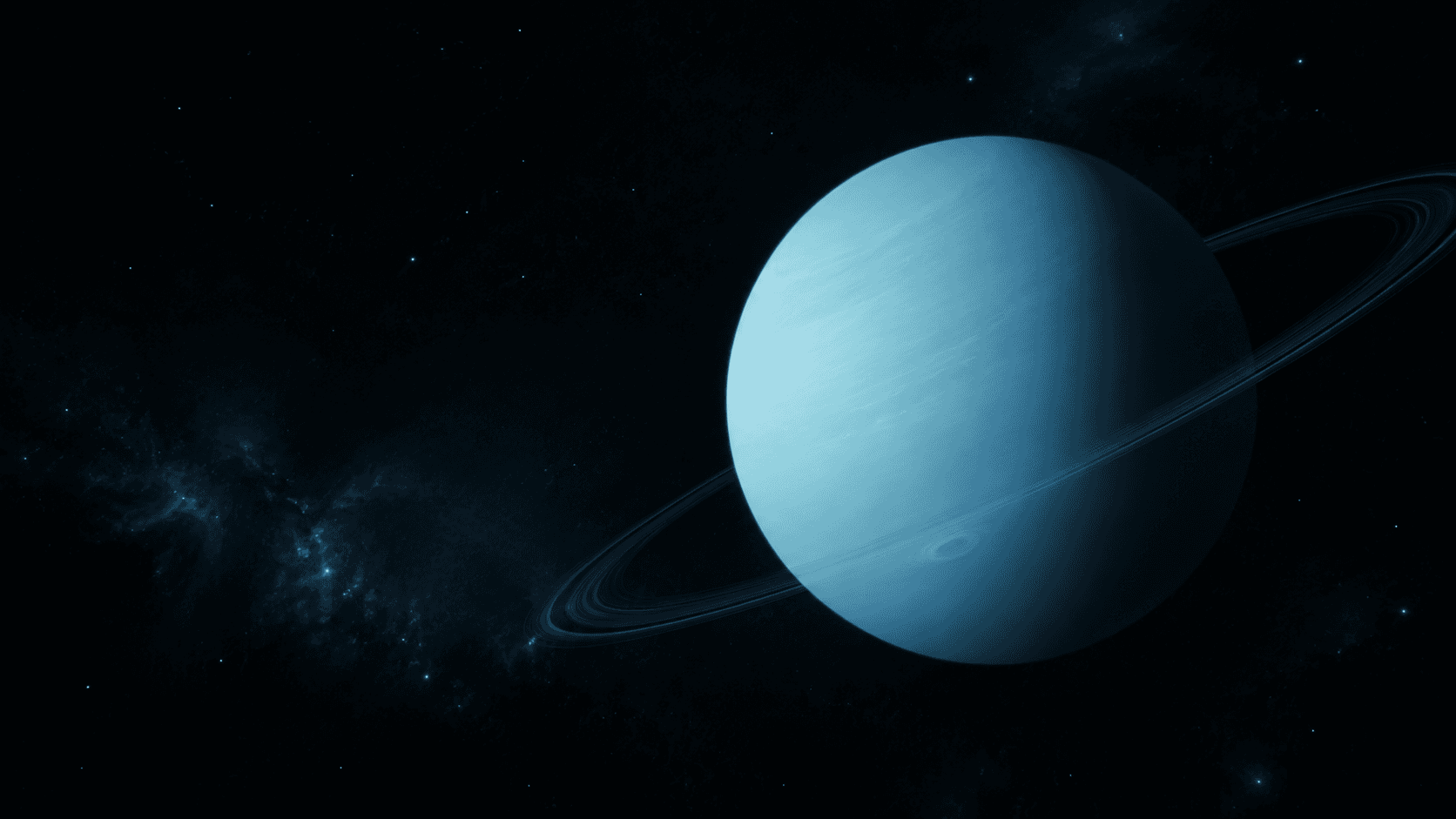
Uranus is the seventh planet from the Sun and the first planet discovered with a telescope, identified by William Herschel in 1781. It is one of two ice giants in the Solar System, along with Neptune, and is famous for its extreme axial tilt: it rotates almost on its side. Its pale blue-green color comes from methane in the upper atmosphere.
Uranus is a cold, distant world with a thick atmosphere of hydrogen, helium, and methane surrounding a mantle rich in water, ammonia, and methane ices. Only one spacecraft, Voyager 2, has flown past Uranus, so much of what is known comes from that 1986 encounter combined with ground- and space-based telescope observations.
This guide covers Uranus's size, structure, tilt, rings, moons, missions, and place in the Solar System. It also compares Uranus with Earth and points to tools for exploring its properties.
Uranus at a Glance
| Fact | Approximate value |
|---|---|
| Position | Seventh planet |
| Average distance from Sun | 2.87 billion km, 19.2 AU |
| Diameter | 50,724 km |
| Mass | 14.5 Earths |
| Year | 84 Earth years |
| Day | 17 h 14 min |
| Axial tilt | 97.8° |
| Cloud-top temperature | About −224°C (−371°F) |
| Main atmospheric gases | Hydrogen, helium, methane |
| Moons | About 27 known |
| Rings | Thin, dark, 13 known |
What Is Uranus?
Uranus is an ice giant. It is much smaller than Jupiter or Saturn and has a different internal structure. Beneath a hydrogen-helium atmosphere lies a hot, dense mantle made primarily of water, ammonia, and methane. In planetary science, these substances are called "ices" not because they are frozen but because of their chemical class. A small rocky core may lie at the center.
Uranus has no solid surface. The visible feature is the top of a cloud deck, mostly hazes and methane clouds. Weather is more subtle than on Jupiter or Saturn, and features often appear as pale bands and occasional bright spots.
The planet is named for the Greek sky god Uranus. Unlike other planets, which take their names from Roman gods, Uranus keeps its Greek name.
Uranus Facts
Uranus's axis is tilted about 98 degrees, so its rotational axis lies nearly in its orbital plane. As a result, each pole spends decades in continuous sunlight and decades in continuous darkness during the planet's 84-year year. The extreme tilt strongly affects seasons and atmospheric circulation.
Uranus is the coldest planet in the Solar System, colder than the more distant Neptune. Its cloud tops sit near −224°C. One reason is that Uranus emits very little internal heat compared with the other giant planets. Why Uranus is so much less thermally active than Neptune remains an open question.
Uranus has a magnetic field that is offset from its center and strongly tilted relative to its rotation axis. The result is a complex, asymmetric magnetosphere that changes shape as the planet rotates. Ring and moon systems orbit close to the planet's equator, effectively "on their side" from an Earth-based viewpoint.
How Far Is Uranus From the Sun?
Uranus orbits at an average distance of about 2.87 billion kilometers (1.78 billion miles), or 19.2 AU. Its slightly elliptical orbit ranges from about 2.74 billion kilometers at perihelion to about 3.00 billion kilometers at aphelion. Sunlight takes about 2 hours 40 minutes to reach Uranus.
At Uranus's distance, sunlight is roughly 370 times weaker than at Earth. Even at midday from within Uranus's cloud tops, the Sun would appear as a very bright star rather than the disk seen from Earth.
How Far Is Uranus From Earth?
Distance between Uranus and Earth changes as both planets orbit the Sun. Near opposition, when Earth passes between Uranus and the Sun, the two are closest, around 2.6 billion kilometers apart. Near solar conjunction, they can be about 3.2 billion kilometers apart.
| Situation | Approximate distance |
|---|---|
| Near opposition | About 2.6 billion km |
| Near solar conjunction | About 3.2 billion km |
Radio signals take roughly 2.4 to 3.0 hours one way. Interactive control of a spacecraft is impossible, and any mission must operate mostly autonomously.
Uranus's Size and Structure
Uranus's diameter is about 50,724 kilometers, roughly 4 times Earth's. Its mass is about 14.5 Earths, and its average density is low. The atmosphere sits above a mantle of "icy" fluids at high pressures. A small rocky-ice core may lie at the center.
Rapid rotation flattens Uranus slightly. Its extreme axial tilt means the rotation axis is nearly in its orbital plane, so its equator and rings appear nearly face-on to Earth at some points in its orbit and nearly edge-on at others.
Uranus's Atmosphere and Weather
Uranus's atmosphere is dominated by hydrogen and helium with a few percent methane and traces of other compounds. Methane absorbs red sunlight, giving the disk its pale blue-green color. Higher, cooler layers form haze that further softens visible features.
Weather is quieter than on Jupiter or Saturn, but changing seasons and improving telescopes have revealed bright clouds, dark spots, and storms. Winds reach several hundred kilometers per hour. Because Uranus radiates very little internal heat, its weather is driven mainly by sunlight and the strong seasonal contrasts caused by its tilt.
Uranus's Rings
Uranus has a system of about 13 known rings. They were discovered in 1977 when astronomers watched Uranus pass in front of a distant star and observed the star's light dip several times as narrow ring segments blocked it. Uranus's rings are much darker and thinner than Saturn's.
Voyager 2 imaged the rings directly during its 1986 flyby, and Hubble and other telescopes have refined the picture since. The rings are made mostly of dark, meter-scale chunks and dust. Small "shepherd" moons help keep the narrow rings in place.
Uranus's Moons
Uranus has about 27 known moons, all named for characters from the works of William Shakespeare or Alexander Pope. Titania and Oberon are the largest, followed by Umbriel, Ariel, and Miranda.
Miranda is one of the most remarkable moons in the Solar System. Its surface shows enormous cliffs, giant grooves, and jumbled terrain, suggesting a violent history. Titania and Oberon have icy surfaces with impact craters and long fault valleys. Voyager 2 imaged the sunlit southern hemispheres during its flyby, so much of the moons' surfaces remain unmapped.
Additional smaller moons orbit near the rings, and irregular outer moons follow distant, inclined orbits, likely captured over time.
Uranus Compared With Earth
| Feature | Uranus | Earth |
|---|---|---|
| Diameter | 50,724 km | 12,742 km |
| Mass | 14.5 Earths | 1 Earth |
| Day | 17 h 14 min | 24 h |
| Year | 84 years | 1 year |
| Moons | About 27 | 1 |
| Rings | Thin, dark | None |
| Atmosphere | Hydrogen-helium-methane | Nitrogen-oxygen |
| Solid surface | None | Yes |
Use the planet comparison tool to explore Uranus alongside other worlds.
Missions to Uranus
Voyager 2 is the only spacecraft to have visited Uranus, flying past in January 1986. In a few hours it took the first close-up images of the planet, revealed detail in the atmosphere and rings, and imaged the five large moons known at the time. It also discovered 10 new moons and 2 new rings and measured Uranus's magnetic field.
Since Voyager 2, all knowledge of Uranus has come from telescopes, including Hubble and JWST. Planetary science communities have identified an orbiter mission to Uranus as a high priority. Any specific future mission's status and schedule should be verified on official agency pages before publication.
Can You See Uranus Tonight?
Uranus is at the very edge of naked-eye visibility from dark skies and looks like a faint star. Binoculars or a small telescope reveal it as a small, blue-green disk. Charts and planetarium software help identify it against a background of stars.
Use the Tonight's Sky viewer to check whether Uranus is above the horizon from your location right now, along with rise time, set time, and direction.
Why Uranus Matters
Uranus is one of the least explored planets in the Solar System, yet it may be the most typical of a class of worlds. Many exoplanets discovered so far fall between Earth and Neptune in size, and Uranus and Neptune are the nearest examples of ice giants. Studying Uranus's structure, composition, and weather improves models of many worlds around other stars.
Uranus's extreme tilt, offset magnetic field, and unusually low internal heat make it a natural laboratory for understanding planetary evolution. Its rings and moons — especially Miranda — hint at dramatic past events. A dedicated orbiter would greatly expand knowledge that has, so far, mostly rested on one 1986 flyby.
Frequently asked questions
Why does Uranus rotate on its side?
Uranus's axis is tilted about 98 degrees. A giant collision or interaction with other bodies during the early Solar System is the leading explanation, but details remain uncertain.
How big is Uranus?
Uranus has a diameter of about 50,724 kilometers, roughly four times Earth's diameter.
How far is Uranus from Earth?
Distance varies from roughly 2.6 billion kilometers at close approach to about 3.2 billion kilometers when the planets are on opposite sides of the Sun.
How far is Uranus from the Sun?
Uranus orbits at an average distance of about 2.87 billion kilometers, or 19.2 astronomical units.
Why is Uranus blue-green?
Methane in Uranus's upper atmosphere absorbs red light and reflects blue and green light back to space, producing the pale blue-green color.
How many moons does Uranus have?
Uranus has about 27 known moons, named for characters in the works of Shakespeare and Alexander Pope. Titania and Oberon are the largest.
Does Uranus have rings?
Yes. Uranus has a system of thin, dark rings, discovered in 1977.
How long is a day on Uranus?
About 17 hours 14 minutes, based on measurements from Voyager 2.
How long is a year on Uranus?
About 84 Earth years.
How cold is Uranus?
Uranus is the coldest planet in the Solar System, with cloud-top temperatures near −224°C (−371°F).
Can humans visit Uranus?
Not with today's technology. Uranus is very distant, has no solid surface, and lies in a cold, hostile environment.
Is Uranus visible tonight?
Uranus is at the edge of naked-eye visibility from very dark skies. Binoculars or a small telescope make it easier to find. Visibility depends on current geometry, weather, and location.
Sources
- NASA Science: Uranus — last verified 2026-09-04
- NASA Science: Uranus Facts — last verified 2026-09-04
- IAU Minor Planet Center — last verified 2026-09-04