
Venus Planet: Facts About the Hottest Planet
Explore Venus facts, why Venus is the hottest planet, how its size compares with Earth, and how to find out if Venus is visible tonight.
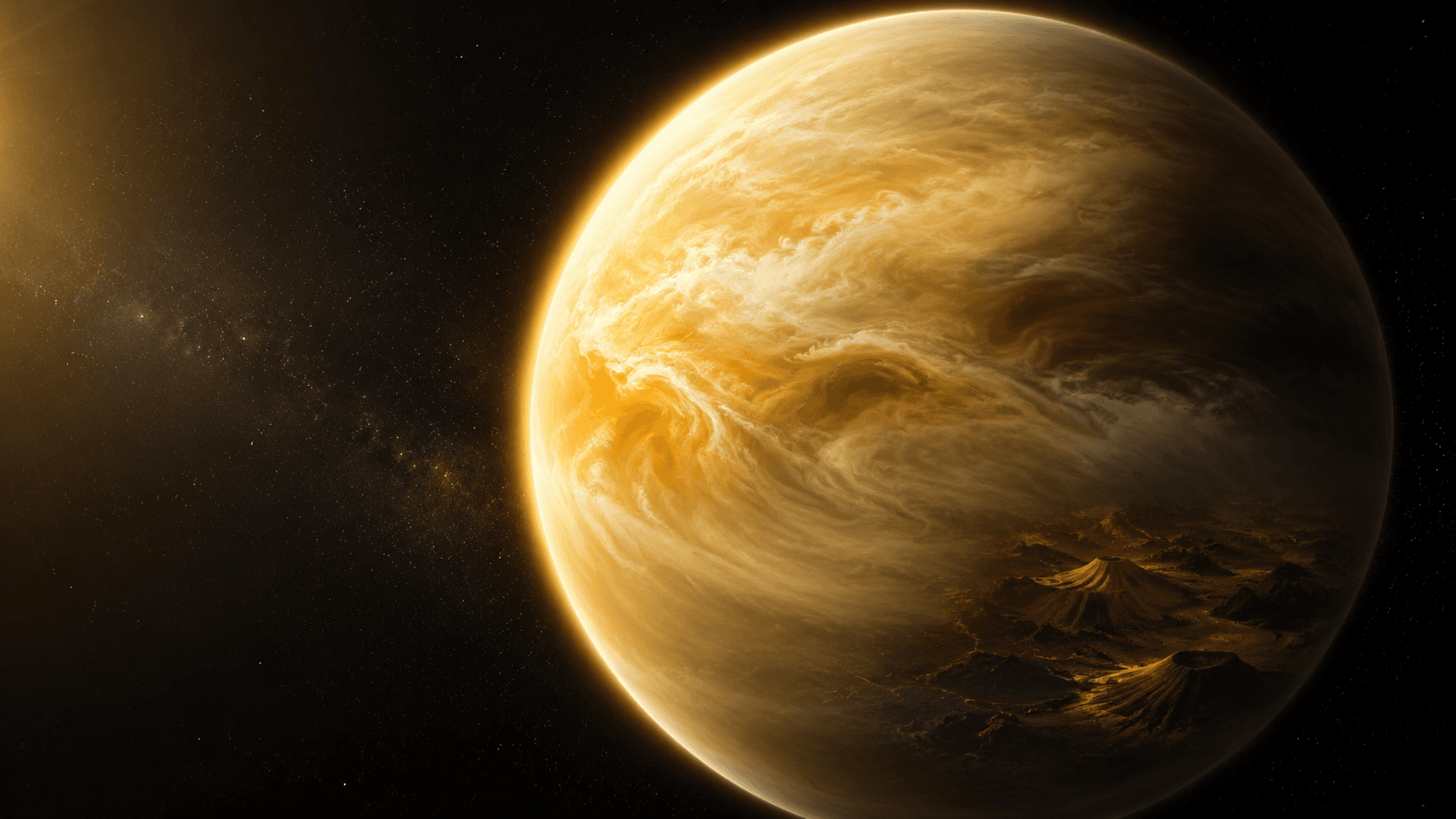
Venus is the second planet from the Sun and the hottest planet in the Solar System. Beneath its bright, beautiful clouds lies a hostile world with an average surface temperature of about 465°C (869°F), atmospheric pressure more than 90 times greater than Earth's, and a carbon-dioxide atmosphere that traps heat through an extreme greenhouse effect. Although Mercury travels closer to the Sun, Venus stays hotter because its dense atmosphere prevents heat from escaping efficiently.
Venus is often called Earth's twin because the two planets are similar in diameter, mass, density, and rocky composition. Yet their present environments could hardly be more different. Earth has liquid oceans, a breathable atmosphere, and temperatures suitable for life. Venus has sulfuric-acid clouds, a dry volcanic surface, and heat capable of melting lead. Understanding how two similarly sized neighboring planets followed such different paths is one of the most important questions in planetary science.
Venus is also one of the easiest planets to see from Earth. It can shine more brightly than any star and often appears as the "evening star" after sunset or the "morning star" before sunrise. Whether Venus is visible tonight, however, depends on the date, observing location, weather, horizon, and Venus's current position relative to Earth and the Sun. You can use the Tonight's Sky viewer to check current visibility from your location.
This guide explores essential Venus facts, explains why Venus is so hot, compares Venus with Earth, describes its atmosphere and surface, reviews major missions, and shows how to determine whether Venus can be seen tonight.
Venus at a Glance
| Venus fact | Approximate value |
|---|---|
| Position from the Sun | Second planet |
| Average distance from the Sun | 108.2 million km (67.2 million miles) |
| Average distance in astronomical units | 0.72 AU |
| Diameter | 12,104 km (7,521 miles) |
| Diameter compared with Earth | About 95% of Earth's diameter |
| Mass compared with Earth | About 81.5% of Earth's mass |
| Surface gravity compared with Earth | About 90% |
| Length of year | About 224.7 Earth days |
| Rotation period | About 243 Earth days |
| Sunrise-to-sunrise solar day | About 117 Earth days |
| Average surface temperature | About 465°C (869°F) |
| Surface pressure | About 92 times Earth's sea-level pressure |
| Main atmospheric gas | Carbon dioxide |
| Moons | 0 |
| Rings | 0 |
| Planet type | Terrestrial or rocky planet |
Values are rounded. Specific temperatures, distances, and atmospheric measurements may differ slightly according to location and source. You can also see how Venus compares directly to every other planet using the planet comparison tool.
What Is Venus?
Venus is a terrestrial planet, meaning it has a solid surface and is made mainly of rock and metal. It orbits between Mercury and Earth and is our nearest planetary neighbor during its closest approaches. Venus is the sixth-largest planet by diameter, only slightly smaller than Earth.
The planet is named for the Roman goddess of love and beauty, known as Aphrodite in ancient Greek tradition. Its brilliant appearance probably helped inspire that association. Nearly every major culture noticed Venus long before telescopes existed. Ancient observers often treated its morning and evening appearances as separate objects until they understood that both were the same planet.
Venus is permanently hidden beneath thick clouds. Ordinary visible-light telescopes show a smooth, bright globe without revealing the surface. Spacecraft use radar, infrared observations, atmospheric probes, and other instruments to study what lies below.
Scientists are especially interested in Venus because it is similar to Earth in basic size and composition. Comparing the two worlds may reveal why Earth remained habitable while Venus developed a crushing atmosphere and extreme surface heat. This comparison also helps researchers interpret rocky exoplanets around other stars.
Venus Facts
1. Venus is the hottest planet in the Solar System
Venus has an average surface temperature of approximately 465°C (869°F). Mercury receives more direct sunlight, but Mercury lacks a thick atmosphere. Venus's dense carbon-dioxide atmosphere traps heat and maintains extremely high temperatures across the planet.
2. Venus is the second planet from the Sun
Venus orbits at an average distance of about 108.2 million kilometers (67.2 million miles), equal to approximately 0.72 astronomical unit. It travels between Mercury and Earth.
3. Venus is nearly the same size as Earth
Venus has a diameter of about 12,104 kilometers (7,521 miles), roughly 95% of Earth's diameter. Its mass is approximately 81.5% of Earth's, and surface gravity is about 90% as strong.
4. A day on Venus is longer than its year
Venus takes approximately 243 Earth days to rotate once relative to distant stars, but only about 224.7 Earth days to orbit the Sun. Its sidereal rotation period is therefore longer than its year.
5. Venus rotates backward
Venus rotates in the opposite direction from most planets. Viewed from above the Solar System's north side, most planets rotate counterclockwise, while Venus rotates clockwise. On Venus, the Sun would generally appear to rise in the west and set in the east.
6. Venus has no moons and no rings
No natural satellites or rings are known around Venus. Mercury is the only other planet without a moon.
7. Venus has a thick carbon-dioxide atmosphere
Carbon dioxide accounts for about 96.5% of the atmosphere. Nitrogen makes up most of the remainder, with small amounts of other gases.
8. Venus is covered by sulfuric-acid clouds
The visible cloud layers contain droplets of sulfuric acid. These reflective clouds make Venus exceptionally bright, but they do not make the surface cooler enough to overcome the powerful greenhouse effect below.
9. Surface pressure is crushing
Pressure at the surface is roughly 92 times Earth's sea-level pressure. The force is similar to the pressure experienced about 900 meters, or roughly 3,000 feet, underwater on Earth.
10. Venus has thousands of volcanoes
Radar maps reveal vast volcanic plains, large shield volcanoes, unusual domes, mountains, and lava-flow features. Evidence indicates that Venus may remain geologically active.
11. Venus does not have an Earth-like global magnetic field
Unlike Earth, Venus has no internally generated global magnetic field that forms a large protective magnetosphere. Interaction between the solar wind and the upper atmosphere creates an induced magnetic environment.
12. Venus is the brightest planet in Earth's sky
Venus can become the brightest natural object in the night sky after the Moon. Its reflective clouds, relative closeness, and size make it easy to recognize during favorable appearances.
13. Venus shows phases
Because Venus orbits inside Earth's orbit, it appears in phases through a telescope, similar to the Moon. It can look nearly full when farther away or like a thin crescent when passing nearer Earth.
14. Venus may once have been more Earth-like
Scientists investigate whether early Venus had cooler conditions and liquid water. The timing and details remain uncertain, but the possibility makes Venus important for understanding planetary climate evolution.
15. Venus has been explored by many spacecraft
More than 40 missions have launched toward Venus. Soviet Venera probes achieved historic landings, NASA's Magellan mapped the surface with radar, and later orbiters studied its atmosphere and environment.
Why Is Venus the Hottest Planet in the Solar System?
Venus is the hottest planet because its thick carbon-dioxide atmosphere produces an extreme greenhouse effect. Sunlight passes through the upper atmosphere and clouds, and part of that energy reaches and warms the surface. The heated ground releases energy as infrared radiation. Carbon dioxide absorbs and re-emits much of this outgoing infrared energy, slowing its escape to space and keeping the lower atmosphere and surface extremely hot.
The greenhouse effect is a natural physical process. Earth also has a greenhouse effect, and without it our planet would be too cold for present life. Venus demonstrates what can happen when a planet has an extraordinarily dense atmosphere dominated by greenhouse gas and lacks an effective long-term system for regulating atmospheric carbon.
Several connected conditions help explain Venus's heat:
- Its atmosphere is about 96.5% carbon dioxide.
- The atmosphere is enormously thick and creates high pressure.
- Heat must travel through a deep atmosphere before escaping to space.
- Powerful atmospheric circulation distributes heat around the planet.
- The surface and lower atmosphere remain hot during both day and night.
- Reflective clouds send much sunlight back to space, but the energy that is absorbed is retained very effectively.
Venus may have undergone a runaway greenhouse process during its history. In a simplified description, warming could have increased evaporation of surface water. Water vapor is itself a greenhouse gas, so additional vapor could have caused more warming and further evaporation. Ultraviolet light could then split water molecules high in the atmosphere, allowing hydrogen to escape into space. Carbon dioxide may have accumulated without oceans and Earth-like geological cycles to remove it efficiently.
Scientists continue to study when and how Venus changed. "Runaway greenhouse" describes an important framework, but many details about early water, volcanic activity, cloud behavior, and atmospheric loss remain under investigation.
Why Is Venus Hotter Than Mercury?
Mercury is closer to the Sun, but Venus is hotter because atmosphere controls how well a planet retains energy. Mercury has only an extremely thin exosphere. A sunlit region on Mercury can become very hot, but after sunset the surface quickly releases heat into space. Mercury's temperatures range from around 430°C (800°F) by day to approximately −180°C (−290°F) at night.
Venus stays near 465°C (869°F) across most of its surface. Its dense atmosphere traps and circulates heat so effectively that nighttime and polar regions do not cool in the way Mercury's dark side does.
| Feature | Venus | Mercury |
|---|---|---|
| Position from the Sun | Second | First |
| Main gas layer | Thick carbon-dioxide atmosphere | Extremely thin exosphere |
| Typical surface temperature | About 465°C (869°F) | About 430°C to −180°C |
| Heat retention | Extremely strong | Very weak |
| Hottest planet | Yes | No |
Distance from the Sun matters, but atmospheric thickness and composition are decisive in this comparison.
Venus Temperature: How Hot Is Venus?
The average surface temperature on Venus is about 465°C (869°F). This is hotter than a household oven and hot enough to melt lead. Unlike Mercury, Venus does not experience enormous changes between daytime and nighttime surface temperatures. Its thick atmosphere moves heat around the planet, keeping the surface intensely hot under both sunlight and darkness.
Temperature changes significantly with altitude. Around 50 kilometers (30 miles) above the surface, temperatures and pressures can fall into ranges closer to conditions found near Earth's surface. That does not make the Venusian clouds comfortable or safe. Sulfuric acid, strong winds, unusual chemistry, and the lack of breathable oxygen create major hazards.
| Location | Approximate condition |
|---|---|
| Venus surface | About 465°C (869°F) on average |
| Lower atmosphere | Extremely hot and high pressure |
| Around 50 km above the surface | Temperatures and pressure become more Earth-like, but chemistry remains hostile |
| Cloud tops | Colder, fast-moving atmosphere with sulfuric-acid droplets |
Mountains on Venus can be somewhat cooler than low plains because temperature decreases with altitude, but the surface remains too hot for unprotected life or conventional electronics to function for long.
Venus Size Comparison to Earth
Venus is frequently called Earth's twin because their sizes are remarkably close. Venus has a diameter of approximately 12,104 kilometers (7,521 miles). Earth's diameter is approximately 12,742 kilometers (7,918 miles). Venus is therefore about 95% as wide as Earth.
Venus has about 81.5% of Earth's mass and nearly 90% of Earth's surface gravity. A person who weighs 150 pounds on Earth would appear to weigh about 136 pounds on Venus, ignoring the impossibility of standing there without protection. You can try similar comparisons with the planet weight calculator.
| Measurement | Venus | Earth | Venus compared with Earth |
|---|---|---|---|
| Diameter | 12,104 km | 12,742 km | About 95% |
| Mass | 4.87 × 10²⁴ kg | 5.97 × 10²⁴ kg | About 81.5% |
| Surface gravity | 8.87 m/s² | 9.81 m/s² | About 90% |
| Surface area | About 460 million km² | About 510 million km² | About 90% |
| Average density | About 5.24 g/cm³ | About 5.51 g/cm³ | Very similar |
Similar size does not mean similar environment. Earth has an oxygen-rich atmosphere, liquid oceans, a strong internally generated magnetic field, and an active water cycle. Venus has a carbon-dioxide atmosphere, sulfuric-acid clouds, extremely little water, no Earth-like global magnetic field, and a surface hot enough to destroy most equipment quickly.
The contrast makes Venus scientifically valuable. If two neighboring rocky planets began with related ingredients, why did one become habitable while the other became an inferno? Missions to Venus seek evidence in its rocks, atmosphere, noble gases, volcanic features, and water-loss history.
How Far Is Venus From the Sun?
Venus orbits the Sun at an average distance of approximately 108.2 million kilometers (67.2 million miles), or about 0.72 astronomical unit. One astronomical unit is Earth's average distance from the Sun.
Its orbit is more circular than that of most planets. The distance still changes slightly, from about 107.5 million kilometers at perihelion to about 108.9 million kilometers at aphelion. Sunlight takes approximately six minutes to reach Venus.
A Venus year lasts about 224.7 Earth days. The planet moves around the Sun faster than Earth because it follows a smaller orbit and experiences a stronger solar gravitational pull.
Venus's Orbit and Backward Rotation
Venus has the slowest rotation of any planet. One rotation relative to distant stars takes approximately 243 Earth days. Its year is shorter, lasting about 224.7 Earth days.
Venus also rotates retrograde, or backward compared with most planets. From its surface, the Sun would generally rise in the west and set in the east. Scientists have proposed that gravitational interactions, atmospheric tides, or major events early in the planet's history helped create this unusual motion, but the complete explanation remains uncertain.
Because the backward rotation and orbital motion work together, a sunrise-to-sunrise solar day lasts about 117 Earth days. This is shorter than the 243-day sidereal rotation period, even though both are far longer than an Earth day.
Venus's Atmosphere and Clouds
Venus has the thickest atmosphere among the rocky planets. Carbon dioxide dominates it, while nitrogen accounts for most of the remaining percentage. Trace gases include sulfur dioxide, water vapor, carbon monoxide, argon, and others.
Clouds cover the entire planet and contain sulfuric-acid droplets. The clouds reflect a large portion of incoming sunlight, creating Venus's brilliant appearance. They also circulate rapidly. While the solid planet rotates very slowly, high-altitude winds can travel around Venus in only a few Earth days, a phenomenon known as atmospheric super-rotation.
At the surface, pressure is about 92 times Earth's sea-level pressure. Carbon dioxide under these hot, dense conditions behaves differently from ordinary air. The atmosphere bends light and produces a hazy, yellowish environment beneath the clouds.
Venus has no Earth-like global magnetic field generated by its interior. The solar wind interacts with the upper atmosphere and creates an induced magnetosphere. This interaction has contributed to atmospheric escape, including the long-term loss of hydrogen associated with ancient water.
What Does the Surface of Venus Look Like?
Venus's clouds prevent an ordinary camera in orbit from seeing the ground clearly in visible light. Radar instruments can send signals through the clouds and measure the returning echoes. NASA's Magellan mission used radar to map nearly the entire surface.
Most of Venus is covered by volcanic plains. The planet has large highland regions, mountains, rift zones, valleys, impact craters, lava channels, and many types of volcanic structures. Ishtar Terra lies in the northern hemisphere and includes Maxwell Montes, the highest mountain range on Venus. Aphrodite Terra stretches across a large part of the equatorial region.
Venus has unusual circular structures called coronae, which may form when hot material rises within the mantle and pushes or deforms the crust. It also has pancake-shaped domes associated with thick lava, shield volcanoes, and broad volcanic rises.
The surface has fewer impact craters than Mercury, Mars, or the Moon. This suggests that large portions of the visible terrain are geologically younger, having been changed by volcanism and deformation. Evidence from repeat radar observations has strengthened the possibility that some volcanic activity continues today, though scientists continue to investigate its scale and frequency.
Does Venus Have Oceans or Water?
Venus is extremely dry today. Its surface has no stable oceans, lakes, or rivers. Small amounts of water vapor exist in the atmosphere, but the total is tiny compared with Earth.
Scientists have found chemical evidence suggesting that Venus lost a substantial amount of water over time. Hydrogen and its heavier form, deuterium, occur in proportions that can reveal atmospheric loss. If early Venus had surface water, rising temperatures may have moved it into the atmosphere. Solar ultraviolet light could break water molecules apart, and lightweight hydrogen could escape into space.
Whether Venus once had long-lasting oceans remains debated. Climate models depend on assumptions about early rotation, clouds, topography, volcanic gases, and sunlight from the young Sun. Future missions will measure atmospheric chemistry and surface composition to narrow the possibilities.
Can Life Exist on Venus?
The surface of Venus is not considered suitable for life as known on Earth. Extreme heat, crushing pressure, and dry conditions would destroy ordinary biological molecules and organisms.
Higher in the clouds, temperature and pressure become less extreme. This has led scientists to discuss whether microorganisms could theoretically survive in airborne droplets. However, the cloud environment is highly acidic and appears to contain very little available water. No confirmed evidence of life has been discovered on Venus.
Claims about possible biological gases must be treated carefully. Atmospheric chemistry can have biological and non-biological explanations, and measurements require independent confirmation. Studying Venusian clouds remains scientifically valuable even if no life is present because their chemistry and circulation are not fully understood.
Can Humans Live on Venus?
Humans cannot live unprotected on Venus. At the surface, the heat can melt lead, pressure can crush conventional equipment, and the atmosphere is toxic and unbreathable. Sulfuric-acid clouds create another hazard higher in the atmosphere.
Some researchers have proposed theoretical floating habitats roughly 50 kilometers above the surface, where pressure and temperature can resemble conditions near Earth's surface. A breathable oxygen-and-nitrogen mixture would even be buoyant in carbon dioxide. Such concepts remain speculative and would still require protection from acid droplets, radiation, winds, equipment failure, and the absence of accessible resources.
Robotic orbiters, balloons, descent probes, and short-lived landers are far more practical for current exploration.
Can You See Venus Tonight?
Venus can often be seen without a telescope, but whether you can see Venus tonight depends on your location, the date and time, weather, local obstructions, and Venus's current position in its orbit.
Venus appears either in the western sky after sunset or in the eastern sky before sunrise. It does not remain visible throughout the night because its orbit lies inside Earth's orbit. From our viewpoint, Venus always stays within a limited angular distance of the Sun.
The fastest way to answer "is Venus visible tonight" from where you actually are is to open the Tonight's Sky viewer. It uses your chosen location and the current date to compute rise time, set time, direction, and altitude for Venus and the other visible planets, so you can plan the best time to look.
If you would rather step through the check yourself:
- Enter your city or allow approximate location access in a trustworthy astronomy application or sky chart.
- Check whether Venus is listed as an evening or morning object for the current date.
- Review its rise time, set time, altitude, and direction.
- Find an observing location with an open horizon and limited buildings or trees.
- Check cloud cover and local weather.
- Look during the recommended twilight window, when the Sun is safely below the horizon.
If Venus is an evening object, look low in the west after sunset. If it is a morning object, look east before sunrise. Venus normally looks like a very bright, steady white point. It may be bright enough to see during twilight before many stars appear.
Important safety warning: Never look directly at the Sun. Never point binoculars, a camera, or a telescope toward the Sun without a correctly installed, purpose-built solar filter and proper training. Wait until the Sun is fully below the horizon when observing nearby Venus with magnifying equipment.
Why a static article cannot always answer "Is Venus visible tonight?"
Visibility changes continually and depends on geography. A statement written for one city can be incorrect elsewhere, and a statement written today can become outdated. That is why this section links out to the live Tonight's Sky page — the only reliable way to answer the question for your exact time and place.
Why Is Venus Called the Morning Star or Evening Star?
Venus is not a star. The names "morning star" and "evening star" describe how it appears from Earth. When Venus lies east of the Sun in our sky, it can remain above the horizon after sunset and appear in the evening. When it lies west of the Sun, it rises before sunrise and appears in the morning.
Venus can become brighter than every star because it is relatively nearby, nearly Earth-sized, and covered by reflective clouds. Unlike many stars, its light often appears steady rather than strongly twinkling. Through a telescope, Venus shows phases from nearly full to crescent, proving that it reflects sunlight while orbiting the Sun.
Missions to Venus
Mariner 2
NASA's Mariner 2 flew past Venus in 1962 and became the first successful spacecraft mission to another planet. Its measurements confirmed the planet's extremely high temperature and provided information about its atmosphere and space environment.
The Venera Program
The Soviet Venera program achieved many historic firsts, including sending probes through the atmosphere and returning data from the surface. Venera landers measured temperature, pressure, chemistry, and surface properties. Several returned images of a rocky, dimly lit landscape before the harsh environment caused them to stop operating.
Pioneer Venus
NASA's Pioneer Venus project included an orbiter and atmospheric probes. It examined the clouds, atmospheric structure, solar-wind interaction, and surface using radar.
Magellan
NASA's Magellan spacecraft entered orbit in 1990 and mapped nearly the entire surface using radar. Its images revealed volcanic plains, mountains, coronae, lava flows, impact craters, and complex deformation hidden below the clouds.
Venus Express and Akatsuki
ESA's Venus Express orbited Venus from 2006 to 2014 and studied the atmosphere, plasma environment, surface temperatures, and possible signs of recent volcanism. Japan's Akatsuki mission has observed Venusian weather and cloud motion from orbit, expanding knowledge of atmospheric super-rotation and waves.
Future Venus Missions
NASA's DAVINCI mission is designed to investigate atmospheric composition and send a probe through the atmosphere, while VERITAS is intended to map the surface and study geology. ESA's EnVision mission will examine Venus from its interior to its upper atmosphere using radar and spectroscopy. Mission schedules can change, so current dates and status should be checked on the official NASA, ESA, and JAXA mission pages before publication.
Venus Compared With Earth
| Feature | Venus | Earth |
|---|---|---|
| Position from the Sun | Second | Third |
| Diameter | 12,104 km | 12,742 km |
| Mass compared with Earth | 81.5% | 100% |
| Surface gravity | About 90% of Earth's | 100% |
| Length of year | 224.7 Earth days | 365.25 days |
| Sidereal rotation | About 243 Earth days, retrograde | About 23 h 56 min, prograde |
| Solar day | About 117 Earth days | About 24 hours |
| Average surface temperature | About 465°C | About 15°C |
| Surface pressure | About 92 times Earth sea level | 1 atmosphere at sea level |
| Main atmospheric gas | Carbon dioxide | Nitrogen |
| Liquid surface oceans | No | Yes |
| Moons | 0 | 1 |
| Internally generated global magnetic field | No | Yes |
Venus and Earth demonstrate that size and distance alone do not determine habitability. Atmosphere, water, geology, magnetic history, and long-term climate feedbacks can send similar rocky planets along very different paths. Try the planet age calculator to see how many "Venus years" you have lived through, or open the planet comparison tool to line Venus up next to Mercury, Earth, and Mars side by side.
Why Venus Matters
Venus is much more than a bright point near the horizon. It is a near-Earth-sized world that followed a radically different environmental path. Its atmosphere demonstrates the enormous influence greenhouse gases can have on planetary temperature. Its volcanic landscape records internal processes that operate without Earth-style oceans and plate tectonics. Its loss of water offers clues about how habitable conditions can disappear.
Venus also helps scientists understand planets beyond the Solar System. Many discovered exoplanets orbit close to their stars and may experience strong greenhouse warming. Learning how Venus formed and changed gives researchers a nearby example for interpreting those distant worlds.
Future missions will look beneath the clouds, measure atmospheric gases, map geological features, and investigate whether active volcanoes continue to reshape the planet. Each result will improve understanding of why Venus became the hottest planet, whether it once had water, and why its history diverged so dramatically from Earth's.
The next time Venus shines as the evening star or morning star, that beautiful light will come from one of the most extreme and scientifically important worlds in the Solar System.
Frequently asked questions
What is Venus?
Venus is the second planet from the Sun and a rocky world almost as large as Earth. It has a dense carbon-dioxide atmosphere, sulfuric-acid clouds, volcanic terrain, crushing surface pressure, and the highest average surface temperature of any planet.
Is Venus the hottest planet in the Solar System?
Yes. Venus is the hottest planet, with an average surface temperature of approximately 465°C (869°F). Mercury is closer to the Sun but lacks the thick atmosphere needed to retain heat through the night.
Why is Venus so hot?
Venus is so hot because its massive carbon-dioxide atmosphere traps outgoing infrared energy through an extreme greenhouse effect. The thick atmosphere also distributes heat, keeping the surface intensely hot during both day and night.
How hot is Venus?
The average surface temperature is about 465°C, or 869°F. Local values vary somewhat with elevation, but the entire surface is extremely hot. The temperature is high enough to melt lead.
Is Venus hotter than Mercury?
Yes. Venus is hotter than Mercury even though Mercury is closer to the Sun. Venus's thick carbon-dioxide atmosphere retains heat, while Mercury's almost airless surface cools dramatically after sunset.
How big is Venus compared with Earth?
Venus is about 95% of Earth's diameter and 81.5% of Earth's mass. Its surface gravity is approximately 90% as strong as Earth's, making Venus the planet most similar to Earth in basic size.
How far is Venus from the Sun?
Venus is approximately 108.2 million kilometers, or 67.2 million miles, from the Sun on average. This is about 0.72 astronomical unit.
How long is a year on Venus?
A Venus year lasts about 224.7 Earth days. Venus completes its orbit faster than Earth because it travels closer to the Sun along a smaller orbital path.
How long is a day on Venus?
Venus takes about 243 Earth days to rotate once relative to distant stars. Because it rotates backward while orbiting the Sun, a sunrise-to-sunrise solar day lasts about 117 Earth days.
Why does Venus rotate backward?
Scientists do not yet have a complete answer. Early impacts, solar gravitational tides, and interactions between the atmosphere and solid planet may have contributed. Venus now rotates in the direction opposite most planets.
Does Venus have moons or rings?
No. Venus has no known moons and no known rings. Mercury is the only other planet without a natural moon.
Can you see Venus tonight?
Possibly. Venus's visibility depends on the current date, your location, weather, and whether Venus is in the morning or evening sky. Use a location-aware sky chart and check its rise, set, altitude, and direction data.
Where should I look for Venus tonight?
When Venus is an evening object, look toward the western horizon after sunset. When it is a morning object, look east before sunrise. Its exact direction and height change, so consult current local sky information.
Why is Venus so bright?
Venus is bright because it is relatively close to Earth, almost Earth-sized, and covered by highly reflective clouds. It can outshine every star and is usually the brightest natural nighttime object after the Moon.
Is Venus a star?
No. Venus is a planet that reflects sunlight. The traditional names 'morning star' and 'evening star' describe its brilliant appearance before sunrise or after sunset.
Can humans live on Venus?
Humans cannot survive on the surface without extraordinary protection. The temperature, pressure, and toxic atmosphere are deadly. Ideas for floating habitats in the upper atmosphere remain theoretical and face major engineering challenges.
Does Venus have water?
Venus has very little water vapor and no stable surface oceans today. Evidence suggests that substantial water was lost to space, but scientists are still investigating whether early Venus once had oceans.
Is Venus volcanically active?
Multiple observations suggest that Venus may still have active volcanism. Radar changes, atmospheric measurements, and young-looking volcanic features support the possibility, but future missions are needed to measure the activity in greater detail.
Sources
- NASA Science: Venus Facts — last verified 2026-09-04
- NASA Science: Venus — last verified 2026-09-04
- NASA Science: Venus Exploration — last verified 2026-09-04
- NASA Science: Skywatching — last verified 2026-09-04
- European Space Agency: From Venus Express to EnVision — last verified 2026-09-04
- European Space Agency: Venus's Surface — last verified 2026-09-04