
Earth Planet: Facts About Our Living World
Explore Earth facts, its size, distance from the Sun, atmosphere, oceans, Moon, temperature, rotation, climate, and why Earth supports life.
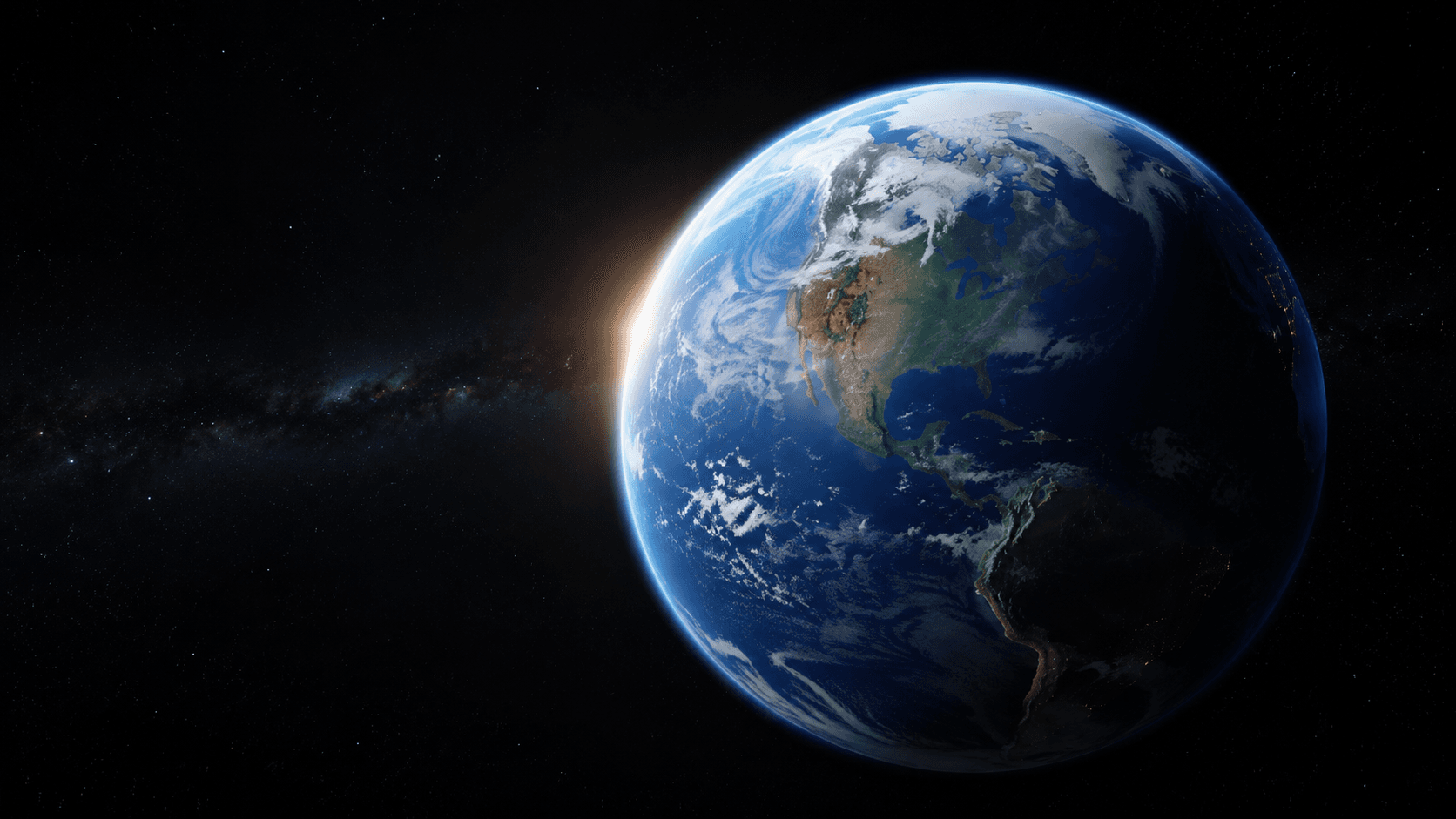
Earth is the third planet from the Sun, the largest of the four rocky planets, and the only world known to support life. Liquid water covers about 71% of its surface, an oxygen-rich atmosphere surrounds it, and a global magnetic field helps reduce exposure to charged particles from the Sun. These features work together with Earth's suitable distance from the Sun, active geology, and long-term climate cycles to create an extraordinary living planet.
Earth is not a perfectly calm or unchanging home. Continents move, mountains rise and erode, oceans circulate, glaciers expand and retreat, and the atmosphere continually transfers heat and moisture. Life has also transformed the planet. Photosynthetic organisms added oxygen to the atmosphere, vegetation affects the movement of water and carbon, and microscopic life reaches from deep rock to high clouds.
From the ground, Earth can feel limitless. From space, it is a small blue world surrounded by darkness. Studying Earth as a planet reveals both its resilience and its vulnerability. It also gives scientists a standard for comparing Mars, Venus, ocean moons, and potentially habitable planets orbiting other stars.
Earth at a Glance
| Earth fact | Approximate value |
|---|---|
| Position from the Sun | Third planet |
| Average solar distance | 149.6 million km (93 million miles), or 1 AU |
| Equatorial diameter | 12,756 km (7,926 miles) |
| Mean diameter | About 12,742 km (7,918 miles) |
| Age | About 4.54 billion years |
| Length of year | About 365.25 days |
| Rotation relative to stars | About 23 h 56 min |
| Average solar day | 24 hours |
| Axial tilt | About 23.4 degrees |
| Surface covered by water | About 71% |
| Average surface temperature | About 15°C (59°F) |
| Natural moons | 1 |
| Surface gravity | 9.81 m/s² |
| Main atmospheric gases | Nitrogen and oxygen |
Values are rounded, and measurements such as global temperature change with method and time period. You can also see how Earth compares to the other planets using the planet comparison tool.
What Is Earth?
Earth is a terrestrial planet composed mainly of rock and metal. It formed about 4.54 billion years ago from material orbiting the young Sun. Gravity pulled dust and larger bodies together, creating a hot early planet. Dense metal moved inward to form the core, while lighter rock formed the mantle and crust.
Earth occupies the Sun's habitable zone, the broad region where temperatures can allow liquid water under suitable atmospheric conditions. Location alone does not guarantee habitability. Venus lies near the zone's inner region but has a runaway greenhouse climate, while Mars lost much of its early atmosphere. Earth combines location with abundant water, a protective atmosphere, a magnetic field, chemical ingredients, and systems that regulate climate over long times.
The name Earth differs from the Roman and Greek names used for most planets. It developed from old Germanic and English words associated with ground or soil.
Essential Earth Facts
Earth is the fifth-largest planet and the largest terrestrial planet. Its diameter is only slightly greater than Venus's, but its environment is unique among known worlds. Earth has one large natural satellite, the Moon, whose gravity drives most ocean tides and stabilizes Earth's axial orientation.
Earth completes one orbit in about 365.25 days. The extra fraction is why calendars add a leap day approximately every four years, with century rules keeping dates aligned more precisely with the seasons. Earth rotates eastward, creating the apparent daily movement of the Sun from east to west.
The planet is not a perfect sphere. Rotation creates a slight bulge around the equator and flattening at the poles, a shape called an oblate spheroid. Sea level also follows an irregular gravitational surface, and elevations range from deep ocean trenches to Mount Everest.
Earth's atmosphere is about 78% nitrogen and 21% oxygen, with argon, carbon dioxide, water vapor, and trace gases making up the rest. Water vapor varies greatly and plays a major role in weather and the greenhouse effect.
How Far Is Earth From the Sun?
Earth is approximately 149.6 million kilometers (93 million miles) from the Sun on average. This distance defines one astronomical unit, or AU, a convenient unit for describing distances within planetary systems.
Earth follows a slightly elliptical orbit. It reaches perihelion, its closest point, at about 147.1 million kilometers and aphelion, its farthest point, at about 152.1 million kilometers. Seasons are not caused by this small distance change. Earth's 23.4-degree axial tilt changes the angle and duration of sunlight received by each hemisphere during the year.
Sunlight takes about eight minutes and twenty seconds to reach Earth. When the Sun is observed, it appears as it was more than eight minutes earlier.
How Big Is Earth?
Earth's mean diameter is about 12,742 kilometers (7,918 miles). Its equatorial circumference is approximately 40,075 kilometers, or 24,901 miles. Earth has a mass of roughly 5.97 × 10²⁴ kilograms.
The planet is about 3.7 times wider than the Moon. Jupiter is about 11 times wider than Earth, while the Sun is about 109 times wider. More than one million Earth-sized volumes could fit inside the Sun, although packing spheres leaves unused space.
| World | Approximate diameter | Compared with Earth |
|---|---|---|
| Mercury | 4,880 km | 38% |
| Venus | 12,104 km | 95% |
| Earth | 12,742 km | 100% |
| Mars | 6,779 km | 53% |
| Jupiter | 139,820 km | About 11 times wider |
Earth's Interior
Earth has four major internal layers: crust, mantle, liquid outer core, and solid inner core. The thin crust supports continents and ocean basins. Beneath it, the mantle consists of hot rock that behaves rigidly over short periods but flows slowly across geological time.
Movement in the mantle helps drive plate tectonics. Earth's outer shell is divided into plates that spread, collide, and slide past one another. These motions build mountains, create ocean crust, trigger many earthquakes, and carry carbon-bearing material into and out of the interior.
The outer core is mainly liquid iron and nickel. Its moving electrically conductive material generates Earth's magnetic field. At the center, enormous pressure keeps the inner core solid even though its temperature is comparable to the Sun's visible surface.
Continents, Oceans, and Plate Tectonics
About 29% of Earth's surface is land and 71% is water. The global ocean is connected even though it is divided geographically into named basins. It stores and transports enormous amounts of heat, shapes weather, supports ecosystems, and participates in the carbon cycle.
Continents move at rates commonly measured in centimeters per year. Over millions of years, this motion opens and closes oceans and assembles and separates supercontinents. New crust forms at mid-ocean ridges, while older ocean crust sinks into the mantle at subduction zones.
Plate tectonics continually renews Earth's surface. It also supports long-term chemical cycles that influence atmospheric carbon dioxide. No other known planet displays the same global system of active plate tectonics.
Earth's Atmosphere
Earth's atmosphere makes life possible while producing weather and climate. Nitrogen provides a stable background gas, oxygen supports complex respiration, and trace greenhouse gases keep the surface warmer than it would otherwise be.
The atmosphere is organized into layers. Most weather occurs in the troposphere. The stratosphere contains the ozone layer, which absorbs much harmful ultraviolet radiation. Above are the mesosphere, thermosphere, and exosphere, where the gas becomes progressively thinner.
The natural greenhouse effect raises Earth's average surface temperature to roughly 15°C (59°F). Without it, the average would be well below freezing. Human activities have increased concentrations of carbon dioxide, methane, and other greenhouse gases, strengthening heat retention and changing the climate. Natural greenhouse warming and modern human-caused warming are related physical processes but should not be confused.
Earth's Temperature and Climate
Earth's global average surface temperature is about 15°C, but actual conditions vary enormously. Antarctica can fall below −80°C, while hot deserts can exceed 50°C. Latitude, altitude, season, cloud cover, ocean currents, surface reflectivity, and local geography all influence temperature.
Weather describes short-term atmospheric conditions. Climate describes long-term patterns. Earth's climate has changed naturally throughout history due to orbital cycles, volcanic activity, solar variations, continental movement, and feedbacks involving ice, oceans, and greenhouse gases. Current rapid warming is primarily driven by human emissions of heat-trapping gases, according to major scientific assessments.
Why Can Earth Support Life?
Earth supports life because several favorable conditions operate together:
- Liquid water provides a medium for chemistry.
- The Sun supplies a long-lasting source of energy.
- The atmosphere maintains pressure and moderates temperature.
- Oxygen supports complex animal life, while carbon dioxide supports photosynthesis.
- A magnetic field reduces direct interaction with the solar wind.
- The ozone layer blocks much harmful ultraviolet radiation.
- Carbon, hydrogen, nitrogen, oxygen, phosphorus, sulfur, and other elements support biology.
- Geological and biological cycles recycle important materials.
- Long-term climate regulation has kept large areas habitable.
Life exists in oceans, soil, air, ice, hot springs, acidic lakes, and deep underground rock. These extremophiles expand understanding of where life might survive elsewhere.
No life has been confirmed beyond Earth. Calling Earth the only planet with life means it is the only world where life is currently known, not that life elsewhere is impossible.
Earth's Moon
Earth has one permanent natural moon. The Moon orbits at an average distance of about 384,400 kilometers (238,855 miles). It likely formed after a large object struck the young Earth and debris assembled in orbit, although researchers continue refining details of this giant-impact model.
The Moon's gravity produces most ocean tides. The Sun also contributes, causing especially strong spring tides when the Sun, Earth, and Moon align. The Moon helps stabilize Earth's axial tilt, influencing long-term climate stability.
The same side of the Moon generally faces Earth because its rotation period equals its orbital period. The far side is not permanently dark; both hemispheres receive sunlight during a lunar month.
Earth's Magnetic Field
Earth's magnetic field is generated mainly by motion in the liquid outer core. It forms a magnetosphere extending far into space. The sunward side is compressed by the solar wind, while the night side stretches into a long magnetotail.
The field guides charged particles toward polar regions, producing auroras. It also limits atmospheric erosion and radiation exposure, though it does not block all energetic particles. Earth's magnetic poles move, and the field has reversed direction many times in geological history.
Earth's Orbit, Rotation, and Seasons
Earth rotates once relative to distant stars in about 23 hours and 56 minutes. A mean solar day is 24 hours because Earth moves along its orbit while rotating. The planet travels around the Sun in approximately 365.25 days.
Axial tilt creates seasons. When the Northern Hemisphere tilts toward the Sun, it receives more direct sunlight and longer days while the Southern Hemisphere receives less. Six months later, the arrangement reverses. Near the equinoxes, day and night are close to equal length globally.
Earth's orbit is closest to the Sun in early January, during Northern Hemisphere winter. This fact clearly shows that seasons are controlled mainly by axial tilt, not distance.
How Old Is Earth?
Earth is approximately 4.54 billion years old. Scientists determine this age using radiometric dating of meteorites, ancient Earth minerals, and lunar samples. Radioactive elements decay at predictable rates, allowing researchers to calculate when minerals formed.
Earth's oldest known minerals are zircon crystals more than four billion years old. Most original crust has been recycled by tectonics and erosion, so meteorites provide an important record of when the Solar System formed.
Earth From Space
Spaceflight transformed understanding of Earth. Weather satellites track storms, fires, clouds, sea ice, and atmospheric conditions. Earth-observing missions such as Landsat measure sea level, gravity, soil moisture, vegetation, air pollution, greenhouse gases, and changes in glaciers. Continuous crewed observations from the International Space Station complement automated satellite records, and imagery returned by the Apollo Program permanently shifted how humans view our home world.
The famous view of a borderless blue planet has cultural power, but satellite observations also provide practical information. Farmers use Earth data to manage crops, emergency agencies monitor disasters, and scientists analyze environmental change.
How Earth Formed and Changed
Earth formed within the solar nebula about 4.5 billion years ago. Repeated impacts produced a hot young world. Differentiation created the core and mantle, volcanic gases contributed to the early atmosphere, and water accumulated from internal sources and water-bearing bodies.
Early life appeared at least billions of years ago. Photosynthetic microbes later released oxygen, causing a major atmospheric transformation. Complex multicellular life developed much later, followed by plants and animals on land. Five recognized mass extinctions profoundly changed biodiversity before humans appeared only recently in geological time.
Earth will continue changing. Plate motion will rearrange continents, the Sun will gradually brighten, and biological evolution will continue. On human time scales, climate and ecosystems are being changed rapidly by land use, pollution, resource consumption, and greenhouse-gas emissions.
Earth Compared With Venus and Mars
| Feature | Venus | Earth | Mars |
|---|---|---|---|
| Diameter | 12,104 km | 12,742 km | 6,779 km |
| Average solar distance | 108.2 million km | 149.6 million km | 227.9 million km |
| Main atmospheric gas | Carbon dioxide | Nitrogen | Carbon dioxide |
| Surface pressure | About 92 Earth atmospheres | 1 | Less than 1% of Earth |
| Average surface temperature | About 465°C | About 15°C | About −65°C |
| Stable surface liquid water | No | Yes | No today |
| Moons | 0 | 1 | 2 |
These three neighboring rocky planets are natural experiments. Venus shows extreme greenhouse warming. Mars shows how a small world can lose much of its atmosphere and surface water. Earth shows the rare combination of conditions that has supported a global biosphere. Try the planet weight calculator to see how you would weigh on each.
Why Earth Matters
Earth is the reference point for every search for a habitable world. Its oceans, atmosphere, geology, magnetic field, and biosphere form an interconnected system that has remained suitable for life through immense change. Studying that system improves weather forecasts, disaster response, agriculture, climate understanding, and protection of natural resources.
Earth's planetary neighbors reveal that a rocky world's future is not determined by size alone. Venus, Earth, and Mars began with related materials but evolved into radically different environments. The differences make Earth's living conditions more remarkable and show why habitability must be understood as a system.
From space, Earth is finite. Every ecosystem, city, ocean, and human life occupies the same thin habitable layer. Learning Earth facts is therefore not only an astronomy lesson. It is a way to understand the only home humanity currently has and the responsibility involved in caring for it.
Frequently asked questions
What is Earth?
Earth is the third planet from the Sun, the largest terrestrial planet, and the only world known to support life. Oceans cover most of its surface, and its atmosphere is dominated by nitrogen and oxygen.
How old is Earth?
Earth is about 4.54 billion years old. Radiometric dating of meteorites, ancient minerals, and lunar samples provides the strongest evidence for this age.
How far is Earth from the Sun?
Earth is about 149.6 million kilometers, or 93 million miles, from the Sun on average. This distance is defined as one astronomical unit.
How big is Earth?
Earth's mean diameter is about 12,742 kilometers, or 7,918 miles. It is the fifth-largest planet and the largest rocky planet.
How long is a day on Earth?
A mean solar day lasts 24 hours. Earth completes a rotation relative to distant stars in about 23 hours and 56 minutes.
How long is a year on Earth?
Earth takes about 365.25 days to orbit the Sun. Leap-year rules keep the calendar aligned with this orbital period.
How many moons does Earth have?
Earth has one permanent natural satellite, the Moon. Small objects can temporarily enter complex orbits near Earth, but they are not additional permanent moons.
What percentage of Earth is water?
About 71% of Earth's surface is covered by water. Oceans contain approximately 97% of the planet's water, while most freshwater is frozen or underground.
What is Earth's average temperature?
Earth's global average surface temperature is roughly 15°C, or 59°F, although it varies with the dataset and period used. Local temperatures span a much greater range.
Why is Earth called the Blue Planet?
Earth appears blue from space because oceans cover most of its surface and the atmosphere scatters blue light. White clouds and ice, green and brown land, and desert regions add other colors.
Is Earth perfectly round?
No. Rotation makes Earth slightly wider at the equator than from pole to pole. Its more precise shape is an oblate spheroid with additional gravitational irregularities.
Why does Earth have seasons?
Earth's axis is tilted about 23.4 degrees. As the planet orbits the Sun, each hemisphere alternately receives more direct sunlight and longer days.
Does Earth have rings?
Earth has no natural ring system. Artificial satellites and debris orbit the planet, but they are not considered planetary rings.
Is Earth the only habitable planet?
Earth is the only planet known to have life and stable surface oceans. Scientists have identified potentially habitable environments elsewhere, but none has confirmed life.
What protects Earth from space radiation?
The atmosphere absorbs much harmful radiation, and the magnetosphere redirects many charged particles. Neither forms a perfect shield, but together they make the surface far safer.
Sources
- NASA Science: Earth Facts — last verified 2026-09-04
- NASA Science: Earth — last verified 2026-09-04
- NASA Earth Observatory — last verified 2026-09-04
- USGS: This Dynamic Earth — last verified 2026-09-04
- NOAA Climate — last verified 2026-09-04