Jupiter Planet: Facts About the Largest Planet
Explore Jupiter facts, its enormous size, distance, temperature, Great Red Spot, rings, atmosphere, moons, and missions to the largest planet.
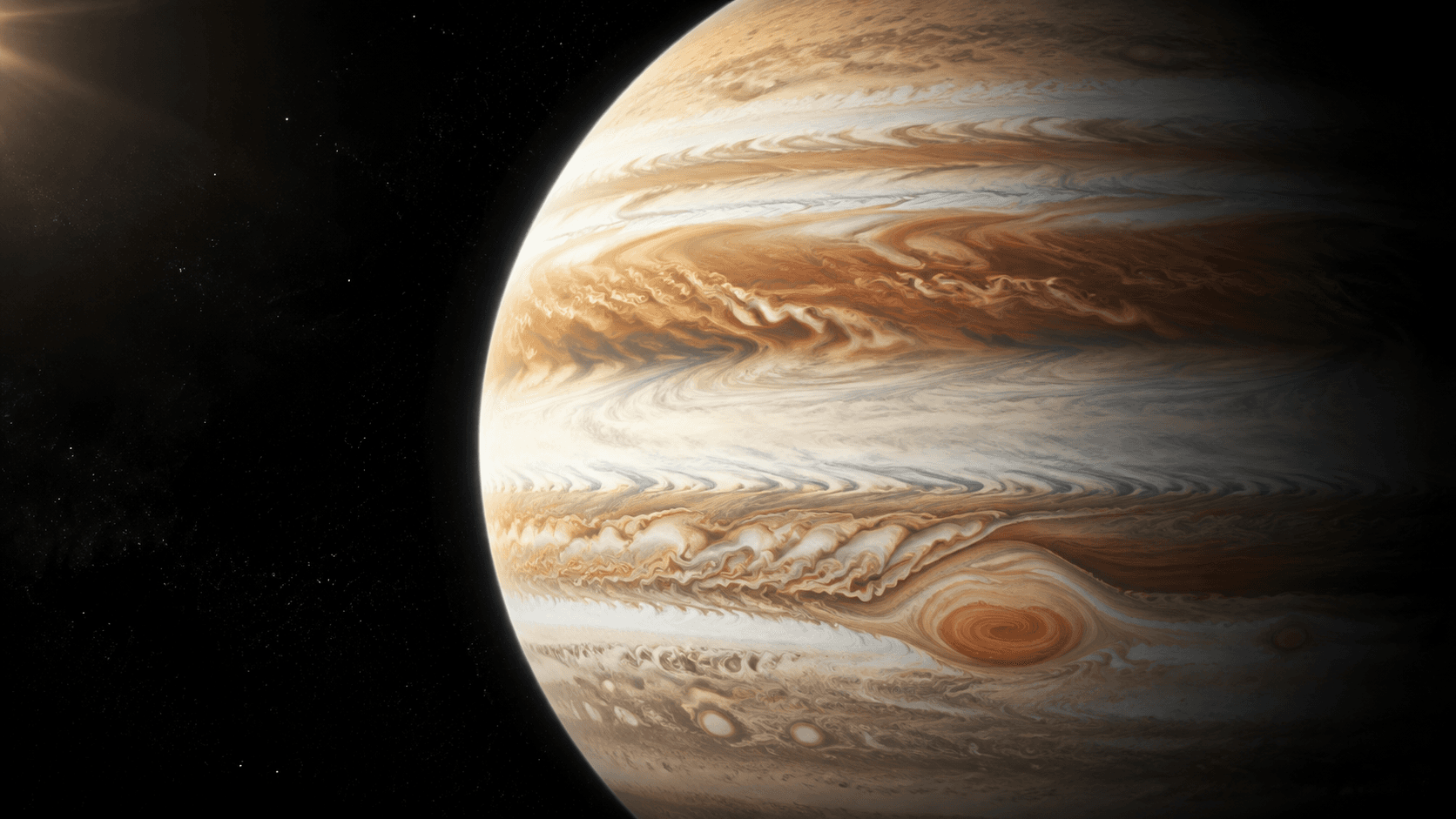
Jupiter is the fifth planet from the Sun and the largest planet in the Solar System. A gas giant of hydrogen and helium, it is more than twice the mass of all other planets combined. Colorful cloud bands, powerful storms, a faint ring system, a large family of moons, and one of the strongest magnetic fields known make Jupiter a defining world.
Named for the king of the Roman gods, Jupiter has shaped the Solar System since its formation. Its gravity influenced the paths of asteroids and comets, contributed to the delivery of material to the inner planets, and helped set the architecture of nearby orbits. Studying Jupiter reveals how giant planets form and how gas envelopes evolve.
This guide covers Jupiter's size, structure, weather, moons, missions, and place in the Solar System. It also compares Jupiter with Earth and its neighbor Saturn, and points to tools for exploring its properties.
Jupiter at a Glance
| Fact | Approximate value |
|---|---|
| Position | Fifth planet |
| Average distance from Sun | 778 million km, 5.2 AU |
| Diameter | 139,820 km |
| Mass | 318 Earths |
| Volume | 1,321 Earths |
| Year | 11.86 Earth years |
| Day | 9 h 56 min |
| Axial tilt | 3.1° |
| Cloud-top temperature | About −145°C (−234°F) |
| Main atmospheric gases | Hydrogen, helium |
| Moons | Many, including the Galilean four |
| Rings | Faint ring system |
What Is Jupiter?
Jupiter is a gas giant, a planet whose vast atmosphere overwhelms any small central core. It has no clear solid surface. Descending into Jupiter, gases become denser and hotter until hydrogen behaves like a liquid metal that conducts electricity, producing the planet's powerful magnetic field.
The visible "surface" is a layer of clouds. Above them are hazes; below are deeper cloud decks and increasingly extreme conditions. Jupiter radiates more energy than it receives from the Sun because it is still slowly contracting and releasing internal heat.
Although Jupiter is huge, it is not massive enough to be a star. It would need roughly 80 times its current mass for the pressure and temperature at its center to sustain hydrogen fusion.
Jupiter Facts
Jupiter is more massive than 300 Earths combined. Its rotation is faster than any other planet, causing a visible equatorial bulge. Bands of clouds circle at different speeds, and strong jet streams shape the boundaries between them.
The Great Red Spot is a persistent storm larger than Earth. It has been observed for centuries and remains active but has been shrinking and changing shape. Jupiter also produces bright polar auroras, powered in part by particles from its volcanic moon Io.
The four large Galilean moons — Io, Europa, Ganymede, and Callisto — were discovered by Galileo in 1610. Their observation helped establish that not everything orbits Earth. Many smaller moons are irregular and were captured over time.
Jupiter's magnetic field is the strongest of any planet. Trapped high-energy particles form intense radiation belts that pose serious challenges for spacecraft electronics.
How Far Is Jupiter From the Sun?
Jupiter orbits at an average distance of about 778 million kilometers (484 million miles), or 5.2 AU. Its slightly elliptical orbit ranges from about 741 million kilometers at perihelion to 817 million kilometers at aphelion. Sunlight takes about 43 minutes to reach Jupiter.
At that distance, sunlight is roughly 27 times weaker than at Earth. Jupiter's warmth in its upper layers comes from a combination of sunlight and substantial internal heat.
How Far Is Jupiter From Earth?
The distance between Earth and Jupiter changes constantly. Near opposition, Jupiter can approach about 588 million kilometers. Near solar conjunction, when Earth and Jupiter are on opposite sides of the Sun, separation can exceed 968 million kilometers.
| Situation | Approximate distance |
|---|---|
| Near opposition | About 588 million km |
| Near solar conjunction | About 968 million km |
Radio signals take roughly 33 to 54 minutes one way, depending on geometry. Live control is impossible over such delays, so spacecraft rely on onboard software and preplanned sequences.
Jupiter's Size and Structure
Jupiter's equatorial diameter is about 139,820 kilometers, roughly 11 times Earth's. Its mass is 318 times Earth's, and its volume could contain more than 1,300 Earths. Despite its size, Jupiter is not very dense because it is made mostly of light gases.
Beneath its clouds, hydrogen becomes denser with depth. In the upper region it behaves as a gas, then as a supercritical fluid, and eventually as liquid metallic hydrogen at enormous pressures. A dense central region contains heavier elements and may be partially mixed with surrounding material rather than forming a sharply defined core.
Rapid rotation and low overall density give Jupiter a visibly flattened, or oblate, shape. The equator is noticeably wider than the pole-to-pole distance.
Jupiter's Atmosphere and Weather
Jupiter's atmosphere is mostly hydrogen and helium, with small amounts of methane, ammonia, water vapor, and other compounds. Cloud layers include ammonia ice near the top and deeper decks of ammonium hydrosulfide and water clouds.
Weather is organized into light zones and darker belts. Zones tend to be regions of rising air and higher clouds, while belts are drier and warmer with sinking motion. Strong jet streams run between them, producing eddies, vortices, and long-lived storms.
The Great Red Spot rotates counterclockwise and has been shrinking over the past century. Other storms come and go, and smaller white and brown ovals dot the cloud tops. Lightning has been detected at multiple latitudes, and powerful auroras glow at the poles.
Jupiter's Rings
Jupiter has a faint ring system discovered by Voyager 1 in 1979. The rings are made of very small dust particles, likely produced when meteoroids strike Jupiter's small inner moons. Unlike Saturn's bright rings, Jupiter's are dark and difficult to see without spacecraft imagery.
The system includes an innermost halo, a main ring, and two gossamer rings connected to the moons Amalthea and Thebe.
Jupiter's Moons
Jupiter has many moons. The four Galilean satellites are worlds in their own right. Io is the most volcanically active body known, driven by tidal heating. Europa has a smooth icy shell over a subsurface ocean that may be habitable. Ganymede is the largest moon in the Solar System and has its own weak magnetic field. Callisto is heavily cratered and may also contain a deep ocean.
Beyond the Galilean moons, Jupiter has a group of small inner moons and many outer, irregular satellites. Many outer moons orbit in the opposite direction of Jupiter's spin, suggesting they were captured. Discoveries of tiny outer moons continue, and totals are updated as observations are confirmed by the IAU Minor Planet Center.
Jupiter's Magnetic Field and Radiation
Jupiter's magnetic field is about 20,000 times stronger than Earth's at cloud-top level and creates a magnetosphere reaching millions of kilometers into space. Charged particles trapped in this field form intense radiation belts, especially near Io's orbit.
Spacecraft near Jupiter must be shielded and often operate on carefully chosen orbits to limit radiation exposure. Auroras at Jupiter's poles are among the most powerful in the Solar System, driven partly by Io's volcanic material.
Jupiter Compared With Earth
| Feature | Jupiter | Earth |
|---|---|---|
| Diameter | 139,820 km | 12,742 km |
| Mass | 318 Earths | 1 Earth |
| Day | 9 h 56 min | 24 h |
| Year | 11.86 years | 1 year |
| Moons | Many | 1 |
| Rings | Faint | None |
| Atmosphere | Hydrogen-helium | Nitrogen-oxygen |
| Solid surface | None | Yes |
Use the planet comparison tool to explore how Jupiter's size, gravity, and orbit compare with other worlds.
Missions to Jupiter
Pioneer 10 and 11 flew past Jupiter in the 1970s, returning first close-up data. Voyager 1 and Voyager 2 discovered the ring system, active volcanism on Io, and details of Jupiter's atmosphere and satellites. Ulysses and Cassini made distant observations while heading elsewhere.
Galileo orbited Jupiter from 1995 to 2003 and delivered a descent probe into its atmosphere. Juno arrived in 2016 and studies Jupiter's interior, magnetic field, gravity field, atmosphere, and auroras from a polar orbit. ESA's JUICE mission is directed at exploring Ganymede and other icy moons, and NASA's Europa Clipper is designed to investigate Europa's habitability.
Mission status and schedules should be verified on official agency pages before publication because plans can change.
Can You See Jupiter Tonight?
Jupiter is one of the brightest objects in the night sky and is often visible without a telescope. It looks like a very steady, cream-colored point. Even small binoculars can reveal its four Galilean moons as tiny points near the planet, and a modest telescope shows cloud bands and sometimes the Great Red Spot.
Use the Tonight's Sky viewer to check whether Jupiter is above the horizon from your location right now, along with rise time, set time, and direction.
Why Jupiter Matters
Jupiter is the archetype of a giant planet and a laboratory for understanding how such worlds form and evolve. Its gravity influenced the delivery of material to the inner Solar System and may have shaped where small bodies live today. Its moons — especially Europa and Ganymede — are among the most promising places beyond Earth to search for habitable environments.
Studying Jupiter also improves knowledge of gas giants around other stars. Many exoplanets discovered so far are Jupiter-sized, and understanding Jupiter helps interpret them. The largest planet remains one of the most important destinations for planetary science.
Frequently asked questions
How big is Jupiter?
Jupiter has a diameter of about 139,820 kilometers, roughly 11 times Earth's diameter. Its mass is more than twice the mass of all other planets combined.
How far is Jupiter from Earth?
Distance varies from roughly 588 million kilometers at close approach to more than 968 million kilometers when the planets are on opposite sides of the Sun.
How far is Jupiter from the Sun?
Jupiter orbits at an average distance of about 778 million kilometers, or 5.2 astronomical units.
Is Jupiter a gas giant or a failed star?
Jupiter is a gas giant. It would need about 80 times more mass to fuse hydrogen and become a small star.
How many moons does Jupiter have?
Jupiter has many officially recognized moons, and new small satellites are still being discovered and confirmed. Its four largest, called the Galilean moons, are Io, Europa, Ganymede, and Callisto.
Does Jupiter have rings?
Yes. Jupiter has a faint ring system made of tiny dust particles supplied by small inner moons.
What is the Great Red Spot?
A massive, long-lived storm larger than Earth. It has been observed for centuries but has been slowly shrinking and changing shape.
How long is a day on Jupiter?
About 9 hours 56 minutes. Jupiter rotates faster than any other planet.
How long is a year on Jupiter?
About 11.86 Earth years.
How cold is Jupiter?
The cloud tops are near −145°C (−234°F). Deeper layers are much hotter due to internal heat and pressure.
Can humans land on Jupiter?
No. Jupiter has no solid surface, and pressure, heat, and radiation rise rapidly with depth.
What is inside Jupiter?
A hydrogen-helium atmosphere transitions into liquid metallic hydrogen and a dense, possibly diluted core rich in heavier elements.
Why does Jupiter have stripes?
Rapid rotation and internal heat drive belts and zones with different temperatures, chemistries, and altitudes, producing the banded appearance.
Is Jupiter visible tonight?
Often. Visibility depends on current geometry, weather, and location. Consult a current sky chart for accurate information.
Sources
- NASA Science: Jupiter Facts — last verified 2026-09-04
- NASA Jupiter — last verified 2026-09-04
- NASA Juno Mission — last verified 2026-09-04
- IAU Minor Planet Center — last verified 2026-09-04