
Mars Planet: Complete Guide to the Red Planet
Explore Mars facts, its distance from Earth and the Sun, temperature, size, moons, water, surface, atmosphere, rovers, and possibility of life.
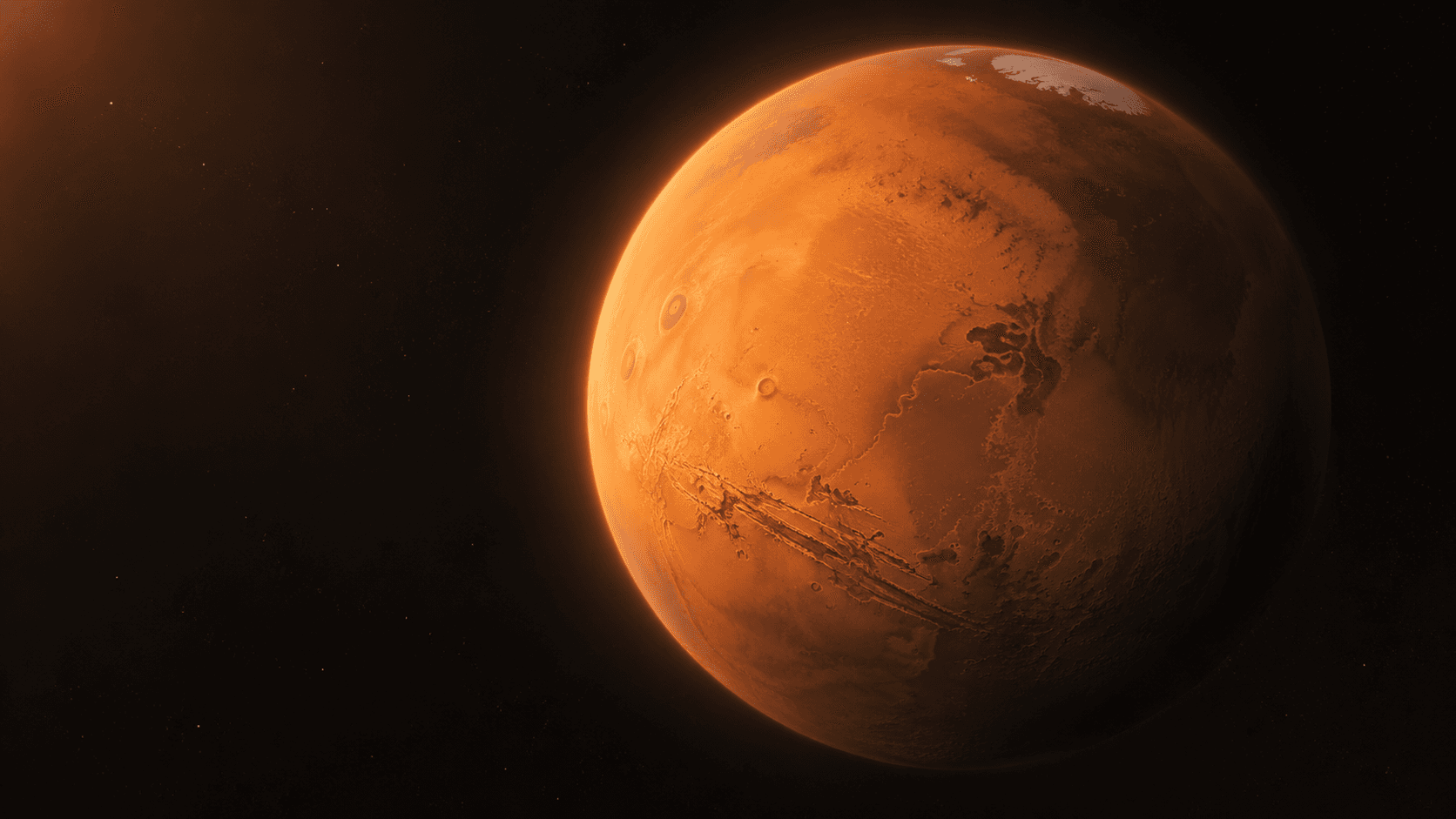
Mars is the fourth planet from the Sun and the second-smallest planet in the Solar System. Known as the Red Planet, Mars is a cold, dry desert with iron-rich soil, enormous volcanoes, deep canyons, polar ice caps, dust storms, and two tiny moons. Evidence preserved in ancient rocks shows that rivers, lakes, and perhaps a northern ocean existed billions of years ago.
Mars attracts exceptional interest because it may once have offered conditions suitable for microbial life. Robotic orbiters, landers, and rovers study its geology, atmosphere, weather, and water history while preparing knowledge needed for future human missions. Mars is not Earth's twin: its atmosphere is thin, surface radiation is high, liquid water is unstable, and average temperatures remain far below freezing.
The distance between Earth and Mars changes constantly as both planets orbit the Sun. A trip commonly takes about seven months using present mission paths, but the exact time depends on launch geometry, spacecraft design, and destination. This guide explains the planet's size, temperature, moons, surface, atmosphere, exploration, visibility, and continuing search for signs of ancient life.
Mars at a Glance
| Fact | Approximate value |
|---|---|
| Position | Fourth planet |
| Average distance from Sun | 227.9 million km (141.6 million miles), 1.52 AU |
| Diameter | 6,779 km (4,212 miles) |
| Year | 687 Earth days |
| Day | 24 h 39 min |
| Axial tilt | 25.2° |
| Average temperature | About −65°C (−85°F) |
| Broad temperature range | About 20°C to −153°C (70°F to −225°F) |
| Surface gravity | 38% of Earth's |
| Main atmospheric gas | Carbon dioxide |
| Moons | Phobos and Deimos |
| Rings | None today |
What Is Mars?
Mars is a terrestrial planet with a solid surface, metallic core, rocky mantle, and crust. Iron minerals in its soil oxidize, or rust, producing the familiar reddish color. Mars appears red-orange to the unaided eye, inspiring ancient associations with war; it is named for the Roman god of war.
Mars is about half Earth's diameter and has roughly one-tenth Earth's mass. Its lower gravity affects mountains, atmosphere, and future human activity. Olympus Mons could grow to extraordinary size partly because lower gravity allows a volcanic structure to become taller without collapsing.
Mars Facts
Mars has the largest known volcano in the Solar System, Olympus Mons, rising roughly 22 kilometers above surrounding plains. Valles Marineris is a canyon system more than 4,000 kilometers long. Mars has two polar caps containing water ice and seasonal carbon-dioxide frost. Its two moons, Phobos and Deimos, are small and irregular.
A Martian day, called a sol, is only about 39 minutes longer than an Earth day. A year lasts 687 Earth days. Mars has seasons because its axis is tilted similarly to Earth's, but the seasons last longer because its year is longer. Its elliptical orbit also makes southern seasons more extreme.
Mars has no global magnetic field today, though magnetized crust shows that an early internal dynamo once existed. Without a strong global field and with low gravity, the atmosphere was vulnerable to loss driven partly by the solar wind.
Dust shapes modern Mars. Fine particles color the sky, cover equipment, form dunes, and occasionally create regional or planet-encircling storms. Martian dust storms do not carry the same pushing force as movie storms because the air is extremely thin, but airborne dust can reduce sunlight and threaten solar-powered missions.
How Far Is Mars From the Sun?
Mars is about 227.9 million kilometers (141.6 million miles) from the Sun on average, or 1.52 AU. Its elliptical orbit ranges from roughly 206.7 million kilometers at perihelion to 249.2 million kilometers at aphelion. Sunlight takes about 12.7 minutes to reach Mars at its average distance.
Mars receives less than half the solar energy Earth receives per unit area. Its greater distance contributes to cold conditions, while the thin atmosphere retains relatively little heat.
How Far Is Mars From Earth?
There is no single Earth–Mars distance. At favorable close approaches, the planets can be around 55 million kilometers apart in theoretical geometry, though typical close approaches are farther. When they are on opposite sides of the Sun, separation can exceed 400 million kilometers.
| Situation | Approximate distance |
|---|---|
| Favorable close approach | Around 55–60 million km |
| Often-cited average separation | About 225 million km |
| Near maximum separation | More than 400 million km |
Current distance must be calculated for a specific date. Communication delay is also variable: a one-way radio signal may take roughly 3 to 22 minutes, making real-time joystick control impossible.
How Long Does It Take to Get to Mars?
Many robotic journeys take about six to nine months, with roughly seven months being a useful general answer. Spacecraft usually follow an energy-efficient transfer orbit rather than a straight line. Launch windows occur about every 26 months, when planetary positions support practical transfers.
Travel time depends on propulsion, vehicle mass, fuel, launch energy, arrival speed, and whether the craft must orbit or land. Faster paths demand more energy and create harder arrival conditions. Future propulsion could change journey times, but claims of specific crewed schedules require current mission plans.
Mars Temperature
Mars has an average surface temperature around −65°C (−85°F). Temperatures may rise to about 20°C (70°F) near the equator on a favorable summer afternoon and fall to approximately −153°C (−225°F) near the poles in winter.
The thin atmosphere cannot store and distribute heat like Earth's. Temperature can change sharply between sun and shadow and between ground and air. A mild reading at a rover's sunlit surface does not mean breathable or comfortable conditions.
| Setting | Approximate temperature |
|---|---|
| Global average | −65°C (−85°F) |
| Warm equatorial afternoon | Up to 20°C (70°F) |
| Cold polar winter | Down to −153°C (−225°F) |
Mars's Atmosphere and Weather
Mars's atmosphere is mainly carbon dioxide, with nitrogen, argon, and trace gases. Surface pressure averages less than 1% of Earth's sea-level pressure. Humans would need a pressurized suit; exposed liquid water would boil or freeze depending on conditions.
Weather includes winds, clouds, frost, dust devils, and storms. Carbon-dioxide ice forms seasonally at the poles. Water-ice clouds can appear, and atmospheric tides respond to daily solar heating. Dust absorbs sunlight and changes atmospheric temperature.
The Surface of Mars
Mars contains ancient cratered highlands, smoother northern plains, volcanoes, canyons, dunes, channels, deltas, and layered sedimentary rocks. The southern hemisphere is generally higher and more cratered than the north.
Olympus Mons is a vast shield volcano about 600 kilometers wide. Valles Marineris stretches across nearly one-quarter of the planet's circumference. Hellas Planitia is an enormous impact basin with some of the lowest elevations.
Ancient valley networks and deltas show that flowing water reshaped the surface. Jezero Crater contains a preserved river delta studied by Perseverance. Gale Crater holds layered rocks examined by Curiosity, providing a long record of changing environments.
Water on Mars
Mars contains abundant water ice. Polar caps, buried glaciers, shallow ground ice, and hydrated minerals preserve water in frozen or chemically bound forms. Atmospheric water vapor and frost are also present.
Ancient Mars had rivers and long-lived lakes. Orbital minerals formed in water, rounded pebbles, sediment layers, and deltas provide strong evidence. As the atmosphere thinned, stable surface liquid water largely disappeared.
Temporary salty films have been proposed, but confirmed stable lakes on today's exposed surface do not exist. Claims about underground liquid reservoirs require careful evaluation because radar interpretations can have multiple explanations.
Is There Life on Mars?
No life has been confirmed on Mars. The strongest search focuses on ancient microbial life because early Mars had water, chemical ingredients, and environments that may have been habitable.
Habitability is not evidence of habitation. Organic molecules detected in rocks can form through biological or non-biological chemistry. Methane reports are scientifically interesting but difficult to reconcile and do not prove biology.
Perseverance examines ancient lake and delta rocks and stores samples for potential future analysis. Curiosity studies past habitability and organic chemistry. Protection rules seek to prevent Earth microbes from contaminating Mars and to protect Earth during any sample return.
Mars's Interior and Magnetic History
Mars has a crust, mantle, and iron-rich core containing lighter elements. InSight measured marsquakes and seismic waves, allowing scientists to estimate internal layers. Mars is not geologically dead; quakes, landslides, impacts, and atmospheric processes continue.
Strong magnetization in old crust suggests Mars once had a global magnetic field. As the interior cooled and the dynamo stopped, the atmosphere became more exposed to solar wind. Atmospheric escape was not the only cause of climate change, but it contributed.
Phobos and Deimos
Phobos and Deimos are irregular, dark moons. Phobos is roughly 27 by 22 by 18 kilometers and orbits only about 6,000 kilometers above the surface. It circles Mars about three times per day and slowly moves inward. In tens of millions of years, it may break apart into a ring or collide with Mars.
Deimos is smaller, roughly 15 by 12 by 11 kilometers, and takes about 30 hours to orbit. The moons may be captured asteroid-like bodies or debris assembled after a large impact; their origin remains debated.
Mars Compared With Earth
| Feature | Mars | Earth |
|---|---|---|
| Diameter | 6,779 km | 12,742 km |
| Gravity | 38% | 100% |
| Day | 24 h 39 min | 24 h |
| Year | 687 days | 365.25 days |
| Moons | 2 | 1 |
| Atmosphere | Thin CO₂ | Dense nitrogen-oxygen |
| Average temperature | −65°C | 15°C |
| Stable surface oceans | No | Yes |
| Global magnetic field | No | Yes |
Similar day length and seasons make Mars familiar, but low pressure, cold, radiation, dust, and scarce accessible resources make it hostile. The planet weight calculator shows how much you'd weigh on Mars.
Could Humans Live on Mars?
People cannot survive unprotected. Habitats need pressure, oxygen, water recycling, food, heat, power, radiation shielding, medical capacity, and redundant life support. Dust may damage seals, mechanisms, solar arrays, and lungs.
Water ice could support drinking, oxygen production, and rocket fuel. Carbon dioxide can supply carbon and oxygen for industrial processes. Underground or soil-covered habitats could reduce radiation exposure.
Mars gravity is 38% of Earth's, and long-term human effects are unknown. Communication delays require local autonomy. Ethical and environmental questions include planetary protection, governance, and preservation of scientific sites.
Terraforming Mars is far beyond present capability. Available carbon dioxide is insufficient for a quick Earth-like atmosphere, and any transformation would require immense energy and time.
Mars Missions and Rovers
Mariner 4 returned the first close-up images in 1965. Viking 1 and 2 achieved successful U.S. landings in 1976 and performed biology experiments whose results did not establish life. Mars Global Surveyor, Mars Odyssey, Mars Express, Mars Reconnaissance Orbiter, and MAVEN mapped terrain, minerals, atmosphere, and climate history.
Sojourner demonstrated rover exploration in 1997. Spirit and Opportunity found evidence of past watery environments. Curiosity landed in 2012 and continues studying Gale Crater's geology and habitability. Perseverance landed in 2021, explores Jezero Crater, searches for biosignature potential, and caches samples. Ingenuity completed the first powered flights on another world and ended operations after 72 flights.
International missions include ESA's Mars Express, India's Mars Orbiter Mission, the United Arab Emirates' Hope orbiter, and China's Tianwen-1 mission. Mission operating status and future schedules must be checked on official agency pages before publication.
Can You See Mars Tonight?
Mars is visible without a telescope during favorable periods, but a correct answer depends on date and location. It may look like a steady orange-red point. Near opposition, Earth passes between Mars and the Sun; Mars rises around sunset, remains visible much of the night, and appears brighter and larger.
Use the Tonight's Sky viewer to see whether Mars is above the horizon from your location right now, along with rise time, set time, altitude, and direction.
What Would a Day on Mars Feel Like?
A visitor inside a protected habitat would recognize the roughly 24-hour rhythm, but almost everything outside would feel unfamiliar. Sunrise and sunset would pass through a dusty sky. Daylight is weaker than on Earth because Mars is farther from the Sun, yet ultraviolet radiation at the ground is more dangerous because there is no thick ozone layer. The horizon can appear gently curved from high terrain, while the small moons move quickly across the sky.
The air would not carry ordinary sound effectively. Low pressure changes how sound travels, and instruments on Perseverance have measured different behavior for low- and high-frequency sounds. Wind might move dust while exerting less physical force than the same-speed wind on Earth. A person could not smell, breathe, or expose skin to the air.
Gravity would make a person feel lighter, but a spacesuit and life-support system would remain heavy and difficult to move. Every outdoor task would require planning around temperature, radiation, terrain, dust, energy, communications, and emergency shelter.
Common Myths About Mars
Mars is not currently covered with canals built by a civilization. Nineteenth-century telescope observations of apparent lines were misinterpreted, and spacecraft revealed natural terrain. The "face on Mars" is an eroded hill whose face-like appearance resulted from low-resolution imagery, lighting, and the human tendency to recognize familiar patterns.
Mars does not become as large as the full Moon in Earth's sky. A recurring online claim confuses telescope magnification with naked-eye appearance. Even at close opposition, Mars remains a bright point without optical aid.
The planet is not uniformly warm, and finding ice does not make its surface immediately habitable. Nor has every unusual rock or chemical signal proved life. Reliable interpretation requires multiple measurements, geological context, and independent confirmation.
Observing Mars Through a Telescope
Mars reveals its best detail near opposition, but atmospheric steadiness, telescope aperture and observer experience matter. A telescope may show a polar cap, dark surface markings, bright clouds or a dusty atmosphere. The apparent disk remains much smaller than popular illustrations suggest. Patient observation and repeated short looks are usually more useful than extreme magnification.
Why Mars Matters
Mars preserves a record of a planet changing from a wetter environment into a cold desert. Its ancient lakes and rivers make it the most accessible place to investigate whether life ever began beyond Earth. Its geology reveals how small rocky planets cool, lose atmosphere, and respond to climate change.
Mars also provides a demanding test for exploration. Robotic missions have learned to orbit, land, drive, drill, fly, and conduct laboratories across another planet. Future missions may return samples and eventually carry people, but exploration must balance discovery with safety and planetary protection.
The Red Planet is neither an easy replacement for Earth nor a lifeless story already understood. It is a complex world whose rocks may hold answers about habitability, planetary evolution, and humanity's place in the Solar System.
Frequently asked questions
Why is Mars red?
Iron minerals in Martian rocks and dust oxidized, producing iron oxides similar to rust. Fine red dust coats much of the surface and colors light passing through the atmosphere.
How far is Mars from Earth?
The distance changes from tens of millions to more than 400 million kilometers. A current value requires a specific date because Earth and Mars move independently.
How cold is Mars?
Mars averages about −65°C (−85°F). Conditions range from approximately 20°C on warm afternoons to −153°C during polar winter.
Does Mars have oxygen?
The atmosphere contains only a small amount of oxygen and is far too thin to breathe. Human missions would need to bring or manufacture oxygen.
Does Mars have water?
Yes, mainly as ice underground and at the poles, plus bound water in minerals and a little atmospheric vapor. Ancient Mars had rivers and lakes.
Has life been found on Mars?
No. Missions have found habitable ancient environments and organic molecules, but no confirmed organism, fossil, or biological signal.
How long is a day on Mars?
A Martian solar day, or sol, lasts about 24 hours and 39 minutes.
How long is a year on Mars?
Mars takes about 687 Earth days, or roughly 1.88 Earth years, to orbit the Sun.
How many moons does Mars have?
Mars has two moons, Phobos and Deimos. Both are small and irregular.
What is the largest volcano on Mars?
Olympus Mons is the largest known volcano in the Solar System, rising about 22 kilometers above nearby plains.
Can humans breathe on Mars?
No. The atmosphere is thin and mostly carbon dioxide. Exposure would cause loss of consciousness and death without pressure and oxygen.
How long does travel to Mars take?
Many robotic missions take six to nine months. The exact duration depends on planetary alignment, propulsion, route, and arrival requirements.
Is Mars bigger than Earth?
No. Mars is about 53% of Earth's diameter and about 11% of its mass.
Does Mars have rings?
Mars has no rings today. Phobos may eventually break apart and temporarily form one.
Can Mars be seen tonight?
Possibly. Visibility depends on current geometry, location, horizon, and weather. Consult a local sky chart for accurate current information.
Sources
- NASA Science: Mars Facts — last verified 2026-09-04
- NASA Mars Exploration — last verified 2026-09-04
- NASA Mars Moons — last verified 2026-09-04
- ESA Mars Express — last verified 2026-09-04