
Intermediate-Mass Black Holes: Facts, Science and Complete Guide
Intermediate-mass black holes — proposed objects between stellar-mass and supermassive black holes, spanning roughly hundreds to hundreds of thousands of solar masses.
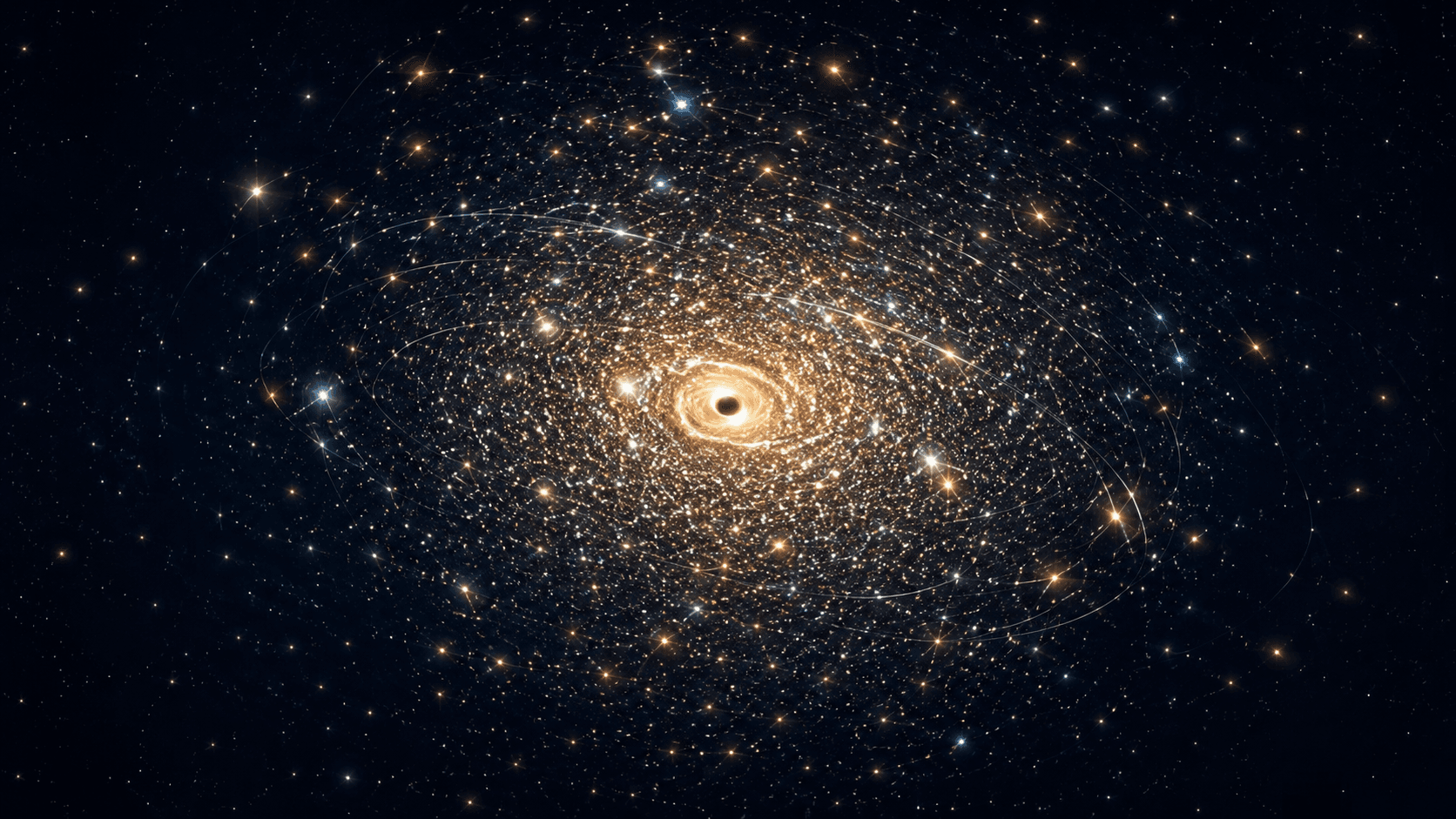
Quick answer: Intermediate-mass black holes are proposed objects between stellar-mass and supermassive black holes, commonly discussed across roughly hundreds to hundreds of thousands of solar masses.
Intermediate-Mass Black Holes at a Glance
| Topic | Explanation |
|---|---|
| Definition | Proposed black holes with masses roughly 10² to 10⁵ solar masses. |
| Physical setting | Possible seeds include remnants of early stars, runaway cluster collisions, or direct collapse. |
| Key evidence | Unusual X-ray sources, cluster stellar motions, tidal-disruption flares, radio emission, and gravitational waves. |
| Why it matters | Would help explain the growth of the earliest supermassive black holes and dense-cluster evolution. |
| Important caution | The category is scientifically plausible but has fewer unambiguous examples than stellar-mass or supermassive black holes. |
What Is an Intermediate-Mass Black Hole?
Intermediate-mass black holes (IMBHs) are proposed compact objects filling the mass gap between stellar-mass and supermassive black holes. Estimated masses range from hundreds to hundreds of thousands of times the Sun's mass. Their existence is well motivated by theory but confirmed examples remain few.
The Essential Science
Candidates are sought through unusual X-ray sources, stellar motions in dense clusters, tidal-disruption flares, radio emission, and gravitational waves from merging compact objects. Measurements are difficult because crowded environments and alternative compact-mass explanations can imitate some signatures.
Important Facts
Confirming an IMBH population would help explain how the earliest supermassive black holes grew so rapidly and how dense star clusters evolve. It would fill an important observational gap in black-hole demographics.
How Astronomers Study IMBHs
Searches use X-ray telescopes to identify ultraluminous X-ray sources, radio observations for jets, and dynamical measurements of stellar motions in globular clusters. Gravitational-wave detectors have already recorded mergers whose remnants approach the intermediate-mass regime.
What Telescopes Actually Measure
Photon energies and timing in X-ray and radio, together with stellar velocities in dense clusters, provide the observables. Gravitational-wave strain provides direct mass measurements for mergers.
Origin and Development
Possible formation routes include repeated mergers of stars and compact objects in dense clusters, collapse of exceptionally massive early stars, runaway stellar collisions, or remnants of direct-collapse seeds. No single route is established for the whole population.
Structure and Physical Conditions
Like all black holes, IMBHs are characterized by mass, spin, and horizon size. Accretion produces X-rays and radio emission that reveal properties of the surrounding gas.
Energy, Gravity, and Motion
Accreting gas radiates near an Eddington-limited efficiency. Tidal disruption of stars that wander too close produces bright, transient flares.
Connections to Other Cosmic Objects
They bridge stellar-mass and supermassive black holes and may seed the latter through mergers or gas accretion.
What Is Known and What Remains Uncertain
The abundance, mass function, and dominant formation channel of IMBHs are all uncertain. Progress requires observations that distinguish IMBH candidates from other compact-mass explanations.
Common Misconceptions
IMBHs are plausible but not routinely confirmed. Individual candidates must be examined carefully.
How IMBHs Fit Into Cosmic Evolution
Bridging stellar and supermassive black holes, they could seed supermassive growth in the early universe and drive dynamics in dense clusters today.
Best Ways to Explain IMBHs to Students
Emphasize the "mass gap" idea: known black holes cluster near tens of solar masses (stellar) and millions or more (supermassive), leaving a middle range where confirmed examples are scarce.
Why IMBHs Matter
Confirming a population would tie together stellar evolution, cluster dynamics, and supermassive black-hole growth into one framework.
A Responsible Summary
IMBHs are theoretically motivated but observationally elusive. Multiple detection channels — X-ray, radio, stellar dynamics, and gravitational waves — pursue candidates.
Detailed Search Questions
What does "intermediate-mass black hole" mean?
A proposed compact object with mass between roughly 10² and 10⁵ solar masses.
What evidence supports the modern picture?
X-ray, radio, stellar-motion, and gravitational-wave measurements all identify candidates, though unambiguous confirmations remain scarce.
How are IMBHs different from other black holes?
They are heavier than stellar-mass and lighter than supermassive examples.
Why do IMBHs matter?
They could explain the rapid growth of the earliest supermassive black holes.
What remains unknown?
The dominant formation channel, mass function, and prevalence of IMBHs are all open questions.
How are their signatures interpreted?
Independent methods must be combined to rule out alternative compact-mass explanations.
What role do gravity and energy play?
As with all black holes, extreme gravity organizes surrounding matter; accretion and mergers release energy as radiation and gravitational waves.
Authoritative Source
Scientific content reviewed September 5, 2026.
Frequently asked questions
What is an intermediate-mass black hole?
Intermediate-mass black holes are proposed objects between stellar-mass and supermassive black holes, commonly discussed across roughly hundreds to hundreds of thousands of solar masses.
How might they form?
Possible routes include repeated mergers in dense clusters, collapse of exceptionally massive early stars, runaway stellar collisions, or direct-collapse seeds.
Have they been confirmed?
Candidates exist but the category has fewer unambiguous examples than stellar-mass or supermassive black holes. Confirmation is difficult because alternatives can imitate signatures.
Why are IMBHs important?
They could explain how the earliest supermassive black holes grew so fast and how dense star clusters evolve.
Sources
- NASA — Black Hole Types — last verified Sat Sep 05 2026 00:00:00 GMT+0000 (Coordinated Universal Time)
More in Black Holes
Primordial Black Holes (Hypothetical): Facts, Science and Complete Guide
Primordial black holes are hypothetical objects that may have formed from unusually dense regions in the early universe rather than from collapsing stars.
Stellar-Mass Black Holes: Facts, Science and Complete Guide
Stellar-mass black holes — compact remnants of massive stars, containing several to tens of solar masses, detected via X-rays, stellar motion, and gravitational waves.
Supermassive Black Holes: Facts, Science and Complete Guide
Supermassive black holes contain hundreds of thousands to billions of solar masses and occupy the centers of most large galaxies, including Sagittarius A* in the Milky Way.