
Supermassive Black Holes: Facts, Science and Complete Guide
Supermassive black holes contain hundreds of thousands to billions of solar masses and occupy the centers of most large galaxies, including Sagittarius A* in the Milky Way.
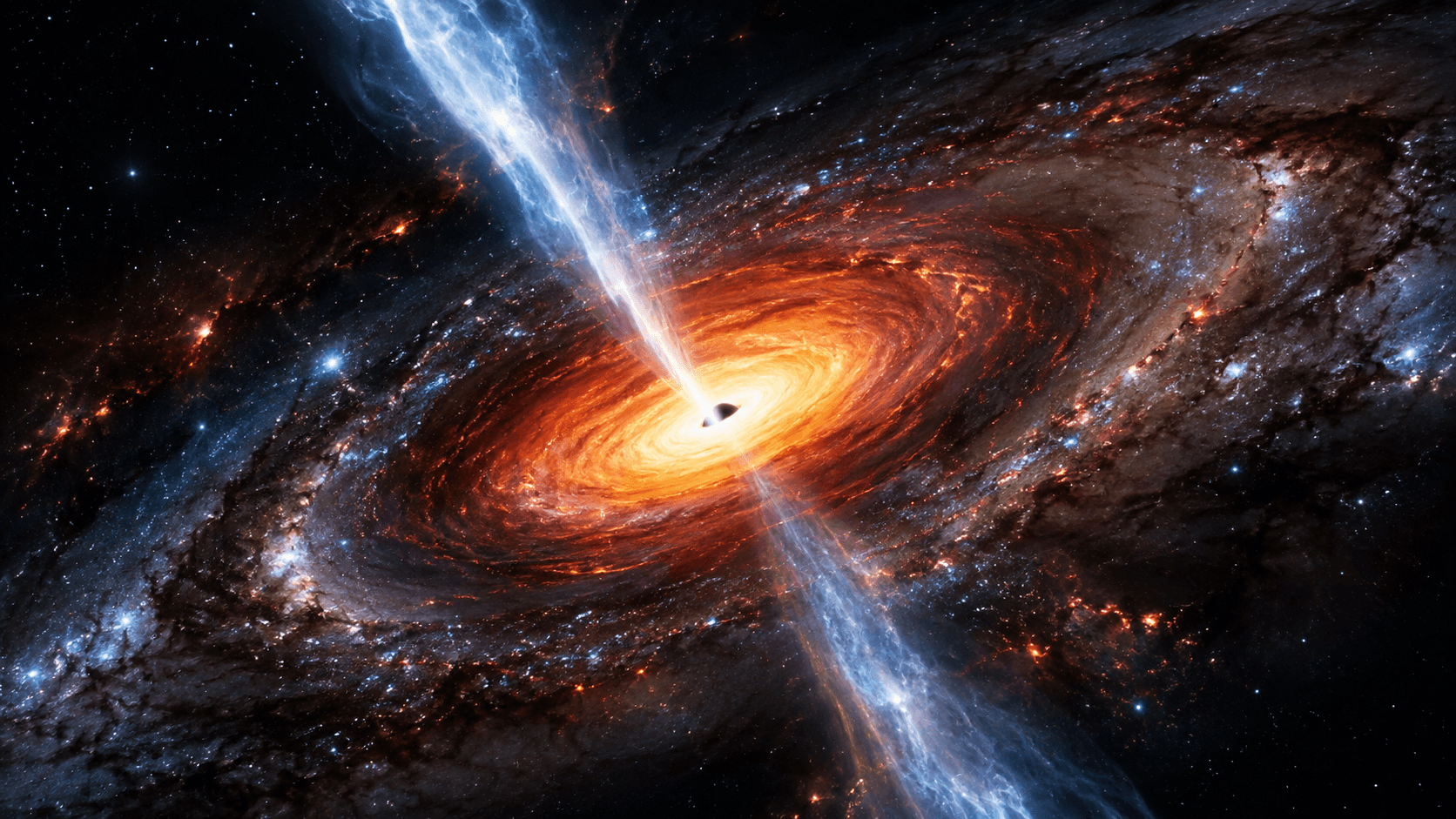
Quick answer: Supermassive black holes contain hundreds of thousands to billions of solar masses and occupy the centers of most large galaxies, including Sagittarius A* in the Milky Way.
Supermassive Black Holes at a Glance
| Topic | Explanation |
|---|---|
| Definition | Black holes with hundreds of thousands to billions of solar masses at galactic centers. |
| Physical setting | Grow through accretion and mergers; sometimes produce luminous active galactic nuclei and quasars. |
| Key evidence | Stellar/gas motions, X-rays, radio, reverberation, jets, gravitational waves, and Event Horizon Telescope imagery. |
| Why it matters | Influence galactic centers and coevolve with their host galaxies. |
| Important caution | The central black hole does not gravitationally dominate an entire galaxy. |
What Is a Supermassive Black Hole?
Supermassive black holes contain hundreds of thousands to billions of solar masses and sit at the centers of most large galaxies. The Milky Way hosts one — Sagittarius A* — with a mass of about four million Suns. Their origins remain an active research problem. Proposed seeds include remnants of early stars, rapidly growing intermediate-mass objects, and direct collapse of massive gas clouds. Accretion and mergers then increase mass, sometimes producing luminous active galactic nuclei and quasars.
The Essential Science
Astronomers measure surrounding stellar and gas motions, X-rays and radio emission from accretion, reverberation signals, relativistic jets, gravitational waves at lower frequencies, and horizon-scale structure with the Event Horizon Telescope (which imaged M87* in 2019 and Sgr A* in 2022).
Important Facts
Supermassive black holes influence galactic centers and can regulate gas through radiation, winds, and jets. Their growth is closely linked with galaxy evolution, although the direction and strength of that relationship vary across systems.
How Astronomers Study Supermassive Black Holes
Optical/infrared observations track stars orbiting the center; X-ray telescopes reveal accretion; radio arrays image jets and horizon-scale rings; low-frequency gravitational-wave detectors (pulsar timing arrays) probe merging supermassive black-hole populations across the universe.
What Telescopes Actually Measure
Radio, X-ray, and infrared photons — plus gravitational-wave strain — supply the primary observables. Interpretations rely on modeling accretion, general relativity, and jet physics.
Origin and Development
Origins remain debated. Seed models must produce black holes of hundreds of thousands to billions of solar masses within the first billion years after the Big Bang. Ongoing mergers and accretion further grow them.
Structure and Physical Conditions
Around the horizon lies a hot accretion flow, possibly a relativistic jet, and a broad-line region of orbiting gas. Beyond, star clusters and dust structures respond to the black hole's gravity.
Energy, Gravity, and Motion
Accretion converts a large fraction of infalling mass-energy into radiation. Jets couple black-hole spin and magnetic fields to launch relativistic outflows that reach kiloparsec scales.
Connections to Other Cosmic Objects
They sit at the centers of spiral and elliptical galaxies, connect to intermediate-mass and stellar-mass black holes, and regulate host-galaxy gas via jets in galaxy clusters.
What Is Known and What Remains Uncertain
The seed origin and rapid early growth of supermassive black holes remain open. The direction of causality with host-galaxy properties is debated.
Common Misconceptions
Central black holes do not "eat" galaxies. They dominate gravity only within their sphere of influence, typically a small fraction of the galaxy's size.
How Supermassive Black Holes Fit Into Cosmic Evolution
Their growth traces gas supply, mergers, and feedback across cosmic time. Quasars mark peak growth phases.
Best Ways to Explain Supermassive Black Holes to Students
Contrast a black hole's tiny horizon (~1 AU for Sgr A*) with the galaxy's tens of thousands of light-years. Show how stars orbit it like planets orbit the Sun.
Why Supermassive Black Holes Matter
They power quasars, shape galactic centers, and coevolve with their hosts.
A Responsible Summary
Supermassive black holes anchor galactic centers. Their growth histories, feedback effects, and horizon-scale images are transforming our understanding of galaxy evolution.
Detailed Search Questions
What does "supermassive black hole" mean?
A black hole of hundreds of thousands to billions of solar masses, typically at a galaxy's center.
What evidence supports the modern picture?
Stellar orbits, X-ray/radio observations, quasar variability, and direct horizon-scale imaging all agree.
How are they different from other black holes?
They are far heavier than stellar-mass or intermediate-mass examples.
Why do they matter?
They regulate galactic gas, power AGN, and coevolve with host galaxies.
What remains unknown?
Seed origins and the earliest quasars' rapid growth remain open.
How are their images interpreted?
EHT images show ring-like structure around the horizon; captions note the wavelength and processing.
What role do gravity and energy play?
Gravity binds the horizon; accretion converts gravitational binding energy into radiation and jets.
Authoritative Source
Scientific content reviewed September 5, 2026.
Frequently asked questions
What is a supermassive black hole?
Supermassive black holes contain hundreds of thousands to billions of solar masses and occupy the centers of most large galaxies, including Sagittarius A* in the Milky Way.
How are they observed?
Through stellar and gas motions, X-rays and radio emission from accretion, reverberation timing, relativistic jets, low-frequency gravitational waves, and horizon-scale imaging by the Event Horizon Telescope.
Do supermassive black holes swallow entire galaxies?
No. The central black hole does not gravitationally dominate an entire galaxy. Most stars orbit in the combined field of stars, gas, and dark matter.
Why do supermassive black holes matter?
They influence galactic centers, regulate gas through radiation and jets, and their growth is closely linked with galaxy evolution.
Sources
- NASA — Black Hole Types — last verified Sat Sep 05 2026 00:00:00 GMT+0000 (Coordinated Universal Time)
More in Black Holes
Intermediate-Mass Black Holes: Facts, Science and Complete Guide
Intermediate-mass black holes — proposed objects between stellar-mass and supermassive black holes, spanning roughly hundreds to hundreds of thousands of solar masses.
Primordial Black Holes (Hypothetical): Facts, Science and Complete Guide
Primordial black holes are hypothetical objects that may have formed from unusually dense regions in the early universe rather than from collapsing stars.
Stellar-Mass Black Holes: Facts, Science and Complete Guide
Stellar-mass black holes — compact remnants of massive stars, containing several to tens of solar masses, detected via X-rays, stellar motion, and gravitational waves.