
Stellar-Mass Black Holes: Facts, Science and Complete Guide
Stellar-mass black holes — compact remnants of massive stars, containing several to tens of solar masses, detected via X-rays, stellar motion, and gravitational waves.
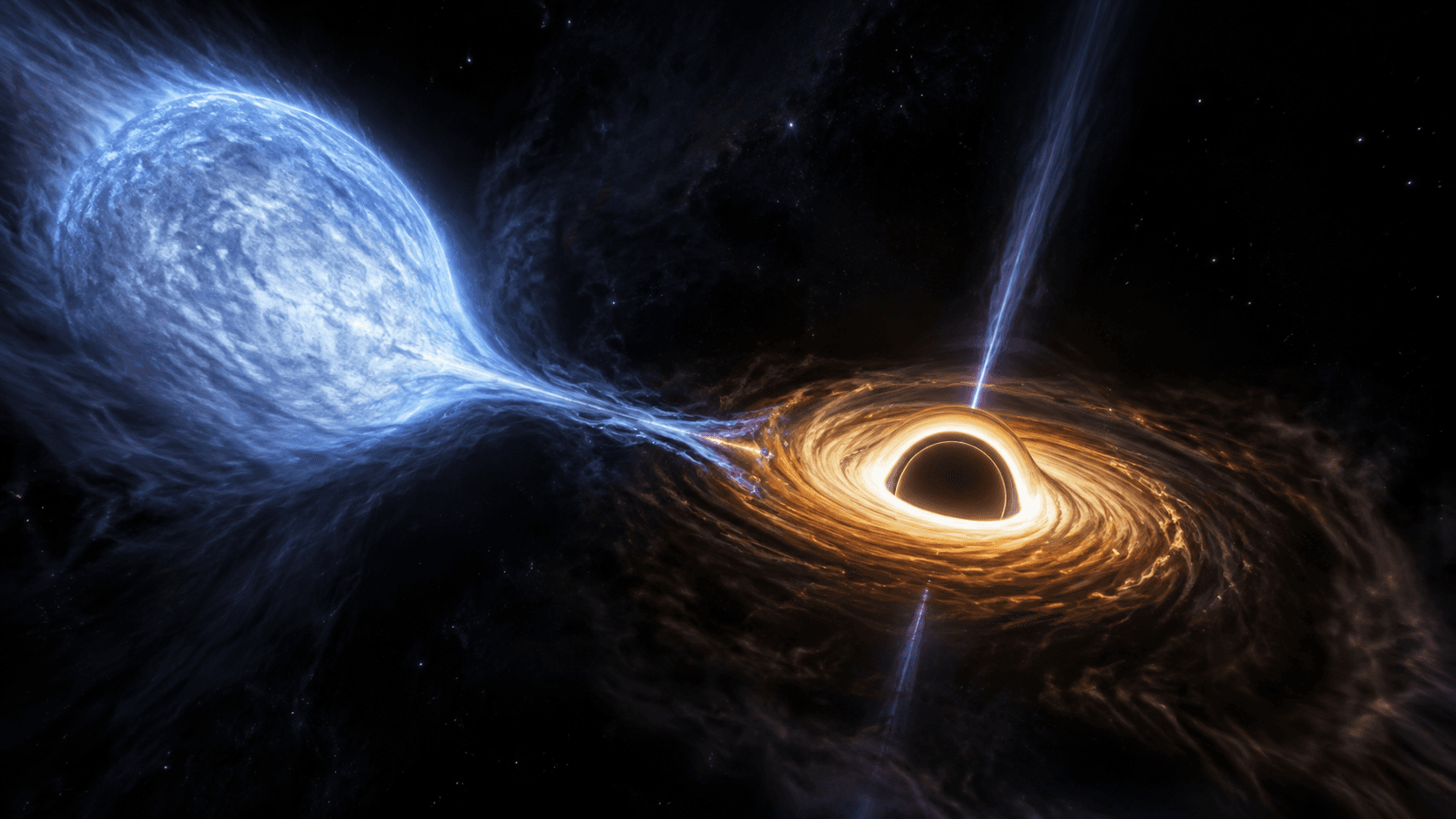
Quick answer: Stellar-mass black holes are compact remnants produced mainly when massive stars collapse. Observed examples typically contain several to tens of times the Sun's mass, although merger remnants can be heavier.
Stellar-Mass Black Holes at a Glance
| Topic | Explanation |
|---|---|
| Definition | Compact remnants of collapsed massive stars, several to tens of solar masses. |
| Physical setting | Sufficiently massive stars exhaust nuclear fuel; the core collapses with or without a bright supernova. |
| Key evidence | X-ray binaries, companion-star motion, microlensing, and gravitational waves. |
| Why it matters | Tests gravity in strong fields; reveals how massive stars die; produces gravitational-wave signals. |
| Important caution | A black hole is not a cosmic vacuum cleaner. |
What Is a Stellar-Mass Black Hole?
Stellar-mass black holes are the compact remnants left when a massive star can no longer support itself against gravity. Observed examples typically span several to tens of solar masses, although merger remnants detected by gravitational-wave observatories reach higher masses. The event horizon is only tens to hundreds of kilometers across, but tidal effects and accretion can extend much farther.
The Essential Science
Astronomers find stellar black holes through X-ray binaries, the motion of visible companion stars, gravitational microlensing, and gravitational waves from merging compact objects. Each channel probes a different mass and distance regime. The outcome of collapse depends on core mass, composition, rotation, mass loss, and binary interaction.
Important Facts
Stellar-mass black holes test gravity in strong fields, reveal how massive stars die, power some of the most energetic accretion flows and jets, and create many of the gravitational-wave signals detected by ground-based observatories.
How Astronomers Study Them
X-ray telescopes reveal accretion flows in binaries. Optical and infrared observations track the companion's motion, giving a dynamical mass. Ground-based gravitational-wave detectors LIGO, Virgo, and KAGRA measure mergers directly, providing masses, spins, and distances.
What Telescopes Actually Measure
Photon counts, arrival times, energies, and polarizations are the primary observables. Gravitational-wave detectors measure spacetime strain. Interpretations rely on modeling the systems that produce these signals.
Origin and Development
Stellar black holes form when a sufficiently massive star exhausts nuclear fuel. The collapse may power a supernova or occur quietly. Binary systems can produce close pairs whose orbits shrink via gravitational-wave emission until they merge.
Structure and Physical Conditions
The horizon is a mathematical boundary in spacetime, not a material surface. Just outside, extreme gravity, tidal forces, and accretion produce X-rays, jets, and winds.
Energy, Gravity, and Motion
Accreting gas releases enormous binding energy as radiation. Gravitational-wave emission from mergers carries away mass-energy directly.
Connections to Other Cosmic Objects
Stellar black holes are one end of the black-hole mass spectrum, which extends up to supermassive objects at galaxy centers.
What Is Known and What Remains Uncertain
Merger rate as a function of mass and metallicity, the "mass gap" between neutron stars and black holes, and formation channels in dense clusters remain active research areas.
Common Misconceptions
A black hole is not a cosmic vacuum cleaner. Far from its event horizon, its gravity acts like that of any object with the same mass.
How Stellar Black Holes Fit Into Cosmic Evolution
Each represents the end of a massive star's life. Their mergers may seed larger black holes in dense clusters or contribute to intermediate-mass populations.
Best Ways to Explain Stellar Black Holes to Students
Contrast the small physical size of the horizon (tens of kilometers) with the outsized dynamical effects on companions and gas.
Why Stellar Black Holes Matter
They test general relativity, illuminate the deaths of massive stars, and drive the field of gravitational-wave astronomy.
A Responsible Summary
Stellar-mass black holes form when massive stars collapse; they are detected via X-rays, stellar motion, and gravitational waves. Their study bridges stellar evolution, general relativity, and multi-messenger astronomy.
Detailed Search Questions
What does "stellar-mass black hole" mean in astronomy?
A compact remnant of a collapsed massive star, typically several to tens of solar masses.
What evidence supports the modern picture?
X-ray binary dynamics, gravitational-wave signals, and optical stellar-motion measurements agree on their properties.
How are they different from other black holes?
They are much less massive than supermassive and possibly intermediate-mass black holes.
Why do they matter?
They test strong-field gravity, reveal massive-star endpoints, and drive gravitational-wave astronomy.
What remains unknown?
The mass distribution, formation channels, and the presence or absence of a "mass gap" remain active questions.
How are their images interpreted?
Most "images" are artist concepts; the primary data are X-ray spectra, timing, and gravitational-wave signals.
What role do gravity and energy play?
Extreme gravity binds the horizon; accretion converts gravitational binding energy into radiation; mergers release energy as gravitational waves.
Authoritative Source
Scientific content reviewed September 5, 2026.
Frequently asked questions
What is a stellar-mass black hole?
Stellar-mass black holes are compact remnants produced mainly when massive stars collapse. Observed examples typically contain several to tens of times the Sun's mass, though merger remnants can be heavier.
How are they detected?
Through X-ray binaries, the motion of visible companion stars, gravitational microlensing, and gravitational waves from merging compact objects.
Why do they matter?
They test gravity in strong fields, reveal how massive stars die, produce energetic accretion flows and jets, and generate many gravitational-wave signals.
Do black holes suck things in?
No. Far from its event horizon, a black hole's gravity acts like that of any object with the same mass.
Sources
- NASA — Black Hole Types — last verified Sat Sep 05 2026 00:00:00 GMT+0000 (Coordinated Universal Time)
More in Black Holes
Intermediate-Mass Black Holes: Facts, Science and Complete Guide
Intermediate-mass black holes — proposed objects between stellar-mass and supermassive black holes, spanning roughly hundreds to hundreds of thousands of solar masses.
Primordial Black Holes (Hypothetical): Facts, Science and Complete Guide
Primordial black holes are hypothetical objects that may have formed from unusually dense regions in the early universe rather than from collapsing stars.
Supermassive Black Holes: Facts, Science and Complete Guide
Supermassive black holes contain hundreds of thousands to billions of solar masses and occupy the centers of most large galaxies, including Sagittarius A* in the Milky Way.