
Primordial Black Holes (Hypothetical): Facts, Science and Complete Guide
Primordial black holes are hypothetical objects that may have formed from unusually dense regions in the early universe rather than from collapsing stars.
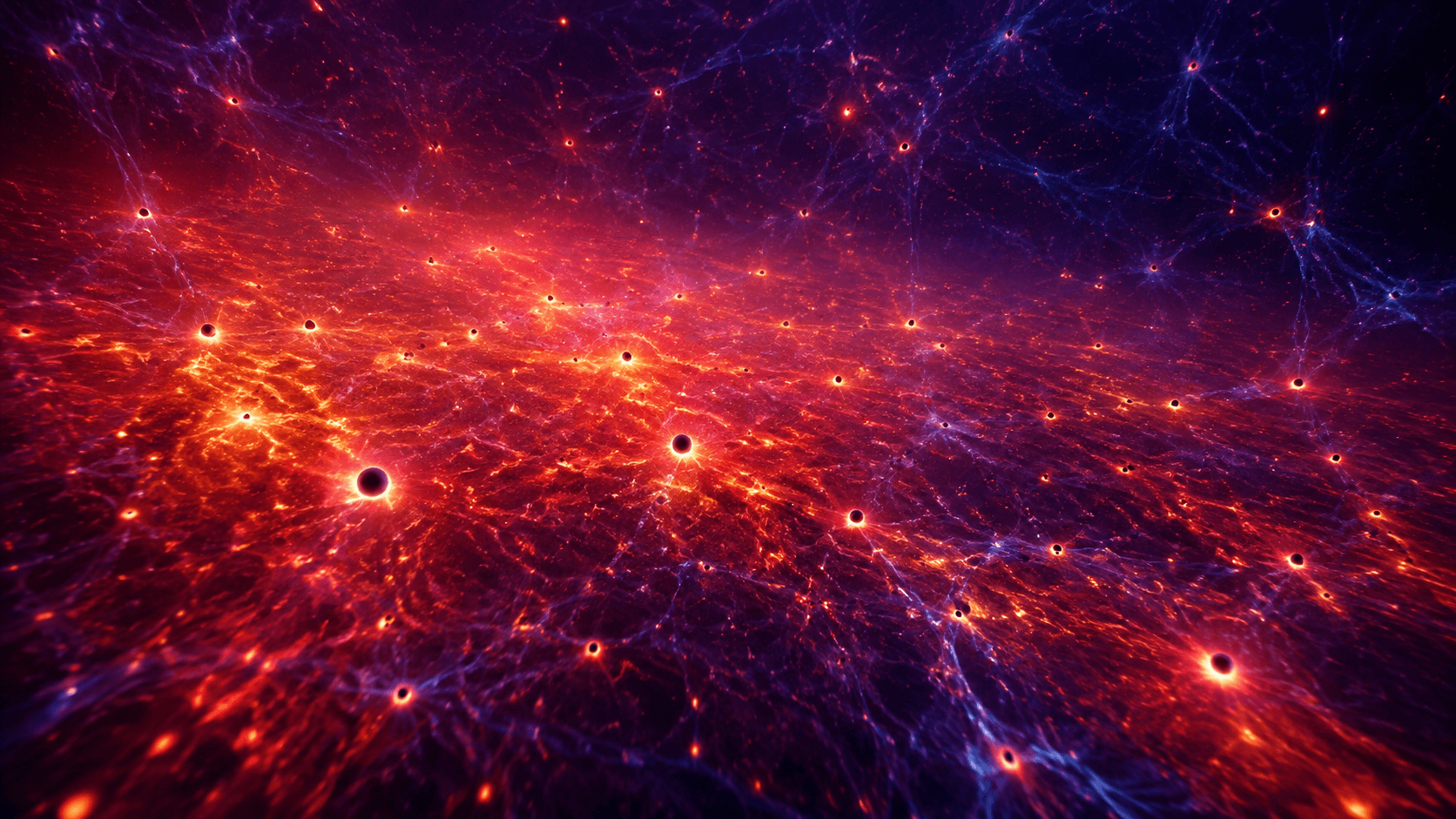
Quick answer: Primordial black holes are hypothetical black holes that may have formed from unusually dense regions in the early universe rather than from collapsing stars.
Primordial Black Holes at a Glance
| Topic | Explanation |
|---|---|
| Definition | Hypothetical black holes formed in the early universe rather than from stellar collapse. |
| Physical setting | Early-universe density fluctuations, phase transitions, or other processes could have compressed matter enough to form black holes. |
| Key evidence | Constraints from microlensing, CMB effects, gravitational waves, dynamics, and gamma-ray searches. No confirmed detection of a primordial origin. |
| Why it matters | Would probe early-universe conditions and could account for some dark matter. |
| Important caution | "Primordial" describes a proposed origin, not a distinct appearance. |
What Are Primordial Black Holes?
Primordial black holes are hypothetical black holes that may have formed from unusually dense regions in the early universe rather than from collapsing stars. Early-universe density fluctuations, phase transitions, or other processes might have compressed matter enough to form black holes across a very broad range of possible masses.
The Essential Science
Searches use gravitational microlensing, cosmic microwave background effects, gravitational waves, dynamical influences, gamma-ray signals associated with possible evaporation, and comparisons with large-scale cosmology. No observation has yet established a primordial origin for a specific black hole.
Important Facts
A surviving population could illuminate conditions shortly after the Big Bang and might account for some fraction of dark matter. Current evidence does not justify saying primordial black holes are the dark matter.
How Astronomers Study Them
Searches include microlensing surveys of dense stellar fields, dynamical constraints from wide binaries and star clusters, gravitational-wave analyses of merger rates, and gamma-ray telescopes probing possible Hawking radiation.
What Telescopes Actually Measure
Microlensing surveys measure brief brightening events; gravitational-wave detectors measure spacetime strain; CMB experiments measure temperature and polarization anisotropies.
Origin and Development
Early-universe density fluctuations, phase transitions, or other processes might have compressed matter enough to form black holes across a very broad range of possible masses. Many mass ranges are constrained by observations, but constraints depend on formation models and population assumptions.
Structure and Physical Conditions
Physically, a primordial black hole would resemble a stellar-mass black hole of the same mass. Only origin distinguishes them.
Energy, Gravity, and Motion
Hawking radiation would cause very low-mass primordial black holes to evaporate over cosmic times; heavier ones would persist. Gravitational lensing and dynamical friction constrain higher-mass populations.
Connections to Other Cosmic Objects
Primordial black holes could seed supermassive black holes, contribute to dark matter, and merge to produce gravitational-wave signals distinct from stellar-origin sources.
What Is Known and What Remains Uncertain
No confirmed detection. Constraints exclude many mass ranges but depend on model assumptions. Some windows remain open.
Common Misconceptions
"Primordial" describes a proposed origin, not a distinct appearance. An individual black hole would be difficult to label primordial without population-level evidence.
How Primordial Black Holes Fit Into Cosmic Evolution
If they exist, they would predate stars and could influence structure formation and dark-matter demographics.
Best Ways to Explain Primordial Black Holes to Students
Emphasize the difference between a well-established theory and a testable hypothesis. Use the language of constraints and mass windows.
Why Primordial Black Holes Matter
They provide a unique probe of the early universe and a natural candidate for at least a component of dark matter.
A Responsible Summary
Primordial black holes remain hypothetical. Multiple observational channels place constraints, and specific mass windows continue to be tested.
Detailed Search Questions
What does "primordial black hole" mean?
A hypothetical black hole formed from early-universe density fluctuations rather than a collapsing star.
What evidence exists?
Only constraints — no confirmed detection. Constraints depend on model assumptions.
How would they differ from stellar-origin black holes?
Only in origin. Individual objects would be hard to distinguish without additional context.
Why do they matter?
They probe early-universe physics and could contribute to dark matter.
What remains unknown?
Whether they exist at all, and if so, in what mass range and abundance.
How are their signatures interpreted?
Population-level statistics — microlensing rates, gravitational-wave populations, gamma-ray backgrounds — carry the most weight.
What role do gravity and energy play?
Gravity governs formation, mergers, and lensing effects; Hawking radiation removes mass-energy from very low-mass examples.
Authoritative Source
Scientific content reviewed September 5, 2026.
Frequently asked questions
What are primordial black holes?
Primordial black holes are hypothetical black holes that may have formed from unusually dense regions in the early universe rather than from collapsing stars.
Are they confirmed?
No. No observation has yet established a primordial origin for a black hole. Constraints exclude many mass ranges but depend on assumptions about the population.
Could they be the dark matter?
A surviving population could account for some fraction of dark matter. Current evidence does not justify saying primordial black holes are the dark matter.
Can we tell them apart from stellar black holes?
Not easily for individual objects. Population-level statistics and specific mass ranges provide the strongest constraints.
Sources
- NASA — Dark Matter — last verified Sat Sep 05 2026 00:00:00 GMT+0000 (Coordinated Universal Time)
More in Black Holes
Intermediate-Mass Black Holes: Facts, Science and Complete Guide
Intermediate-mass black holes — proposed objects between stellar-mass and supermassive black holes, spanning roughly hundreds to hundreds of thousands of solar masses.
Stellar-Mass Black Holes: Facts, Science and Complete Guide
Stellar-mass black holes — compact remnants of massive stars, containing several to tens of solar masses, detected via X-rays, stellar motion, and gravitational waves.
Supermassive Black Holes: Facts, Science and Complete Guide
Supermassive black holes contain hundreds of thousands to billions of solar masses and occupy the centers of most large galaxies, including Sagittarius A* in the Milky Way.