
Astrometry and Exoplanets
Learn how astrometry finds exoplanets by measuring tiny changes in a star's position, how it differs from radial velocity, and what Gaia revealed.
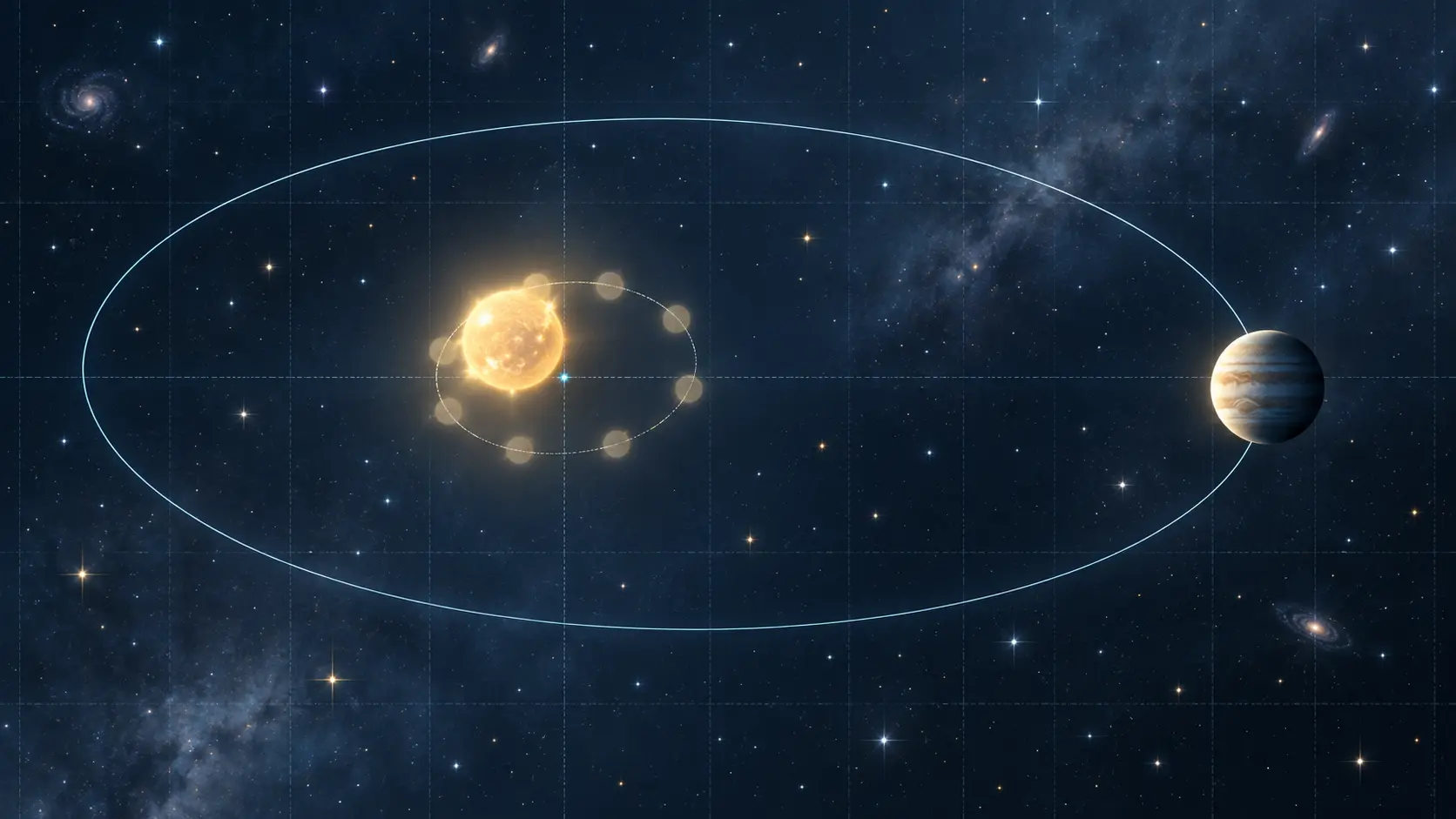
What is astrometry?
Astrometry finds exoplanets by measuring tiny changes in a star's position on the sky. An unseen planet pulls its star around their shared center of mass, making the star trace a small path relative to distant background objects. If researchers can separate that orbital wobble from the star's ordinary motion and from Earth's changing viewpoint, they can infer a planetary companion.
Astrometry is one of astronomy's oldest measurement disciplines. It determines the positions, distances, and motions of celestial objects. Applying it to exoplanets requires extraordinary precision because the angular displacement caused by a planet can be measured in microarcseconds — millionths of an arcsecond.
The method complements radial velocity. Radial velocity measures motion toward and away from Earth through Doppler shifts. Astrometry measures motion across the plane of the sky. Together they can reveal the three-dimensional orbit and true mass of a planet.
Why a star changes position
A planet and star both orbit their barycenter. If the planet is massive or far from the star, the star's physical orbit around this balance point is larger. Whether the motion looks large in the sky also depends on distance: the same physical displacement creates a bigger apparent angle for a nearby star than for a distant one.
Jupiter makes the Sun travel around a barycenter that can lie outside the solar surface. Seen from a nearby star system with sufficiently precise instruments, this motion would be a strong astrometric clue to Jupiter. Earth's effect is much smaller.
The size of the astrometric signal grows approximately with planet mass and orbital separation and decreases with stellar mass and system distance. That makes astrometry well suited to giant planets in wider orbits around nearby, lower-mass stars. This sensitivity differs from the strong short-period preference of transits and radial velocity.
Proper motion, parallax, and orbital wobble
A star's apparent position changes for several reasons. Proper motion is its genuine travel across space. Over time it creates an almost steady path across the sky. Parallax is the annual apparent shift caused by observing from different points in Earth's orbit. Nearby stars show a larger parallax ellipse against more distant objects.
An orbiting planet adds another periodic motion. The challenge is to fit all these components simultaneously. A short data set might confuse part of a long planetary orbit with a change in proper motion. A one-year orbital signal can interact with the annual parallax pattern. Multiple planets add more loops.
Accurate models include position at a reference time, proper motion, parallax, orbital parameters, instrument calibration, and sometimes perspective acceleration from the star's changing distance. The longer the observing baseline and the better the precision, the easier it becomes to separate the terms.
How astronomers measure angles this small
An arcsecond is 1/3,600 of a degree. A milliarcsecond is one-thousandth of an arcsecond, and a microarcsecond is one-millionth. At such scales, telescope optics, detector geometry, spacecraft attitude, temperature, relativistic light bending, and reference-star motion all matter.
Astrometric observatories repeatedly scan or image the sky. They compare each target with a network of reference sources and solve a large calibration problem. The reference points are not perfectly fixed: stars have their own parallax and proper motion, while distant quasars help define a stable frame.
Space offers a stable environment without atmospheric turbulence. Ground-based astrometry remains useful with adaptive optics, interferometry, and long-term programs, but broad microarcsecond precision is exceptionally demanding.
The astrometric orbit
The stellar wobble projected onto the sky generally appears as an ellipse. Its shape and orientation encode orbital inclination and the direction of the orbital plane. Unlike radial velocity alone, astrometry can determine whether an orbit is closer to face-on or edge-on.
The size of the ellipse, the period, and the known stellar properties constrain the companion's mass. Because inclination is measured rather than hidden inside a sine term, astrometry can provide true mass instead of only a minimum mass.
An orbital fit also yields eccentricity, time of closest approach, and orientation angles. With only a fraction of a long orbit observed, several solutions may remain possible. Additional data from radial velocity or direct imaging can greatly improve the fit.
Astrometry compared with radial velocity
Both methods observe the star's reflex motion, but from perpendicular directions. Radial velocity detects the line-of-sight component by measuring spectral shifts. Astrometry detects the transverse component through changes in sky position.
Radial velocity is strongest for systems viewed nearly edge-on because the star moves substantially toward and away from the observer. A perfectly face-on orbit creates almost no radial-velocity signal but displays its full astrometric circle. Astrometry therefore recovers some planets that Doppler searches find difficult.
Radial velocity favors massive close-in planets because their gravitational pull creates fast, repeated velocity changes. Astrometric displacement increases with orbital size, so it is particularly useful for longer-period giant planets. Observing a wide orbit still requires patience: researchers must cover enough of the period to distinguish curvature from proper motion.
Combining the methods produces a fuller orbit. Radial velocity can establish period and phase while astrometry supplies inclination and orientation. The joint solution reveals true mass and helps distinguish a planet from a heavier brown dwarf or low-mass star seen at an unfortunate inclination.
Astrometry compared with transits
A transit requires the planet's orbit to cross the stellar disk from Earth's viewpoint. Astrometry does not. It can examine systems in nearly any orientation and is actually strong for face-on orbits that never transit.
Transits measure planet radius and favor short periods. Astrometry measures stellar displacement and favors massive planets with wider separation. A transiting planet can still produce an astrometric signal, but small close-in worlds generally move the star by a tiny physical distance.
When both measurements exist, radius, true mass, density, and three-dimensional orbit become accessible. Such overlap is rare for small planets today but scientifically valuable.
Gaia and the astrometric revolution
The European Space Agency's Gaia mission repeatedly measured the sky with unprecedented breadth and precision. Its central goal was to build a three-dimensional map of the Milky Way by measuring positions, parallaxes, proper motions, brightness, colors, and, for many stars, radial velocities.
Planet discovery is one result of this stellar census. A giant planet can cause an otherwise unexplained astrometric orbit. Gaia data also identify accelerating stars whose paths curve because of unseen companions. Follow-up observations help determine whether the companion is a planet, brown dwarf, or star.
Gaia-4b became an important demonstration: a planet first identified through Gaia astrometry and confirmed with radial-velocity measurements. The result showed how survey astrometry and ground-based spectroscopy can work together. Data processing continues after observations, and later Gaia releases can improve orbital solutions because they use longer time baselines and refined calibrations.
It is important not to describe every Gaia non-single-star solution as a confirmed planet. Catalog signals include binary stars and candidates needing validation. Reliable classification requires appropriate orbital quality checks and, often, independent evidence.
How a candidate becomes convincing
Analysts first test whether standard position, proper motion, and parallax explain the observations. If significant structured residuals remain, they consider acceleration or an orbit. The orbital period must be supported by adequate sampling and should not arise from scanning patterns or calibration issues.
The fitted companion mass can eliminate some interpretations, but stellar-mass companions can be faint. Spectroscopy searches for radial velocity and signs of a second set of spectral lines. High-contrast imaging may reveal a luminous companion. Photometry can detect eclipses or stellar variability.
A combined solution should predict all data consistently. If the astrometric orbit specifies an inclination and phase, the radial-velocity curve should match. Long-term imaging should place a wide companion at the predicted position. This cross-checking turns a subtle positional signal into a robust planetary measurement.
The role of long observing baselines
Suppose a Jupiter analog takes about twelve years to orbit. A mission lasting five years observes less than half of its path. The data may show curvature and acceleration without closing the ellipse. Earlier position catalogs and later follow-up extend the baseline and help constrain the orbit.
Researchers sometimes compare the proper motion measured during one mission with a longer-term proper motion calculated from widely separated catalogs. A difference can reveal acceleration by a companion. This technique is powerful for selecting targets for direct imaging or radial-velocity monitoring.
Time is therefore part of the instrument. An unchanged telescope can become more informative simply because the observing span grows. Archiving calibrated measurements and connecting reference frames across decades are central to astrometric planet science.
Advantages of the astrometric method
Astrometry measures orbital inclination and can yield true companion mass. It works for face-on systems and does not need a transit. It is naturally sensitive to nearby giant planets on wider orbits, complementing methods that emphasize close-in worlds.
The method provides the orbit's orientation on the sky. This helps plan direct-imaging observations by predicting where a planet should appear and when its separation will be favorable. It can identify massive outer planets that influence the stability and history of smaller inner worlds.
Large surveys measure stars for many scientific purposes at once. The same data that map the Galaxy can reveal binary stars, black-hole candidates, and planetary systems. Astrometry also improves stellar distance and mass estimates that support every other exoplanet technique.
Limitations and possible errors
Signals are extraordinarily small. Systematic calibration errors can imitate or distort an orbit. Distant stars show smaller angular motion, and low-mass close-in planets produce weak displacement. Long-period worlds require long baselines.
Modeling can become degenerate when only a small orbital arc is observed or when the period resembles one year. Reference sources move, blended companions shift the measured photocenter, and stellar surface features can produce small position changes in extremely precise data.
An astrometric companion is not automatically a planet. The measured motion could come from a brown dwarf or star, and light from an unresolved companion changes the photocenter. Follow-up spectroscopy and imaging are often essential.
Survey selection effects must also be modeled. A catalog of astrometric planets will overrepresent nearby systems, massive companions, and separations suited to the mission duration.
Astrometry and direct imaging
Direct imaging benefits enormously from prior orbital knowledge. Searching blindly near a bright star requires examining a large region and coping with uncertain separation. An astrometric orbit can predict the planet's location, reducing search space and improving scheduling.
Once imaged, the planet's relative position adds another astrometric measurement. Combining absolute motion of the star with relative planet-star imaging can yield a dynamical mass that depends less on uncertain cooling models.
This partnership is particularly valuable for young giant planets. Imaging supplies atmospheric spectra and brightness; astrometry supplies mass and orbit. A planet with both becomes a benchmark for testing how planetary luminosity changes with age and formation conditions.
Could astrometry find another Earth?
An Earth twin would move a Sun-like star by a very small amount. The astrometric signature grows for nearby systems, but reaching the required precision and stability is difficult. A dedicated future space mission could target nearby stars with long, repeated observations.
Such a detection would be valuable before direct imaging. Knowing the orbit could tell a future telescope when the planet is most separated from its star. True mass would help interpret radius or atmospheric measurements.
The challenge is not only photon collection. Instrument geometry must remain calibrated at extraordinary levels, and stellar activity can shift a star's apparent center. The search pushes optics, detectors, spacecraft control, and statistical inference simultaneously.
A simple astrometry example
Imagine a nearby star measured many times over ten years. Proper motion produces a steady diagonal track. Annual parallax adds a repeating loop. After both are fitted, the residual positions trace a slower ellipse with a five-year period.
Spectroscopy finds a matching five-year radial-velocity cycle. The astrometric ellipse shows that the orbit is tilted 40 degrees rather than edge-on. Correcting for inclination turns the Doppler minimum mass into a true mass consistent with a giant planet.
Direct imaging later detects a faint source at the predicted location. Its spectrum indicates a cool atmosphere, and continued imaging follows the orbit. Three methods now tell one consistent story: astrometry provides sky-plane motion and inclination, spectroscopy provides line-of-sight velocity, and imaging provides planetary light.
Frequently asked questions
How does astrometry detect an exoplanet?
It repeatedly measures a star's position and searches for a periodic wobble caused by the gravity of an orbiting planet.
What is the difference between astrometry and radial velocity?
Astrometry measures motion across the sky. Radial velocity measures motion toward and away from Earth using Doppler shifts.
Why can astrometry measure true mass?
It can determine orbital inclination. That removes the unknown inclination factor that often limits radial velocity to minimum mass.
Did Gaia discover exoplanets?
Gaia data have produced astrometric planet candidates and discoveries confirmed through follow-up, including Gaia-4b. Catalog solutions must still be checked because many unseen companions are stars or brown dwarfs.
What planets are easiest for astrometry?
Massive planets on relatively wide orbits around nearby stars generally create the largest angular wobble.
Compare all exoplanet detection methods
No single technique reveals every kind of planet. Each is sensitive to a different combination of planet size, mass, distance and orbital geometry, so the full catalog is a mosaic of all of them working together.
| Method | Main signal | Best suited to | Key measurement | Main limitation |
|---|---|---|---|---|
| Transit | Repeating dip in starlight | Short-period planets aligned with Earth | Radius and period | Most orbits do not transit |
| Radial velocity | Doppler shift of stellar spectrum | Massive or close planets around bright stars | Minimum mass and orbit | Stellar activity and inclination |
| Direct imaging | Planetary light separated from star | Young giant planets on wide orbits | Spectrum, brightness, projected position | Extreme contrast |
| Microlensing | Temporary magnification anomaly | Distant and cold planets | Mass ratio and projected separation | Usually does not repeat |
| Astrometry | Position change across sky | Nearby massive planets on wider orbits | True mass and orbital orientation | Extremely small angles and long baselines |
Related exoplanet detection methods
Transit method
A planet crossing between us and its star briefly dims its light. Repeat dips at a fixed period reveal an orbiting world and measure its size.
Radial velocity
A planet's gravity tugs its star into a small, rhythmic wobble. Precise spectrographs measure the Doppler shift and reveal the planet's orbit and mass.
Direct imaging
Coronagraphs and starshades block the star's glare so a young, warm planet can be photographed as its own point of light.
Gravitational microlensing
A foreground star's gravity briefly magnifies a background star's light. A planet in the foreground system adds a short, revealing anomaly.
Sources and further reading
- European Space Agency — How to Find an Exoplanet — last verified 2026-09-17
- European Space Agency — Wobbling Stars Reveal Hidden Companions in Gaia Data — last verified 2026-09-17
- Carnegie Science — First Gaia Astrometric Planet Discovery Confirmed — last verified 2026-09-17
- NASA Exoplanet Archive — last verified 2026-09-17