
Gravitational Microlensing and Exoplanets
Understand how gravitational microlensing detects exoplanets through temporary brightening, what its light curves reveal, and why Roman will use it.
What is gravitational microlensing?
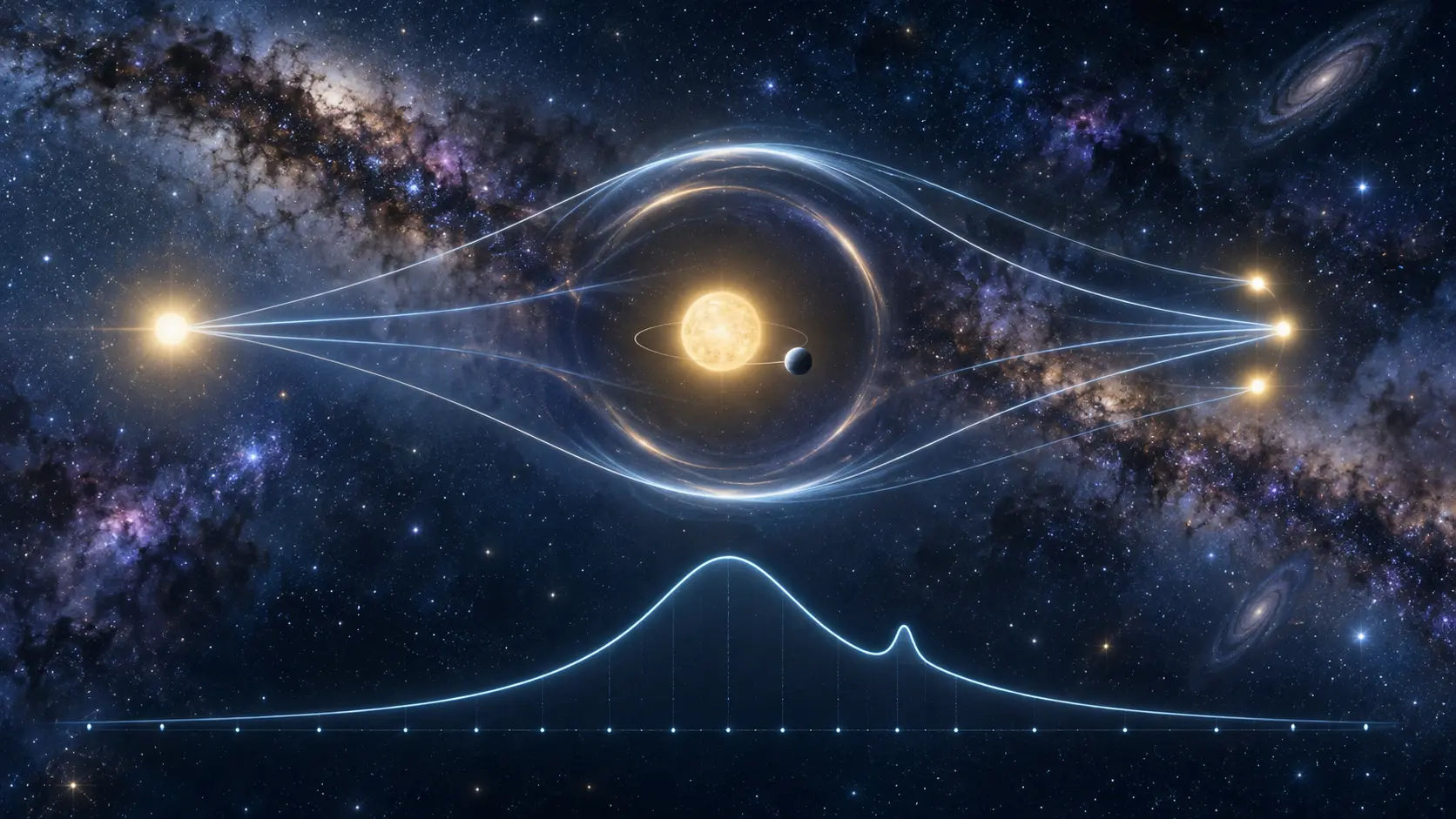
Gravitational microlensing finds exoplanets when the gravity of a foreground star and its planet bends and magnifies light from a more distant background star. The objects must pass into a rare, close alignment from Earth's viewpoint. As the alignment improves and then separates, the background star temporarily brightens. A planet orbiting the foreground lens star can add a short feature to the otherwise smooth brightening curve.
The technique is based on general relativity. Mass curves spacetime, changing the path followed by light. A star can therefore behave like a natural lens even though it is not transparent glass. In ordinary microlensing observations, the separate lensed images are too close together for the telescope to resolve. Astronomers instead measure their combined change in brightness.
Microlensing can reveal planets that are difficult to find through other methods, including low-mass worlds at moderate or wide distances from their stars, planets thousands of light-years away, and possibly planets traveling without a host star.
From gravitational lensing to microlensing
Gravitational lensing appears on several scales. A galaxy cluster can produce visible arcs and multiple images of more distant galaxies. A single foreground star has a much smaller angular effect. Its multiple images of a background star are usually separated by only tiny angles, so the event is called microlensing.
In perfect alignment, the background source would form an Einstein ring around the lens. More commonly, the alignment is offset and creates unresolved images with changing total magnification. The size scale depends on the lens mass and the distances among observer, lens, and source.
No light must come from the lens itself. Gravity creates the signal. This allows microlensing to detect faint stars, dark remnants, and planets whose own light would be impossible to see at such distances.
The shape of a microlensing light curve
A basic single-lens event produces a smooth, symmetric rise and fall in the background star's brightness. The event may last days, weeks, or months. The timescale depends on lens mass, geometry, distance, and relative motion.
If the lens star has a planet, the planet creates additional regions of high magnification called caustics. When the source star passes near or across one, the light curve departs from the simple shape. This planetary anomaly might last days for a giant world or only hours for a low-mass planet.
Dense monitoring is crucial. Missing a few hours because of daylight or clouds can erase the strongest evidence for a small planet. Microlensing networks place telescopes at different longitudes so one observatory can continue after another rotates into daylight.
How the planet's gravity changes the event
The star supplies most of the lensing mass and creates the main brightening. Its planet slightly changes the gravitational map around the lens system. The magnitude and duration of the anomaly depend strongly on the planet-to-star mass ratio and on the projected separation at the time of the event.
Analysts compare the observed light curve with binary-lens models. They search a large parameter space because multiple configurations can sometimes produce similar features. Finite size of the source star, Earth's motion, and observations from different locations can add information.
Microlensing directly measures a mass ratio more readily than an absolute planet mass. Converting the fit into physical mass and distance requires additional constraints or statistical models. High-resolution follow-up may later separate the foreground lens star from the background source and measure its light and motion.
Why microlensing events are usually one-time discoveries
Transits and radial velocity repeat every orbit. Microlensing depends on a chance alignment among observer, foreground lens, and distant source. Once relative motion carries the objects apart, the same geometry is extraordinarily unlikely to return.
This means astronomers cannot simply wait for the next event to confirm a missed feature. They must capture the light curve as it happens. Survey teams use automated alerts so follow-up telescopes can increase observation frequency during promising events.
The lack of repetition is a limitation, but it does not make the evidence unscientific. A detailed, densely sampled light curve can contain a distinctive planetary pattern. Independent telescopes, filters, and analysis groups can test the interpretation.
Why astronomers watch the center of the Milky Way
Microlensing requires a foreground lens and a more distant source to align. The dense star fields toward the Galactic bulge offer an enormous number of potential combinations. Surveys monitor millions of stars, looking for the rare ones that brighten in the expected way.
Crowding makes these fields challenging. Many stars blend into the same detector pixels, dust dims visible light, and brightness varies for ordinary astrophysical reasons. Difference imaging subtracts a reference view from later images to reveal what changed. Infrared space observations can see through more dust and deliver stable, sharp measurements.
Major programs have included the Optical Gravitational Lensing Experiment, known as OGLE, the Microlensing Observations in Astrophysics collaboration, known as MOA, and the Korea Microlensing Telescope Network. Their long-running surveys discover events and enable rapid follow-up.
What kinds of planets microlensing can find
Microlensing is sensitive to planets near a special projected region related to the lens star's Einstein ring. For common Galactic lens systems, that often corresponds to orbital separations of a few astronomical units. This makes the technique valuable for planets beyond the snow line, where water and other volatile materials could condense during formation.
The method can detect giant planets, Neptune-mass worlds, and lower-mass planets when the alignment, cadence, and signal quality are favorable. Because the signature depends strongly on mass ratio rather than planetary light, a cold planet can be detected even if it emits almost no observable radiation.
It also reaches distant systems across the Milky Way, sampling a population different from nearby radial-velocity and direct-imaging targets. This geographic reach helps test whether planet populations change with Galactic environment.
Free-floating and wide-orbit planets
A short microlensing event without a clear host-star signature may be caused by a free-floating planet or a planet on such a wide orbit that its star has little effect during the event. These possibilities are scientifically exciting but difficult to distinguish.
Very short events demand rapid cadence and careful rejection of instrumental or stellar variability. Measuring the microlens parallax from separated observatories can constrain the lens. Later high-resolution imaging may search for a possible host.
Claims about free-floating planet abundance have evolved as samples and models improve. Articles should avoid treating every isolated short event as a confirmed rogue planet. Population estimates require correction for detection efficiency and consideration of alternative lens masses and geometries.
Turning model parameters into mass and distance
The primary event timescale alone does not uniquely determine lens mass. A massive distant lens moving quickly can resemble a lighter nearby lens moving slowly. This is the mass-distance-motion degeneracy.
Several measurements can help. Finite-source effects can yield the angular Einstein radius when the source star's angular size is estimated. Microlens parallax measures differences caused by Earth's orbit or by observing from widely separated locations, such as Earth and a spacecraft. Combining these quantities can determine lens mass and distance more directly.
Lens light may become visible after the source and lens separate enough for a high-resolution telescope to distinguish them. Its brightness and color constrain the host star. Proper motion confirms that the object followed the expected path. Not every event offers all these measurements, so published planet properties can have broad uncertainties.
Advantages of gravitational microlensing
The technique does not depend on receiving light from the planet or even the host star. It can detect cold, low-luminosity planets at great distance. It is sensitive to separations that complement the short orbits favored by transits and radial velocity.
Microlensing can survey dense star fields and estimate how common planets are beyond the snow line. It has potential sensitivity to low-mass and unbound worlds. It can also detect systems whose orbital planes have any orientation; no transit alignment is required.
These strengths make microlensing essential for a complete planetary census. A galaxy containing many close-in planets but few cold outer worlds would form differently from one resembling the broad architecture of our Solar System.
Limitations and selection effects
Events usually do not repeat. Targets can be faint and extremely distant, making follow-up by radial velocity or transit observations impractical. The measured mass ratio and projected separation do not automatically give exact planet mass and full orbit.
Rare alignments require monitoring enormous numbers of stars. Crowding, dust, weather, and day-night cycles complicate ground surveys. Planetary features can be short, while model degeneracies sometimes admit more than one solution.
Microlensing is therefore powerful statistically but not always ideal for detailed atmospheric study of each planet. It tells researchers about populations that other techniques barely sample.
The Nancy Grace Roman Space Telescope and microlensing
NASA's Nancy Grace Roman Space Telescope is designed to conduct a wide-field infrared survey toward dense regions of the Milky Way. From space, it avoids atmospheric turbulence and daylight while achieving stable, high-resolution imaging across a large field.
Roman's planned Galactic exoplanet survey will monitor stars frequently enough to capture brief anomalies. Scientists expect it to discover a broad range of planets, including worlds with masses and orbital distances that are hard for current surveys. Exact predicted counts depend on survey design and assumptions about the true planet population, so they should be described as forecasts rather than guarantees.
Roman can also use the parallax effect and precise imaging to improve mass measurements for many events. Its census will complement transit discoveries, direct images, and local radial-velocity systems. Together, these techniques can map planets from scorching close orbits to cold outer regions and possibly unbound space.
A simple example
Suppose a background star gradually becomes brighter over several weeks and then fades symmetrically. A single foreground star can explain the main curve. During one night, however, the brightness rises sharply, changes direction, and returns toward the expected curve.
Telescopes at several sites record the same feature, ruling out local weather or a detector problem. A binary-lens model fits the anomaly with a small companion to the foreground star. The fitted mass ratio suggests a planet, and the projected separation places it near the host's outer planetary region.
Later measurements estimate the source star's size and relative motion. Space and ground observations provide parallax. Together they yield a physical mass estimate and distance. This chain — from alert to anomaly to modeling and follow-up — illustrates why microlensing is both time-sensitive and information-rich.
Frequently asked questions
How does gravitational microlensing detect a planet?
A foreground star magnifies a background star's light. A planet around the foreground star adds a brief, recognizable change to the magnification pattern.
Does the planet pass in front of the background star?
It does not need to physically cover the star. Its gravity bends light when the objects appear closely aligned on the sky.
Why can't astronomers observe the same event again?
The signal depends on moving objects entering a rare alignment. Once they separate, that precise geometry normally never repeats.
Can microlensing find Earth-size planets?
It can detect low-mass planets in favorable events. Sensitivity depends on observing cadence, alignment, noise, source size, and the planet-to-star mass ratio.
What is a free-floating planet?
It is a planetary-mass object not gravitationally bound to a star. Some short microlensing events are candidates, but distinguishing truly unbound planets from wide-orbit worlds requires careful analysis.
Compare all exoplanet detection methods
No single technique reveals every kind of planet. Each is sensitive to a different combination of planet size, mass, distance and orbital geometry, so the full catalog is a mosaic of all of them working together.
| Method | Main signal | Best suited to | Key measurement | Main limitation |
|---|---|---|---|---|
| Transit | Repeating dip in starlight | Short-period planets aligned with Earth | Radius and period | Most orbits do not transit |
| Radial velocity | Doppler shift of stellar spectrum | Massive or close planets around bright stars | Minimum mass and orbit | Stellar activity and inclination |
| Direct imaging | Planetary light separated from star | Young giant planets on wide orbits | Spectrum, brightness, projected position | Extreme contrast |
| Microlensing | Temporary magnification anomaly | Distant and cold planets | Mass ratio and projected separation | Usually does not repeat |
| Astrometry | Position change across sky | Nearby massive planets on wider orbits | True mass and orbital orientation | Extremely small angles and long baselines |
Related exoplanet detection methods
Transit method
A planet crossing between us and its star briefly dims its light. Repeat dips at a fixed period reveal an orbiting world and measure its size.
Radial velocity
A planet's gravity tugs its star into a small, rhythmic wobble. Precise spectrographs measure the Doppler shift and reveal the planet's orbit and mass.
Direct imaging
Coronagraphs and starshades block the star's glare so a young, warm planet can be photographed as its own point of light.
Astrometry
Precise position measurements reveal the tiny looped path an orbiting planet forces on its star. Gaia is beginning to unveil long-period giants this way.
Sources and further reading
- NASA Science — Microlensing — last verified 2026-09-17
- NASA Goddard Scientific Visualization Studio — Roman Space Telescope Microlensing Animations — last verified 2026-09-17
- The Planetary Society — Space-Warping Planets, The Microlensing Method — last verified 2026-09-17
- NASA Roman Science Center — Exoplanets — last verified 2026-09-17