
Direct Imaging of Exoplanets
Learn how direct imaging reveals exoplanets by blocking stellar glare, how coronagraphs work, what the images show, and why the method is difficult.
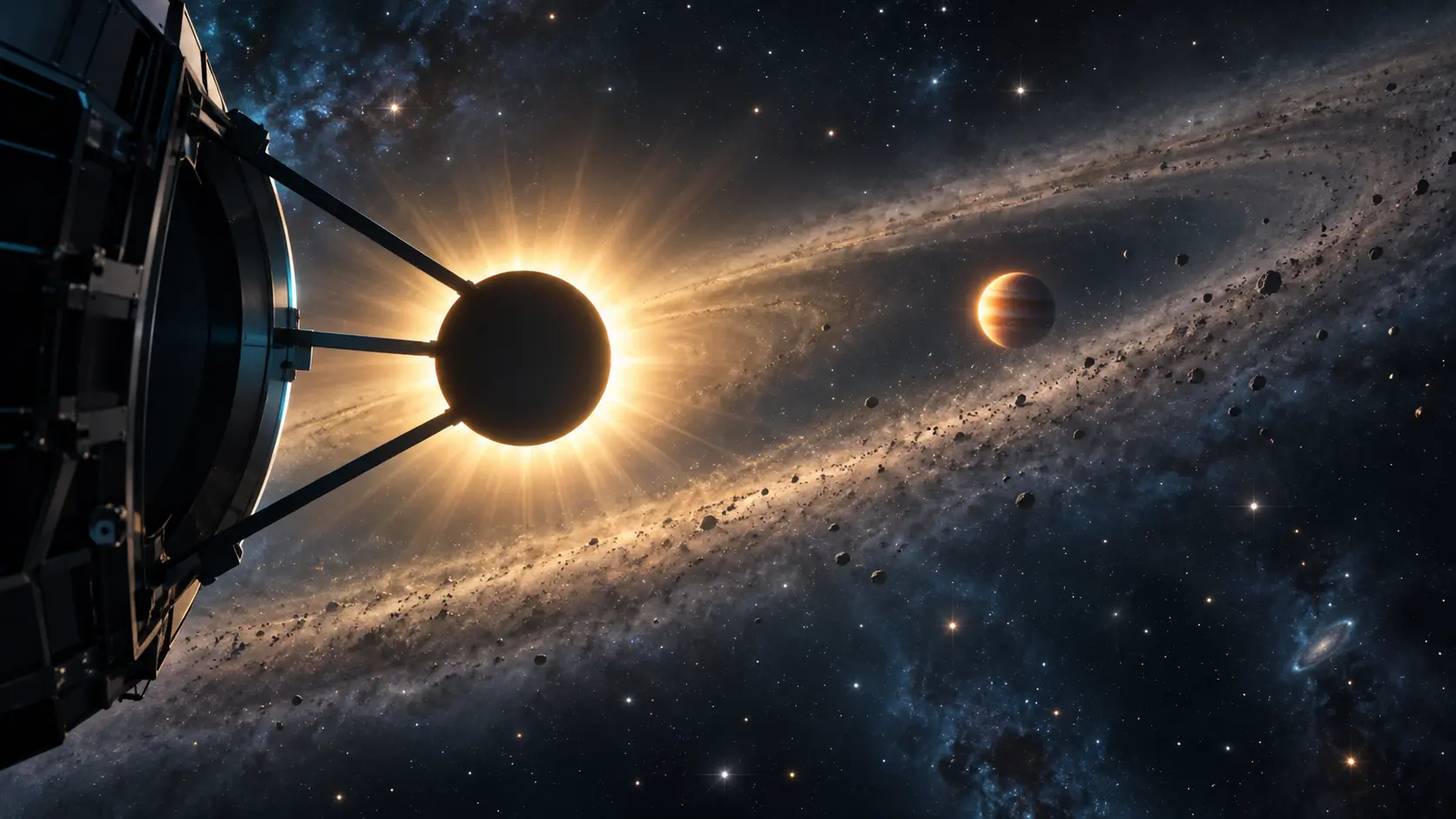
What is direct imaging of exoplanets?
Direct imaging of exoplanets means detecting light from a planet as a source separate from its host star. The result may look like a tiny dot rather than a detailed globe, but that dot contains valuable information. Astronomers can track its motion, measure its brightness at different wavelengths, and sometimes obtain a spectrum of its atmosphere.
This method is fundamentally different from watching a star dim or wobble. Transit and radial-velocity measurements infer a planet through its effect on starlight or stellar motion. Direct imaging attempts to isolate photons coming from the planetary system itself — thermal radiation emitted by a warm planet or starlight reflected from its atmosphere and clouds.
The central problem is contrast. A star like the Sun can be billions of times brighter than an Earth-like planet seen in reflected visible light. Even a giant planet is extremely faint beside its star. The two objects also appear very close together at interstellar distances. Direct imaging therefore demands exceptional optics, careful control of scattered light, and advanced processing.
Why a nearby star hides its planets
Imagine trying to see a firefly beside a lighthouse from many kilometers away. The lighthouse is not only brighter; glare spreads through the optics and atmosphere, covering the nearby point. Exoplanet imaging faces a similar problem on a far more demanding scale.
Light behaves like a wave. When it enters a telescope, diffraction creates rings and structure around the star's image instead of a perfect point. Imperfections in mirrors produce additional patterns called speckles. From the ground, turbulence constantly changes the incoming wavefront. A faint planet may sit inside this structured glare.
Angular separation is equally important. A planet far from its star in physical distance may still appear only a fraction of an arcsecond away. Larger telescopes provide finer resolution, while shorter wavelengths generally sharpen the view. However, planet-star contrast and atmospheric turbulence change with wavelength, so instrument design involves tradeoffs.
Coronagraphs: creating an artificial eclipse
A coronagraph is an optical system that suppresses starlight inside a telescope. In a simplified explanation, a mask blocks the bright central star while other components control diffraction and remove scattered light. The name comes from instruments used to hide the Sun's disk so its faint corona can be observed.
Modern exoplanet coronagraphs are more sophisticated than a single opaque circle. They use carefully shaped masks, pupil stops, wavefront sensors, and deformable mirrors. A deformable mirror has actuators that make extremely small adjustments to correct optical errors and reduce speckles in a selected region around the star.
Different coronagraph designs balance throughput, bandwidth, inner working angle, sensitivity to pointing errors, and manufacturing complexity. The inner working angle describes how close to the star the instrument can effectively search. A design that reaches closer can investigate planets on smaller apparent orbits, but it may demand tighter stability.
NASA's Nancy Grace Roman Space Telescope carries a coronagraph technology demonstration designed to advance high-contrast imaging capabilities. Future observatories aim to build on such technologies to search for smaller, cooler planets around nearby stars.
Starshades: blocking light before it reaches the telescope
A starshade is a different concept. It would be a separate spacecraft flying tens of thousands of kilometers in front of a space telescope. Its carefully shaped petals would block and diffract a target star's light so a deep shadow falls on the telescope, while light from nearby planets enters the telescope.
External suppression can offer broad wavelength coverage and reduce some internal optical demands. However, formation flying must be extremely accurate. Repositioning a starshade between targets consumes fuel and takes time. The structure would need to deploy reliably at a large scale.
Coronagraphs and starshades are not interchangeable solutions in every mission. They have different engineering strengths, observing cadences, and risks. Both address the same central requirement: reduce stellar glare without erasing the nearby planetary signal.
Adaptive optics for ground-based telescopes
Earth's atmosphere bends and mixes incoming starlight. Stars twinkle to the human eye, while a telescope sees a rapidly changing blur. Adaptive optics measures these distortions with a wavefront sensor and reshapes a mirror many times per second to compensate.
A bright natural guide star or an artificial laser guide star helps characterize turbulence. Extreme adaptive-optics systems are optimized for high contrast near bright stars. They combine fast correction with coronagraphs and specialized cameras.
Ground observatories benefit from very large mirrors and instruments that can be upgraded. They are especially powerful at infrared wavelengths for young, warm planets. They must still contend with atmospheric absorption, thermal background, weather, and residual speckles. Upcoming extremely large telescopes are expected to improve resolution and sensitivity substantially.
Why young, massive, widely separated planets are easier
Newly formed giant planets retain heat from their formation. They glow strongly in infrared light and can be much brighter relative to their stars than older, cooler planets. A massive young world on a wide orbit also has a larger angular separation, making it easier to distinguish from glare.
This creates a strong selection effect. Many directly imaged planets are not Earth analogs. They are young gas giants orbiting far from their stars. Their temperatures, masses, and system ages help scientists test how giant planets form, cool, migrate, and interact with disks.
An older Earth-size planet near a Sun-like star is extraordinarily difficult. It is faint, close to the star in angular terms, and primarily seen through reflected light in visible wavelengths. Detecting such a world requires contrast control far beyond a normal astronomical camera.
How astronomers know the dot is a planet
A faint source near a star might be a background star or galaxy. Researchers take images months or years apart. Nearby stars have measurable proper motion across the sky. A bound planet should move with the star rather than remain fixed in the distant background.
Astronomers also look for orbital motion around the host. Because wide-orbit planets may take decades or centuries to complete an orbit, observations often capture only a short arc. Statistical orbit fitting combines the changing positions with knowledge of the star's mass and distance.
Spectral measurements can show temperatures and molecular absorption expected for a planetary atmosphere. Brightness and system age are compared with evolutionary models to estimate mass, although those estimates depend on assumptions about formation and cooling. In some systems, dynamical effects or other detection methods provide additional constraints.
Famous directly imaged planetary systems
HR 8799 is one of the best-known examples. Multiple giant planets have been imaged orbiting the young star, and repeated observations show their motion. Because several planets share the system, astronomers can study orbital stability, resonances, atmospheric properties, and formation history.
Beta Pictoris hosts a young planetary system and a prominent debris disk. Imaging connects the planet with structures in the disk and shows how planets can shape surrounding material. Other famous targets include 51 Eridani b and giant companions on wide orbits.
Images of protoplanetary and debris disks are closely related to direct planet studies. Rings, gaps, spirals, and asymmetries can hint at unseen planets, but a disk feature alone is not always proof. Gas, dust, magnetic fields, and disk physics can create complex structures.
The list of directly imaged worlds changes as observations and classifications improve. A companion's mass can place it near the boundary among planets, brown dwarfs, and low-mass stars. Clear reporting should distinguish confirmed planets, candidates, and objects with uncertain formation histories.
What a direct image can reveal
Images provide the planet's projected separation and position angle relative to its star. Repeated images constrain the orbit. Measurements in several filters create a rough spectral energy distribution, showing how brightness changes with wavelength.
If the object is bright enough, spectroscopy can reveal molecules, clouds, surface gravity, temperature, and atmospheric chemistry. Researchers have detected substances including water, carbon monoxide, and methane in some giant-planet atmospheres. Cloud particles can make spectra unexpectedly red or smooth and complicate model fits.
Direct imaging can measure rotation in favorable cases through spectral line broadening or changing brightness. Time-series observations may trace patchy clouds. Polarization can help separate planet or disk light from stellar glare and reveal properties of scattering particles.
Unlike a transit spectrum, a direct spectrum does not require the planet to cross its star. That opens atmospheric study to systems in many orientations and to planets on wide orbits. It also allows repeated observations at selected orbital phases, subject to telescope sensitivity.
Image processing and the danger of false signals
Raw high-contrast images are dominated by residual starlight. Observers rotate the field, change wavelengths, or use reference stars so algorithms can model the stellar point-spread function and subtract it. Techniques such as angular differential imaging and spectral differential imaging help distinguish a real source from speckles.
Processing can accidentally remove part of a planet's signal or turn noise into a planet-like spot. Teams inject artificial planets into data to measure sensitivity and processing bias. They report contrast curves showing what brightness levels could have been detected at different separations.
Independent observations strengthen a discovery. A candidate should persist across appropriate wavelengths and epochs, move consistently with the host, and survive alternative reductions. Scientific images are not simple snapshots; they are calibrated measurements whose processing must be documented.
Advantages of direct imaging
Direct imaging does not require an edge-on orbit. It can discover planets far from their stars, a region where transit monitoring would take a very long time and radial-velocity signals would evolve slowly. It allows light from the planet to be studied separately, enabling atmospheric spectra and measurements of clouds, temperature, and chemistry.
Images also place planets in the visible context of disks and other companions. Repeated positions show orbital motion. For nearby systems, imaging can complement astrometry and radial velocity to determine three-dimensional architecture and dynamical mass.
The method is particularly valuable for understanding young planetary systems. Their planets are bright in infrared light, and their disks preserve evidence of formation and interaction.
Limitations and biases
The enormous contrast and tiny angular separation exclude most planets from current direct detection. Surveys strongly favor young, hot, massive planets on wide orbits around nearby stars. A detected point usually does not display continents, rings, or weather patterns spatially; it remains unresolved.
Mass estimates often rely on cooling models and the uncertain age of the host. Background objects and speckles can imitate companions. Long orbital periods mean that only a small section of an orbit may be observed. Telescope time, stable weather, and complex processing limit survey size.
These biases are scientifically important. Direct-imaging catalogs probe a different part of planet population space than transit or radial-velocity catalogs. Combining their results gives a more complete view.
JWST, Roman, and future observatories
The James Webb Space Telescope provides powerful infrared sensitivity, coronagraphic modes, and spectroscopy for selected planets and disks. It is not designed to photograph an Earth twin beside a Sun-like star, but it can study young giants and push toward lower masses in favorable systems.
Roman's Coronagraph Instrument is intended primarily as a technology demonstration. Its advances in masks, detectors, deformable mirrors, and wavefront control are steps toward future missions capable of much deeper contrast.
NASA's planned Habitable Worlds Observatory concept is aimed at directly imaging and characterizing potentially habitable worlds around nearby Sun-like stars, while major ground telescopes will use their large apertures for high-resolution infrared studies. Success will require not only detecting a faint dot but separating atmosphere, surface, cloud, and stellar effects well enough to make careful claims.
Frequently asked questions
Have exoplanets actually been photographed?
Yes. Astronomers have directly imaged a limited number of exoplanets, usually young giant worlds on wide orbits. They normally appear as points of light rather than detailed disks.
Why is direct imaging so hard?
A planet is extremely faint compared with its star and appears very close to it. Diffraction, optical imperfections, and atmospheric turbulence spread starlight over the planet's location.
What does a coronagraph do?
It suppresses a star's light inside a telescope so that much fainter nearby planets or disks can be detected.
Can JWST directly image an Earth-like exoplanet?
JWST can image and study some exoplanets, especially young giants, but it was not designed to capture an Earth twin in reflected light next to a Sun-like star.
Are direct images true color?
Not necessarily. Scientific images often combine infrared filters or map invisible wavelengths to visible colors. Captions should explain how an image was constructed.
Compare all exoplanet detection methods
No single technique reveals every kind of planet. Each is sensitive to a different combination of planet size, mass, distance and orbital geometry, so the full catalog is a mosaic of all of them working together.
| Method | Main signal | Best suited to | Key measurement | Main limitation |
|---|---|---|---|---|
| Transit | Repeating dip in starlight | Short-period planets aligned with Earth | Radius and period | Most orbits do not transit |
| Radial velocity | Doppler shift of stellar spectrum | Massive or close planets around bright stars | Minimum mass and orbit | Stellar activity and inclination |
| Direct imaging | Planetary light separated from star | Young giant planets on wide orbits | Spectrum, brightness, projected position | Extreme contrast |
| Microlensing | Temporary magnification anomaly | Distant and cold planets | Mass ratio and projected separation | Usually does not repeat |
| Astrometry | Position change across sky | Nearby massive planets on wider orbits | True mass and orbital orientation | Extremely small angles and long baselines |
Related exoplanet detection methods
Transit method
A planet crossing between us and its star briefly dims its light. Repeat dips at a fixed period reveal an orbiting world and measure its size.
Radial velocity
A planet's gravity tugs its star into a small, rhythmic wobble. Precise spectrographs measure the Doppler shift and reveal the planet's orbit and mass.
Gravitational microlensing
A foreground star's gravity briefly magnifies a background star's light. A planet in the foreground system adds a short, revealing anomaly.
Astrometry
Precise position measurements reveal the tiny looped path an orbiting planet forces on its star. Gaia is beginning to unveil long-period giants this way.
Sources and further reading
- NASA Science — How We Find and Classify Exoplanets — last verified 2026-09-17
- Roman User Documentation — Roman Coronagraph Instrument — last verified 2026-09-17
- NASA Universe of Learning — Lights, Coronagraph, Action! — last verified 2026-09-17
- NASA Exoplanet Archive — last verified 2026-09-17