
Radial Velocity Method for Finding Exoplanets
Discover how the radial velocity method uses Doppler shifts and stellar wobble to find exoplanets, estimate mass, map orbits, and confirm transits.
What is the radial velocity method?
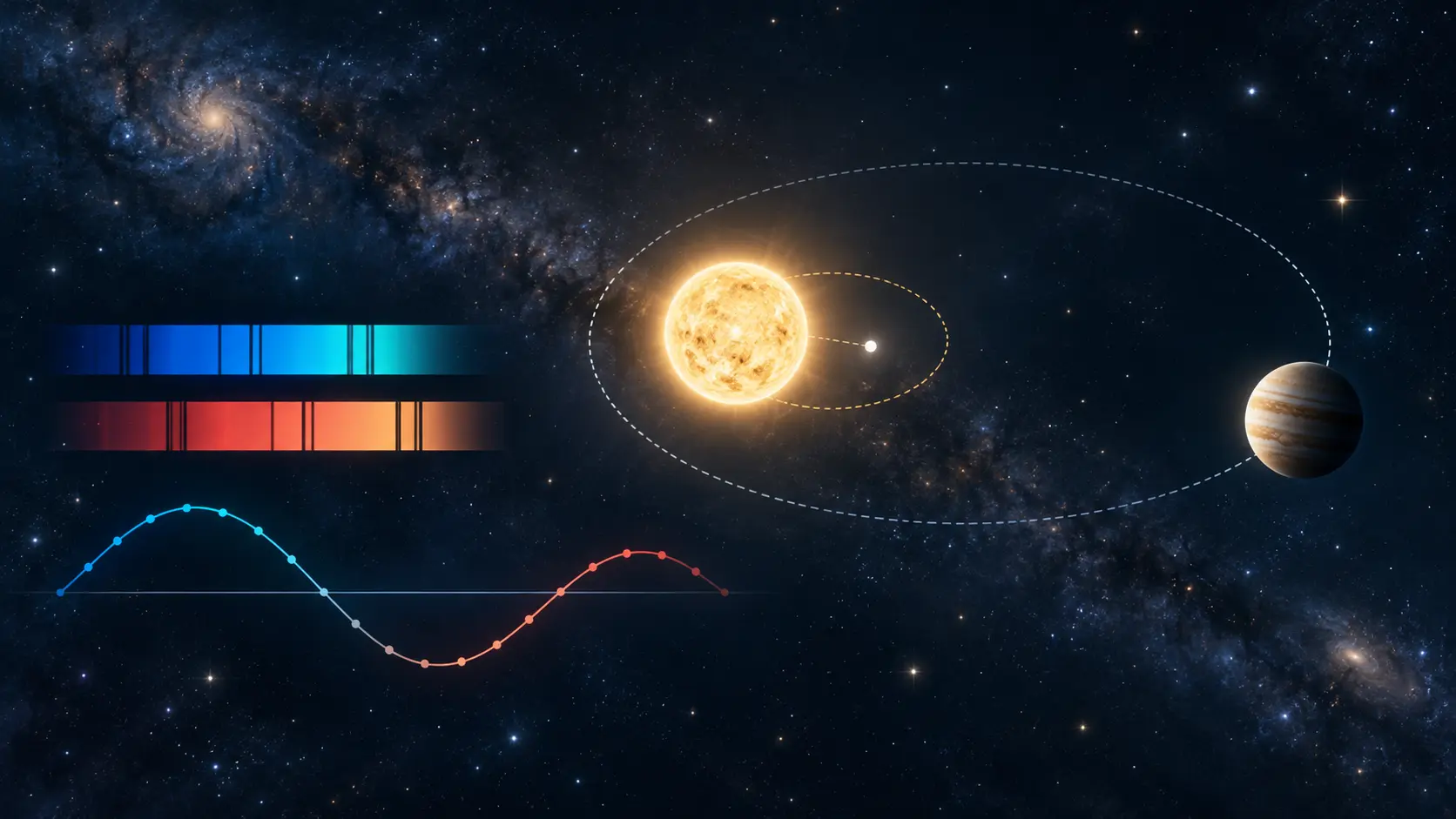
The radial velocity method for exoplanets detects the small back-and-forth motion of a star caused by the gravity of an orbiting planet. A planet does not simply circle a motionless star. Both objects orbit their shared center of mass. Because the star is much heavier, its orbit is small, but precise spectrographs can measure the part of that motion directed toward or away from Earth.
When the star moves toward us, its spectral lines shift slightly toward shorter, bluer wavelengths. When it moves away, the lines shift toward longer, redder wavelengths. This is the Doppler effect. A repeating pattern of redshift and blueshift can reveal an unseen companion, its orbital period, and a lower limit on its mass.
The technique is also known as Doppler spectroscopy, the Doppler method, or the stellar wobble method. It powered many early discoveries around ordinary stars and remains essential for confirming and measuring planets found by transit surveys.
Why a planet makes its star wobble
Gravity acts on both bodies. Imagine a heavy adult and a small child balanced on a seesaw. The balance point lies nearer the adult, but neither person remains exactly at the center. In a star-planet system, the balance point is called the barycenter. The star traces a small orbit around it while the planet traces a much larger one.
A massive planet produces a stronger pull. A close planet completes its orbit quickly and can create a large, rapidly repeating stellar signal. That is why early radial-velocity surveys readily found hot Jupiters: giant planets on very tight orbits. Smaller planets and wider orbits produce subtler changes or require years of observation.
The Sun's motion caused by Jupiter is on the order of a dozen meters per second, while Earth's effect on the Sun is only about nine centimeters per second. Measuring Earth-like signals around Sun-like stars therefore demands extreme instrumental stability and a deep understanding of the star itself.
How a spectrograph measures motion
Starlight contains a spectrum: its light spread by wavelength. Dark absorption lines appear where atoms in the star's atmosphere absorb particular wavelengths. These lines form a detailed reference pattern. A high-resolution spectrograph compares the measured positions of many lines over time.
If the entire pattern shifts toward blue and later toward red in a periodic way, astronomers calculate the associated line-of-sight velocity. The changes can be far smaller than the width of an individual spectral line, so scientists use large numbers of lines, stable calibration sources, precise temperature control, and statistical modeling.
The result is a radial-velocity curve: velocity plotted against time. A circular orbit can produce a nearly sinusoidal curve. An eccentric orbit creates an asymmetrical shape because the planet and star move faster near their closest approach and slower when farther apart.
What astronomers learn from the curve
The time required for the pattern to repeat gives the orbital period. The curve's amplitude shows how strongly the star moves and therefore constrains the companion's mass. The shape provides orbital eccentricity. The phase indicates where the companion is in its orbit relative to the observation time.
The calculation also depends on the star's mass. Astronomers estimate stellar properties from spectra, brightness, distance, and models. Multiple planets can produce overlapping signals. Analysts fit several orbital patterns while accounting for instrument offsets and stellar activity.
Long observations may reveal trends that do not yet complete a full cycle. A steady acceleration can suggest a distant companion, but determining its orbit may require many more years. Radial-velocity archives therefore become increasingly valuable as their time baselines grow.
Why radial velocity often gives minimum mass
The instrument measures only motion along the observer's line of sight. If the orbit is viewed edge-on, the star's measured radial motion closely represents its full orbital speed. If the orbit is tilted toward a face-on view, much of the movement occurs across the sky, and the radial component looks smaller.
Without knowing orbital inclination, researchers calculate a quantity commonly written as M sin i, where M is the companion's true mass and i is inclination. Because the sine of an angle cannot exceed one, this value is a minimum mass. The true mass may be higher.
If the planet transits, its orbit is nearly edge-on and inclination can be measured from the transit geometry. Combining the two methods gives a much better estimate of true mass. Astrometry can also measure motion across the sky and help break the inclination uncertainty, especially for wider-orbit companions.
The discovery of 51 Pegasi b
In 1995, Michel Mayor and Didier Queloz announced 51 Pegasi b, the first confirmed exoplanet orbiting a Sun-like star. Its discovery through radial velocity was surprising. The planet has roughly a four-day orbit and is a gas giant extremely close to its star, a configuration unlike anything in the Solar System.
The planet's strong, rapid signal helped make it detectable. More importantly, it showed that planetary systems could have architectures astronomers had not expected. The discovery helped begin an era of systematic planet hunting and forced theories of planet formation and migration to expand.
Radial-velocity programs then found many other giant planets, eccentric orbits, and multiplanet systems. The method's role later shifted as Kepler and TESS generated large numbers of transit candidates, but it did not become less important. It became a key partner technique for weighing those worlds.
Combining radial velocity and transits
A transit measures a planet's radius. Radial velocity measures a mass constraint. Together, they allow calculation of average density: mass divided by volume. Density provides a first look at bulk composition.
A small, dense planet may be mostly rock and metal. A planet of the same mass but a larger radius may contain abundant water, a thick atmosphere, or light gases. There is no perfect one-to-one mapping because different interiors can produce similar mass and radius, but the combined information greatly narrows the possibilities.
Radial velocity can also reject false positives. A signal thought to be a planet might actually be a low-mass star in an eclipsing binary, which produces a much larger velocity change. For very small transiting planets, however, the expected velocity may be too weak for a secure mass measurement, especially if the host star is faint or active.
Stellar activity: the difficult noise source
Stars have spots, bright regions, convection, oscillations, rotation, magnetic cycles, and flares. These phenomena change the shapes of spectral lines and can imitate a Doppler shift. A signal that repeats near the star's rotation period deserves special caution.
Researchers monitor activity indicators within the spectrum, analyze brightness data, compare different wavelength regions, and model correlated noise. A true planetary signal should remain coherent according to orbital physics, while the surface of a star evolves. Even so, separating a small planet from stellar behavior is one of the field's greatest challenges.
The star is not merely background noise. It is a complex physical object. Reaching centimeter-per-second precision requires improvements in stellar modeling as well as better instruments.
Instruments and calibration
Planet-search spectrographs are designed for stability. Tiny changes in temperature, pressure, optics, or detector response could resemble a velocity shift. Instruments may operate in controlled environments and use calibration systems such as laser frequency combs or stabilized lamps.
Famous high-precision spectrographs include HARPS at ESO's La Silla Observatory, ESPRESSO at the Very Large Telescope, HIRES at Keck, and other instruments operating at visible or near-infrared wavelengths. Infrared observations are especially useful for cooler stars, although Earth's atmosphere and detector behavior introduce their own complications.
Observing strategy matters. A single exposure can be distorted by stellar oscillations. Measurements spread across nights and seasons help reveal different timescales. Signals from Earth's motion, moonlight, atmospheric absorption, and instrument upgrades must all be handled carefully.
Advantages of radial velocity
The method works even when a planet does not transit. It provides a mass constraint, orbital period, eccentricity, and clues to multiplanet dynamics. It can monitor the same star for years and identify companions across a range of periods.
Radial velocity is especially effective for massive planets close to their stars and for systems around bright stars with rich, stable spectra. It can confirm transit candidates and turn a measured radius into a physically meaningful density. Long-term observations can reveal distant giant planets that provide context for inner rocky worlds.
The technique has also improved dramatically. Signals that were once inaccessible are now within reach around suitable quiet stars. Progress continues through more stable instruments, better calibration, and more sophisticated treatments of stellar activity.
Limitations and biases
The inclination ambiguity means the method often returns minimum mass rather than true mass. It generally examines one star at a time, unlike wide-field transit surveys that can monitor many targets simultaneously. High precision favors bright, relatively nearby stars.
Small planets in long orbits generate weak, slow signals. A full orbital solution may require years or decades. Active, rapidly rotating, hot, or spectrally complicated stars can be difficult targets. Multiple planets and stellar cycles may create overlapping patterns.
Detection catalogs therefore do not represent a perfectly unbiased sample of all planets. Early surveys emphasized short-period giants because those were easiest to measure. Modern occurrence-rate studies model these selection effects rather than assuming the observed population mirrors the galaxy.
Radial velocity and the search for Earth analogs
Detecting an Earth twin around a Sun-like star is a demanding goal. The expected stellar motion is only about nine centimeters per second and repeats yearly. Instrumental effects, Earth's own orbit, atmospheric contamination, and stellar variability can all be larger.
Teams are improving spectrograph stability and using simultaneous indicators of magnetic activity. Observing networks can reduce gaps caused by daylight and weather. Space-based concepts avoid the atmosphere but face demanding cost and engineering requirements.
Even before an exact Earth twin is found this way, radial velocity can measure nearby super-Earths, temperate planets around smaller stars, and the architectures of systems selected for atmospheric study. The technique's greatest strength is often its partnership with transits, astrometry, direct imaging, and precise stellar science.
Frequently asked questions
How does radial velocity detect an exoplanet?
It measures repeated Doppler shifts in a star's spectrum as an orbiting planet pulls the star toward and away from Earth.
Why is it called the wobble method?
The star moves in a small orbit around the star-planet barycenter. From a distance, this reflex motion looks like a wobble.
What does radial velocity measure about a planet?
It provides the orbital period, eccentricity, and a lower limit on mass. With orbital inclination from a transit or astrometry, astronomers can estimate true mass.
Why can starspots imitate a planet?
As a spotted star rotates, different parts of its surface contribute unevenly to spectral lines. The line changes can resemble a Doppler shift.
Is radial velocity better than the transit method?
Neither is universally better. Transits measure radius and radial velocity constrains mass. Using them together provides much more information.
Compare all exoplanet detection methods
No single technique reveals every kind of planet. Each is sensitive to a different combination of planet size, mass, distance and orbital geometry, so the full catalog is a mosaic of all of them working together.
| Method | Main signal | Best suited to | Key measurement | Main limitation |
|---|---|---|---|---|
| Transit | Repeating dip in starlight | Short-period planets aligned with Earth | Radius and period | Most orbits do not transit |
| Radial velocity | Doppler shift of stellar spectrum | Massive or close planets around bright stars | Minimum mass and orbit | Stellar activity and inclination |
| Direct imaging | Planetary light separated from star | Young giant planets on wide orbits | Spectrum, brightness, projected position | Extreme contrast |
| Microlensing | Temporary magnification anomaly | Distant and cold planets | Mass ratio and projected separation | Usually does not repeat |
| Astrometry | Position change across sky | Nearby massive planets on wider orbits | True mass and orbital orientation | Extremely small angles and long baselines |
Related exoplanet detection methods
Transit method
A planet crossing between us and its star briefly dims its light. Repeat dips at a fixed period reveal an orbiting world and measure its size.
Direct imaging
Coronagraphs and starshades block the star's glare so a young, warm planet can be photographed as its own point of light.
Gravitational microlensing
A foreground star's gravity briefly magnifies a background star's light. A planet in the foreground system adds a short, revealing anomaly.
Astrometry
Precise position measurements reveal the tiny looped path an orbiting planet forces on its star. Gaia is beginning to unveil long-period giants this way.
Sources and further reading
- NASA Science — How We Find and Classify Exoplanets — last verified 2026-09-17
- ESO — The Radial Velocity Method for Finding Exoplanets — last verified 2026-09-17
- The Planetary Society — Color-Shifting Stars, The Radial-Velocity Method — last verified 2026-09-17
- National Academies — Appendix C, Exoplanet Detection Methods — last verified 2026-09-17