
Spiral Galaxies: Facts, Science and Complete Guide
Spiral galaxies — rotating disks with spiral arms, central bulges, gas, dust, and dark-matter halos. Facts, structure, dynamics, and famous examples.
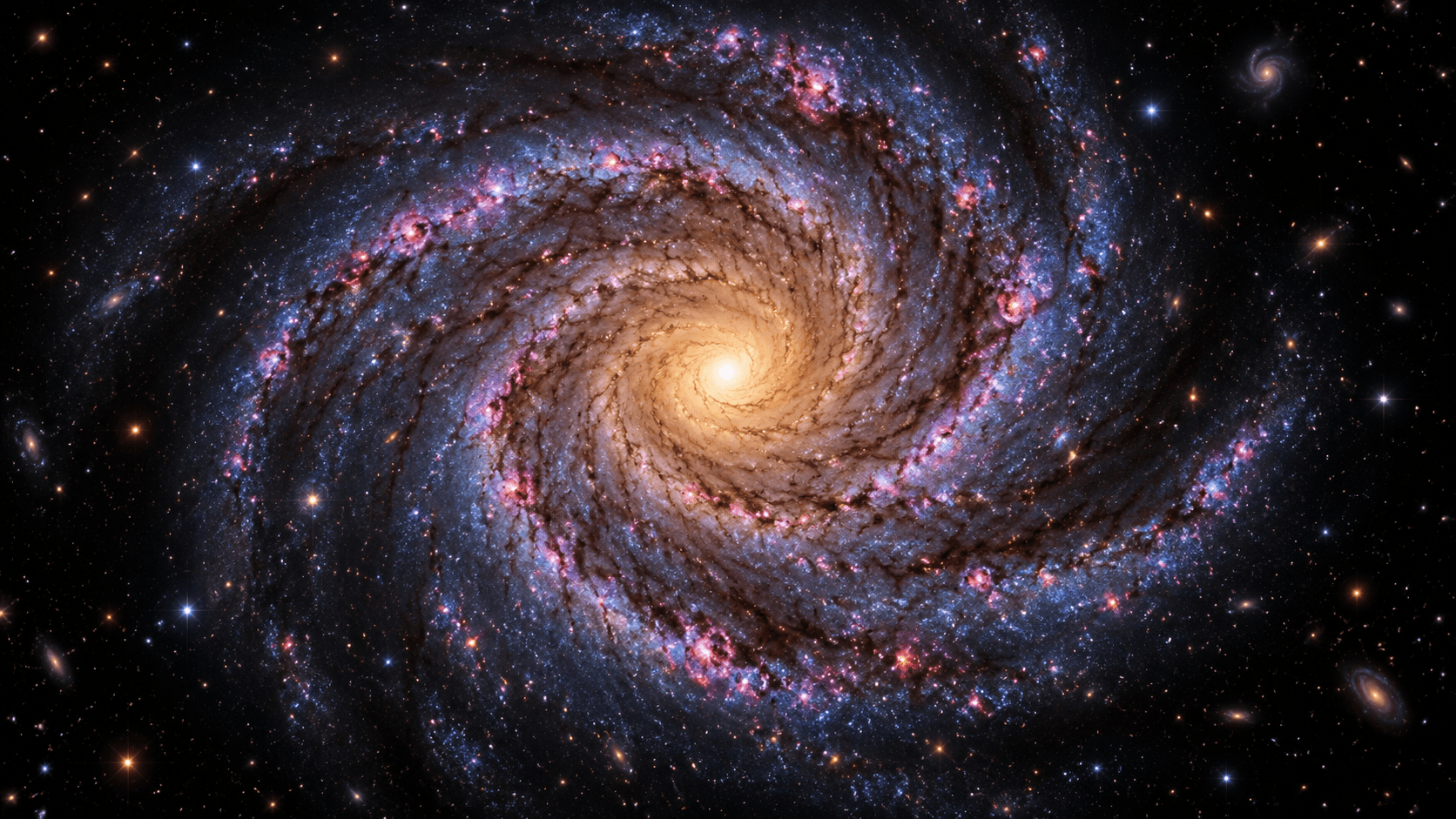
Quick answer: Spiral galaxies are rotating systems with flattened stellar disks, spiral patterns, central bulges, gas and dust, and extended dark-matter halos. Many, including the Milky Way, contain a central bar.
Spiral Galaxies at a Glance
| Topic | Explanation |
|---|---|
| Definition | Rotating stellar disks with spiral arms, central bulges, gas and dust, and dark-matter halos. |
| Physical setting | Arms are patterns where gas is compressed and star formation stands out. Stars pass through the pattern rather than co-rotating with it. |
| Key evidence | Ordinary vs. barred classification uses bulge size and arm tightness; rotation curves reveal unseen mass; centers host supermassive black holes. |
| Why it matters | Shows how disks assemble, create stars, redistribute angular momentum, and respond to companions. |
| Important caution | Spiral arms are not rigid streams and a face-on view is only one orientation. |
What Is a Spiral Galaxy?
Spiral galaxies are rotating systems with flattened stellar disks, spiral patterns, central bulges, gas and dust, and extended dark-matter halos. Many, including the Milky Way, contain a central bar. Spiral arms are long-lived patterns or evolving structures where gas is compressed and star formation becomes prominent. Stars pass through these patterns rather than remaining forever in a fixed arm. Blue young stars and glowing nebulae make arms visually striking.
The Essential Science
Astronomers classify ordinary and barred spirals using bulge size, arm tightness, and structure. Rotation curves — how orbital speed changes with distance from the center — reveal large quantities of unseen mass now attributed to dark matter. Central regions commonly host supermassive black holes. Real systems differ in mass, composition, environment, rotation, magnetic field, and interaction history, producing the variety seen in surveys.
Important Facts
Spirals show how disks assemble, create stars, redistribute angular momentum, and respond to companions. Comparing nearby and distant spirals reveals how galaxies change over cosmic time. Nearby examples such as Andromeda calibrate methods; large surveys reveal frequency, diversity, and evolution.
How Astronomers Study Spirals
Images provide spatial context; spectra reveal composition, temperature, and motion; time-series observations expose change; theoretical models test whether known physics can reproduce the data. Radio observations of neutral hydrogen trace gas out beyond the visible disk. Infrared imaging pierces dust in the arms and bulge. Optical imaging reveals young clusters and dust lanes.
What Telescopes Actually Measure
A telescope records photons, not a finished explanation. Detectors count energy arriving at particular positions, wavelengths, and times. Calibration removes known instrumental effects. Some images record visible light; others translate infrared, radio, ultraviolet, X-ray, or gamma-ray measurements into visible colors. A responsible caption identifies the telescope, wavelength, processing, and whether the visual is data, simulation, or artist concept.
Origin and Development
Cosmological simulations and observations of distant galaxies show that disks assemble from gas cooling into rotating structures. Mergers can disturb disks; secular processes rearrange gas and stars. Bars form and dissolve as internal dynamics evolve.
Structure and Physical Conditions
A spiral contains a thin disk of young stars and gas, a thick disk of older stars, a central bulge, and a stellar halo. Star-forming regions are concentrated along arms. Dark matter dominates the total mass. Numerical estimates are commonly rounded for general readers.
Energy, Gravity, and Motion
Gravity organizes matter; pressure, rotation, magnetic fields, radiation, and feedback resist or redirect collapse. Differential rotation shears gas and shapes structure. Energy conservation links gravitational, kinetic, thermal, magnetic, and radiative components.
Connections to Other Cosmic Objects
Spirals recycle gas through star formation in nebulae and enrichment by evolved stars and supernovae. They host globular clusters, central supermassive black holes, and often satellite irregular galaxies. Similar-looking objects can have different origins.
What Is Known and What Remains Uncertain
The role of bars, halo shape, dark matter distribution, and merger history in producing observed morphology remains an active research area. Progress requires observations that can distinguish predictions, not merely sharper images.
Common Misconceptions
Spiral arms are not rigid streams carrying the same stars together. Stars pass through arm patterns, which live longer than any individual orbit. A face-on view is one orientation of many.
How Spirals Fit Into Cosmic Evolution
Distant spirals appear clumpier and more gas-rich than modern ones. Observing spirals across cosmic time reveals how disk assembly, merger rate, and gas supply have changed.
Best Ways to Explain Spirals to Students
Compare the spiral arm to a slow-moving "traffic jam" that compresses passing gas without keeping the same cars. Show radio and infrared images alongside optical imagery to expose the hidden disk components.
Why Spirals Matter
They are the archetype of star-forming galaxies and the setting of our own Solar System. Their study connects star formation, dark matter, black holes, and cosmology.
A Responsible Summary
Spiral galaxies are rotating disks with spiral patterns, bulges, gas, dust, and dark-matter halos. Classification and rotation curves diagnose their structure and mass. Their evolution ties together star formation, disk dynamics, mergers, and central supermassive black holes.
Detailed Search Questions
What does "spiral galaxy" mean in astronomy?
A rotating system with a flattened stellar disk, spiral pattern, central bulge, gas and dust, and dark-matter halo. Many are barred.
What evidence supports the modern explanation?
Classification, rotation curves, kinematic maps of stars and gas, and multiwavelength imaging together anchor the picture. Confidence grows when independent methods agree.
How are spirals different from related objects?
Ellipticals lack disks and are gas-poor; irregulars lack orderly rotation.
Why are spirals important to scientists?
They probe disk assembly, star formation, dark matter, and central black-hole growth.
What remains unknown?
Details of arm persistence, bar-driven evolution, and the halo's shape remain active research topics.
How are images created and interpreted?
Composites often blend multiple wavelengths; captions must distinguish direct data, simulations, and artist concepts.
What role do gravity and energy play?
Gravity holds the disk together; angular momentum, feedback, and thermal pressure shape its structure and evolution.
Authoritative Source
Scientific content reviewed September 5, 2026.
Frequently asked questions
What is a spiral galaxy?
Spiral galaxies are rotating systems with flattened stellar disks, spiral patterns, central bulges, gas and dust, and extended dark-matter halos. Many, including the Milky Way, contain a central bar.
How do scientists study spiral galaxies?
Astronomers classify ordinary and barred spirals using bulge size, arm tightness, and structure. Rotation curves reveal large quantities of unseen mass. Central regions commonly host supermassive black holes.
Why are spiral galaxies important?
Spirals show how disks assemble, create stars, redistribute angular momentum, and respond to companions. Comparing nearby and distant spirals reveals how galaxies change over cosmic time.
What is commonly misunderstood?
Spiral arms are not rigid streams carrying the same stars together, and a face-on view is only one orientation. Edge-on spirals appear as thin disks with dust lanes and a central bulge.
Can spirals be seen from Earth?
Yes — the Andromeda Galaxy is visible without a telescope from dark skies. Many others are prominent through modest amateur telescopes.
Where can reliable information be found?
Start with the NASA overview and follow its links to instrument documentation and peer-reviewed research.
Sources
- NASA — Galaxy Types — last verified Sat Sep 05 2026 00:00:00 GMT+0000 (Coordinated Universal Time)
More in Galaxies
Elliptical Galaxies: Facts, Science and Complete Guide
Learn about elliptical galaxies — rounded stellar systems dominated by older stars, low gas, and evidence from mergers, dynamics, and cluster environments.
Galaxy Clusters: Facts, Science and Complete Guide
Galaxy clusters — gravitationally bound systems of hundreds or thousands of galaxies, hot intracluster gas, and dominant dark matter.
Irregular Galaxies: Facts, Science and Complete Guide
Irregular galaxies lack the orderly spiral or elliptical shape. Many are small, gas-rich, actively forming stars, or distorted by interactions.