
Stellar Nebulae: Facts, Science and Complete Guide
A nebula is a cloud of gas and dust in interstellar space. Nebulae can be sites of star formation, material from dying stars, supernova debris, or clouds lit by nearby stars.
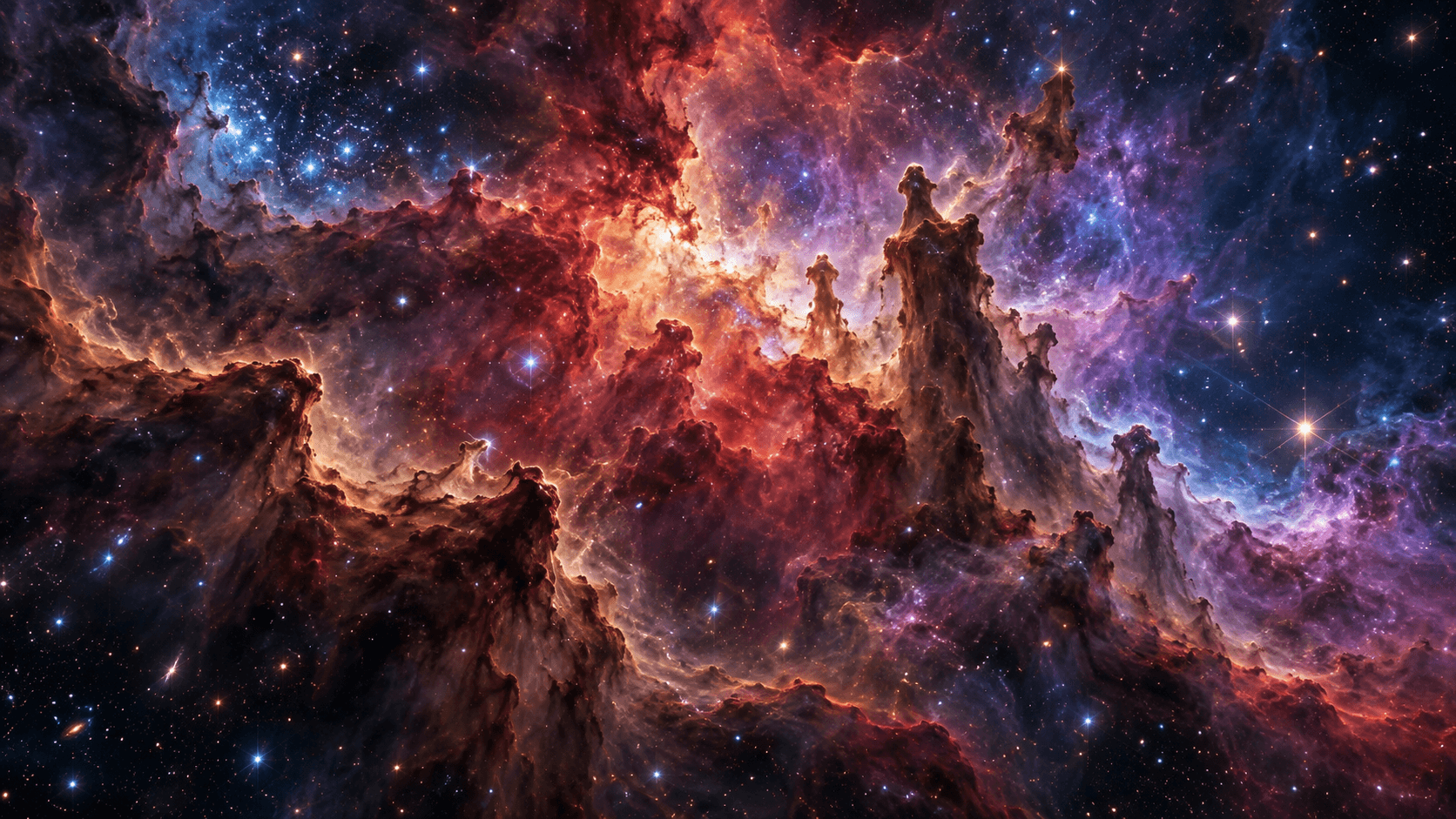
Quick answer: A nebula is a cloud of gas and dust in interstellar space. Nebulae can be sites of star formation, material expelled by dying stars, debris from supernovae, or clouds illuminated by nearby stars.
Stellar Nebulae at a Glance
| Topic | Explanation |
|---|---|
| Definition | Interstellar clouds of gas and dust with a range of origins and appearances. |
| Physical setting | Categories include emission, reflection, dark/absorption, planetary, and supernova-remnant nebulae. |
| Key evidence | Hydrogen and helium dominate; UV radiation can ionize gas; dust scatters or blocks light. |
| Why it matters | Nebulae recycle material between generations of stars. |
| Important caution | Not every nebula forms stars, and "planetary nebula" is a historical misnomer. |
What Is a Nebula?
A nebula is a cloud of gas and dust in interstellar space. Nebulae can be sites of star formation, material expelled by dying stars, debris from supernovae, or clouds illuminated by nearby stars. Major observational categories include emission nebulae, reflection nebulae, dark or absorption nebulae, planetary nebulae, and supernova remnants. These labels describe how a cloud shines or how it formed; one complex region can contain more than one phenomenon.
The Essential Science
Hydrogen and helium dominate many nebulae, while dust and heavier elements shape chemistry and light. Ultraviolet radiation can ionize gas, dust can scatter blue light, and dense dust can block background stars. Infrared and radio observations reveal hidden structures.
Important Facts
Nebulae recycle material between generations of stars. They preserve evidence about stellar birth and death and supply enriched matter from which later stars, planets, and small bodies may form.
How Astronomers Study Nebulae
Multi-wavelength imaging — optical, infrared, radio, and X-ray — reveals different components. Spectroscopy measures composition, temperature, ionization, and velocities. Interferometry resolves fine structure.
What Telescopes Actually Measure
Emission-line ratios reveal ionization and density; continuum emission maps dust; molecular line emission traces cold gas. Captions should identify wavelengths and processing.
Origin and Development
Different nebulae have different origins: star-forming clouds from molecular gas, planetary nebulae from evolved stars, supernova remnants from stellar explosions.
Structure and Physical Conditions
Nebulae contain regions of very different density, temperature, ionization, and dust content. Structure often reflects the interaction of stellar radiation and winds with pre-existing gas.
Energy, Gravity, and Motion
Radiation, stellar winds, magnetic fields, and gravity all shape nebulae. In star-forming regions, feedback from young stars carves cavities and pillars.
Connections to Other Cosmic Objects
Nebulae link star formation, protostars, evolved stars, and galaxies. Their compositions record chemical enrichment across cosmic time.
What Is Known and What Remains Uncertain
Detailed structures depend sensitively on the surrounding environment, magnetic fields, and prior star-formation history — details continue to be refined.
Common Misconceptions
"Stellar nebula" is a broad phrase, not one precise evolutionary stage. A planetary nebula has nothing to do with planet formation.
How Nebulae Fit Into Cosmic Evolution
Nebulae recycle material and enrich galaxies, driving chemical evolution and enabling later star and planet formation.
Best Ways to Explain Nebulae to Students
Contrast emission (self-luminous), reflection (scattering), and dark (blocking) nebulae with images of the Orion, Pleiades, and Horsehead. Show planetary and supernova-remnant examples too.
Why Nebulae Matter
They are cosmic recycling centers: birthplaces of stars, deathbeds of others, and canvases for stellar radiation.
A Responsible Summary
Nebulae are diverse interstellar clouds with distinct origins. Their multi-wavelength study reveals star formation, stellar death, and galactic chemical evolution.
Detailed Search Questions
What does "nebula" mean?
A cloud of gas and dust in interstellar space, with several distinct origins and appearances.
What evidence classifies nebulae?
Spectra, emission-line ratios, morphology, and multi-wavelength composites classify each type.
How are nebulae different from other objects?
They are diffuse gas and dust structures, not gravitationally bound stellar systems.
Why do nebulae matter?
They recycle stellar material and enrich galaxies with heavier elements.
What remains unknown?
Detailed shapes and 3D structure of individual nebulae depend on complex processes still being modeled.
How are their images interpreted?
Colors often encode emission from specific elements; captions should identify the mapping.
What role do gravity and energy play?
Gravity assembles material; radiation, winds, and magnetic fields shape and disperse it.
Authoritative Source
Scientific content reviewed September 5, 2026.
Frequently asked questions
What is a nebula?
A nebula is a cloud of gas and dust in interstellar space. Nebulae can be sites of star formation, material expelled by dying stars, debris from supernovae, or clouds illuminated by nearby stars.
What are the main types of nebula?
Emission nebulae, reflection nebulae, dark or absorption nebulae, planetary nebulae, and supernova remnants.
Do all nebulae form stars?
No. Planetary nebulae and supernova remnants come from dying stars; reflection nebulae simply scatter nearby starlight.
Is 'stellar nebula' a precise term?
It is a broad phrase covering several distinct phenomena, not one precise evolutionary stage. A planetary nebula has nothing to do with planet formation.
Sources
- NASA — Decoding Nebulae — last verified Sat Sep 05 2026 00:00:00 GMT+0000 (Coordinated Universal Time)
More in Nebulae
Planetary Nebulae: Facts, Science and Complete Guide
A planetary nebula is a brief glowing shell of ionized gas expelled by an aging low- or intermediate-mass star, surrounding a hot exposed core that will become a white dwarf.
Star Birth: Inside Nebulae
Inside star-forming nebulae, gravity gathers cold gas and dust into dense cores that become protostars, disks, jets, young stars, and sometimes planetary systems.