
Protostars: Facts, Science and Complete Guide
Protostars are forming stellar objects powered by gravitational contraction and accretion before stable hydrogen fusion dominates the core.
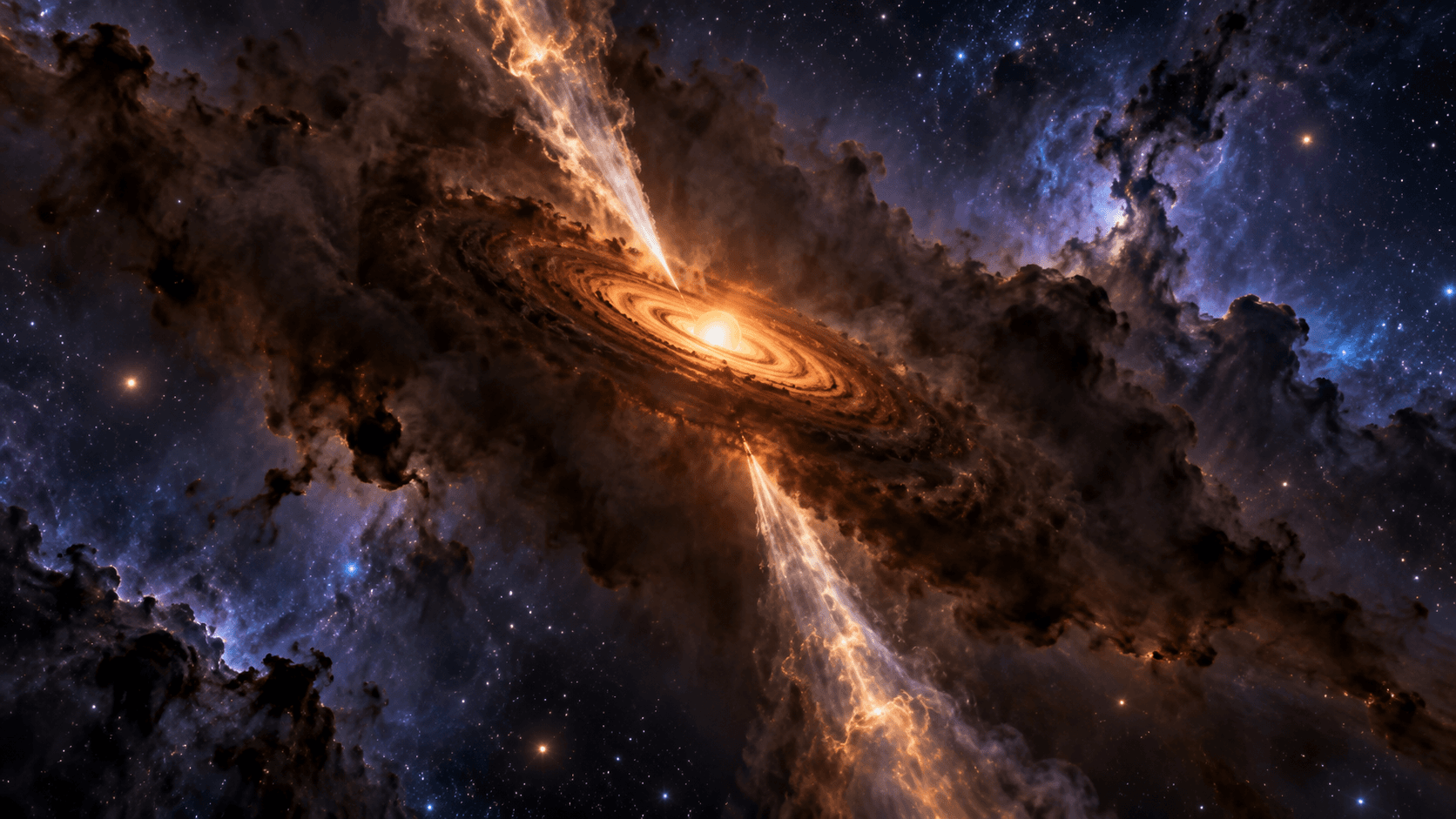
Quick answer: A protostar is a forming stellar object powered mainly by gravitational contraction and accretion before stable hydrogen fusion dominates its core.
Protostars at a Glance
| Topic | Explanation |
|---|---|
| Definition | Forming stellar object before steady core hydrogen fusion. |
| Physical setting | Collapsing cloud core forms a rotating disk; magnetic fields launch bipolar jets. |
| Key evidence | Observational classes based on spectral energy distributions and envelope content. |
| Why it matters | Reveals how stars and planetary systems form. |
| Important caution | Protostars can be luminous but are not yet main-sequence stars. |
What Is a Protostar?
A protostar is a forming stellar object powered mainly by gravitational contraction and accretion before stable hydrogen fusion dominates its core. A dense cloud core collapses, heats, and rotates. Infalling material builds a disk because angular momentum prevents straight-line infall. Magnetic fields channel bipolar jets and outflows that carry away angular momentum and interact with the surrounding cloud.
The Essential Science
Protostars evolve through observational classes (Class 0, I, II, III) based largely on their spectral energy distributions and surrounding material. Accretion can be episodic — brief bursts alternate with quieter periods. The final mass depends on the available reservoir, feedback, companions, and how efficiently matter reaches the center.
Important Facts
Infrared and millimeter telescopes penetrate dusty envelopes, while molecular emission maps gas motion. Jets and shock-excited knots (Herbig–Haro objects) record past accretion.
How Astronomers Study Protostars
Facilities like JWST, ALMA, and Herschel resolve envelopes and disks. Interferometry maps disk structure at astronomical-unit scales. Time-domain observations catch outbursts.
What Telescopes Actually Measure
Detectors measure infrared and radio photons that escape the dusty cocoon. Molecular line emission traces velocity fields; continuum emission traces dust mass and temperature.
Origin and Development
A dense cloud core collapses; angular momentum forms a disk; magnetic fields launch jets; the protostar gains mass until surrounding gas is dispersed or exhausted. Then contraction alone dominates until fusion begins.
Structure and Physical Conditions
Envelope, disk, protostar, jets, and outflows form a nested structure. Each component has different density, temperature, and velocity signatures.
Energy, Gravity, and Motion
Gravitational potential energy released during infall powers accretion luminosity. Rotation drives disk formation; magnetic fields channel outflows.
Connections to Other Cosmic Objects
Protostars form inside star-forming nebulae and evolve into main-sequence stars. They may host planet-forming disks and become part of clusters.
What Is Known and What Remains Uncertain
Details of episodic accretion, disk fragmentation, and the origin of stellar mass distribution remain active research areas.
Common Misconceptions
Protostars are not simply "dim main-sequence stars." Their energy source, structure, and surroundings are qualitatively different.
How Protostars Fit Into Cosmic Evolution
Every star and planetary system passed through a protostellar phase. Protostars connect molecular clouds and mature stars.
Best Ways to Explain Protostars to Students
Show ALMA disk images and JWST protostellar jets. Emphasize the sequence: collapse → disk → jets → main sequence.
Why Protostars Matter
They reveal how stars and planets form, connecting cosmic gas to future solar systems.
A Responsible Summary
Protostars are the forming precursors of stars. Their evolution, driven by gravity, rotation, and magnetic fields, sets the stage for both stars and planetary systems.
Detailed Search Questions
What does "protostar" mean?
A forming stellar object before sustained core hydrogen fusion.
What evidence supports the current picture?
Multi-wavelength imaging, molecular line kinematics, and jet observations agree on the collapse-disk-outflow scenario.
How are protostars different from stars?
They are powered by accretion and contraction rather than steady fusion, and they are typically embedded in gas and dust.
Why do they matter?
They connect cosmic gas to stars and planetary systems.
What remains unknown?
Details of episodic accretion, disk fragmentation, and the initial mass function's origin remain active research.
How are their images interpreted?
Composite images show dust envelopes, disks, and jets across infrared and radio wavelengths.
What role do gravity and energy play?
Gravity drives infall; released binding energy powers accretion luminosity; magnetic fields organize outflows.
Authoritative Source
Scientific content reviewed September 5, 2026.
Frequently asked questions
What is a protostar?
A protostar is a forming stellar object powered mainly by gravitational contraction and accretion before stable hydrogen fusion dominates its core.
How is a protostar different from a main-sequence star?
A protostar's luminosity comes largely from contraction and accretion, not steady hydrogen fusion. It is often surrounded by an infalling envelope and accretion disk.
How do we see protostars if they are hidden?
Infrared and millimeter observations penetrate the dust; jets and outflows probe past accretion; molecular emission maps the surrounding gas.
How long does the protostar phase last?
From tens of thousands to a few million years, depending on mass and environment.
Sources
- JWST Star Formation — last verified Sat Sep 05 2026 00:00:00 GMT+0000 (Coordinated Universal Time)
More in Stars
How Stars Are Born in Giant Clouds
Stars form when cold, dense regions inside giant molecular clouds collapse under gravity, creating protostars that gather mass until sustained hydrogen fusion begins.
Main-Sequence Stars: Facts, Science and Complete Guide
Main-sequence stars are in the long, stable phase during which hydrogen fusion in the core balances gravity.
Red Giant Stars: Facts, Science and Complete Guide
A red giant is an evolved star whose outer layers have expanded and cooled after hydrogen in the core became depleted. Sun-like stars enter this phase late in their lives.