
Star Birth: Inside Nebulae
Inside star-forming nebulae, gravity gathers cold gas and dust into dense cores that become protostars, disks, jets, young stars, and sometimes planetary systems.
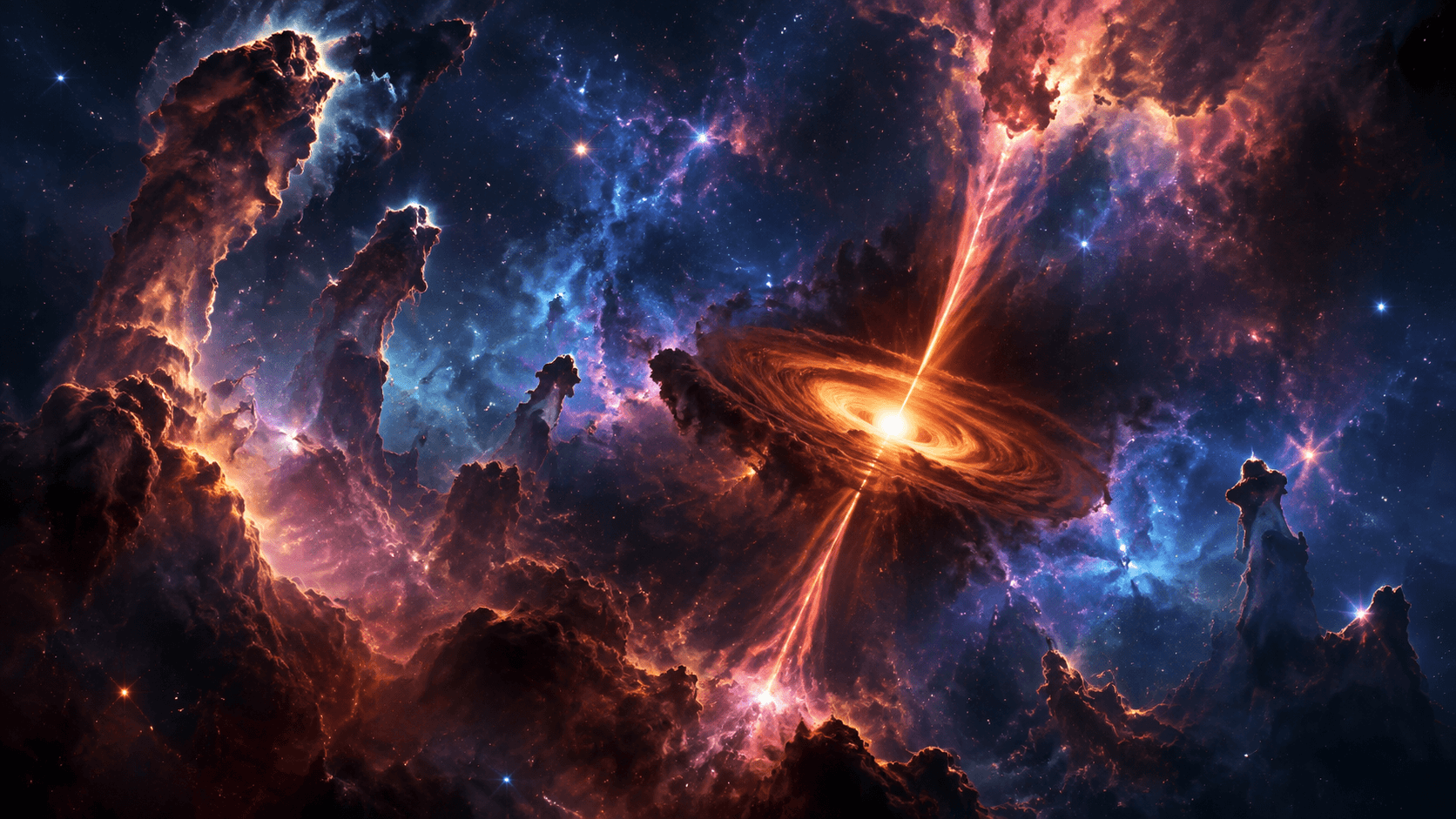
Quick answer: Inside star-forming nebulae, gravity gathers cold gas and dust into dense cores that become protostars, disks, jets, young stars, and sometimes planetary systems.
Star Birth Inside Nebulae at a Glance
| Topic | Explanation |
|---|---|
| Definition | Gravitational collapse and evolution of dense cores inside molecular clouds into stars. |
| Physical setting | Cold, dense material is dark at visible wavelengths; infrared and radio observatories reveal hidden structures. |
| Key evidence | Collapse, disks, jets, and feedback from newborn massive stars. |
| Why it matters | Every star and planetary system passed through this process. |
| Important caution | Not every nebula forms stars — some come from dying stars or reflect distant starlight. |
Star Birth Inside Nebulae
Visible glowing gas is only part of a stellar nursery. The coldest and densest material can be dark at visible wavelengths, so infrared and radio observatories are essential. Massive newborn stars ionize gas and reshape their surroundings with radiation, winds, and outflows.
The Essential Science
Collapse and fragmentation create many cores. Conservation of angular momentum produces disks, while magnetic fields and jets remove angular momentum and regulate accretion. Feedback can compress nearby material or disperse the cloud and halt further formation.
Important Facts
Regions such as Orion, Carina, and the Eagle Nebula reveal different stages at once. Multi-wavelength observations connect cold molecular gas, embedded protostars, exposed young stars, and illuminated cavities.
How Astronomers Study Star Birth
JWST reveals embedded protostars, dust, and jets in infrared. ALMA maps cold dust and molecular gas at high resolution. Optical imagery shows revealed clusters and ionized gas.
What Telescopes Actually Measure
Continuum emission traces dust mass; molecular emission maps velocity and chemistry; jets and outflows show up as heated, ionized filaments.
Origin and Development
Molecular clouds form dense clumps under turbulence and gravity. Clumps fragment into cores; cores collapse into protostars. Feedback shapes and eventually disperses the cloud.
Structure and Physical Conditions
Nested structures — cloud, clump, core, envelope, disk, jets — coexist in nurseries. Each stage has distinct density and temperature signatures.
Energy, Gravity, and Motion
Gravity drives infall; magnetic fields organize outflows; radiation from young massive stars ionizes gas and can drive galactic-scale winds.
Connections to Other Cosmic Objects
Star birth inside nebulae produces the protostars that become main-sequence stars, and the outflows carve the pillars visible in famous images.
What Is Known and What Remains Uncertain
Efficiency of star formation, the origin of the initial mass function, and the role of magnetic fields remain active research topics.
Common Misconceptions
Not every nebula forms stars. Planetary nebulae and supernova remnants come from dying or exploded stars.
How Star Birth Fits Into Cosmic Evolution
Star birth drives galactic evolution, chemical enrichment, and the eventual formation of planetary systems.
Best Ways to Explain Star Birth to Students
Overlay JWST infrared and ALMA millimeter images on famous optical nebulae to reveal hidden protostars and disks.
Why Star Birth Matters
Every star and planet — including our Sun and Earth — began this way.
A Responsible Summary
Star birth inside nebulae is a hierarchical process driven by gravity and shaped by feedback. Multi-wavelength observations from ALMA and JWST are transforming our view.
Detailed Search Questions
What does "star birth" mean?
The process by which molecular-cloud material becomes stars via collapse, disks, and jets.
What evidence supports the picture?
Multi-wavelength imagery of Orion, Carina, and the Eagle Nebula reveal every stage simultaneously.
How does star birth differ from planet formation?
Planet formation happens in disks around already-formed protostars, after the star is well established.
Why does it matter?
It sets the pace of galactic evolution and produces the ingredients for planetary systems.
What remains unknown?
Details of magnetic fields, star-formation efficiency, and initial mass function origins remain research areas.
How are its images interpreted?
Composites reveal cold gas, warm dust, and hot ionized regions in different wavelengths.
What role do gravity and energy play?
Gravity drives infall; released binding energy powers protostars; feedback disperses the cloud.
Authoritative Source
Scientific content reviewed September 5, 2026.
Frequently asked questions
Where do stars form?
Inside star-forming nebulae, gravity gathers cold gas and dust into dense cores that become protostars, disks, jets, young stars, and sometimes planetary systems.
Do all nebulae form stars?
No. Planetary nebulae and supernova remnants come from dying stars; reflection nebulae may simply scatter nearby starlight.
What famous nebulae are stellar nurseries?
The Orion Nebula, Carina Nebula, and Eagle Nebula are among the best-studied star-forming regions.
What role do jets play?
Bipolar jets from protostars carry away angular momentum, allowing gas to fall onto the young star and disk.
Sources
- JWST Star Formation — last verified Sat Sep 05 2026 00:00:00 GMT+0000 (Coordinated Universal Time)
More in Nebulae
Planetary Nebulae: Facts, Science and Complete Guide
A planetary nebula is a brief glowing shell of ionized gas expelled by an aging low- or intermediate-mass star, surrounding a hot exposed core that will become a white dwarf.
Stellar Nebulae: Facts, Science and Complete Guide
A nebula is a cloud of gas and dust in interstellar space. Nebulae can be sites of star formation, material from dying stars, supernova debris, or clouds lit by nearby stars.