
Planetary Nebulae: Facts, Science and Complete Guide
A planetary nebula is a brief glowing shell of ionized gas expelled by an aging low- or intermediate-mass star, surrounding a hot exposed core that will become a white dwarf.
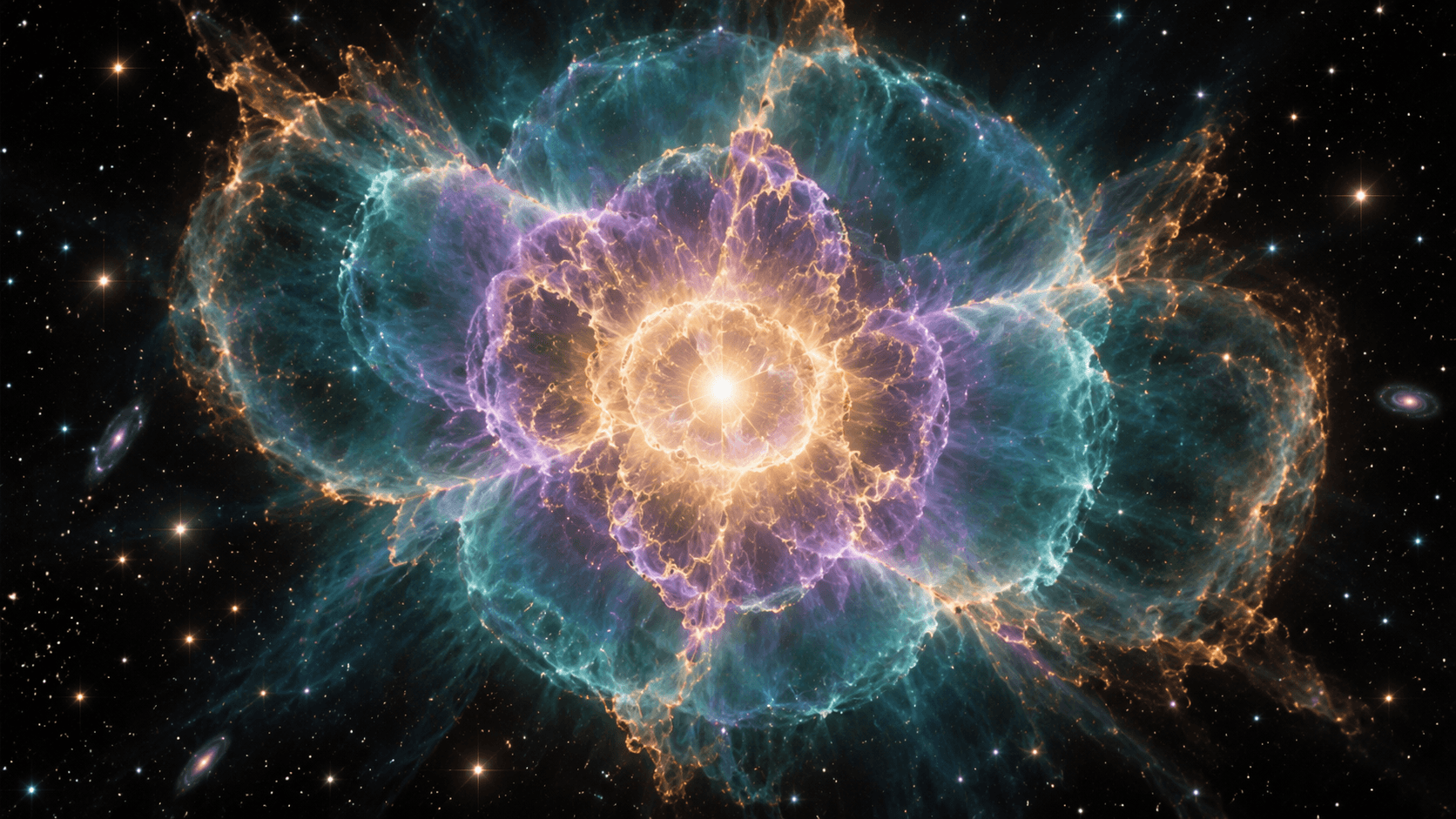
Quick answer: A planetary nebula is a brief glowing shell of ionized gas expelled by an aging low- or intermediate-mass star, surrounding a hot exposed core that will become a white dwarf.
Planetary Nebulae at a Glance
| Topic | Explanation |
|---|---|
| Definition | Brief ionized-gas shell around the hot core of a dying red-giant-descended star. |
| Physical setting | Pulsation and stellar winds strip the envelope; UV radiation from the exposed hot core ionizes it. |
| Key evidence | Bipolar lobes, rings, knots, and jets shaped by rotation, magnetic fields, binaries, and disks. |
| Why it matters | Returns carbon, nitrogen, and dust to the interstellar medium. |
| Important caution | Planetary nebulae do not form planets. The name is historical. |
What Is a Planetary Nebula?
A planetary nebula is the brief, glowing shell of ionized gas ejected by an aging low- or intermediate-mass star as it evolves off the asymptotic giant branch. The misleading name arose because some examples looked round and planet-like through early telescopes. Pulsation and stellar winds remove the envelope. Ultraviolet radiation from the heating core ionizes the gas, producing emission lines and vivid structures.
The Essential Science
Bipolar lobes, rings, knots, and jets may be shaped by rotation, magnetic fields, binary companions, disks, and multiple episodes of mass loss. The visible phase typically lasts only thousands to tens of thousands of years before expansion makes the gas too diffuse to detect.
Important Facts
Planetary nebulae return carbon, nitrogen, dust, and other processed material to the interstellar medium — enriching future generations of stars and planets. Spectra reveal abundances, temperature, density, expansion speed, and the evolution of the central star.
How Astronomers Study Them
Optical spectroscopy identifies emission lines from ionized species. Infrared observations trace warm dust; radio observations reveal molecular gas and expansion.
What Telescopes Actually Measure
Emission-line ratios diagnose temperature and density; expansion measurements give ages; central-star temperatures come from spectroscopy.
Origin and Development
A red giant sheds its outer envelope through winds and pulsation. As the exposed core heats up (to ≥ 25,000 K), UV radiation ionizes the surrounding gas, creating the planetary nebula. The nebula expands and eventually disperses.
Structure and Physical Conditions
A hot central star (a nascent white dwarf) illuminates a shell of gas expanding at typical speeds of tens of km/s. Shape depends strongly on the presence of a binary companion or disk.
Energy, Gravity, and Motion
UV radiation from the central star heats and ionizes the shell. Expansion is driven by earlier winds and pulsations. Gravity plays a secondary role once the shell has decoupled.
Connections to Other Cosmic Objects
They connect red giants to white dwarfs and return material to the interstellar medium.
What Is Known and What Remains Uncertain
Origins of striking bipolar and multipolar shapes remain actively studied. Binary interactions likely play a major role but the details vary.
Common Misconceptions
Planetary nebulae do not form planets. The word "planetary" is historical, based on early telescopic appearances.
How Planetary Nebulae Fit Into Cosmic Evolution
They mark a brief but important stage in stellar evolution and enrich galaxies with heavy elements.
Best Ways to Explain Planetary Nebulae to Students
Show images of the Ring, Helix, and Cat's Eye nebulae. Explain that each central "star" is a dying core about to become a white dwarf.
Why Planetary Nebulae Matter
They recycle stellar material and preview the Sun's eventual fate.
A Responsible Summary
Planetary nebulae are brief, luminous shells expelled by dying low- and intermediate-mass stars. They return processed material to the galaxy and reveal the transition to the white-dwarf stage.
Detailed Search Questions
What does "planetary nebula" mean?
A brief, ionized-gas shell around the hot core of a dying low- or intermediate-mass star.
What evidence supports the picture?
Expansion measurements, ionization spectra, and connections to observed white dwarfs all agree.
How are planetary nebulae different from other nebulae?
They arise from evolved single or binary stars, not from star formation or supernova explosions.
Why do they matter?
They enrich the interstellar medium and mark the transition to white dwarfs.
What remains unknown?
The origins of complex bipolar shapes and the role of binary companions continue to be studied.
How are their images interpreted?
Colors often encode emission from specific ionized species; captions should identify the mapping.
What role do gravity and energy play?
Energy from the hot central star ionizes the ejected shell; gravity plays a secondary role after ejection.
Authoritative Source
Scientific content reviewed September 5, 2026.
Frequently asked questions
What is a planetary nebula?
A planetary nebula is a brief glowing shell of ionized gas expelled by an aging low- or intermediate-mass star, surrounding a hot exposed core that will become a white dwarf.
Do planetary nebulae form planets?
No. The name is historical — some early telescopic views appeared round and planet-like. Planetary nebulae have nothing to do with planet formation.
How long do they last?
Typically thousands to tens of thousands of years before the gas becomes too diffuse to detect.
What produces the shapes?
Rotation, magnetic fields, binary companions, disks, and multiple episodes of mass loss can shape bipolar lobes, rings, knots, and jets.
Sources
- Hubble Nebulae Guide — last verified Sat Sep 05 2026 00:00:00 GMT+0000 (Coordinated Universal Time)
More in Nebulae
Star Birth: Inside Nebulae
Inside star-forming nebulae, gravity gathers cold gas and dust into dense cores that become protostars, disks, jets, young stars, and sometimes planetary systems.
Stellar Nebulae: Facts, Science and Complete Guide
A nebula is a cloud of gas and dust in interstellar space. Nebulae can be sites of star formation, material from dying stars, supernova debris, or clouds lit by nearby stars.