
How Stars Are Born in Giant Clouds
Stars form when cold, dense regions inside giant molecular clouds collapse under gravity, creating protostars that gather mass until sustained hydrogen fusion begins.
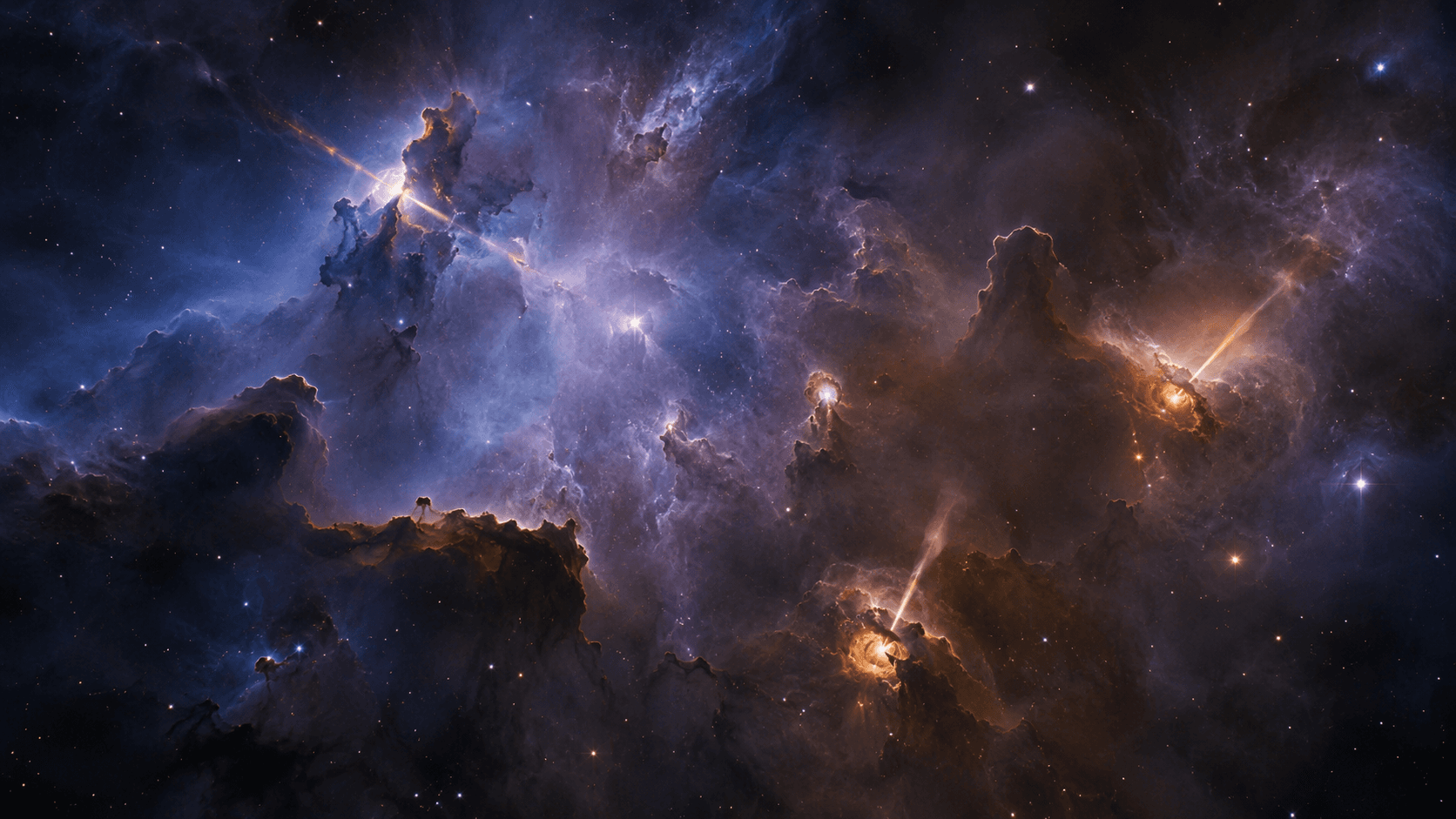
Quick answer: Stars form when cold, dense regions inside giant molecular clouds collapse under gravity, creating protostars that gather mass until sustained hydrogen fusion begins.
Star Formation at a Glance
| Topic | Explanation |
|---|---|
| Definition | The gravitational collapse and evolution of molecular-cloud cores into stars. |
| Physical setting | Cold molecular clouds of hydrogen, helium, dust, and trace molecules. |
| Key evidence | Fragmentation → collapse → disk → jets → main sequence. |
| Why it matters | Every star, planet, and eventually life traces back to this process. |
| Important caution | A nebula does not instantly become one star. Formation takes hundreds of thousands to millions of years. |
How Stars Form
Cold molecular clouds contain mostly hydrogen, along with helium, dust, and trace molecules. Turbulence, collisions, spiral-arm compression, expanding bubbles, or supernova shocks can help create dense clumps, but gravity must ultimately overcome internal pressure and other support.
Cloud fragmentation produces dense cores; a core collapses; rotation builds an accretion disk; magnetic fields help launch jets; the protostar gains mass; rising central temperature and pressure eventually allow hydrogen fusion; surrounding gas is dispersed and a young star reaches the main sequence.
The Essential Science
The process is hierarchical. A giant molecular cloud fragments into denser clumps; those clumps fragment into cores; each core forms one or more protostars. Feedback from the most massive stars — winds, radiation, and supernovae — disperses the parent cloud and can trigger or halt further formation.
Important Facts
Astronomers observe radio emission from cold molecules, infrared light escaping dust, millimeter radiation from disks, and optical or infrared jets. Young clusters demonstrate that stars usually form in groups rather than in complete isolation.
How Astronomers Study Star Formation
ALMA maps cold dust and gas at high resolution; JWST reveals warm dust, embedded protostars, and outflow shocks; radio surveys track cold molecular clouds; optical imaging catches revealed young clusters.
What Telescopes Actually Measure
Continuum emission from dust reveals mass and temperature; molecular line emission maps velocity and chemistry; shocks appear as heated, ionized filaments in the infrared and optical.
Origin and Development
Turbulence and gravity compete in molecular clouds. When gravity wins locally, collapse proceeds. Angular momentum forms a disk; magnetic fields channel outflows; radiation and winds eventually clear the region.
Structure and Physical Conditions
Cores range from tens to thousands of solar masses; individual protostars form within them. Temperatures range from a few tens of kelvin in the cold cloud to millions of kelvin near new protostars.
Energy, Gravity, and Motion
Gravitational binding energy released during collapse powers protostellar luminosity. Angular momentum, magnetic braking, and outflows redistribute momentum so gas can reach the central protostar.
Connections to Other Cosmic Objects
Star formation happens inside stellar nebulae, takes place in the disks of spiral and irregular galaxies, and produces main-sequence stars with planet-forming disks.
What Is Known and What Remains Uncertain
Details of the initial mass function's origin, the role of magnetic fields, and the efficiency of star formation in different environments remain active research areas.
Common Misconceptions
A nebula does not instantly become one star. Formation is a long, complex process producing many stars of varied masses.
How Star Formation Fits Into Cosmic Evolution
Star formation drives galactic evolution, chemical enrichment, and cosmic history. Its rate has changed dramatically over cosmic time.
Best Ways to Explain Star Formation to Students
Sequence the process: cloud → clump → core → collapse → disk → jets → main-sequence star. Use JWST and ALMA imagery to illustrate each stage.
Why Star Formation Matters
Every star and planet — including our Sun and Earth — began this way.
A Responsible Summary
Star formation begins in cold molecular clouds. Gravity, aided by external triggers, drives fragmentation and collapse. Disks, jets, and feedback shape the outcome. The result: main-sequence stars, often with planet-forming disks.
Detailed Search Questions
What does "star formation" mean?
The physical process by which molecular-cloud material becomes stars.
What evidence supports the current picture?
Multi-wavelength imaging of nurseries such as Orion, Carina, and the Eagle Nebula shows every stage of the process at once.
How is star formation different from planetary or galactic assembly?
Star formation focuses on the collapse and ignition of stars; planet formation occurs in surrounding disks; galaxy assembly is a much larger, longer-timescale process.
Why does it matter?
It sets the pace of galactic evolution and produces the ingredients for planets and life.
What remains unknown?
The role of magnetic fields, the initial mass function's origin, and star-formation efficiency in different environments continue to be studied.
How are its images interpreted?
Multi-wavelength composites reveal different phases and components; captions should identify each.
What role do gravity and energy play?
Gravity drives collapse; released binding energy powers protostars; feedback shapes future formation.
Authoritative Source
Scientific content reviewed September 5, 2026.
Frequently asked questions
How do stars form?
Stars form when cold, dense regions inside giant molecular clouds collapse under gravity, creating protostars that gather mass until sustained hydrogen fusion begins.
What triggers collapse?
Turbulence, collisions, spiral-arm compression, expanding bubbles, or supernova shocks can help create dense clumps, but gravity must overcome internal pressure.
Do stars form alone?
Rarely. Young clusters demonstrate that stars usually form in groups. One cloud can produce many stars with a wide range of masses.
How long does star formation take?
Hundreds of thousands to millions of years from cloud fragmentation to a young star reaching the main sequence.
Sources
- NASA — Stars — last verified Sat Sep 05 2026 00:00:00 GMT+0000 (Coordinated Universal Time)
More in Stars
Main-Sequence Stars: Facts, Science and Complete Guide
Main-sequence stars are in the long, stable phase during which hydrogen fusion in the core balances gravity.
Protostars: Facts, Science and Complete Guide
Protostars are forming stellar objects powered by gravitational contraction and accretion before stable hydrogen fusion dominates the core.
Red Giant Stars: Facts, Science and Complete Guide
A red giant is an evolved star whose outer layers have expanded and cooled after hydrogen in the core became depleted. Sun-like stars enter this phase late in their lives.