
Hot Jupiter Exoplanets
Discover what hot Jupiter exoplanets are, how they form and migrate, why their atmospheres are extreme, and what famous examples teach astronomers.
What is a hot Jupiter?
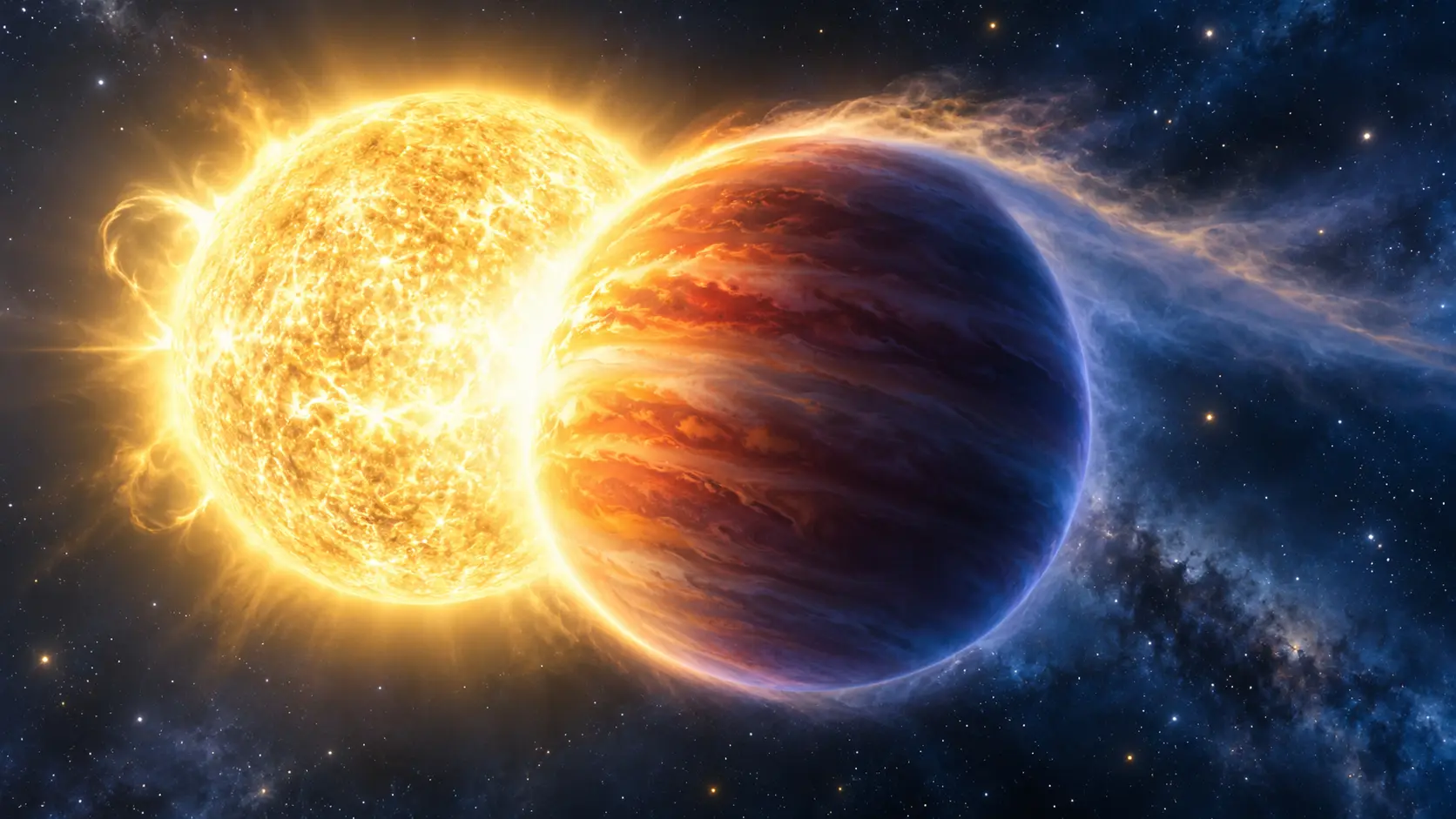
Hot Jupiter exoplanets are gas giants roughly comparable to Jupiter in mass or size that orbit extremely close to their stars. Many complete a year in only a few Earth days. At those distances they receive intense radiation, develop very high atmospheric temperatures, and often become tidally locked, with one side continually facing the star.
The Solar System has no hot Jupiter. Jupiter orbits the Sun at about five astronomical units and takes nearly twelve years to complete an orbit. When astronomers began finding giant planets closer to their stars than Mercury is to the Sun, the discoveries challenged the simple expectation that planetary systems should resemble our own.
The category is descriptive rather than governed by one perfect boundary. Researchers often consider giant planets with orbital periods of roughly ten days or less to be hot Jupiters, but papers may use different mass, radius, temperature, or period limits. Ultra-hot Jupiters form an especially irradiated subgroup whose dayside temperatures can become high enough to break some molecules apart and ionize metals.
Why the first discoveries were so surprising
In 1995, Michel Mayor and Didier Queloz announced 51 Pegasi b, the first confirmed exoplanet orbiting a Sun-like star. The planet circles its star in a little more than four days. Its strong gravitational pull made the star wobble enough for precise spectroscopy to detect a repeating Doppler shift.
At the time, giant planets were expected to form in cold outer disks where ices help a solid core grow quickly and collect hydrogen and helium. A Jupiter-mass world close to a star seemed difficult to explain. The discovery demonstrated that planet formation does not end when the disk first produces planets. Orbits can change dramatically.
Hot Jupiters were also easier for early surveys to detect than small, distant planets. They tug strongly on their stars and complete many orbits in a short time. If aligned to transit, their large disks block a noticeable fraction of starlight. Their prominence in early catalogs reflected both genuine existence and strong observational selection.
How hot Jupiters may form and migrate
Most models begin with giant-planet formation farther from the star, beyond a region where solid ices are abundant. The young planet then moves inward. Astronomers study several possible migration pathways rather than assuming one story explains every system.
Disk migration can occur while the planet-forming disk still surrounds the star. Gravitational interaction between a giant planet and disk gas exchanges angular momentum and shifts the orbit. The speed and direction depend on planet mass, disk structure, gaps, turbulence, and nearby planets. Migration may stop near the disk's inner edge or when other forces balance the movement.
High-eccentricity migration can happen after the gas disk fades. Gravitational encounters with another planet or a distant stellar companion can stretch the giant planet's orbit into a long ellipse. Each close approach to the star raises tides in the planet and star. Energy is dissipated, and over time the orbit shrinks and becomes more circular.
Some systems may experience planet-planet scattering, while others undergo long-term secular interactions or the Kozai-Lidov mechanism caused by an inclined companion. Measurements of orbital alignment, eccentricity, neighboring planets, and stellar companions help evaluate these histories.
How astronomers detect hot Jupiters
The radial-velocity method measures the star's line-of-sight wobble. A massive planet on a short orbit creates a strong, rapidly repeating signal, making hot Jupiters favorable Doppler targets. The curve gives the period, eccentricity, and a minimum mass. If the planet also transits, inclination is known and the true mass can be estimated.
The transit method watches for periodic dips when a planet crosses the stellar disk. A Jupiter-size planet passing in front of a Sun-size star can block about one percent of the light, far more than an Earth-size planet. Transit depth yields radius, while the interval between transits yields period.
Together, transit radius and radial-velocity mass produce average density. Some hot Jupiters are unexpectedly inflated, with radii larger than standard cooling models would predict. Their large atmospheric scale heights also make them excellent targets for transmission spectroscopy.
Secondary eclipses and phase curves reveal additional properties. When the planet moves behind the star, its thermal emission and reflected light temporarily disappear. Brightness changes across the orbit map the contrast between day and night and show how winds redistribute energy.
Atmospheres under extreme irradiation
A close-in giant planet receives far more energy than Jupiter. The dayside may reach thousands of degrees. Molecules absorb and emit radiation, winds carry heat, clouds form or evaporate, and ultraviolet light changes atmospheric chemistry.
Many hot Jupiters are tidally locked because strong tides synchronize rotation with orbit. Permanent dayside heating drives powerful circulation toward the nightside. Infrared phase curves can locate the hottest region. An eastward displacement from the point directly beneath the star suggests fast equatorial winds; a centered hotspot may indicate weak redistribution or magnetic drag.
Clouds and hazes complicate spectra. Silicates, metal oxides, sulfides, and other condensates may form at different temperatures and pressures. On ultra-hot daysides, molecules such as water can partly dissociate, then recombine on the cooler nightside. Metals including iron can exist as vapor and later condense.
Spectra have revealed sodium, potassium, water vapor, carbon monoxide, and other species in suitable worlds, although every detection must account for the host star and instrument systematics. Atmospheric composition helps test formation location, migration, and chemical processes.
Inflated radii and deep energy puzzles
Many strongly irradiated hot Jupiters are larger than expected for their masses and ages. Heat from formation should gradually escape, allowing a gas giant to contract. Yet some remain puffy.
Proposed explanations include deposition of a fraction of stellar energy deep inside the planet, slowed cooling caused by atmospheric circulation and opacity, tidal heating from a noncircular orbit, and electrical currents generated as winds move ionized gas through a magnetic field. No single mechanism necessarily explains every inflated planet.
The trend between irradiation and radius shows that stellar heating matters, but internal structure, heavy-element content, age, and orbital history also contribute. Precise mass and radius measurements across many systems help separate these effects.
Atmospheric escape and planetary survival
High-energy ultraviolet and X-ray radiation can heat the upper atmosphere until gas escapes. Transit observations at particular wavelengths sometimes reveal hydrogen, helium, or metals extending beyond the planet's visible radius.
Most hot Jupiters are massive enough to retain much of their bulk over stellar lifetimes, but escape shapes their upper atmospheres. Lower-mass hot planets can lose a larger fraction. Extreme cases near the Roche limit may be tidally distorted, and material can flow away.
WASP-12b is a famous example of a very close, highly irradiated giant whose orbit and atmosphere are subjects of continuing study. Reports about a planet "being eaten" should be phrased carefully: scientists measure orbital decay, escape, or tidal distortion and compare models rather than observe a simple instantaneous destruction.
Weather, winds, and exotic clouds
Hot Jupiters provide laboratories for atmospheric physics impossible to reproduce on Earth. Their winds may travel at kilometers per second. The dayside and nightside can differ greatly, yet circulation may transport enough heat to reduce the contrast.
Cloud patterns can change with longitude. Nightside temperatures may allow minerals to condense, while dayside heat vaporizes them. Some models predict showers of molten silicate or iron droplets, though such descriptions summarize complex microphysics rather than direct images of rainfall.
High-resolution spectroscopy measures Doppler shifts from winds and rotation. Repeated observations search for changing weather. Combining spectra, eclipse measurements, and phase curves creates a three-dimensional picture of temperature, chemistry, and motion.
Orbital alignment and the history of a system
During a transit, astronomers can measure how the planet blocks different rotating portions of the stellar surface. This Rossiter-McLaughlin effect reveals the angle between the planet's orbit and the star's rotation projected on the sky.
Some hot Jupiters are aligned, while others travel on highly tilted or even apparently retrograde paths. Misalignment can support a dynamically violent history, although stars and planets can later alter one another through tides. Alignment patterns also vary with stellar temperature and internal structure.
Neighboring planets provide more clues. A smooth disk migration history may preserve compact companions, while strong scattering can remove or destabilize them. Surveys therefore examine the architecture around hot Jupiters rather than treating each giant in isolation.
Famous hot Jupiter examples
51 Pegasi b transformed exoplanet science by proving that a gas giant could orbit a Sun-like star every few days. HD 209458 b became the first transiting exoplanet found around a Sun-like star and enabled early atmospheric studies, including evidence of escaping material.
HD 189733 b is a nearby, well-studied transiting hot Jupiter with extensive atmospheric observations. Its deep blue appearance in visible-light measurements does not imply an Earth-like ocean; scattering by atmospheric particles can produce color.
WASP-12b is notable for its extreme proximity, tidal distortion, and evidence connected with mass loss and orbital evolution. WASP-76b is an ultra-hot Jupiter frequently discussed in relation to vaporized metals and strong day-night differences. Every system samples a different combination of stellar radiation, gravity, composition, and history.
Are hot Jupiters habitable?
Hot Jupiters do not have solid surfaces like Earth and are exposed to intense radiation, so they are not considered promising locations for familiar surface life. Their deep atmospheres reach enormous pressures, while upper layers face heat, winds, and energetic radiation.
Speculation sometimes focuses on moons, but stable large moons close to a star face strong dynamical constraints. No exomoon around a hot Jupiter has been securely established. Habitability claims require more than being near a temperature range; they depend on long-term stability, atmosphere, radiation, water, chemistry, and many unknowns.
The scientific value of hot Jupiters does not depend on habitability. They reveal how systems rearrange, how atmospheres respond to extreme energy, and how planets and stars exchange angular momentum.
Why hot Jupiters still matter
They are large and observationally favorable, allowing astronomers to test instruments and atmospheric techniques later applied to smaller planets. They expose migration processes that can affect every world in a system. Their transit timing and orbital decay can test tides, while their atmospheres explore chemistry across extreme temperatures.
Hot Jupiters also remind researchers that detection catalogs contain biases. Their early abundance did not mean most planets were giant and close to their stars. It meant the first instruments were most sensitive to them. Understanding both the planets and the selection process helped turn isolated discoveries into population science.
Frequently asked questions
What makes a planet a hot Jupiter?
It is a Jupiter-like gas giant on a very close orbit, generally with a period of days rather than years and a strongly heated atmosphere. Exact boundaries differ among studies.
Why are hot Jupiters so close to their stars?
Most probably formed farther out and migrated inward through interactions with the gas disk, other planets, or stellar companions. More than one pathway may operate.
Are hot Jupiters bigger than Jupiter?
Some are more massive, some less massive, and many have larger radii because intense heating helps inflate their atmospheres.
Are hot Jupiters tidally locked?
Many are expected to rotate synchronously, keeping the same side toward the star. The exact atmospheric rotation pattern can be more complicated because strong winds move gas independently.
Can a hot Jupiter have life?
It is not considered a likely environment for familiar life. It lacks a solid surface and experiences extreme temperature, pressure, winds, and radiation.
Compare all major exoplanet types
The main planet-type labels below describe size, orbit, or environment rather than a fixed composition or habitability. Use them as starting points rather than final categories.
| Planet type | Typical description | Defining property | Key caution |
|---|---|---|---|
| Hot Jupiter | Giant planet on a days-long orbit | Large gas giant under intense irradiation | Easy detection creates catalog bias |
| Warm Neptune / sub-Neptune | Intermediate-size atmosphere-rich world | Size between Earth and Neptune or Neptune-like moderate irradiation | Labels overlap and do not fix composition |
| Super-Earth | Larger or more massive than Earth, below Neptune | Observational mass or radius range | “Super” does not mean Earth-like or habitable |
| Terrestrial world | Mainly rock and metal | Bulk rocky composition | Earth-size does not prove Earth-like conditions |
| Rogue planet | Planetary-mass body unbound to a star | Free-floating motion | Some may form like brown dwarfs; mass and origin can be uncertain |
Related planet types
Warm Neptunes & sub-Neptunes
Intermediate-size planets between Earth and Neptune, often wrapped in hydrogen-rich atmospheres. The most common class discovered by Kepler and TESS, with no direct Solar System analogue.
Super-Earths
Rocky worlds larger than Earth but smaller than Neptune. Their densities span iron-rich to water-rich, and "super" does not mean Earth-like or habitable.
Terrestrial worlds
Small rocky planets like Earth, Mars, or Venus but around other stars. Some orbit in habitable zones of nearby cool dwarfs and are prime JWST targets.
Rogue planets
Planetary-mass objects that drift through the galaxy unbound to any star. Detected by microlensing or infrared imaging, they record the hidden dynamics of planet formation.
Sources and further reading
- NASA Science — What Is an Exoplanet? — last verified 2026-09-17
- NASA Exoplanet Archive — last verified 2026-09-17
- NASA Spitzer — Exoplanets — last verified 2026-09-17
- The Planetary Society — The Different Kinds of Exoplanets You Meet in the Milky Way — last verified 2026-09-17