
Warm Neptunes and Sub-Neptune Planets
Learn what sub-Neptune planets and warm Neptunes are, how their atmospheres and interiors differ, and why they are central to exoplanet science.
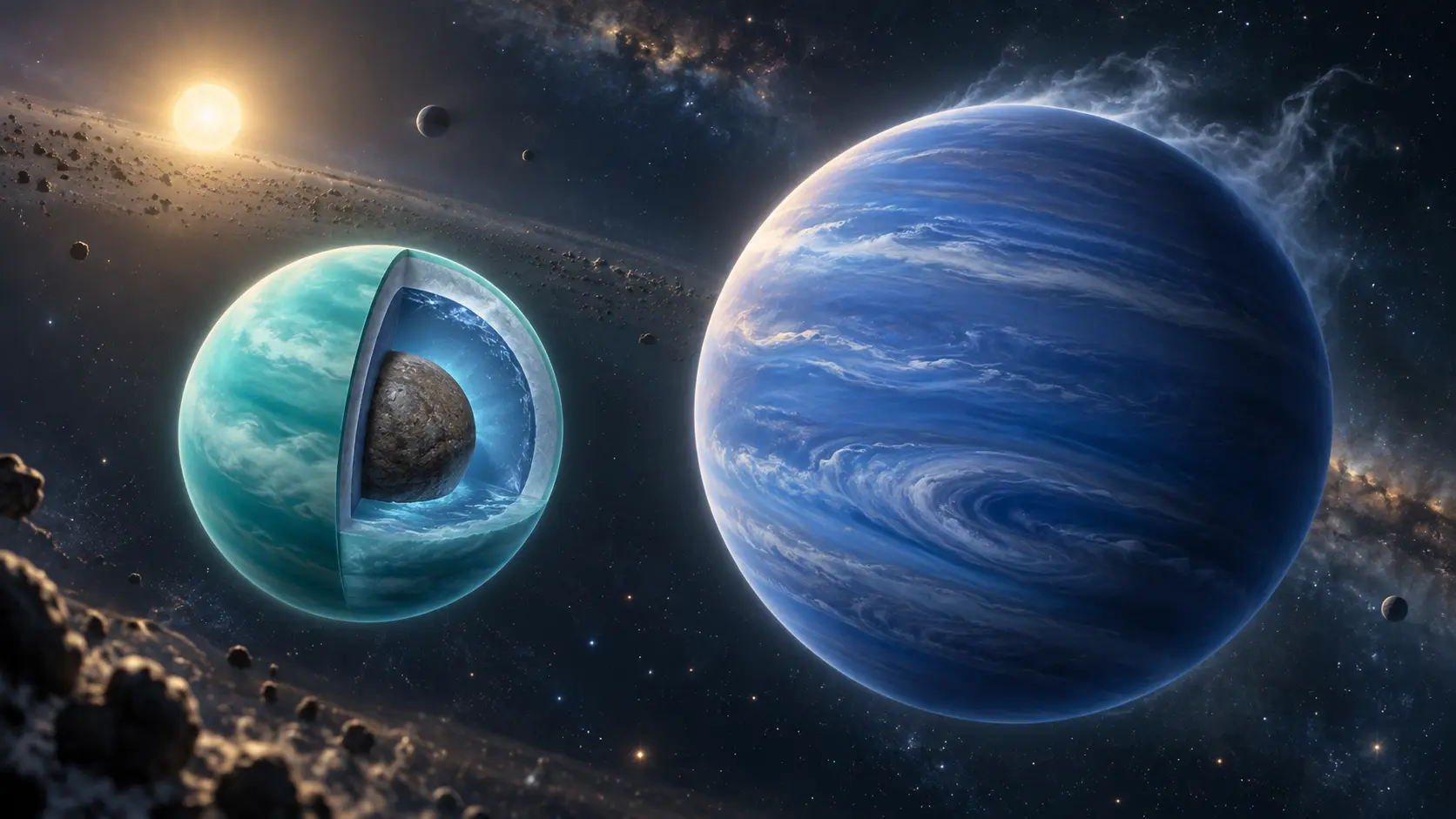
What are warm Neptunes and sub-Neptunes?
Sub-Neptune planets are worlds generally larger than Earth but smaller than Neptune, often with radii around two to four times Earth's radius and atmospheres rich in hydrogen and helium. Warm Neptunes are Neptune-size or Neptune-mass planets receiving more stellar energy than our Neptune but less than the most scorched hot Neptunes. Neither label has one universal boundary, so mass, radius, temperature, and orbital period must be stated when precision matters.
These planets are especially important because the Solar System contains no close equivalent between Earth and Neptune in size. Exoplanet surveys, however, show that planets within this broad range are common. Their abundance revealed that our local arrangement is only one possible outcome of planet formation.
The combined card is useful because both categories concern intermediate-size worlds with substantial volatile material or gas. They are not necessarily the same. A sub-Neptune is mainly a size class, while "warm" describes irradiation or temperature. A planet may be both, but a warm Neptune can be closer to Neptune's full size or mass.
Size names are not composition names
Astronomers often classify a newly discovered planet first by measured radius or minimum mass. Those measurements do not uniquely specify composition. A planet two and a half times Earth's radius could contain a rocky core beneath a hydrogen-helium envelope, a large water-rich layer, a high-pressure ice mantle, or some combination.
The term mini-Neptune is sometimes used interchangeably with sub-Neptune, but authors may define it differently. Some reserve mini-Neptune for gas-rich planets that resemble reduced Neptunes, while "sub-Neptune" remains a broad observational size class.
A super-Earth is not automatically rocky either. At small radii, a dense rocky composition is more likely; at larger radii, even a few percent of the planet's mass in light gas can greatly expand its size. Accurate mass, radius, age, atmosphere, and stellar irradiation are needed to move from a label toward a physical model.
How astronomers discover them
Most known sub-Neptunes were identified through transits. When a planet crosses its star, the depth of the brightness dip reveals the ratio of planet radius to stellar radius. Repeated dips establish the orbital period.
Radial-velocity measurements estimate mass by detecting the star's Doppler wobble. Small planets create weak signals, especially around faint or active stars, so many sub-Neptunes have precise radii but poorly known masses. Transit timing variations in compact multiplanet systems can provide an alternative mass estimate.
Combining mass and radius yields average density. A low density suggests an extended atmosphere, while a high density may indicate a larger fraction of rock, metal, water, or ice. Interior solutions remain degenerate because different mixtures can create similar bulk properties.
Transmission spectroscopy measures how apparent transit depth changes with wavelength. Molecules, clouds, and hazes affect the spectrum. Secondary eclipses and thermal phase observations are more difficult for temperate small planets but can add temperature and energy information.
Why sub-Neptunes appear so common
Kepler revealed large numbers of planets between Earth and Neptune in size, often in compact systems with short orbital periods. Planet formation naturally supplies solid cores, while young disks contain hydrogen, helium, water, and other volatiles. A core that grows before the gas disk disappears can capture an envelope without becoming a gas giant.
Migration may bring planets formed farther out into close orbits. Collisions can merge cores or remove atmosphere. Stellar radiation and a planet's own cooling energy can strip gas, especially from lower-mass worlds close to their stars.
The final population reflects formation, migration, accretion, impacts, cooling, and escape. That is why sub-Neptunes are not a single uniform family. They may be among the most diverse planet classes.
The radius valley
Planet surveys show a relative shortage of worlds at certain radii between common super-Earth and sub-Neptune groups. This feature is called the radius valley or radius gap. It suggests that atmospheric loss can transform initially similar planets into different outcomes.
A core with enough gravity may retain a hydrogen-helium envelope and remain a sub-Neptune. A smaller or more irradiated planet may lose most of that gas and become a compact super-Earth. Photoevaporation driven by high-energy stellar radiation is one leading explanation.
Core-powered mass loss is another. As a young planet cools, heat from its interior can drive atmospheric escape. Both mechanisms may operate, and their importance can depend on stellar type, planet mass, orbital distance, and time.
The radius valley is population evidence, not a sharp rule for classifying one planet. Individual worlds require direct measurements.
What lies beneath a sub-Neptune atmosphere?
A common model begins with an iron-rich core and silicate mantle surrounded by water or other volatiles and a hydrogen-helium envelope. The layer fractions vary widely. Under high pressure, water does not necessarily behave as familiar liquid oceans; it can form supercritical fluid or exotic ice phases.
Some sub-Neptunes may be gas dwarfs: rocky cores with a relatively modest light-gas envelope that dominates the observed radius. Others may be water-rich worlds formed beyond the snow line and later migrated inward. Distinguishing these possibilities is difficult because bulk density alone admits several structures.
Atmospheric composition can help. Abundances of carbon-bearing, oxygen-bearing, and nitrogen-bearing molecules contain clues to formation location and chemistry. Clouds can hide those signatures, and interior-atmosphere evolution can alter them.
Warm Neptune atmospheres
Compared with hot Neptunes, warm Neptunes receive less intense stellar energy and may preserve molecules and clouds that are destroyed at higher temperatures. They can therefore bridge the gap between highly irradiated close-in worlds and cold Solar System ice giants.
Hydrogen-dominated atmospheres have large scale heights, making spectral features easier to detect than they would be in a heavy, compact atmosphere. Yet hazes and clouds can flatten a transmission spectrum. A flat spectrum does not mean no atmosphere exists; it may mean aerosols block the deeper molecular signal.
Methane, water vapor, carbon dioxide, carbon monoxide, ammonia, and photochemical products can become important depending on temperature, pressure, elemental ratios, and mixing. Disequilibrium chemistry occurs when transport moves gas faster than reactions restore equilibrium.
The hot Neptune desert
Very close to stars, surveys find relatively few Neptune-size planets compared with smaller rocky planets and larger hot Jupiters. This underpopulated region is called the hot Neptune desert or Neptunian desert.
Strong irradiation may remove much of a Neptune-size planet's atmosphere, leaving a smaller core. Tidal disruption, migration history, and differences in formation efficiency may also contribute. The desert's boundaries change depending on whether researchers plot radius, mass, period, or stellar flux.
Warm Neptunes outside the most severe region help reveal how atmospheric survival changes with energy. Planets near the desert's edges are especially useful for testing escape models.
K2-18 b and careful habitability language
K2-18 b is a well-known sub-Neptune orbiting within the broad habitable zone of a cool star. Observations have identified atmospheric molecules including methane and carbon dioxide. Scientists have discussed several interior scenarios, including a hydrogen-rich atmosphere above a water-rich interior and alternatives involving a deep magma ocean or other structures.
Being in the habitable zone only means the received stellar energy could permit liquid surface water under suitable conditions. A sub-Neptune may have a thick atmosphere, no accessible solid surface, and pressures or temperatures hostile to familiar life. Atmospheric molecules can have biological and nonbiological sources.
Claims about possible biosignatures must therefore include uncertainty, independent verification, and full chemical context. K2-18 b is scientifically valuable precisely because it tests how much can be learned—and what remains ambiguous—about a distant intermediate-size planet.
Other useful examples
GJ 436 b is a warm Neptune known for an eccentric close orbit and atmospheric escape. HAT-P-11 b is a Neptune-size planet whose transits have supported atmospheric studies. TOI-1231 b is a temperate or warm Neptune around a small star and is attractive for comparative atmosphere research.
Sub-Neptune systems discovered by Kepler and TESS often contain several planets in compact orbits. Their period ratios and transit timing variations reveal formation and dynamical history. Some worlds have surprisingly low densities, while others approach rocky compositions.
No single example defines the class. Comparative studies across stellar age, metallicity, radiation, and orbital distance are more informative than treating one planet as a universal template.
Could a sub-Neptune be habitable?
Habitability depends on what environment is meant. A thick hydrogen atmosphere can create temperatures and pressures unsuitable for an Earth-like surface. If the planet possesses a deep global ocean, high-pressure ice may separate liquid water from the rocky interior, potentially limiting geochemical cycles.
Some theoretical work considers aerial microbial niches or ocean-atmosphere environments, but there is no evidence of life on a sub-Neptune. Even the presence of water does not establish habitability.
Sub-Neptunes remain important to astrobiology because they are common, observable, and chemically diverse. They teach researchers how to interpret atmospheres before applying similar methods to smaller rocky planets.
How JWST and future telescopes study them
JWST observes selected transiting sub-Neptunes across infrared wavelengths. Its spectra can identify molecular absorption, measure temperature structure, and test for clouds and hazes. Multiple visits are often needed because signals are small and host stars can vary.
Ground-based high-resolution spectroscopy separates planetary lines from Earth's atmosphere and the star through their changing Doppler motion. Future missions can expand samples and observe smaller or cooler planets.
The goal is not simply to collect molecule names. Researchers seek elemental ratios, metallicity, cloud properties, escape rates, and connections to mass, radius, age, and irradiation. Population context turns each atmosphere into evidence about planet formation.
Why comparative samples matter
One atmosphere cannot reveal the full history of this broad class. Astronomers compare planets around stars of different ages because young systems show the early stages of contraction and atmospheric loss, while older systems show which envelopes survived. Comparisons across orbital distance test how irradiation changes cloud formation, chemistry, and escape.
Stellar metallicity is another clue. A star's elemental composition reflects the material available in its birth environment, although the planet can become enriched differently. Multiplanet systems are especially useful because sibling worlds formed in the same disk but may have received different amounts of gas and radiation.
Uniform surveys reduce the risk of mistaking instrument choices for real planetary trends. The strongest conclusions come from combining carefully selected population samples with detailed studies of a few benchmark worlds.
Frequently asked questions
What is a sub-Neptune planet?
It is generally a planet larger than Earth but smaller than Neptune, often around two to four Earth radii and possessing a significant atmosphere. Definitions vary.
Is a sub-Neptune the same as a super-Earth?
The terms can overlap in some usage, but super-Earth usually emphasizes a mass or size above Earth, while sub-Neptune often implies a larger radius and volatile or gaseous envelope. Composition must be measured rather than assumed.
What makes a Neptune "warm"?
It receives more radiation and has a higher equilibrium temperature than Neptune, without necessarily reaching the extreme conditions of the hottest close-in Neptunes. There is no single universal temperature boundary.
Do sub-Neptunes have solid surfaces?
Some may have rocky interiors, but a thick atmosphere or deep volatile layer may prevent any familiar accessible surface. Bulk measurements alone cannot always tell.
Are sub-Neptunes common?
Yes. Kepler and other surveys show that planets between Earth and Neptune in size are common, even though the Solar System has no close example.
Compare all major exoplanet types
The main planet-type labels below describe size, orbit, or environment rather than a fixed composition or habitability. Use them as starting points rather than final categories.
| Planet type | Typical description | Defining property | Key caution |
|---|---|---|---|
| Hot Jupiter | Giant planet on a days-long orbit | Large gas giant under intense irradiation | Easy detection creates catalog bias |
| Warm Neptune / sub-Neptune | Intermediate-size atmosphere-rich world | Size between Earth and Neptune or Neptune-like moderate irradiation | Labels overlap and do not fix composition |
| Super-Earth | Larger or more massive than Earth, below Neptune | Observational mass or radius range | “Super” does not mean Earth-like or habitable |
| Terrestrial world | Mainly rock and metal | Bulk rocky composition | Earth-size does not prove Earth-like conditions |
| Rogue planet | Planetary-mass body unbound to a star | Free-floating motion | Some may form like brown dwarfs; mass and origin can be uncertain |
Related planet types
Hot Jupiters
Gas giants larger than or comparable to Jupiter that orbit their stars in only days. Intensely irradiated, often tidally locked, and famously the first exoplanets found around Sun-like stars.
Super-Earths
Rocky worlds larger than Earth but smaller than Neptune. Their densities span iron-rich to water-rich, and "super" does not mean Earth-like or habitable.
Terrestrial worlds
Small rocky planets like Earth, Mars, or Venus but around other stars. Some orbit in habitable zones of nearby cool dwarfs and are prime JWST targets.
Rogue planets
Planetary-mass objects that drift through the galaxy unbound to any star. Detected by microlensing or infrared imaging, they record the hidden dynamics of planet formation.
Sources and further reading
- NASA Science — What Is an Exoplanet? — last verified 2026-09-17
- NASA Exoplanet Archive — last verified 2026-09-17
- Bean, Raymond & Owen — The Nature and Origins of Sub-Neptune Size Planets — last verified 2026-09-17
- Madhusudhan et al. — Exploring the Sub-Neptune Frontier with JWST — last verified 2026-09-17