
Terrestrial Exoplanets and Rocky Worlds
Explore terrestrial exoplanets, how astronomers identify rocky worlds, what controls their atmospheres and habitability, and the best-known examples.
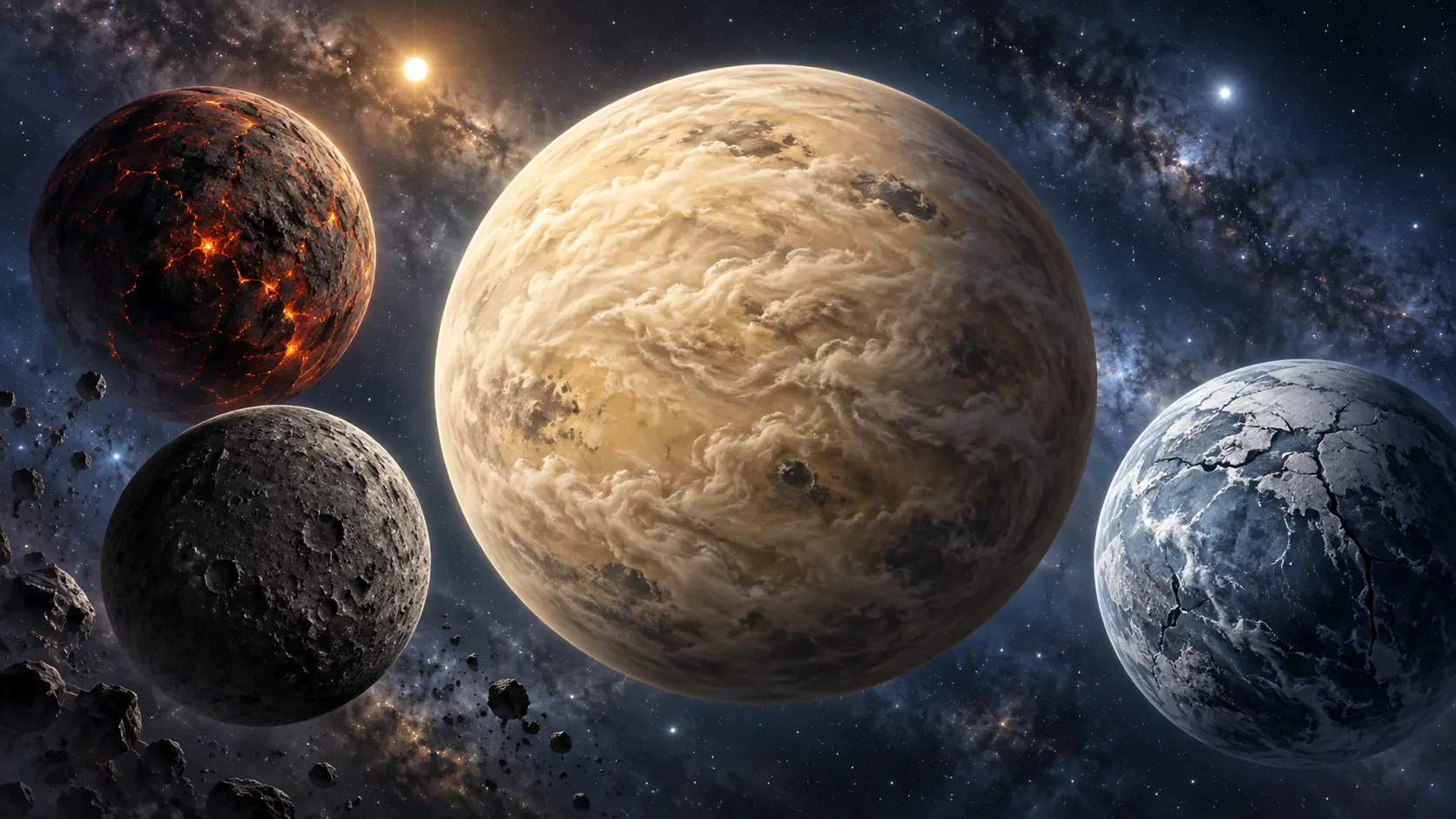
What is a terrestrial exoplanet?
Terrestrial exoplanets are worlds composed mainly of rock and metal rather than deep hydrogen-helium envelopes. They may be similar in size to Earth, smaller like Mars, or somewhat larger. "Terrestrial" describes bulk composition; it does not mean the planet has continents, oceans, breathable air, life, or an Earth-like climate.
Mercury, Venus, Earth, and Mars are the Solar System's terrestrial planets, yet their environments are dramatically different. Mercury is nearly airless, Venus has a crushing carbon-dioxide atmosphere, Earth has surface oceans, and Mars is cold with a thin atmosphere. Rocky exoplanets are expected to be at least as diverse.
Because these worlds are small and faint, astronomers usually observe them indirectly. Radius, mass, density, orbital energy, atmosphere, and stellar environment are assembled into a physical picture. Every step carries uncertainty.
How astronomers decide whether a planet is rocky
A transit gives radius when the star's radius is known. Radial velocity or transit timing variations can give mass. Density then provides a first test. A high density may be consistent with iron and silicate rock, while a low density requires substantial gas or volatiles.
There is no perfect density cutoff. Internal compression increases with mass, and different iron-to-rock ratios produce different densities. A planet rich in water can overlap a dry rocky planet in some measurements. An atmosphere may add little mass but noticeably increase radius.
Scientists compare observations with interior models. A planet falling near an Earth-like rock-and-iron curve is described as consistent with a rocky composition. That is stronger than judging by radius alone but still not a direct sample of the surface.
Earth-size is not Earth-like
Earth-size refers to radius. A planet can match Earth's size while receiving hundreds of times more stellar radiation. It could have a molten surface, no atmosphere, or a dense Venus-like atmosphere.
Earth-mass refers to mass, and Earth-density refers to average density. Earth-like is an informal phrase that should identify the specific resemblance. A truly close Earth analog would need a similar mass, radius, rocky composition, temperate energy, stable atmosphere, surface water, and compatible star—far more than one measurement.
The same caution applies to the term "habitable." Astronomers can identify potentially habitable conditions, but no exoplanet is confirmed to host life.
The habitable zone
The circumstellar habitable zone is the range where a rocky planet with an appropriate atmosphere could maintain liquid water on its surface. The boundaries depend on stellar brightness and spectrum as well as climate assumptions.
An orbit inside the zone does not guarantee water. The planet might be dry, airless, cloud-covered, or trapped in a runaway greenhouse. Outside the conventional zone, greenhouse gases, tidal heating, or subsurface oceans can complicate the picture.
Habitable-zone estimates are useful for prioritizing observations. They are not a substitute for measuring an atmosphere and climate. Articles should say "in the habitable zone" rather than "habitable" unless evidence supports the stronger statement.
Atmospheres of rocky exoplanets
Rocky atmospheres may be inherited, released by volcanoes, delivered by impacts, altered by oceans, or stripped by radiation and collisions. Small planets have weaker gravity than gas giants, making light gases easier to lose.
Possible secondary atmospheres include carbon dioxide, nitrogen, water vapor, sulfur dioxide, oxygen, and trace gases. The actual mixture depends on interior chemistry, surface reactions, impacts, escape, and biological activity if life exists.
Transmission spectroscopy of terrestrial planets is extremely challenging. Their atmospheres are thin in geometric extent and block only a tiny extra fraction of starlight. Clouds, hazes, stellar spots, and flares can create or conceal spectral features.
Thermal emission during secondary eclipse offers another path. A large day-night temperature contrast may indicate little atmosphere, while efficient heat redistribution can suggest a substantial atmosphere or ocean. Surface and atmospheric properties can produce similar signals, so several observations are needed.
Red dwarf rocky planets
Most rocky planets accessible to current atmospheric studies orbit small M dwarfs. A planet blocks a larger fraction of a small star, and the star's habitable zone is close enough to produce frequent transits.
Close orbits make tidal locking likely. One hemisphere may face the star continuously, but a sufficiently thick atmosphere or ocean could move heat to the nightside. Climate models show that synchronous rotation does not automatically make a planet uninhabitable.
The star itself is a major concern. Young red dwarfs can emit intense ultraviolet and X-ray radiation and powerful flares. They may erode atmospheres and alter chemistry. Whether an atmosphere survives depends on initial inventory, gravity, magnetic interactions, replenishment, and the star's history.
The TRAPPIST-1 system
TRAPPIST-1 is an ultra-cool dwarf with seven known Earth-size planets. Several receive stellar energy placing them near or within common habitable-zone estimates. The system offers a rare laboratory because the planets share one star and likely formed from related material.
Their resonant orbital chain creates transit timing variations that constrain masses. Mass and radius estimates suggest broadly rocky compositions, with differences in volatile content possible. The planets are not simply seven Earth copies.
JWST observations can test atmospheres through transits and thermal emission. Results for the inner planets have placed limits on thick atmospheres, while the cooler planets require more observing time. Stellar activity and small signals make interpretation difficult.
The importance of TRAPPIST-1 lies in comparative planetology. Observing several worlds under different irradiation around the same star helps separate the effects of energy, mass, and formation.
Other important rocky-world candidates
Proxima Centauri b orbits the nearest star to the Sun and has a minimum mass consistent with a terrestrial planet. It does not transit, so radius and atmospheric properties remain unknown. The host is an active red dwarf.
Kepler-186 f was the first Earth-size planet discovered in the habitable zone of another star. Its distance and faint host make detailed atmospheric observations difficult. Kepler-452 b orbits a Sun-like star in a longer-period orbit but is larger than Earth and may fall near the transition to volatile-rich planets.
LHS 1140 b is a nearby transiting temperate planet with mass and radius measurements that make it a valuable atmospheric target. TOI-700 d and TOI-700 e are small habitable-zone planets around a relatively quiet M dwarf. None has been confirmed to have surface oceans or life.
Airless worlds and lava planets
Some terrestrial exoplanets orbit so close to their stars that rock can melt. Their atmospheres, if present, may be made from vaporized surface material or volcanic gases. Tidal locking creates a hot dayside and cooler nightside.
An airless planet's thermal phase changes rapidly with viewing angle because rock stores and transports limited heat. A thick atmosphere smooths the temperature difference. Infrared observations can therefore test atmosphere scenarios even without resolving the surface.
Airless worlds are not failed Earths. They reveal atmospheric loss, tidal evolution, surface mineralogy, and the boundary conditions of rocky-planet climate.
Interiors, tectonics, and volcanism
Mass and radius constrain the core-to-mantle ratio but cannot reveal plate boundaries. Stellar elemental abundances may provide clues to the building material, though planet formation can fractionate elements.
Plate tectonics helps Earth recycle carbon over geological time, but scientists do not know how common it is. Planet mass, water, mantle temperature, composition, crust strength, and cooling history all matter. A stagnant-lid planet can still have volcanism and atmospheric cycling.
Volcanic gases might be detected indirectly, especially if eruptions produce temporary changes or strong sulfur chemistry. Such observations would require exceptional data and cautious interpretation.
Oceans and water worlds
Water can exist as vapor, liquid, ice, or supercritical fluid depending on temperature and pressure. A rocky planet may have small oceans like Earth, be mostly dry, or contain so much water that a global ocean hundreds of kilometers deep forms.
On a deep water world, high-pressure ice can develop beneath the ocean and separate it from rock. That could change nutrient cycling. Conversely, limited land does not automatically prevent habitability; ocean circulation and atmospheric exchange may support stable climates.
Detecting water vapor in an atmosphere is not the same as detecting surface oceans. Ocean evidence may require combined reflection, polarization, climate, and atmospheric measurements beyond current capability for most targets.
Biosignatures and false positives
A biosignature is a measurable feature potentially produced by life. Oxygen, ozone, methane, nitrous oxide, pigment reflectance, and chemical disequilibrium are often discussed. None is a simple yes-or-no proof.
Oxygen can accumulate without life through water loss or photochemistry. Methane can come from geology. Stellar ultraviolet radiation changes reaction pathways. Clouds and surface minerals affect spectra.
Scientists therefore seek multiple gases in environmental context and consider false-positive scenarios. A credible life claim would require repeated observations, independent teams, strong statistics, and elimination of plausible nonbiological explanations.
Can JWST find another Earth?
JWST can test atmospheres of favorable rocky planets, especially those transiting nearby small stars. It can measure thermal emission and search for broad molecular features, but detecting an exact Earth twin around a Sun-like star is beyond its intended capabilities.
Many transits may be needed to combine enough signal. Stellar variability can dominate. A nondetection may mean no atmosphere, a high cloud deck, an atmosphere with weak features, or insufficient data.
Future large space observatories aim to directly image potentially habitable planets around nearby Sun-like stars and analyze reflected light. Ground-based extremely large telescopes will contribute high-resolution spectroscopy.
What would make a convincing Earth analog?
A strong candidate would have measured Earth-like mass and radius, a rocky density, an orbit allowing temperate conditions, and an atmosphere compatible with surface liquid water. A stable star, moderate radiation, and evidence of long-term climate regulation would strengthen the case.
Even then, habitability would not prove life. Earth itself changed dramatically over time, and many habitable environments here support no detectable remote biosignature.
The search is therefore staged: discover the planet, measure its orbit and size, estimate mass, detect an atmosphere, characterize climate and chemistry, and only then assess possible biological explanations.
Why terrestrial worlds matter
Rocky planets connect astronomy with geology, atmospheric science, climate, chemistry, and biology. Their diversity reveals which parts of Earth's history are common and which may be rare.
Population statistics show how often small planets form. Individual atmosphere measurements reveal survival and climate. Comparative systems such as TRAPPIST-1 test the effect of irradiation. Ultimately, terrestrial exoplanets offer the clearest path to answering whether environments resembling Earth exist elsewhere.
The boundary with the larger super-Earth class is blurry: both share rocky compositions, and only the mass or radius separates them in practice.
Frequently asked questions
What is a terrestrial exoplanet?
It is a planet beyond the Solar System composed mainly of rock and metal rather than a deep hydrogen-helium envelope.
Are terrestrial exoplanets Earth-like?
They are rocky, but their temperatures, atmospheres, water, and geology can be completely different from Earth.
Which known exoplanet is most like Earth?
There is no single confirmed Earth twin. Different candidates match Earth in size, mass, irradiation, or star type, but none matches every property with complete measurements.
Does being in the habitable zone mean life exists?
No. It only indicates that surface liquid water could be possible under suitable atmospheric conditions.
Can scientists see continents on rocky exoplanets?
No current telescope resolves continents on an exoplanet. Most knowledge comes from transits, stellar wobble, thermal emission, and spectra.
Compare all major exoplanet types
The main planet-type labels below describe size, orbit, or environment rather than a fixed composition or habitability. Use them as starting points rather than final categories.
| Planet type | Typical description | Defining property | Key caution |
|---|---|---|---|
| Hot Jupiter | Giant planet on a days-long orbit | Large gas giant under intense irradiation | Easy detection creates catalog bias |
| Warm Neptune / sub-Neptune | Intermediate-size atmosphere-rich world | Size between Earth and Neptune or Neptune-like moderate irradiation | Labels overlap and do not fix composition |
| Super-Earth | Larger or more massive than Earth, below Neptune | Observational mass or radius range | “Super” does not mean Earth-like or habitable |
| Terrestrial world | Mainly rock and metal | Bulk rocky composition | Earth-size does not prove Earth-like conditions |
| Rogue planet | Planetary-mass body unbound to a star | Free-floating motion | Some may form like brown dwarfs; mass and origin can be uncertain |
Related planet types
Hot Jupiters
Gas giants larger than or comparable to Jupiter that orbit their stars in only days. Intensely irradiated, often tidally locked, and famously the first exoplanets found around Sun-like stars.
Warm Neptunes & sub-Neptunes
Intermediate-size planets between Earth and Neptune, often wrapped in hydrogen-rich atmospheres. The most common class discovered by Kepler and TESS, with no direct Solar System analogue.
Super-Earths
Rocky worlds larger than Earth but smaller than Neptune. Their densities span iron-rich to water-rich, and "super" does not mean Earth-like or habitable.
Rogue planets
Planetary-mass objects that drift through the galaxy unbound to any star. Detected by microlensing or infrared imaging, they record the hidden dynamics of planet formation.
Sources and further reading
- NASA Science — What Is an Exoplanet? — last verified 2026-09-17
- NASA Exoplanet Archive — last verified 2026-09-17
- NASA Science — TRAPPIST-1 — last verified 2026-09-17
- NASA Exoplanet Exploration — Planet Types — last verified 2026-09-17