
Super-Earth Planets
Learn what super-Earth planets are, whether they are rocky or habitable, how astronomers study them, and what famous examples reveal.
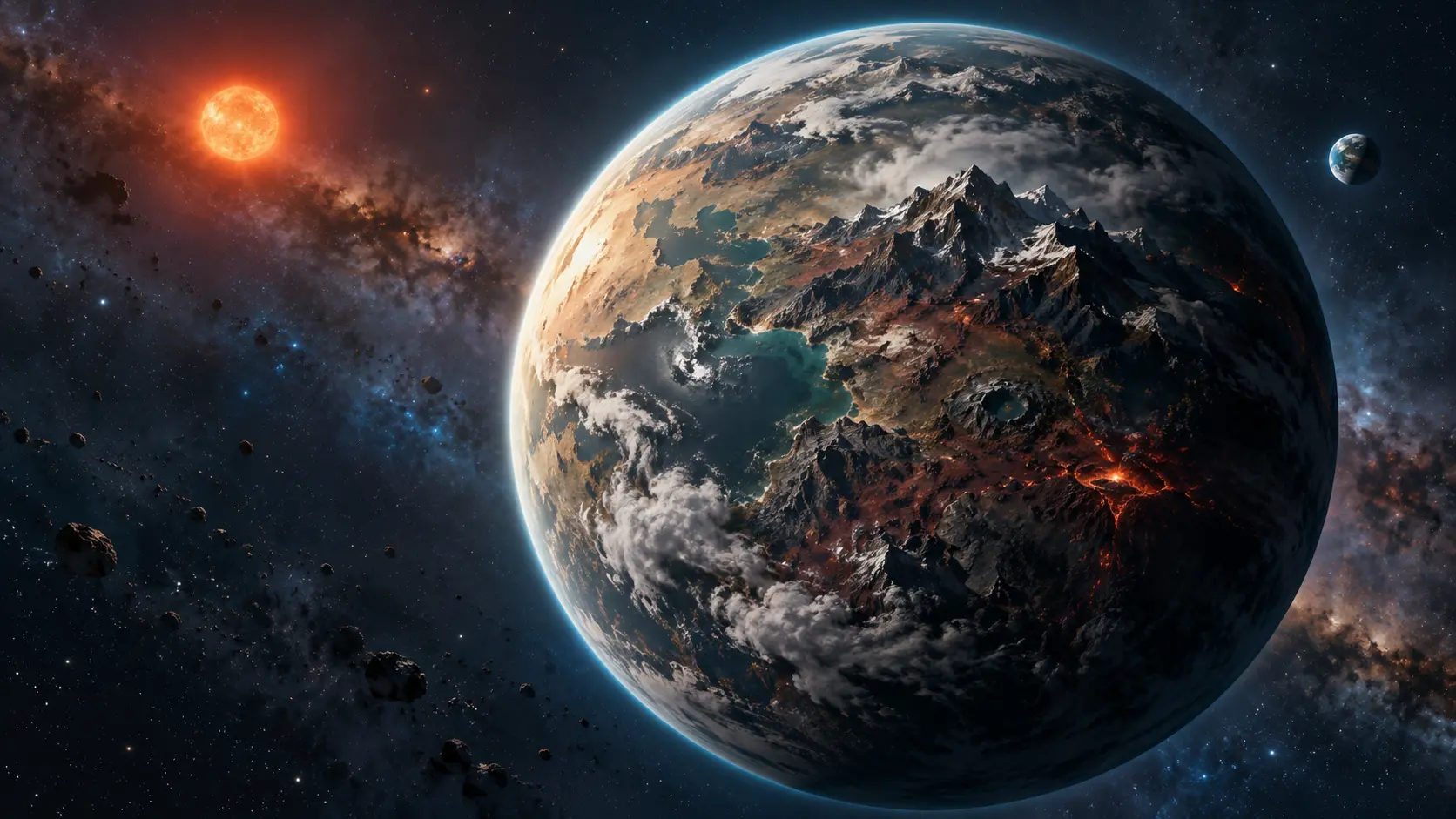
What is a super-Earth?
Super-Earth planets are exoplanets larger or more massive than Earth but smaller than Neptune. The name describes size or mass, not surface conditions. A super-Earth is not necessarily a larger copy of Earth, and it is not automatically rocky, habitable, or inhabited.
Different studies use different boundaries. Some define super-Earths by mass, commonly from roughly one or two Earth masses up to about ten. Others use radius, often around one to nearly two Earth radii. Near the upper end, many planets retain substantial hydrogen-helium envelopes and are also described as sub-Neptunes or mini-Neptunes.
That overlap is scientifically meaningful. Nature does not organize planets into perfectly separated boxes. Astronomers use measured radius, mass, density, atmosphere, and stellar energy to understand an individual world rather than relying only on its category name.
Why the term can be misleading
"Super" refers to bulk size or mass. It does not mean superior to Earth or especially suitable for life. A hot super-Earth may have a molten surface. A low-density planet may be wrapped in thick gas. A high-density planet may be iron-rich. Another could have a large fraction of water or high-pressure ice.
News headlines sometimes call any planet larger than Earth an "Earth-like world." That wording should be avoided unless similarity is clearly defined. Earth-like could refer to radius, mass, rocky composition, temperature, atmosphere, or surface water, and those are separate properties.
A responsible description states what was measured. For example: "a 1.5-Earth-radius planet in the star's habitable zone" is more informative than "another Earth."
How super-Earths are detected
Transit surveys have discovered many super-Earths. When a planet passes in front of its star, the fractional decrease in light gives the ratio of planet size to star size. Small cool stars are valuable targets because a super-Earth blocks a larger percentage of their light.
Radial velocity detects the star's back-and-forth motion. Super-Earth signals can be only a few meters per second or less, so stellar activity and instrument stability are serious challenges. Combining transit and radial velocity yields both radius and mass.
Transit timing variations can measure masses in multiplanet systems. If neighboring planets pull on one another, their transits occur slightly early or late. Astrometry may eventually measure the sky-plane reflex motion of some nearby systems, while direct imaging of a true super-Earth remains extremely difficult.
Mass, radius, and density
Average density is calculated from mass and volume. Because volume grows with the cube of radius, a modest radius uncertainty can substantially affect density. Stellar radius uncertainty also propagates into planet radius.
A dense super-Earth may be consistent with an iron core and silicate mantle. A lower density may require water, ice, or a gas envelope. Interior models are not unique. A world with more iron and more water can sometimes match the same measurements as a different mixture with a light atmosphere.
Researchers therefore study populations. The observed radius distribution suggests that many close-in planets split into smaller, likely stripped rocky cores and larger worlds that retained gas. The boundary depends on period, stellar type, age, and mass.
Are super-Earths rocky?
Many planets below roughly 1.5 to 1.8 Earth radii are consistent with mostly rocky compositions, but this is a statistical tendency, not an absolute law. Some small planets may contain substantial water, and some larger planets may be dense stripped cores.
Pressure changes materials. A super-Earth's stronger gravity compresses rock and metal, so simply scaling Earth's density can be misleading. Very massive rocky worlds may have deep mantles with mineral phases not found near Earth's surface.
A planet's atmosphere also affects its measured transit radius. A small amount of hydrogen and helium by mass can extend over a large volume. Atmosphere detection or limits are therefore essential for identifying a genuinely bare rocky planet.
Gravity and conditions on the surface
Surface gravity depends on both mass and radius. A planet five times Earth's mass is not necessarily five times Earth's surface gravity because it is also larger. Many plausible rocky super-Earths might have surface gravity one to several times Earth's.
Higher gravity can compress the atmosphere, influence mountain height, affect volcanic gases, and change how organisms or machines would move. It does not by itself determine whether a planet can retain an atmosphere; temperature, molecular weight, radiation, magnetic environment, and impact history matter too.
For most super-Earths, there is no direct image of a surface. Surface temperature estimates often assume an atmosphere or an albedo that has not been measured. Articles should not describe oceans, continents, or weather as established unless observations support them.
Atmospheres of super-Earths
A rocky super-Earth could have an atmosphere released by volcanoes, delivered by impacts, inherited from the disk, or rebuilt after early loss. Possible gases include nitrogen, carbon dioxide, water vapor, sulfur compounds, hydrogen, and products of photochemistry.
Close-in planets face intense ultraviolet and X-ray radiation. Light gases escape most easily, potentially exposing a secondary atmosphere or bare surface. Massive planets have stronger gravity, which helps retention, but high temperature and radiation can still drive loss.
Transmission spectroscopy is difficult because a compact, heavy atmosphere has a small scale height and produces weak features. Clouds, hazes, starspots, and flares further complicate the signal. Thermal emission and phase curves can sometimes constrain dayside temperature and atmosphere thickness.
Lava worlds and ultra-short-period super-Earths
Some super-Earths orbit in less than a day. Their surfaces may become hot enough to melt rock. If tidally locked, they can have a permanent magma-covered dayside and a cooler nightside.
55 Cancri e is a famous example. It is a short-period super-Earth with extreme irradiation, and researchers have studied its thermal emission and possible atmosphere. Interpretations have changed as instruments and models improved. It should not be described as a confirmed ocean world or a straightforward bare lava ball without noting uncertainty.
K2-141 b and similar ultra-short-period planets are used to explore rock-vapor atmospheres, magma circulation, and surface-atmosphere exchange. These worlds extend planetary climate science beyond gases and liquids familiar on Earth.
Super-Earths in habitable zones
A habitable zone is the range of orbital distances where a rocky planet with a suitable atmosphere could maintain liquid surface water. It is a screening concept, not a declaration of habitability.
A super-Earth in the habitable zone may retain a thick hydrogen envelope that creates excessive pressure and heat. It may be water-rich with high-pressure ice beneath an ocean. It may be airless because of stellar activity, or locked into a climate state unlike Earth.
Conversely, higher mass could help a planet retain an atmosphere and drive long-lived geological activity. The result depends on formation, composition, star, orbit, rotation, magnetic environment, and time. Researchers must measure each factor rather than assume larger means better.
Red dwarf systems
Many nearby super-Earth candidates orbit M dwarfs because small stars make transit and radial-velocity signals larger. Their habitable zones are close, giving short periods and frequent transits.
Red dwarfs can be magnetically active, especially when young. Flares and high-energy radiation may erode atmospheres or change chemistry. Close planets often become tidally locked, though atmospheric and ocean circulation could still transport heat to the nightside.
Long stellar lifetimes offer enormous time for evolution, but early activity creates difficult initial conditions. Habitability around red dwarfs remains an active scientific question rather than a settled yes or no.
Important super-Earth examples
55 Cancri e is an intensely heated nearby transiting super-Earth and a prime target for thermal observations. LHS 1140 b is a temperate planet around a nearby red dwarf with measured mass and radius that motivate atmospheric study.
Kepler-10 b was among the first confirmed rocky planets found by Kepler. CoRoT-7 b was an early transiting super-Earth and helped demonstrate the difficulty of measuring small planets around active stars.
Kepler-452 b is often called an Earth cousin because of its size and orbit around a Sun-like star, but its mass and atmosphere are not precisely known. Its radius suggests it may not be an exact Earth analog. Proxima Centauri b is often grouped with super-Earths by minimum mass; it does not transit, so radius and composition remain uncertain.
Plate tectonics, volcanism, and magnetic fields
Researchers debate whether super-Earth mass makes plate tectonics more or less likely. Stronger gravity may increase stresses that help plates move, while high pressure, mantle viscosity, water content, and thermal history can change the outcome.
Volcanism can replenish an atmosphere and cycle carbon, but excessive volcanism may create hostile conditions. A magnetic field depends on fluid motion in a conducting interior, rotation, heat flow, and core structure. A larger iron core does not guarantee a protective magnetic field.
These properties are extremely difficult to observe directly. Scientists use mass, radius, age, atmospheric gases, stellar activity, and physical models to infer possibilities. Claims should be presented as hypotheses, not maps of unseen geology.
Super-Earths and planet formation
The Solar System's lack of super-Earths is itself a clue. Elsewhere, compact systems often contain several planets larger than Earth inside Mercury's orbit. They may have formed near their current locations from abundant inner-disk material, formed farther out and migrated inward, or experienced both processes.
Planet spacing and resonances record dynamical history. Some systems sit near simple period ratios but not exactly in resonance, perhaps because migration, tides, or disk interactions altered them. Collisions can remove atmospheres and change core fractions.
Stellar metallicity and disk mass influence available building material. Comparing super-Earth populations around different stars helps connect planet properties with birth environments.
Could humans live on a super-Earth?
No known super-Earth has been shown to offer a human-survivable surface. Most are too distant for travel, and even nearby examples have poorly known atmospheres. Higher gravity, radiation, temperature, pressure, and chemistry could make them hostile.
The question is still useful because it identifies measurements needed: surface pressure, temperature, atmospheric composition, radiation, liquid water, and long-term climate stability. Current telescopes can begin atmospheric studies for favorable worlds, but they cannot yet provide a complete habitability assessment.
Science should separate imagination from evidence. A habitable-zone orbit or Earth-like radius is an invitation to investigate, not proof of a second home.
Why super-Earths matter
Super-Earths occupy a major part of the galaxy's planet population but are missing from our Solar System. They test how rocky cores grow, how atmospheres are gained and lost, and how system architecture evolves.
They also bridge observational goals. Large hot examples are accessible today, while smaller temperate super-Earths push instruments toward the challenge of Earth analogs. Every reliable mass, radius, and spectrum improves the models used to interpret future discoveries.
The line between a large super-Earth and a small terrestrial world is not sharp. Reading both articles together shows how modern classification is a conversation between measurement, model, and language rather than a fixed taxonomy.
Frequently asked questions
What is a super-Earth in simple terms?
It is an exoplanet larger or more massive than Earth but smaller than Neptune. The term does not guarantee an Earth-like surface.
Are all super-Earths rocky?
No. Smaller examples are more likely to be rocky, while larger ones may have deep volatile layers or thick hydrogen-helium atmospheres.
Are super-Earths habitable?
Some orbit in habitable zones, but habitability also requires suitable atmosphere, pressure, temperature, water, radiation conditions, and stability. None is confirmed inhabited.
Why is there no super-Earth in our Solar System?
The exact reason is unknown. It reflects the Solar System's particular formation and migration history, which may differ from the histories of compact systems found by Kepler.
Is a super-Earth stronger in gravity than Earth?
Usually, but gravity depends on both mass and radius. A low-density planet can be large without having proportionally extreme surface gravity.
Compare all major exoplanet types
The main planet-type labels below describe size, orbit, or environment rather than a fixed composition or habitability. Use them as starting points rather than final categories.
| Planet type | Typical description | Defining property | Key caution |
|---|---|---|---|
| Hot Jupiter | Giant planet on a days-long orbit | Large gas giant under intense irradiation | Easy detection creates catalog bias |
| Warm Neptune / sub-Neptune | Intermediate-size atmosphere-rich world | Size between Earth and Neptune or Neptune-like moderate irradiation | Labels overlap and do not fix composition |
| Super-Earth | Larger or more massive than Earth, below Neptune | Observational mass or radius range | “Super” does not mean Earth-like or habitable |
| Terrestrial world | Mainly rock and metal | Bulk rocky composition | Earth-size does not prove Earth-like conditions |
| Rogue planet | Planetary-mass body unbound to a star | Free-floating motion | Some may form like brown dwarfs; mass and origin can be uncertain |
Related planet types
Hot Jupiters
Gas giants larger than or comparable to Jupiter that orbit their stars in only days. Intensely irradiated, often tidally locked, and famously the first exoplanets found around Sun-like stars.
Warm Neptunes & sub-Neptunes
Intermediate-size planets between Earth and Neptune, often wrapped in hydrogen-rich atmospheres. The most common class discovered by Kepler and TESS, with no direct Solar System analogue.
Terrestrial worlds
Small rocky planets like Earth, Mars, or Venus but around other stars. Some orbit in habitable zones of nearby cool dwarfs and are prime JWST targets.
Rogue planets
Planetary-mass objects that drift through the galaxy unbound to any star. Detected by microlensing or infrared imaging, they record the hidden dynamics of planet formation.
Sources and further reading
- NASA Science — What Is an Exoplanet? — last verified 2026-09-17
- NASA Exoplanet Archive — last verified 2026-09-17
- The Planetary Society — The Different Kinds of Exoplanets You Meet in the Milky Way — last verified 2026-09-17
- NASA Exoplanet Exploration — Planet Types — last verified 2026-09-17