
Elliptical Galaxies: Facts, Science and Complete Guide
Learn about elliptical galaxies — rounded stellar systems dominated by older stars, low gas, and evidence from mergers, dynamics, and cluster environments.
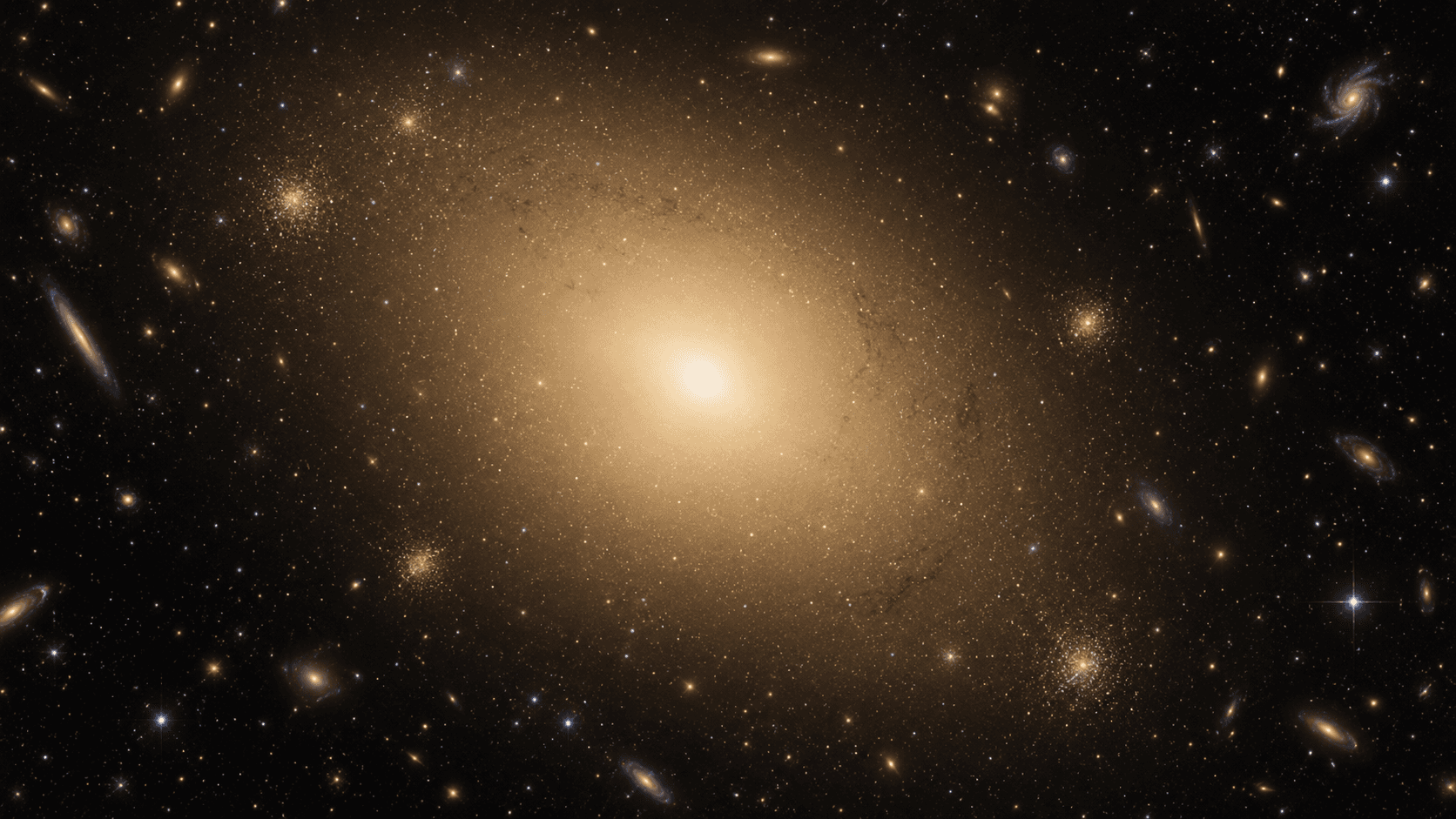
Quick answer: Elliptical galaxies are rounded or elongated stellar systems with little organized disk structure, generally low supplies of cold gas and dust, and populations dominated by older stars.
Elliptical Galaxies at a Glance
| Topic | Explanation |
|---|---|
| Definition | Rounded or elongated stellar systems with little organized disk structure, low cold gas and dust, and older stellar populations. |
| Physical setting | Stars follow many differently oriented orbits, creating a smooth appearance. Ellipticals range from dwarfs to giant systems in cluster centers. |
| Key evidence | Classification runs from nearly round E0 to highly elongated E7 shapes; spectroscopy and stellar motion reveal mass, age, chemistry, and dark matter. |
| Why it matters | Ellipticals help astronomers study galaxy mergers, old stellar populations, globular clusters, supermassive black holes, and cluster environments. |
| Important caution | An elliptical galaxy is not simply an old spiral viewed from the wrong direction. The two classes have different structures, orbital patterns, and gas content. |
What Is an Elliptical Galaxy?
Elliptical galaxies are rounded or elongated stellar systems with little organized disk structure, generally low supplies of cold gas and dust, and populations dominated by older stars. Their stars follow many differently oriented orbits, creating a smooth appearance. Ellipticals range from dwarfs to giant systems in cluster centers. Many formed or were transformed through mergers, repeated interactions, gas loss, and suppressed star formation.
Each statement refers to measurable properties rather than appearance alone. Astronomers connect those measurements using gravity, thermodynamics, chemistry, and models tested against observations. This category is closely related to the Milky Way Galaxy (a barred spiral) and to spiral and irregular galaxies.
The Essential Science
Classification runs from nearly round E0 systems to highly elongated E7 appearances, although projected shape does not uniquely reveal three-dimensional structure. Spectroscopy and stellar motion expose mass, age, chemistry, and dark matter. Real cosmic systems differ in mass, composition, environment, age, rotation, magnetic field, and interaction history. Those differences produce the variety seen by telescopes.
Physical explanations must conserve energy, momentum, and mass while agreeing with radiation and motion. When several models fit an image, spectroscopy, timing, polarization, or higher-resolution observations can help separate them.
Important Facts
Ellipticals help astronomers study galaxy mergers, old stellar populations, globular clusters, supermassive black holes, hot gas, and the environmental effects found in galaxy groups and clusters. That importance extends beyond any single object because astronomy uses comparisons: one well-studied example calibrates methods, and a large population reveals patterns and exceptions.
Astronomers use light-years for stellar and galactic distances, solar masses for mass, and parsecs in professional measurements. Comparisons must always identify whether they describe diameter, mass, volume, luminosity, or distance.
How Astronomers Study Elliptical Galaxies
Astronomy is an observational science. Confidence grows when independent measurements point to the same explanation. Images provide spatial context; spectra reveal composition, temperature, and motion; time-series observations expose change; and theoretical models test whether known physics can reproduce the data.
For ellipticals, the most informative evidence concerns the ellipticity distribution, stellar motions, X-ray emission from hot gas, and central supermassive black hole masses. Researchers compare observations across wavelength, time, and location so that instrumental artifacts are not mistaken for permanent features.
What Telescopes Actually Measure
A telescope first records photons, not a finished explanation. Detectors count energy arriving at particular positions, wavelengths, and times. Calibration removes known instrumental effects. Analysts then derive brightness, spectrum, temperature, velocity, polarization, and chemical abundance.
Astronomical images are scientific products. Some record visible light; others translate infrared, radio, ultraviolet, X-ray, or gamma-ray measurements into colors people can see. A responsible caption identifies the telescope, wavelength, processing, and whether the visual is data, a simulation, or an artist's concept.
Origin and Development
Many ellipticals formed or were transformed through mergers, repeated interactions, gas loss, and suppressed star formation. Origins are reconstructed from present evidence and from observations of related systems at different stages — comparable to understanding a forest by observing seedlings, mature trees, and fallen trunks, while recognizing that cosmic objects follow different paths.
Formation models are valuable only when they make predictions that observations can test. Researchers ask which structures, spectra, populations, and time scales should appear if a proposed origin is correct.
Structure and Physical Conditions
Elliptical galaxies contain regions of very different density, temperature, composition, pressure, magnetic field, and motion. A simple boundary in a diagram often represents a transition rather than a hard material wall. Numerical estimates are commonly rounded for general readers because measured values and category boundaries vary among sources.
Energy, Gravity, and Motion
Gravity organizes matter over astronomical scales, but pressure, rotation, magnetic fields, radiation, collisions, and feedback can resist or redirect collapse. The observed state of an elliptical reflects the competition among these processes. Energy can appear as visible light, heat, fast particles, motion, magnetic activity, or radiation beyond human vision.
Connections to Other Cosmic Objects
Ellipticals help astronomers study galaxy mergers, old stellar populations, globular clusters, supermassive black holes, hot gas, and the environmental effects in galaxy groups and clusters. Similar-looking objects may have different origins, and objects at the same evolutionary stage may look different because of mass, orientation, dust, or viewing wavelength.
What Is Known and What Remains Uncertain
Scientific uncertainty identifies how precisely a value is measured and which interpretations remain compatible with evidence. Strong articles distinguish direct detection, indirect evidence, model-dependent inference, candidate objects, and hypotheses that have not been confirmed.
The necessary caution: an elliptical galaxy is not simply an old spiral viewed from the wrong direction. The two classes have different structures, orbital patterns, and gas content, though transformations between galaxy types can occur.
Common Misconceptions
The most common mistake is treating ellipticals as "spirals seen sideways." A second is treating color, size, and distance as self-evident in an image. Exposure, wavelength, processing, perspective, and logarithmic scaling all change appearance. Scientific captions and scale information are essential.
How This Topic Fits Into Cosmic Evolution
Cosmic history links simple early material to stars, elements, planets, galaxies, and large-scale structure. Elliptical galaxies preserve evidence of earlier conditions while their energy or material influences what forms later. Detailed nearby observations expose mechanisms; distant surveys show how common those mechanisms were at earlier cosmic times.
Best Ways to Explain Ellipticals to Students
Begin with the quick definition, then introduce the physical cause, observable evidence, scale, and uncertainty. Use real observations alongside simplified diagrams. Label false-color images and artist concepts clearly. Invite learners to identify which claims are direct measurements and which are interpretations.
Why Elliptical Galaxies Matter
Ellipticals help astronomers study galaxy mergers, old stellar populations, globular clusters, supermassive black holes, hot gas, and the environmental effects found in galaxy groups and clusters. The topic demonstrates that gravity shapes structure, energy changes form, light carries information, and evidence can constrain events that cannot be watched from beginning to end.
A Responsible Summary
Elliptical galaxies are rounded or elongated stellar systems dominated by older stars, with little organized disk structure. Classification uses E0 through E7 morphology, and spectroscopy and stellar motion reveal mass, age, chemistry, and dark matter. Their populations and dynamics tell us about mergers, dense environments, and the coevolution of galaxies with their central supermassive black holes.
Detailed Search Questions
What does "elliptical galaxy" mean in astronomy?
An elliptical galaxy is a rounded or elongated stellar system with little organized disk structure, low cold gas and dust, and older stellar populations. Definitions in astronomy often describe an evolutionary state, structure, mass range, or observational category rather than a sharply bounded everyday object.
What evidence supports the modern explanation?
Classification uses ellipticity; spectroscopy and stellar motion expose mass, age, chemistry, and dark matter. Confidence grows when imaging, spectra, motion, timing, and theoretical predictions agree.
How are ellipticals different from related objects?
Ellipticals differ from spirals in structure, orbital patterns, and gas content, and from irregular galaxies in symmetry and organization.
Why are ellipticals important to scientists?
They test how mergers, environment, and feedback shape stellar populations and central supermassive black holes.
What remains unknown?
The relative contributions of major mergers, minor mergers, and gas depletion to elliptical formation vary among populations and remain debated. Better wavelength coverage and longer time baselines are often as valuable as higher resolution.
How are images created and interpreted?
Detectors record various wavelengths; astronomers calibrate the data, assign display colors, and align observations. Captions must distinguish direct images, processed composites, simulations, and artist concepts.
What role do gravity and energy play?
Gravity gathers and organizes matter; thermal pressure, rotation, magnetic fields, fusion, collisions, and expansion can oppose or redirect it. Energy conservation links these processes.
Authoritative Source
Scientific content reviewed September 5, 2026.
Frequently asked questions
What is an elliptical galaxy?
Elliptical galaxies are rounded or elongated stellar systems with little organized disk structure, generally low supplies of cold gas and dust, and populations dominated by older stars.
How do scientists know about elliptical galaxies?
Classification runs from nearly round E0 systems to highly elongated E7 appearances, though projected shape does not uniquely reveal three-dimensional structure. Spectroscopy and stellar motion expose mass, age, chemistry, and dark matter.
Why are elliptical galaxies important?
Ellipticals help astronomers study galaxy mergers, old stellar populations, globular clusters, supermassive black holes, hot gas, and the environmental effects found in galaxy groups and clusters.
What is commonly misunderstood about elliptical galaxies?
An elliptical galaxy is not simply an old spiral viewed from the wrong direction. The two classes have different structures, orbital patterns, and gas content, though transformations between galaxy types can occur.
Can elliptical galaxies be seen from Earth?
Bright nearby ellipticals such as M87 are visible in modest telescopes. Distant examples require professional observatories.
Where can reliable information be found?
Start with the linked NASA overview and follow its references to instrument documentation, data archives, and peer-reviewed research.
Sources
- NASA — Galaxy Types — last verified Sat Sep 05 2026 00:00:00 GMT+0000 (Coordinated Universal Time)
More in Galaxies
Galaxy Clusters: Facts, Science and Complete Guide
Galaxy clusters — gravitationally bound systems of hundreds or thousands of galaxies, hot intracluster gas, and dominant dark matter.
Irregular Galaxies: Facts, Science and Complete Guide
Irregular galaxies lack the orderly spiral or elliptical shape. Many are small, gas-rich, actively forming stars, or distorted by interactions.
Spiral Galaxies: Facts, Science and Complete Guide
Spiral galaxies — rotating disks with spiral arms, central bulges, gas, dust, and dark-matter halos. Facts, structure, dynamics, and famous examples.