
Galaxy Clusters: Facts, Science and Complete Guide
Galaxy clusters — gravitationally bound systems of hundreds or thousands of galaxies, hot intracluster gas, and dominant dark matter.
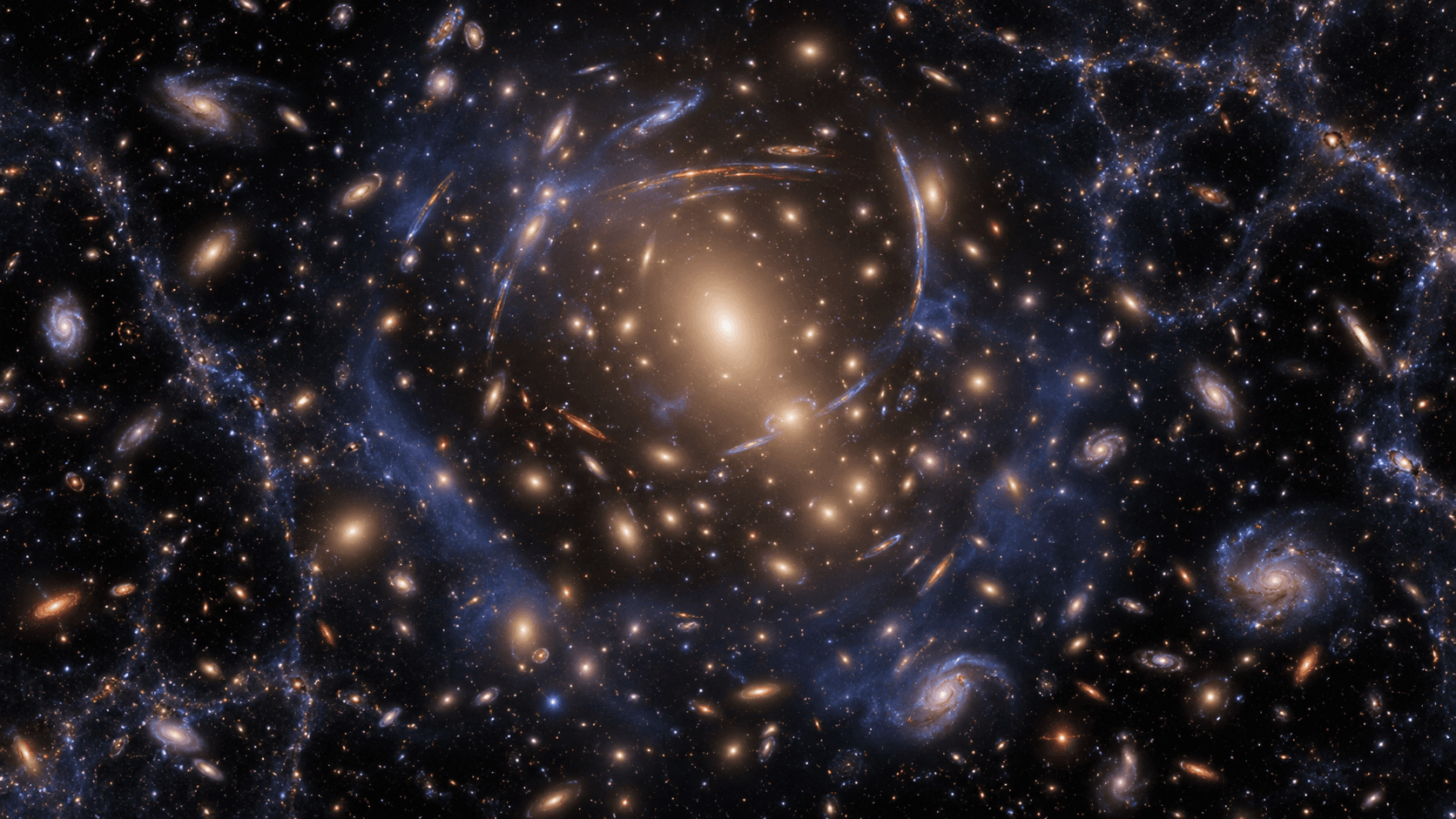
Quick answer: Galaxy clusters are gravitationally bound systems containing hundreds or thousands of galaxies, enormous reservoirs of hot X-ray-emitting gas, and much more dark matter than visible matter.
Galaxy Clusters at a Glance
| Topic | Explanation |
|---|---|
| Definition | Gravitationally bound systems of many galaxies plus hot gas and dark matter. |
| Physical setting | Clusters grow at nodes of the cosmic web; hot intracluster plasma fills the space between galaxies. |
| Key evidence | Optical surveys, X-ray, radio, gravitational lensing, and the Sunyaev–Zeldovich effect. |
| Why it matters | Laboratories for dark matter, galaxy evolution, plasma physics, gravity, and cosmology. |
| Important caution | A galaxy cluster is not a star cluster. |
What Is a Galaxy Cluster?
Galaxy clusters are gravitationally bound systems containing hundreds or thousands of galaxies, enormous reservoirs of hot X-ray-emitting gas, and much more dark matter than visible matter. Clusters grow where matter collects along the cosmic web. Galaxies contribute only part of the ordinary matter; the space between them holds extremely hot intracluster plasma. Dark matter supplies most of the gravitational mass, while mergers generate shocks and turbulence.
The Essential Science
Astronomers study clusters with optical galaxy surveys, X-ray telescopes, radio observations, gravitational lensing, and the Sunyaev–Zeldovich effect on the cosmic microwave background. Each method traces a different component: stars, plasma, magnetic fields, and total mass. Combined, they build a self-consistent picture.
Important Facts
Clusters are laboratories for dark matter, galaxy evolution, plasma physics, gravity, and cosmology. Their abundance and growth help constrain the universe's matter content and expansion history.
How Astronomers Study Clusters
Multiple, independent techniques are essential. X-rays trace the hot plasma; radio observations trace relativistic electrons and magnetic fields; lensing measures total mass regardless of type; galaxy surveys reveal member populations and dynamics.
What Telescopes Actually Measure
Detectors record specific wavelengths. X-ray images show plasma; optical images show galaxies; radio maps show non-thermal emission. Captions should identify wavelength, instrument, and processing.
Origin and Development
Clusters grow through infall of galaxies and gas along cosmic filaments and by merging with smaller groups. Merger shocks heat the intracluster gas and can trigger radio halos and relics.
Structure and Physical Conditions
A cluster contains member galaxies, hot X-ray-emitting plasma (~10^7 K), non-thermal particles and magnetic fields, and a dominant dark-matter halo. Central regions often host a brightest cluster galaxy and complex cooling gas.
Energy, Gravity, and Motion
Gravity binds the system; thermal pressure supports the hot gas; radiative cooling and AGN feedback regulate the central regions. Merger dynamics inject enormous kinetic energy.
Connections to Other Cosmic Objects
Clusters host elliptical and spiral galaxies, central supermassive black holes that regulate gas via jets, and populations of intermediate-mass black hole candidates.
What Is Known and What Remains Uncertain
The physics of intracluster plasma turbulence, radio halos, and AGN feedback remains actively studied. Cluster counts across cosmic time constrain dark energy but depend on mass calibration.
Common Misconceptions
A galaxy cluster is not the same as a star cluster. Galaxy clusters contain whole galaxies and span millions of light-years.
How Clusters Fit Into Cosmic Evolution
Clusters are the most massive gravitationally bound structures. Their formation history traces the growth of cosmic structure and the balance between matter and dark energy.
Best Ways to Explain Clusters to Students
Show composite images of Coma or Perseus with X-ray, optical, and lensing layers. Explain that most of the mass is invisible and inferred from motions and light bending.
Why Clusters Matter
They test cosmology, expose dark-matter behavior, and reveal the strongest AGN and merger-driven feedback in the universe.
A Responsible Summary
Galaxy clusters are the largest gravitationally bound systems: many galaxies plus dominant plasma and dark matter. Multi-wavelength observations, lensing, and cosmological surveys together anchor their study.
Detailed Search Questions
What does "galaxy cluster" mean in astronomy?
A gravitationally bound system of many galaxies, hot plasma, and dark matter, typically spanning millions of light-years.
What evidence supports the modern picture?
Optical, X-ray, radio, lensing, and SZ measurements combine to reveal all components and total mass.
How are clusters different from related objects?
Groups are smaller and less relaxed; superclusters are gravitationally unbound structures on even larger scales.
Why are they important?
They test cosmology, dark matter, plasma physics, and galaxy evolution in extreme environments.
What remains unknown?
Details of plasma turbulence, radio halos, mass calibration, and AGN feedback continue to challenge models.
How are their images interpreted?
Multi-wavelength composites combine X-ray, optical, and radio; captions should list wavelengths and instruments.
What role do gravity and energy play?
Gravity binds the cluster; thermal, turbulent, magnetic, and AGN feedback energies regulate the intracluster medium.
Authoritative Source
Scientific content reviewed September 5, 2026.
Frequently asked questions
What is a galaxy cluster?
Galaxy clusters are gravitationally bound systems containing hundreds or thousands of galaxies, enormous reservoirs of hot X-ray-emitting gas, and much more dark matter than visible matter.
How do scientists study clusters?
Astronomers use optical galaxy surveys, X-ray telescopes, radio observations, gravitational lensing, and the Sunyaev–Zeldovich effect. Each method traces a different component.
Why do clusters matter?
Clusters are laboratories for dark matter, galaxy evolution, plasma physics, gravity, and cosmology. Their abundance and growth constrain the universe's matter content and expansion history.
Is a galaxy cluster the same as a star cluster?
No. Galaxy clusters contain whole galaxies and span millions of light-years; star clusters contain thousands of stars within a single galaxy.
Sources
- NASA — Large-Scale Structures — last verified Sat Sep 05 2026 00:00:00 GMT+0000 (Coordinated Universal Time)
More in Galaxies
Elliptical Galaxies: Facts, Science and Complete Guide
Learn about elliptical galaxies — rounded stellar systems dominated by older stars, low gas, and evidence from mergers, dynamics, and cluster environments.
Irregular Galaxies: Facts, Science and Complete Guide
Irregular galaxies lack the orderly spiral or elliptical shape. Many are small, gas-rich, actively forming stars, or distorted by interactions.
Spiral Galaxies: Facts, Science and Complete Guide
Spiral galaxies — rotating disks with spiral arms, central bulges, gas, dust, and dark-matter halos. Facts, structure, dynamics, and famous examples.