
Irregular Galaxies: Facts, Science and Complete Guide
Irregular galaxies lack the orderly spiral or elliptical shape. Many are small, gas-rich, actively forming stars, or distorted by interactions.
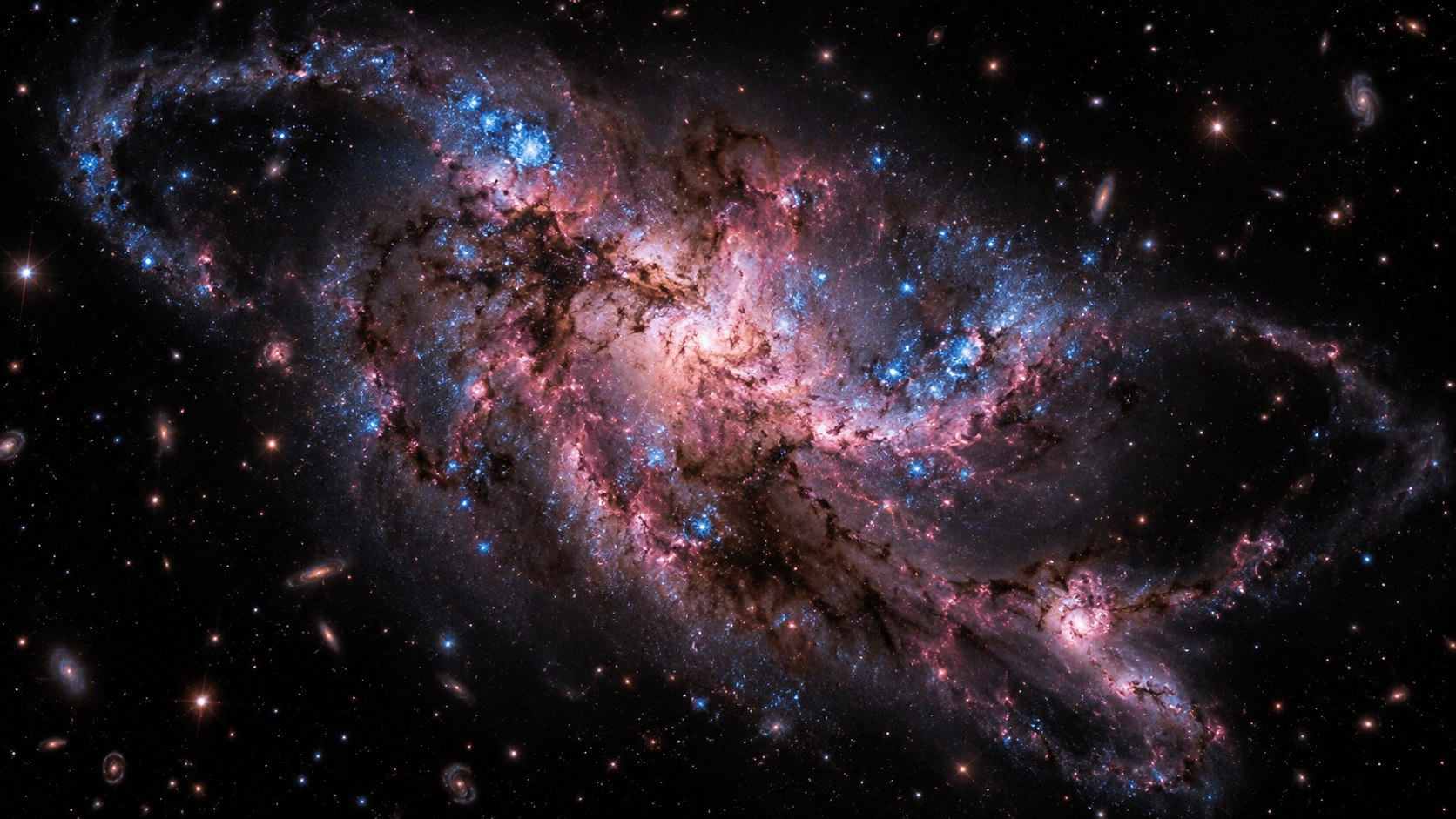
Quick answer: Irregular galaxies lack the orderly spiral or elliptical structure used in the simplest classification systems. Many are small, gas-rich, actively forming stars, or distorted by gravitational interactions.
Irregular Galaxies at a Glance
| Topic | Explanation |
|---|---|
| Definition | Galaxies without orderly spiral or elliptical structure; often small, gas-rich, star-forming, or distorted. |
| Physical setting | Interactions, mergers, stellar feedback, ram pressure, and clumpy star formation contribute to irregular structure. |
| Key evidence | The Large and Small Magellanic Clouds are nearby irregular dwarfs interacting with the Milky Way. |
| Why it matters | Irregulars resemble common galaxies in the early universe. |
| Important caution | "Irregular" does not mean random — detailed observations reveal rotation, shells, bars, tidal tails, and chemical patterns. |
What Is an Irregular Galaxy?
Irregular galaxies lack the orderly spiral or elliptical structure used in the simplest classification systems. Many are small, gas-rich, actively forming stars, or distorted by gravitational interactions. Some have underlying rotation or bars but disrupted appearances; others are chaotic dwarf systems.
The Essential Science
The Large and Small Magellanic Clouds are nearby irregular dwarf galaxies interacting with the Milky Way and each other. Their proximity makes them valuable laboratories for star formation and stellar populations under conditions different from the Milky Way. Real systems differ in mass, composition, environment, and interaction history.
Important Facts
Irregular galaxies can resemble common galaxies in the early universe, where systems were smaller, gas-rich, and frequently interacting. They help researchers test how feedback and environment shape galaxy evolution.
How Astronomers Study Irregulars
Multi-wavelength imaging traces stars, gas, and dust; kinematic mapping reveals rotation and turbulence; chemical abundances trace enrichment history. Nearby irregulars can be resolved into individual stars, giving direct age and composition measurements.
What Telescopes Actually Measure
Detectors record energy at particular positions, wavelengths, and times. Calibration removes instrumental effects. False-color composites should be captioned to show wavelengths and processing.
Origin and Development
Interactions, mergers, stellar feedback, ram pressure, and naturally clumpy star formation all contribute to irregular structure. Origins are reconstructed from present evidence and from observations of related systems at different stages.
Structure and Physical Conditions
Regions of very different density, temperature, composition, pressure, magnetic field, and motion coexist in these systems. Boundaries in diagrams often represent transitions rather than material walls.
Energy, Gravity, and Motion
Gravity organizes matter; pressure, rotation, magnetic fields, radiation, and feedback resist or redirect collapse. Small mass makes irregulars especially sensitive to internal feedback and external tides.
Connections to Other Cosmic Objects
Irregulars often accompany spirals as satellite galaxies. They may become elliptical or spiral through mergers. Their gas-rich nature drives active star formation in nebulae.
What Is Known and What Remains Uncertain
The relative roles of internal turbulence, external interactions, and low-mass halo physics in producing irregularity remain active research topics.
Common Misconceptions
"Irregular" does not mean scientifically unimportant or completely random. Detailed observations often reveal rotation, shells, bars, tidal tails, chemical patterns, and distinct histories.
How Irregulars Fit Into Cosmic Evolution
At earlier cosmic times, many galaxies were smaller, gas-rich, and clumpy — closer to modern irregulars. Nearby irregulars serve as analogs for early-universe conditions.
Best Ways to Explain Irregulars to Students
Compare Magellanic Cloud imagery with spiral and elliptical images to illustrate morphological diversity, then discuss which properties (mass, gas, environment, history) cause the differences.
Why Irregulars Matter
They complete the morphological picture, calibrate star-formation studies in unusual environments, and reveal how mergers and tides transform galaxies.
A Responsible Summary
Irregular galaxies fall outside the orderly spiral–elliptical classification but reward detailed study: they contain rotation, structure, chemistry, and history. Nearby examples like the Magellanic Clouds serve as laboratories for star formation and galactic dynamics at low mass.
Detailed Search Questions
What does "irregular galaxy" mean in astronomy?
A galaxy that lacks the symmetric spiral or elliptical form, often small, gas-rich, and disrupted.
What evidence supports the modern explanation?
Nearby irregulars can be resolved into individual stars; kinematics, chemistry, and morphology together reconstruct their histories.
How are irregulars different from related objects?
They lack the orderly rotation of spirals and the smoothness of ellipticals.
Why do they matter?
They probe early-universe-like conditions, low-mass halo physics, and merger-driven evolution.
What remains unknown?
The relative importance of internal turbulence vs. external tides in producing observed structure is still debated.
How are their images interpreted?
Multi-wavelength composites reveal stars, gas, and dust; captions should identify the wavelengths shown.
What role do gravity and energy play?
Gravity organizes matter; feedback and tides disrupt it. Small masses amplify both effects.
Authoritative Source
Scientific content reviewed September 5, 2026.
Frequently asked questions
What is an irregular galaxy?
Irregular galaxies lack the orderly spiral or elliptical structure used in the simplest classification systems. Many are small, gas-rich, actively forming stars, or distorted by gravitational interactions.
What are the best-known examples?
The Large and Small Magellanic Clouds are nearby irregular dwarf galaxies interacting with the Milky Way and each other.
Why do irregular galaxies matter?
They resemble common galaxies in the early universe — smaller, gas-rich, and frequently interacting — and help researchers test how feedback and environment shape galaxy evolution.
Is 'irregular' the same as 'random'?
No. Detailed observations of irregulars often reveal rotation, shells, bars, tidal tails, chemical patterns, and distinct histories.
Sources
- NASA — Galaxy Types — last verified Sat Sep 05 2026 00:00:00 GMT+0000 (Coordinated Universal Time)
More in Galaxies
Elliptical Galaxies: Facts, Science and Complete Guide
Learn about elliptical galaxies — rounded stellar systems dominated by older stars, low gas, and evidence from mergers, dynamics, and cluster environments.
Galaxy Clusters: Facts, Science and Complete Guide
Galaxy clusters — gravitationally bound systems of hundreds or thousands of galaxies, hot intracluster gas, and dominant dark matter.
Spiral Galaxies: Facts, Science and Complete Guide
Spiral galaxies — rotating disks with spiral arms, central bulges, gas, dust, and dark-matter halos. Facts, structure, dynamics, and famous examples.