
The Milky Way Galaxy: Facts, Science and Complete Guide
Our home galaxy — a barred spiral about 100,000 light-years across with a central bar, spiral arms, supermassive black hole, and dark-matter halo.
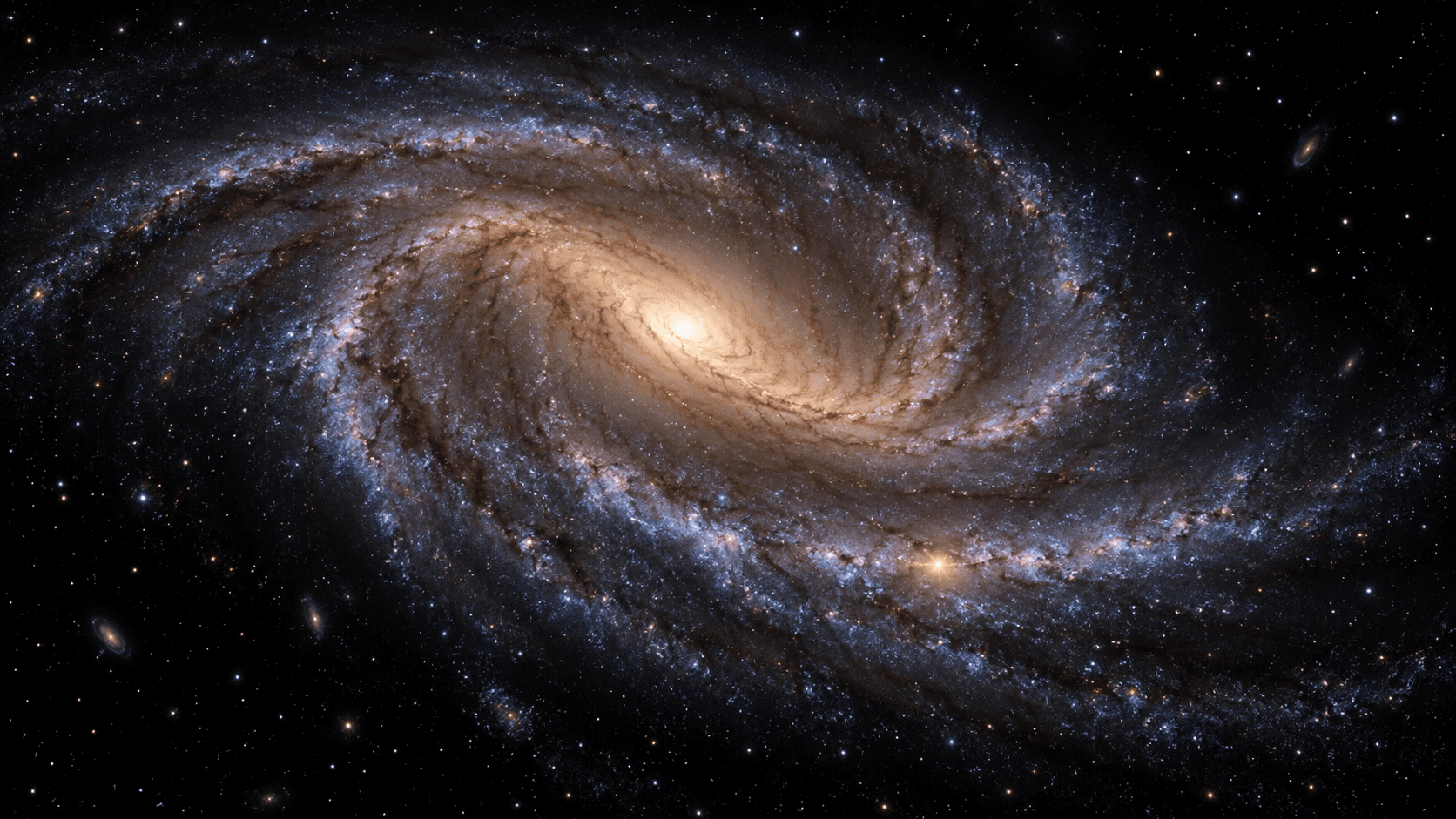
Quick answer: The Milky Way is the barred spiral galaxy containing the Sun, Earth, and the solar system. Its disk spans roughly 100,000 light-years, while a much larger dark-matter halo surrounds it.
The Milky Way at a Glance
| Topic | Explanation |
|---|---|
| Definition | Barred spiral galaxy hosting the Solar System. |
| Physical setting | Thin and thick disk, spiral structure, central bar and bulge, stellar halo, globular clusters, gas, dust, and dark matter. |
| Key evidence | Sun ≈ 26,000 light-years from center in the Orion Spur; Galactic orbit ≈ a few hundred million years. |
| Why it matters | Direct laboratory for star formation, stellar populations, black holes, and Galactic dynamics. |
| Important caution | The bright Milky Way band is our inside view of the crowded disk, not the whole galaxy seen from outside. |
What Is the Milky Way?
The Milky Way is the barred spiral galaxy that contains the Sun, Earth, and the entire solar system. Its disk spans roughly 100,000 light-years, while a much larger dark-matter halo surrounds it. Major components include a thin and thick disk, spiral structure, a central bar and bulge, a stellar halo, globular clusters, gas, dust, and dark matter. Sagittarius A*, a roughly four-million-solar-mass black hole, occupies the Galactic Center.
The Essential Science
The Sun lies about 26,000 light-years from the center in the Orion Spur, between the larger Sagittarius and Perseus arms. One Galactic orbit takes roughly a few hundred million years. Because observers live inside the disk, dust and overlapping stars make the Galaxy difficult to map. Astrometric missions such as Gaia have transformed this by measuring positions, distances, and motions for over a billion stars.
Important Facts
Radio, infrared, optical, ultraviolet, X-ray, and gamma-ray surveys reveal different components. Stellar distances and motions from astrometric missions help reconstruct structure, while gas velocities trace rotation and spiral features.
How Astronomers Study the Milky Way
Because we are inside the Galaxy, mapping requires combining multiple techniques: astrometry for stars, radio spectroscopy for cold gas, infrared imaging for dust-obscured regions, X-ray imaging for hot gas, and radio/infrared observations of Sagittarius A*.
What Telescopes Actually Measure
Each wavelength reveals a different component: cold gas in radio, dust-embedded stars in infrared, hot plasma in X-rays. Galactic composites should note which wavelengths appear in which colors.
Origin and Development
The Milky Way assembled through hierarchical merging with smaller systems. The stellar halo preserves stars from ancient accreted galaxies; the disk formed later from cooling gas. Ongoing accretion continues with satellites such as the Magellanic Clouds.
Structure and Physical Conditions
A thin disk (~300 light-years thick) contains young stars, gas, and dust. A thicker disk contains older stars. A bulge and central bar dominate the middle. A diffuse stellar halo and dark-matter halo extend outward. Regions of very different density, temperature, and composition coexist.
Energy, Gravity, and Motion
Rotation is differential — inner regions complete orbits faster than outer ones. Dark matter dominates gravity beyond the disk. Feedback from nebulae, supernovae, and the central black hole regulates gas.
Connections to Other Cosmic Objects
The Milky Way is a spiral galaxy in the Local Group, gravitationally paired with Andromeda and orbited by many dwarf and irregular satellites. Its central Sagittarius A* is a supermassive black hole.
What Is Known and What Remains Uncertain
Total mass, halo shape, dark-matter distribution, and full history remain refined by ongoing surveys. The precise structure of the central bar and outer arms is still debated.
Common Misconceptions
The bright Milky Way band is not the entire galaxy seen from outside. The solar system is not near the Galactic Center — we lie roughly halfway out in the disk.
How the Milky Way Fits Into Cosmic Evolution
Studying its detailed structure provides a "ground truth" against which distant galaxies are compared. The Milky Way–Andromeda pair will merge in about 4–5 billion years.
Best Ways to Explain the Milky Way to Students
Use inside-view photographs and infrared all-sky images, then compare to face-on artist concepts. Emphasize that we cannot leave the Galaxy to photograph it directly.
Why the Milky Way Matters
It is our home and the calibration point for all galactic astronomy. Details visible in the Milky Way anchor interpretations of distant galaxies.
A Responsible Summary
The Milky Way is a barred spiral galaxy containing the Sun and Solar System, with a central supermassive black hole, disk, halo, and dark-matter envelope. Ongoing astrometric and multi-wavelength surveys are transforming its mapping.
Detailed Search Questions
What does "Milky Way" mean in astronomy?
Our home galaxy — a barred spiral about 100,000 light-years across.
What evidence supports the current picture?
Astrometry, radio and infrared surveys of gas and stars, and detailed studies of the Galactic Center anchor the modern description.
How is the Milky Way different from other galaxies?
Every galaxy is unique. The Milky Way's specific mass, structure, and satellite system are known in more detail than any other spiral because we live inside it.
Why is the Milky Way important?
It calibrates our understanding of galactic structure, star formation, dark matter, and central black-hole physics.
What remains unknown?
Precise dark-matter distribution, full arm structure, and detailed formation history remain areas of active research.
How are its images interpreted?
Inside views are through crowded, dusty foreground; face-on illustrations are artist concepts, not photographs.
What role do gravity and energy play?
Gravity from stars, gas, and dark matter binds the disk and halo; internal feedback and rotation shape the visible structure.
Authoritative Source
Scientific content reviewed September 5, 2026.
Frequently asked questions
What is the Milky Way?
The Milky Way is the barred spiral galaxy containing the Sun, Earth, and the solar system. Its disk spans roughly 100,000 light-years, while a much larger dark-matter halo surrounds it.
Where is the Sun in the Milky Way?
The Sun lies about 26,000 light-years from the center in the Orion Spur, between the larger Sagittarius and Perseus arms.
What is at the center?
Sagittarius A*, a supermassive black hole of about four million solar masses, sits at the Galactic Center.
How long does the Sun take to orbit the Galaxy?
About 220 to 250 million years — a few hundred million years for one Galactic orbit.
Is the bright band we see the whole Milky Way?
No. The bright Milky Way band is an inside view through the crowded disk, not the entire galaxy seen from outside.
Sources
- NASA — Galaxies — last verified Sat Sep 05 2026 00:00:00 GMT+0000 (Coordinated Universal Time)
More in Galaxies
Elliptical Galaxies: Facts, Science and Complete Guide
Learn about elliptical galaxies — rounded stellar systems dominated by older stars, low gas, and evidence from mergers, dynamics, and cluster environments.
Galaxy Clusters: Facts, Science and Complete Guide
Galaxy clusters — gravitationally bound systems of hundreds or thousands of galaxies, hot intracluster gas, and dominant dark matter.
Irregular Galaxies: Facts, Science and Complete Guide
Irregular galaxies lack the orderly spiral or elliptical shape. Many are small, gas-rich, actively forming stars, or distorted by interactions.