
The Sun: Our Closest Star
The Sun is a 4.6-billion-year-old G-type main-sequence star whose light, heat, gravity, and magnetic activity shape the entire Solar System.
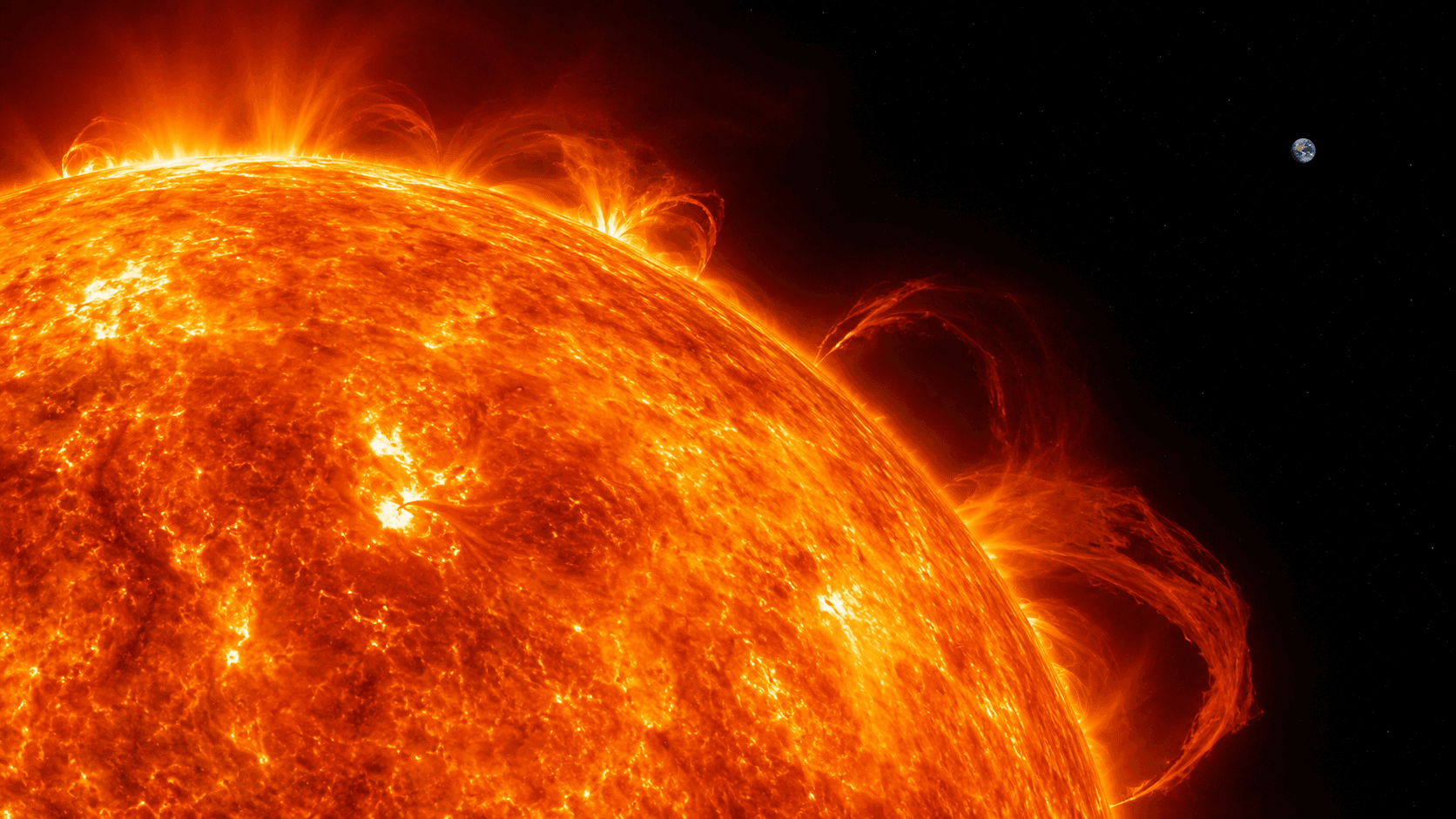
Quick answer: The Sun is a roughly 4.6-billion-year-old G-type main-sequence star whose light, heat, gravity, and magnetic activity shape the entire Solar System.
The Sun at a Glance
| Topic | Explanation |
|---|---|
| Definition | ~4.6-billion-year-old G-type main-sequence star. |
| Physical setting | Core ≈ 15 million °C; energy travels through radiative and convective zones before leaving the photosphere. |
| Key evidence | Fusion converts hydrogen to helium; magnetic dynamo drives an ~11-year activity cycle. |
| Why it matters | Powers surface life, climate, and space weather near Earth. |
| Important caution | The Sun is not average in every property — it is more massive than most Milky Way stars. |
What Is the Sun?
The Sun is a roughly 4.6-billion-year-old G-type main-sequence star. It contains almost all the Solar System's mass. Its core reaches about 15 million degrees Celsius, enabling hydrogen fusion. Energy travels outward through the radiative and convective zones before leaving the visible photosphere and passing through the chromosphere and corona.
The Essential Science
Fusion converts hydrogen into helium and releases energy. The Sun's magnetic dynamo produces sunspots, flares, coronal mass ejections, and an approximately 11-year activity cycle. The solar wind creates the heliosphere and drives space weather near Earth.
Important Facts
Solar energy supports most surface life, powers weather and climate, and makes liquid water possible on Earth. Solar storms can affect satellites, radio communication, navigation, power systems, and astronauts.
How Astronomers Study the Sun
Ground- and space-based observatories such as SDO, Parker Solar Probe, and Solar Orbiter monitor the Sun across many wavelengths. Helioseismology probes the interior; neutrino detectors confirm core fusion.
What Telescopes Actually Measure
Filters isolate specific spectral lines that reveal different layers: the photosphere in visible light, chromosphere in H-alpha, corona in extreme-ultraviolet and X-rays.
Origin and Development
The Sun formed from a collapsing molecular cloud alongside its planets. It has slowly grown brighter over its lifetime and will continue to do so before becoming a red giant in about 5 billion years.
Structure and Physical Conditions
Core → radiative zone → convective zone → photosphere → chromosphere → transition region → corona → solar wind. Each layer has distinct temperature, density, and dynamics.
Energy, Gravity, and Motion
Gravity balances thermal pressure and radiation pressure in the interior. Magnetic fields organize surface activity and transport energy into the corona.
Connections to Other Cosmic Objects
The Sun is a member of the main sequence, a future red giant and eventual white dwarf. It orbits the center of the Milky Way.
What Is Known and What Remains Uncertain
The precise heating mechanism of the corona and the origin of the solar cycle's variability remain active research topics.
Common Misconceptions
The Sun is not burning like fire. It is not an "average" star — most stars in the Milky Way are dimmer red dwarfs.
How the Sun Fits Into Cosmic Evolution
Understanding the Sun anchors interpretations of other stars and habitable worlds. Its history and future illustrate the main-sequence to red-giant to white-dwarf progression.
Best Ways to Explain the Sun to Students
Contrast fusion with combustion. Use full-disk H-alpha and EUV images alongside visible-light photos.
Why the Sun Matters
Life on Earth depends on solar energy. Studying the Sun protects modern technology from space weather.
A Responsible Summary
The Sun is a G-type main-sequence star powered by hydrogen fusion. Its activity cycle drives space weather and its evolution will eventually reshape the inner Solar System.
Detailed Search Questions
What does "the Sun" mean in astronomy?
The G-type main-sequence star at the center of our Solar System.
What evidence supports the current picture?
Fusion neutrinos, helioseismology, and multi-wavelength imaging together anchor solar physics.
How is the Sun different from other stars?
It is more massive than most Milky Way stars (which are red dwarfs) and less massive than blue giants.
Why does the Sun matter?
It powers Earth's climate, drives space weather, and calibrates stellar physics.
What remains unknown?
Coronal heating and cycle variability continue to be studied.
How are solar images interpreted?
Different wavelengths reveal different atmospheric layers; captions should identify the filter.
What role do gravity and energy play?
Gravity balances pressure; fusion supplies energy; magnetic fields transport it to the corona and out through the solar wind.
Authoritative Source
Scientific content reviewed September 5, 2026.
Frequently asked questions
How old is the Sun?
Roughly 4.6 billion years, as measured by solar-system meteorites and stellar evolution models.
How hot is the Sun's core?
About 15 million degrees Celsius — hot enough to sustain hydrogen fusion.
What type of star is the Sun?
A G-type main-sequence star. It is more massive than most Milky Way stars, which are red dwarfs.
Will the Sun become a red giant?
Yes, in about five billion years the Sun will become a red giant before shedding its outer layers as a planetary nebula and leaving a white dwarf remnant.
Is the Sun burning like fire?
No. The Sun's energy comes from nuclear fusion in its core, not chemical combustion.
Sources
- NASA — Sun Facts — last verified Sat Sep 05 2026 00:00:00 GMT+0000 (Coordinated Universal Time)
More in Stars
How Stars Are Born in Giant Clouds
Stars form when cold, dense regions inside giant molecular clouds collapse under gravity, creating protostars that gather mass until sustained hydrogen fusion begins.
Main-Sequence Stars: Facts, Science and Complete Guide
Main-sequence stars are in the long, stable phase during which hydrogen fusion in the core balances gravity.
Protostars: Facts, Science and Complete Guide
Protostars are forming stellar objects powered by gravitational contraction and accretion before stable hydrogen fusion dominates the core.