
White Dwarf Stars: Facts, Science and Complete Guide
A white dwarf is the hot, dense stellar core left after a low- or intermediate-mass star sheds its outer layers. It is roughly Earth-sized while containing a substantial fraction of the Sun's mass.
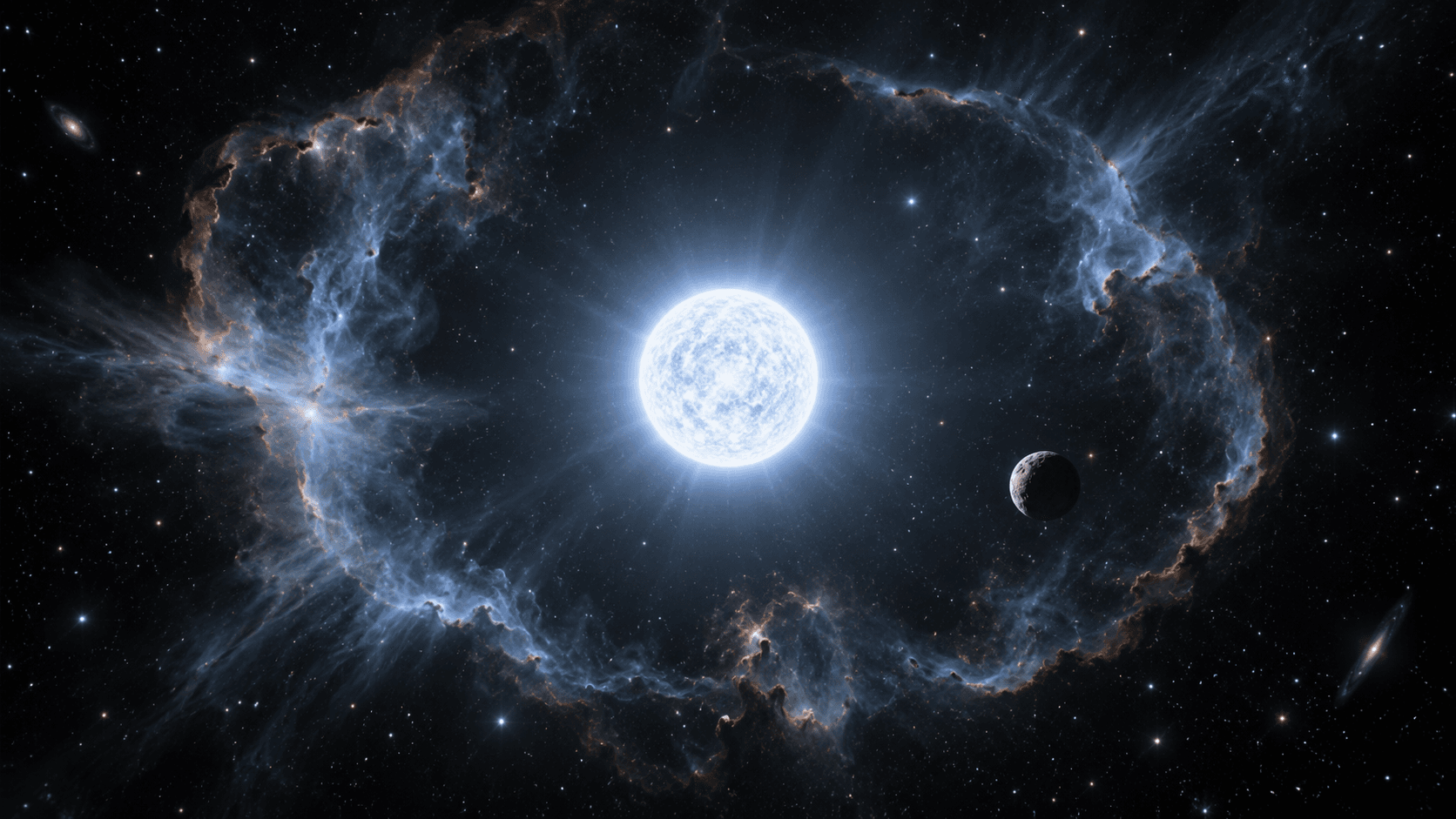
Quick answer: A white dwarf is the hot, dense stellar core left after a low- or intermediate-mass star sheds its outer layers. It is roughly Earth-sized while containing a substantial fraction of the Sun's mass.
White Dwarf Stars at a Glance
| Topic | Explanation |
|---|---|
| Definition | Hot, dense remnant of a low- or intermediate-mass star. |
| Physical setting | Electron degeneracy pressure supports it against gravity; no ordinary fusion continues. |
| Key evidence | Interior composition (mostly C/O) and cooling curves match theory. |
| Why it matters | Cosmic clocks, endpoints of Sun-like stars, and progenitors of Type Ia supernovae in binaries. |
| Important caution | A white dwarf is not a low-mass "dwarf" main-sequence star. |
What Is a White Dwarf?
A white dwarf is the hot, dense stellar core left after a low- or intermediate-mass star sheds its outer layers (as a planetary nebula). It is roughly Earth-sized while containing up to about 1.4 solar masses. White dwarfs no longer sustain ordinary fusion. Electron degeneracy pressure resists further collapse, creating an inverse mass–radius relationship: more massive white dwarfs are smaller.
The Essential Science
Many contain mostly carbon and oxygen, while some have helium or oxygen-neon-rich interiors. Surface spectra are shaped by hydrogen, helium, magnetic fields, temperature, and material accreted from companions or disrupted planetary bodies.
Important Facts
White dwarfs serve as cosmic clocks (their cooling curves date populations), reveal the future of Sun-like stars, preserve evidence of former planetary systems (through polluted atmospheres), and in binaries can produce novae or Type Ia supernovae under suitable conditions.
How Astronomers Study White Dwarfs
Photometry gives temperature and cooling age; spectroscopy identifies surface composition and magnetic fields; asteroseismology of pulsating white dwarfs probes the interior structure.
What Telescopes Actually Measure
Spectral lines reveal composition and gravity; parallax measurements give distances; cooling-curve models translate observed temperature into age.
Origin and Development
A main-sequence star evolves off the main sequence, becomes a red giant, sheds its envelope as a planetary nebula, and leaves the exposed core: a white dwarf. It then cools over billions of years.
Structure and Physical Conditions
A degenerate carbon-oxygen (or oxygen-neon) interior sits beneath thin helium and hydrogen layers. Densities exceed 10⁶ g/cm³. The surface temperature can start above 100,000 K and cool to a few thousand K over billions of years.
Energy, Gravity, and Motion
Gravity is countered by electron degeneracy pressure. Radiation carries away residual thermal energy, causing steady cooling.
Connections to Other Cosmic Objects
Direct descendants of main-sequence and red-giant stars, they can accrete from binary companions to produce Type Ia supernovae — key cosmological distance indicators.
What Is Known and What Remains Uncertain
Detailed cooling physics, especially crystallization of the interior, and rare progenitors of Type Ia supernovae remain active research topics.
Common Misconceptions
A white dwarf is not a low-mass main-sequence "dwarf" star. No black dwarf is expected to exist yet because the universe has not been old enough for a white dwarf to cool completely.
How White Dwarfs Fit Into Cosmic Evolution
They are the ultimate fate of about 97% of all stars — including the Sun. Their cooling curves calibrate galactic ages.
Best Ways to Explain White Dwarfs to Students
Point out that a teaspoon of white-dwarf material would weigh several tons on Earth. Explain that the size decreases as mass increases — the opposite of everyday experience.
Why White Dwarfs Matter
They calibrate cosmology (Type Ia supernovae), preserve chemistry of former planetary systems, and reveal the endpoint of most stellar lives.
A Responsible Summary
White dwarfs are the compact, cooling remnants of low- and intermediate-mass stars. Supported by electron degeneracy pressure, they slowly fade over cosmic time, serving as clocks and standard candles.
Detailed Search Questions
What does "white dwarf" mean?
A hot, dense stellar remnant supported by electron degeneracy pressure.
What evidence supports the current picture?
Cooling curves, spectra, and asteroseismic frequencies together anchor the model.
How are white dwarfs different from stars?
They no longer sustain fusion; degeneracy pressure — not thermal pressure — supports them.
Why do white dwarfs matter?
They calibrate stellar and cosmological ages, and their binaries produce Type Ia supernovae.
What remains unknown?
Interior crystallization, magnetic field origins, and Type Ia progenitor pathways remain active questions.
How are their images interpreted?
Spectra and photometry, combined with distances, determine mass, temperature, and age.
What role do gravity and energy play?
Gravity would collapse them if not for degeneracy pressure; residual thermal energy radiates away over cosmic time.
Authoritative Source
Scientific content reviewed September 5, 2026.
Frequently asked questions
What is a white dwarf?
A white dwarf is the hot, dense stellar core left after a low- or intermediate-mass star sheds its outer layers. It is roughly Earth-sized while containing a substantial fraction of the Sun's mass.
How does a white dwarf resist gravity?
Electron degeneracy pressure supports it. More massive white dwarfs are actually smaller — an inverse mass–radius relation.
What are white dwarfs made of?
Most contain mostly carbon and oxygen; some have helium or oxygen-neon-rich interiors.
Do white dwarfs eventually become black dwarfs?
In theory, after cooling for trillions of years. The universe has not yet been old enough for any white dwarf to complete that process.
Sources
- NASA — Star Types — last verified Sat Sep 05 2026 00:00:00 GMT+0000 (Coordinated Universal Time)
More in Stars
How Stars Are Born in Giant Clouds
Stars form when cold, dense regions inside giant molecular clouds collapse under gravity, creating protostars that gather mass until sustained hydrogen fusion begins.
Main-Sequence Stars: Facts, Science and Complete Guide
Main-sequence stars are in the long, stable phase during which hydrogen fusion in the core balances gravity.
Protostars: Facts, Science and Complete Guide
Protostars are forming stellar objects powered by gravitational contraction and accretion before stable hydrogen fusion dominates the core.