
Red Giant Stars: Facts, Science and Complete Guide
A red giant is an evolved star whose outer layers have expanded and cooled after hydrogen in the core became depleted. Sun-like stars enter this phase late in their lives.
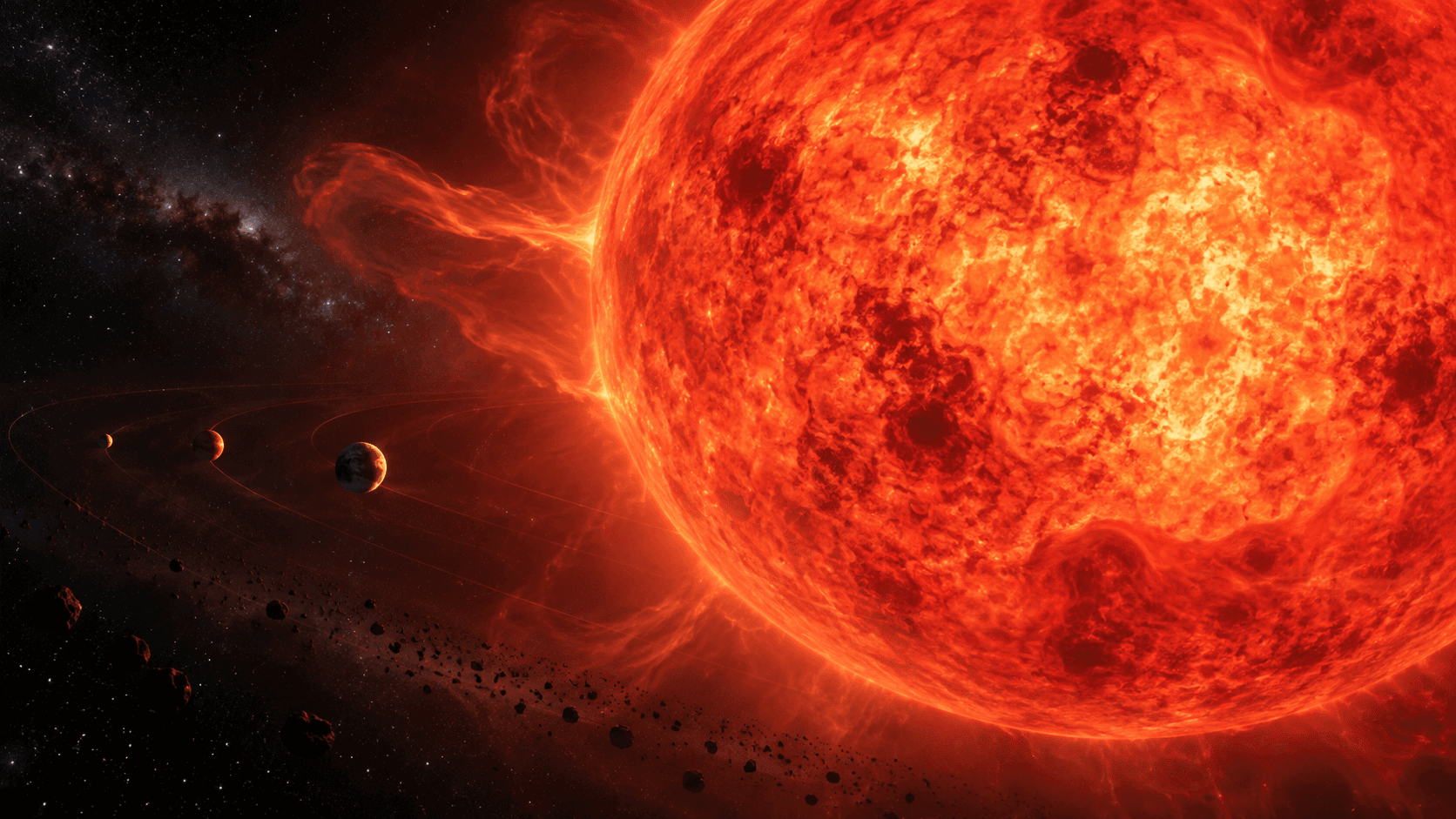
Quick answer: A red giant is an evolved star whose outer layers have expanded and cooled after hydrogen in the core became depleted. Sun-like stars enter this phase late in their lives.
Red Giant Stars at a Glance
| Topic | Explanation |
|---|---|
| Definition | Evolved star with expanded, cooler outer layers after core hydrogen exhaustion. |
| Physical setting | Helium core contracts and heats; hydrogen fusion continues in a shell around the core. |
| Key evidence | Later stages include helium fusion and, for suitable masses, asymptotic-giant-branch pulsation. |
| Why it matters | Measures stellar ages and distances; enriches the interstellar medium with heavier elements. |
| Important caution | Red giants are not necessarily more massive than they were on the main sequence. |
What Is a Red Giant?
A red giant is an evolved star whose outer layers have expanded and cooled after core hydrogen became depleted. Core hydrogen exhaustion removes a major energy source, so the helium core contracts and heats while hydrogen fusion continues in a surrounding shell. Increased energy expands the envelope, lowering its surface temperature and shifting its light toward redder wavelengths.
The Essential Science
Later evolution includes helium fusion (starting with the helium flash for lower-mass stars) and, for suitable masses, repeated shell burning and pulsation on the asymptotic giant branch (AGB). Strong winds return gas, dust, carbon, and other elements to interstellar space.
Important Facts
Red giants help measure stellar ages and distances, trace chemical enrichment, and reveal interior structure through stellar oscillations (asteroseismology). Their changing brightness and mass loss also affect orbiting planets.
How Astronomers Study Red Giants
Photometric variability, spectroscopic abundances, and asteroseismic frequencies characterize red giants. Time-domain surveys such as Kepler and TESS have revolutionized their study.
What Telescopes Actually Measure
Brightness variations, spectral lines, and radial velocities reveal internal structure through stellar oscillations, plus mass-loss rates through emission-line profiles.
Origin and Development
A main-sequence star exhausts core hydrogen and evolves off the main sequence. Its core contracts while its envelope expands and cools, producing the red giant. Later stages depend on mass.
Structure and Physical Conditions
Red giants have a small dense core, a shell of hydrogen fusion, and a huge convective envelope. Their surfaces are cool (2,000–4,000 K) but their sizes make them highly luminous.
Energy, Gravity, and Motion
Gravity contracts the core; shell fusion supplies energy that inflates the envelope. Mass loss through winds and pulsation removes envelope material over time.
Connections to Other Cosmic Objects
Red giants evolve from main-sequence stars and lead — for low- and intermediate-mass stars — to planetary nebulae and white dwarfs.
What Is Known and What Remains Uncertain
Details of mass loss on the AGB, convective mixing, and the origins of unusual chemistry (like the carbon-rich stars) continue to be refined.
Common Misconceptions
Red giants aren't necessarily more massive than they were before. "Giant" refers to size and luminosity, not extra mass. Red supergiants are a separate, more massive population.
How Red Giants Fit Into Cosmic Evolution
They enrich galaxies with carbon, nitrogen, and dust that fuel later generations of star and planet formation.
Best Ways to Explain Red Giants to Students
Show how the Sun's future — from main sequence to red giant to planetary nebula to white dwarf — illustrates the sequence for solar-mass stars.
Why Red Giants Matter
They are cosmic recyclers, ferrying processed material from stellar interiors back into the interstellar medium.
A Responsible Summary
Red giants form when core hydrogen fails and the envelope expands. They enrich galaxies with elements and dust, and their asteroseismic signals reveal deep interior structure.
Detailed Search Questions
What does "red giant" mean?
An evolved star with an expanded, cool outer envelope after core hydrogen exhaustion.
What evidence supports the picture?
H–R diagram positions, asteroseismic signals, and abundance patterns all agree with the shell-burning model.
How are red giants different from red supergiants?
Red supergiants are more massive, larger, and evolve through heavier-element fusion.
Why do red giants matter?
They enrich galaxies and reveal stellar interiors through pulsations.
What remains unknown?
AGB mass loss, mixing processes, and unusual abundance patterns remain research areas.
How are their images interpreted?
Photometric colors and spectra are interpreted with temperature, extinction, and evolutionary stage in mind.
What role do gravity and energy play?
Core contraction supplies gravitational energy; shell fusion supplies nuclear energy; both drive envelope expansion and mass loss.
Authoritative Source
Scientific content reviewed September 5, 2026.
Frequently asked questions
What is a red giant?
A red giant is an evolved star whose outer layers have expanded and cooled after hydrogen in the core became depleted. Sun-like stars enter this phase late in their lives.
Will the Sun become a red giant?
Yes. In about five billion years, the Sun will expand into a red giant before shedding its outer layers as a planetary nebula.
Are red giants more massive than main-sequence stars?
Not necessarily. 'Giant' describes their expanded radius and high luminosity, not extra mass.
How is a red giant different from a red supergiant?
Red supergiants are more massive stars in a distinct evolutionary population; they are larger and fusion proceeds through heavier elements.
Sources
- NASA — Star Types — last verified Sat Sep 05 2026 00:00:00 GMT+0000 (Coordinated Universal Time)
More in Stars
How Stars Are Born in Giant Clouds
Stars form when cold, dense regions inside giant molecular clouds collapse under gravity, creating protostars that gather mass until sustained hydrogen fusion begins.
Main-Sequence Stars: Facts, Science and Complete Guide
Main-sequence stars are in the long, stable phase during which hydrogen fusion in the core balances gravity.
Protostars: Facts, Science and Complete Guide
Protostars are forming stellar objects powered by gravitational contraction and accretion before stable hydrogen fusion dominates the core.