
Main-Sequence Stars: Facts, Science and Complete Guide
Main-sequence stars are in the long, stable phase during which hydrogen fusion in the core balances gravity.
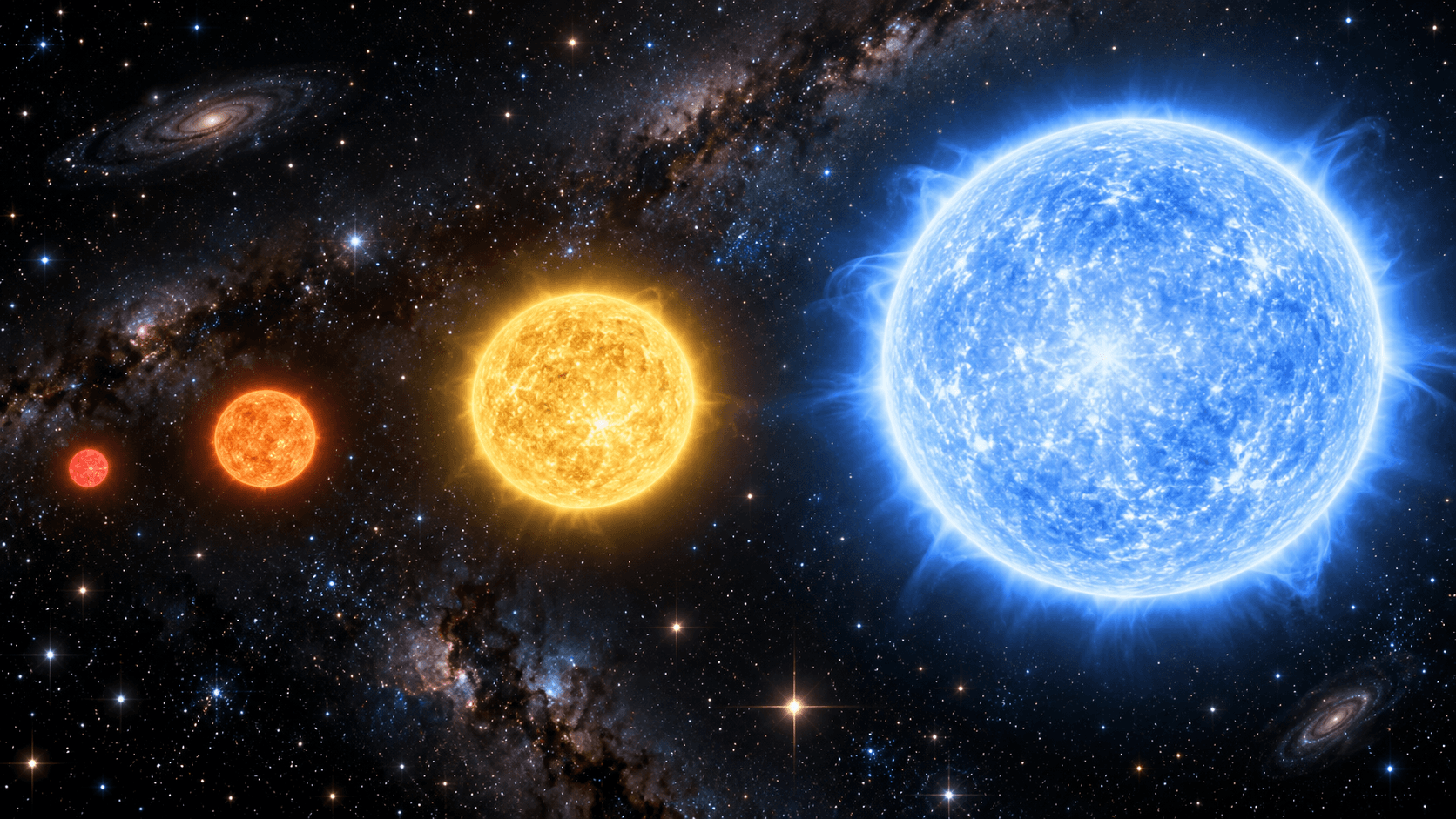
Quick answer: A main-sequence star is in the long, comparatively stable phase during which hydrogen fusion in its core supplies energy that helps balance gravity.
Main-Sequence Stars at a Glance
| Topic | Explanation |
|---|---|
| Definition | Star sustained by core hydrogen fusion. |
| Physical setting | Occupies a diagonal band on the Hertzsprung–Russell diagram; hot luminous stars at one end, cool faint stars at the other. |
| Key evidence | Mass is the primary control on temperature, luminosity, and lifetime. |
| Why it matters | Foundation of stellar astronomy; the Sun is a G-type main-sequence star. |
| Important caution | "Main sequence" is a state, not a single kind of star. |
What Is a Main-Sequence Star?
A main-sequence star is in the long, stable phase where hydrogen fusion in its core supplies energy that balances gravity. Main-sequence stars occupy a diagonal band on the Hertzsprung–Russell diagram. Hot, luminous, massive stars lie toward one end; cool, faint, low-mass stars lie toward the other. The Sun is a G-type main-sequence star.
The Essential Science
Mass is the primary control. Massive stars have hotter cores, higher fusion rates, greater luminosities, and much shorter lives. Low-mass stars consume fuel slowly and can remain on the main sequence far longer than the current age of the universe.
Important Facts
Spectra reveal temperature and composition, parallax provides distance, and brightness yields luminosity. Binary systems allow mass measurements. Clusters let astronomers compare stars with similar ages and compositions.
How Astronomers Study the Main Sequence
Astrometric distance, photometric brightness, and spectroscopic temperature and gravity place stars on the H–R diagram. Eclipsing binaries directly measure masses and radii; asteroseismology probes interiors.
What Telescopes Actually Measure
Photon counts as a function of wavelength (spectrum) and time (light curve), plus astrometric position. Together these derive luminosity, temperature, radius, mass, composition, and age.
Origin and Development
A protostar contracts until core temperature reaches roughly 10 million K, at which point sustained hydrogen fusion begins and the star settles onto the main sequence. It remains there as long as core hydrogen lasts.
Structure and Physical Conditions
Main-sequence stars have a fusing core, radiative and convective transport zones (locations vary with mass), and an outer atmosphere. Structure depends strongly on mass.
Energy, Gravity, and Motion
Gravity is balanced by pressure gradients from thermal motion and radiation. Nuclear fusion supplies the energy that sustains the pressure gradient.
Connections to Other Cosmic Objects
Main-sequence stars evolve from protostars, enter the main sequence, and — depending on mass — become red giants leading to white dwarfs or, at higher mass, supernovae and stellar-mass black holes.
What Is Known and What Remains Uncertain
Details of convection, mass loss, rotation, and internal mixing continue to be refined by asteroseismic and interferometric measurements.
Common Misconceptions
"Main sequence" is not a single kind of star. It describes a relationship and evolutionary state spanning a huge range of masses and lifetimes.
How Main-Sequence Stars Fit Into Cosmic Evolution
Most stars spend most of their lives on the main sequence, making its physics central to galactic and cosmic evolution.
Best Ways to Explain the Main Sequence to Students
Use an H–R diagram and show representative stars — from massive O-types to cool M-dwarfs — plotted on it, with the Sun at G-type.
Why the Main Sequence Matters
It anchors stellar classification, luminosity–distance relations, and the timescales of galactic evolution.
A Responsible Summary
Main-sequence stars fuse hydrogen in their cores in steady balance with gravity. Mass sets everything else — temperature, luminosity, radius, and lifetime.
Detailed Search Questions
What does "main sequence" mean?
The stable, hydrogen-fusing phase most stars spend most of their lives in.
What evidence supports the picture?
Positions on the H–R diagram agree with independent mass, radius, and composition measurements.
How are main-sequence stars different from evolved stars?
Evolved stars (red giants, white dwarfs) no longer fuse hydrogen in their cores.
Why does the main sequence matter?
It sets stellar lifetimes and calibrates distance and luminosity across astronomy.
What remains unknown?
Interior mixing, convection, and rotation details continue to be refined.
How are main-sequence images interpreted?
Photometric colors and spectra should be interpreted with temperature, extinction, and distance in mind.
What role do gravity and energy play?
Gravity holds the star together; fusion supplies the counter-pressure.
Authoritative Source
Scientific content reviewed September 5, 2026.
Frequently asked questions
What is a main-sequence star?
A main-sequence star is in the long, comparatively stable phase during which hydrogen fusion in its core supplies energy that helps balance gravity.
Where does the Sun sit?
The Sun is a G-type main-sequence star near the middle of the diagonal band on the Hertzsprung–Russell diagram.
Why does mass matter?
Massive stars have hotter cores, higher fusion rates, greater luminosities, and shorter lives. Low-mass stars fuse fuel slowly and can remain on the main sequence far longer than the current age of the universe.
Do main-sequence stars look the same?
No. The band spans a huge range of masses, colors, temperatures, and lifetimes. 'Main sequence' describes a state, not a uniform appearance.
Sources
- NASA — Star Types — last verified Sat Sep 05 2026 00:00:00 GMT+0000 (Coordinated Universal Time)
More in Stars
How Stars Are Born in Giant Clouds
Stars form when cold, dense regions inside giant molecular clouds collapse under gravity, creating protostars that gather mass until sustained hydrogen fusion begins.
Protostars: Facts, Science and Complete Guide
Protostars are forming stellar objects powered by gravitational contraction and accretion before stable hydrogen fusion dominates the core.
Red Giant Stars: Facts, Science and Complete Guide
A red giant is an evolved star whose outer layers have expanded and cooled after hydrogen in the core became depleted. Sun-like stars enter this phase late in their lives.