
51 Pegasi b
Learn how 51 Pegasi b was discovered in 1995, why its four-day orbit shocked astronomers, how radial velocity works, and why it earned Nobel recognition.
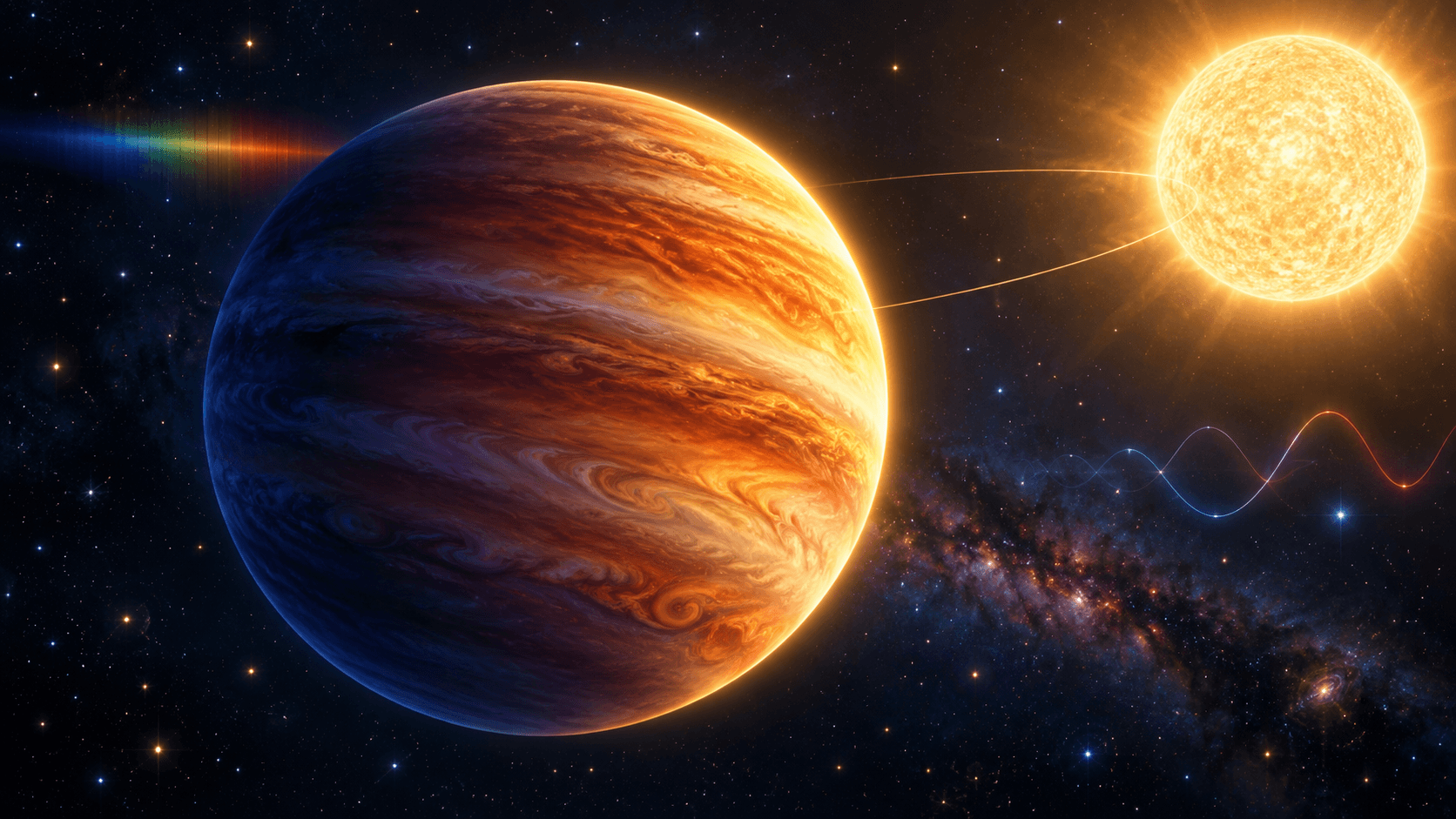
The discovery that opened a new era
51 Pegasi b is a hot Jupiter orbiting a Sun-like star about 50 light-years away. Michel Mayor and Didier Queloz announced it in October 1995 after detecting a repeating stellar wobble with the radial-velocity method. The planet completes an orbit in about 4.23 days and has a minimum mass around half Jupiter's. It was not the first exoplanet of any kind — the first confirmed planets were found around a pulsar — but it was the first confirmed planet orbiting a normal, Sun-like main-sequence star.
That distinction transformed astronomy. A giant planet so close to its star did not fit the Solar System-based expectations of the time. Its existence showed that planetary systems can migrate and rearrange, while its easy-to-repeat signal helped convince a skeptical community.
The planet, star, and name
The host star 51 Pegasi is a G-type star in the constellation Pegasus, broadly similar to the Sun and visible to the unaided eye under sufficiently dark conditions. The numeral comes from a historical star catalog, not its distance or discovery order. In exoplanet naming, the lower-case "b" marks the first planet reported around the star; the star itself is implicitly component "a."
The International Astronomical Union later approved the proper name Dimidium for the planet, derived from a Latin word meaning "half," alluding to its approximate minimum mass in Jupiter units. Scientific literature still commonly uses 51 Pegasi b or 51 Peg b.
The planet does not transit from our viewpoint, so its radius is not directly measured by transit depth. Most illustrations show a striped gas giant, but no resolved photograph exists. Its orbital inclination and therefore exact mass have been constrained by several techniques, yet published values and methods should be checked before quoting more than the robust minimum-mass result.
How radial velocity revealed the planet
A planet does not orbit the exact center of a stationary star. Both bodies orbit their shared center of mass. As the star moves toward Earth, its spectral lines shift to slightly shorter, bluer wavelengths; as it moves away, they shift redward. The shifts are tiny but measurable with a stable, high-resolution spectrograph.
Mayor and Queloz used ELODIE at the Observatoire de Haute-Provence in France. They found a velocity cycle of about 4.23 days. The repetition, amplitude, and near-circular pattern matched the gravitational influence of a planetary-mass companion close to the star.
Radial velocity gives the orbital period, velocity semi-amplitude, eccentricity constraints, and a minimum companion mass. The unknown inclination introduces the sine factor: a face-on orbit could hide a larger mass because little motion occurs along our line of sight. For 51 Pegasi b, later evidence supports a planetary interpretation rather than a star seen at an improbable angle.
Why astronomers were surprised
In the Solar System, gas giants orbit far from the Sun. Standard core-accretion theory places their formation beyond the snow line, where cold temperatures allow ices to add solid material and build a core quickly enough to capture hydrogen and helium before the disk disappears.
51 Pegasi b orbits closer to its star than Mercury does to the Sun. At that distance, the present-day environment is too hot for the traditional icy-core formation route. Astronomers therefore had to take planetary migration seriously. A giant can form farther out and exchange angular momentum with the gas disk, moving inward. Later interactions with other planets or stars can also produce an elongated orbit that tides shrink and circularize.
The planet's short orbit was observationally convenient. Multiple cycles could be recorded in weeks, unlike Jupiter's 12-year period. Independent observers rapidly confirmed the wobble, strengthening the case.
What came before 51 Pegasi b?
In 1992, Aleksander Wolszczan and Dale Frail announced planets around the pulsar PSR B1257+12. Those worlds were the first confirmed exoplanets, but a pulsar is the dense remnant of an exploded star, an environment far removed from the Sun. Earlier claims around ordinary stars had failed or remained uncertain, which made researchers cautious.
51 Pegasi b was the watershed discovery around a Sun-like main-sequence star. It showed that planets were not restricted to the Solar System or exotic remnants. It also launched a productive wave of radial-velocity searches that soon found more giant planets with unexpected eccentric and close orbits.
Calling it simply "the first exoplanet" erases the pulsar-planet achievement. Calling it "the first exoplanet discovered around a Sun-like star" preserves the historic importance accurately.
Nobel Prize recognition
The 2019 Nobel Prize in Physics was divided between cosmology and exoplanet science. James Peebles received half for theoretical discoveries in physical cosmology. Michel Mayor and Didier Queloz shared the other half for the discovery of an exoplanet orbiting a solar-type star.
The prize recognized the discovery's role in changing humanity's picture of the universe. It was not a prize for discovering all exoplanets or for proving extraterrestrial life. Mayor supervised Queloz, then a graduate student, and the detection depended on instrument development, observing strategy, analysis, and rapid confirmation within a broader community.
What is a hot Jupiter?
A hot Jupiter is a gas giant on a very short orbit, strongly heated by its star. Boundaries vary, but periods of several days and giant-planet masses or radii are characteristic. 51 Pegasi b became the prototype. Our overview of hot Jupiters explores the class in more detail.
Close-in giants are often tidally locked, with one hemisphere facing the star. Their atmospheres can have powerful winds, large day-night temperature differences, high-altitude hazes, and escaping gas. Because 51 Pegasi b does not transit, its atmosphere is harder to study than those of transiting hot Jupiters. High-resolution spectroscopy has nevertheless attempted to separate the planet's Doppler-shifted light from the star.
The planet's likely temperature makes it a poor place for familiar life. It has no known solid surface, and the atmosphere grows hotter and denser with depth.
Why hot Jupiters were found early
Detection catalogs are shaped by selection effects. A massive close-in planet exerts a stronger pull than a low-mass distant one and repeats its signal rapidly. Transiting hot Jupiters also block about one percent of a Sun-like star's light, much more than an Earth-size planet.
Early surveys therefore found a disproportionate number of hot Jupiters even though later statistics showed they are uncommon around Sun-like stars. This is a classic lesson: the easiest object to detect is not necessarily the most common. Survey teams calculate detection efficiency before drawing population conclusions.
51 Pegasi b helped establish observing methods that eventually reached smaller masses and longer periods. Improvements in wavelength calibration, temperature and pressure stability, stellar-activity modeling, and statistical analysis now allow instruments to measure motions approaching the scale induced by terrestrial planets in favorable systems.
Did 51 Pegasi b form where it is now?
Probably not under standard formation models. The intense inner disk contains less solid ice, and a growing giant can disrupt local gas. Disk migration offers a smooth inward path during the system's youth. High-eccentricity migration followed by tidal circularization offers another pathway.
The nearly circular current orbit is consistent with strong tides but does not uniquely identify the history. Researchers examine the star's rotation, chemical composition, possible companions, and orbital inclination. Population patterns across many hot Jupiters — not one planet alone — help distinguish migration channels.
Some close-in giants show misaligned or retrograde orbits, supporting dynamically violent histories. Others are aligned and may favor disk migration. Stellar tides can alter alignment later, so the evidence remains statistical.
Can we see 51 Pegasi b?
No conventional image resolves a disk. The star and planet are separated by a tiny angle, and the star vastly outshines the planet. Astronomers have used spectroscopy to seek the planet's thermal or reflected-light signature by exploiting its changing velocity.
Direct detection in this context means isolating planetary photons or spectral lines, not producing a detailed photograph. Such measurements can constrain inclination, atmospheric molecules, winds, albedo, and temperature. Any webpage artwork must be captioned as an artist's concept.
Could the planet have moons?
No moon has been confirmed. A planet so close to its star has a relatively small Hill sphere — the region where its gravity dominates over the star's. Stable satellite orbits are limited, and tidal evolution can cause moons to migrate or be lost. It is not impossible to explore theoretical small satellites, but claims about habitable moons around 51 Pegasi b are highly speculative.
The system's scientific importance does not depend on habitability. It tests formation, migration, tides, atmospheres, and detection methods.
From one planet to thousands
After 1995, radial-velocity teams discovered planets around 70 Virginis, 47 Ursae Majoris, and many other stars. Transit surveys later measured radii and uncovered compact systems. Kepler established that small planets are common; TESS finds nearby targets; Webb studies atmospheres; Gaia measures stellar motion; and future observatories aim at cooler terrestrial worlds.
The field shifted from asking whether planets exist elsewhere to measuring their demographics and chemistry. 51 Pegasi b remains an ideal narrative anchor because it connects a single repeated Doppler curve to this modern census.
Why 51 Pegasi b still matters
The discovery overturned an assumption built from one example — our Solar System. It showed that nature builds stable systems unlike ours and that migration is central to planet formation. It validated precise spectroscopy as a planet-finding tool and helped turn exoplanet research into a major field.
It also provides a model for careful communication. The planet was surprising, independent confirmation mattered, and the conclusion became stronger through repeatable measurement. Its lasting lesson is not merely that a giant circles 51 Pegasi, but that observations can force theory to expand.
Frequently asked questions
Was 51 Pegasi b the first exoplanet discovered?
It was the first confirmed exoplanet around a Sun-like main-sequence star. Confirmed pulsar planets were announced in 1992.
Who discovered 51 Pegasi b?
Michel Mayor and Didier Queloz announced the discovery in 1995 using the ELODIE spectrograph in France.
How was it found?
The radial-velocity method detected periodic Doppler shifts in the host star caused by the planet's gravity.
How long is a year on 51 Pegasi b?
About 4.23 Earth days.
Is 51 Pegasi b habitable?
No. It is a highly irradiated gas giant with no known solid surface and is not considered suitable for familiar life.
Why did its discovery win a Nobel Prize?
Mayor and Queloz shared half of the 2019 Physics Nobel for discovering the first exoplanet around a solar-type star, a result that transformed astronomy.
Compare featured exoplanets
These six featured worlds sample very different corners of the exoplanet catalog. Distances, masses, and interpretations come from evolving datasets, so treat each row as a snapshot rather than a final answer.
| World | Type | Distance | Orbital period | Notable for |
|---|---|---|---|---|
| TRAPPIST-1 system | Seven Earth-size rocky worlds | ~40 light-years | 1.5 – 19 days | Compact resonant chain; benchmark JWST atmosphere study |
| Proxima Centauri b | Roughly Earth-mass candidate | ~4.24 light-years | ~11.2 days | Closest known exoplanet; active red-dwarf host |
| Kepler-452b | Possible super-Earth (status debated) | ~1,400 light-years | ~385 days | Sun-like host; low-signal transit whose planet status is contested |
| K2-18b | Habitable-zone sub-Neptune | ~120 light-years | ~33 days | Webb spectrum shows CH₄ and CO₂; DMS/DMDS claims contested |
| WASP-39b | Hot Saturn | ~700 light-years | ~4.05 days | First clear CO₂ detection; SO₂ photochemistry with JWST |
| 51 Pegasi b | Prototype hot Jupiter | ~50 light-years | ~4.23 days | First confirmed planet around a Sun-like star (1995 Nobel-cited discovery) |
More featured exoplanets
TRAPPIST-1 system
Seven Earth-size rocky worlds orbit an ultra-cool dwarf 40 light-years away. Three sit near the habitable zone, and JWST is measuring their atmospheres one by one.
Proxima Centauri b
A roughly Earth-mass planet orbiting the nearest star to the Sun, discovered by radial velocity. It sits in the habitable zone but faces frequent stellar flares.
Kepler-452b
A statistically validated super-Earth candidate in the habitable zone of a Sun-like star ~1,400 light-years away. Its low-signal detection is now debated.
K2-18b
A habitable-zone sub-Neptune ~120 light-years away. JWST detected methane and carbon dioxide; tentative DMS/DMDS signals remain debated.
WASP-39b
A hot Saturn-mass giant ~700 light-years away. JWST returned the first clear CO₂ detection and evidence of SO₂ photochemistry in an exoplanet atmosphere.
Sources and further reading
- Mayor & Queloz (1995), Nature — A Jupiter-mass companion to a solar-type star — last verified 2026-09-17
- European Southern Observatory — 51 Pegasi b and 2019 Nobel background — last verified 2026-09-17
- NobelPrize.org — 2019 Physics Prize scientific background — last verified 2026-09-17
- NASA Exoplanet Archive — 51 Pegasi b parameters — last verified 2026-09-17