
TRAPPIST-1 System
Explore the TRAPPIST-1 system, its seven Earth-size planets, habitability questions, JWST atmosphere studies, orbital resonance, and what scientists know.
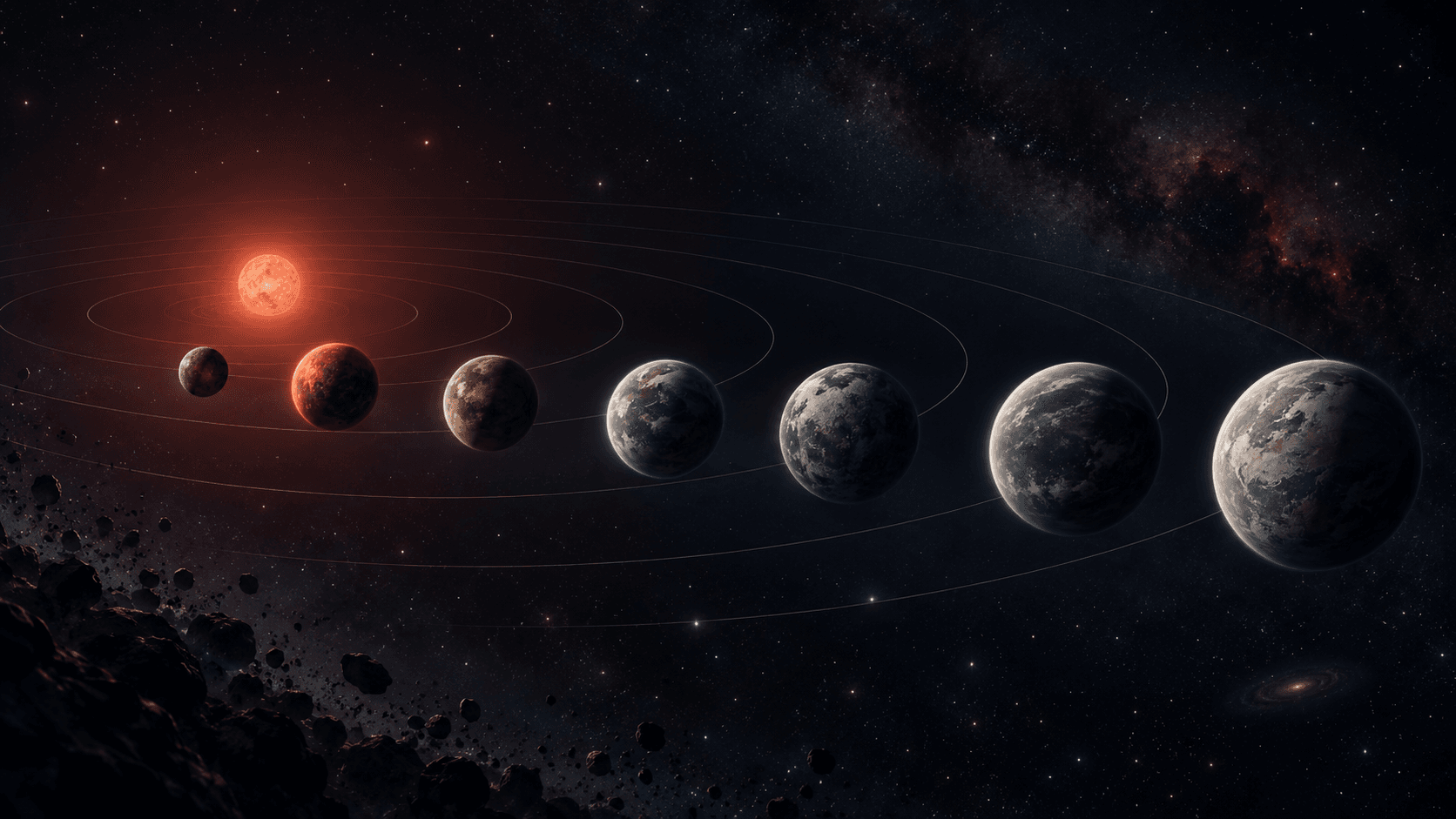
The TRAPPIST-1 system at a glance
The TRAPPIST-1 system is a compact family of seven roughly Earth-size rocky exoplanets orbiting a cool, faint star about 40 light-years away. All seven planets circle closer to their star than Mercury circles the Sun, yet the star is so much cooler than the Sun that several receive amounts of energy that make them important targets in the search for potentially temperate environments. They are not seven "second Earths," and no life has been detected. Their importance comes from an extraordinary natural experiment: seven related worlds formed around the same star, allowing astronomers to compare them planet by planet.
The host is an ultracool red dwarf called TRAPPIST-1. It has only a small fraction of the Sun's mass and radius and shines mostly at infrared wavelengths. The planetary system is viewed nearly edge-on from Earth, so every known planet transits. Those repeated crossings let telescopes measure radii, refine orbits, search for atmospheres, and use small variations in transit timing to estimate masses.
Discovery: from three worlds to seven
The system takes its name from the TRAPPIST robotic telescope in Chile. In 2016, researchers reported three candidate planets transiting the small star. Follow-up observations, especially with NASA's Spitzer Space Telescope and ground-based observatories, untangled the overlapping signals. In 2017, astronomers announced a seven-planet architecture.
Transit surveys favor a small host star. An Earth-size planet blocks a much larger fraction of an ultracool dwarf's disk than it would block of the Sun, producing a deeper signal. The short orbital periods also allow many transits to be observed in a reasonable time. In TRAPPIST-1, years last roughly one and a half to nineteen Earth days from the innermost known planet to the outermost.
The planets are labeled b through h in order of discovery convention, broadly matching increasing distance from the star. The letters do not grade habitability. TRAPPIST-1e is not "better" because of its letter, and planet b is not necessarily the first planet that formed.
Seven planets in an unusually compact arrangement
TRAPPIST-1b and c receive intense irradiation and are expected to be hot. Planets d, e, f, and g occupy the middle region, while h is the coolest and outermost known world. Popular summaries often say that three planets — e, f, and g — are in the habitable zone. The exact boundaries depend on atmospheric assumptions, stellar spectrum, clouds, rotation, and the definition used. A habitable-zone label says only that surface liquid water could be energetically possible under suitable conditions; it does not establish an atmosphere, ocean, or biology.
The entire architecture would fit comfortably inside Mercury's orbit. That compactness does not imply imminent collisions because the orbits are organized. The planets participate in a resonant chain: their orbital periods have relationships close to ratios of small integers. Repeated gravitational tugs produce transit-timing variations, with some transits occurring slightly early or late. Modeling those variations gives masses and densities without requiring a strong radial-velocity signal from each planet.
What mass and density tell us
Combining transit radii with timing-derived masses shows that the seven planets are broadly consistent with rocky compositions rather than hydrogen-dominated mini-Neptunes. "Rocky" remains a bulk description. A planet could contain an iron-rich core, silicate mantle, water or ice, surface volatiles, and an atmosphere in proportions that are difficult to separate from mass and radius alone.
Density comparisons across one system are especially valuable because the planets share a star and probably share aspects of formation history. Subtle differences may record where they formed, how material migrated through the disk, how much water they acquired, and how irradiation altered them. Models must account for uncertainties in stellar properties, planet masses, interiors, and volatile layers; there is rarely a unique composition that fits one mass and radius.
Tidal locking, climate, and the meaning of "year"
Strong tides likely synchronized the planets' rotations, leaving the same hemisphere facing the star on long timescales. Tidal locking is not automatically fatal to habitability. A substantial atmosphere or ocean could move heat from day to night. Three-dimensional climate models find that some synchronized planets can maintain moderate regions, but the outcome depends on atmospheric pressure, gases, clouds, water inventory, surface reflectivity, and stellar activity.
A short year is not the same as a short day. Synchronous rotation means the planet turns once per orbit relative to distant space while its star remains fixed in the sky for a surface observer. The substellar region receives continuous illumination, the antistellar region continuous darkness, and a ring near the terminator experiences permanent twilight. Those are model expectations, not landscapes directly observed.
The difficult history of red-dwarf radiation
Ultracool dwarfs live for extremely long times, giving biology a theoretically long window. Their youth can be harsh. Red dwarfs may spend extended periods brighter and more magnetically active than their later main-sequence state. Ultraviolet and X-ray radiation can heat upper atmospheres, split water molecules, and help light gases escape. Flares and stellar particles may further change atmospheric chemistry and erosion.
Whether any TRAPPIST-1 planet retained or rebuilt an atmosphere depends on its initial volatile supply, magnetic environment, interior outgassing, impact history, mass, and orbit. A planet can lose a primordial hydrogen envelope yet later possess a secondary atmosphere released from rocks. Conversely, being in today's habitable zone cannot restore water already lost. Researchers therefore reconstruct the star's history, not only its current brightness.
What JWST is testing
The James Webb Space Telescope can observe a planet's transit, secondary eclipse, or thermal phase behavior. During a transit, a small portion of starlight may pass through an atmosphere and acquire wavelength-dependent molecular fingerprints. During secondary eclipse, the planet disappears behind the star; subtracting the combined light from the star-only measurement isolates the planet's contribution statistically.
The planets are extremely challenging even for Webb. Their atmospheres, if present, produce small signals, stellar spots can mimic spectral features, and many observing events may be needed. Early Webb observations of the hot inner planets have ruled out some thick, clear atmosphere scenarios and measured thermal emission, but a nondetection does not prove an airless surface. Thin atmospheres, high clouds, unusual compositions, or spatially variable stellar contamination can remain consistent with limited data.
The temperate planets are harder because they emit less infrared light and orbit more slowly. Claims should identify the planet, observing mode, atmosphere model, and confidence. A headline such as "Webb found no atmosphere in TRAPPIST-1" incorrectly generalizes results from one world or a restricted class of atmospheres to all seven.
TRAPPIST-1e and the habitable-zone favorites
TRAPPIST-1e attracts particular attention because its measured density is compatible with a predominantly rocky interior and it receives an intermediate amount of stellar energy. Climate simulations can produce temperate conditions under some atmospheric assumptions. That makes it a priority for study, not a confirmed Earth analogue.
TRAPPIST-1f and g receive less energy and could require stronger greenhouse warming to keep surface water liquid. More carbon dioxide can warm a planet, but at low temperatures it may condense, and clouds can either warm or cool. Planet d receives more energy and may lie near an inner habitable-zone boundary, where water loss or a runaway greenhouse becomes a concern. These distinctions depend on models, and updated stellar and planetary values can shift boundaries.
Could there be oceans or atmospheres?
Bulk density allows water-rich interpretations for some planets, but it cannot show whether water sits in an ocean, ice mantle, hydrated rock, or vapor. Formation models suggest volatiles could have been delivered, while escape models show that substantial inventories might also have been lost. Both histories are plausible enough to motivate observations.
Atmospheric gases would shape temperatures and spectra. Carbon dioxide has strong infrared bands; water vapor, methane, carbon monoxide, and other molecules may be detectable in favorable cases. No single gas would demonstrate life. Oxygen can accumulate abiotically after water loss, methane can have geological sources, and biological interpretations require environmental context plus multiple mutually consistent signals.
Why the resonance matters
The resonant chain acts like an archaeological record. Smooth migration in the original gas disk can capture planets into linked period ratios. Later collisions or strong scattering would tend to disrupt that delicate order. The surviving pattern therefore constrains formation and migration.
Resonance also improves mass estimates. When neighboring planets repeatedly align, their gravitational pulls shift transit schedules in recognizable ways. Researchers fit all transit times together to infer masses and orbital eccentricities. Better masses improve densities; better densities narrow interior models; improved orbits predict future transits for atmospheric campaigns.
Small eccentricities can generate tidal heating inside synchronized worlds. Too much heating could drive volcanism or alter climate, while moderate internal energy might sustain geological cycling. Present constraints do not justify confident claims about volcanoes or plate tectonics. Tidal calculations depend on internal structure and energy dissipation that cannot yet be directly measured.
Can humans travel to TRAPPIST-1?
At approximately 40 light-years, TRAPPIST-1 is nearby on a galactic scale but far beyond current spacecraft capability. Light itself takes about four decades to cross the distance. Voyager-like probes would require hundreds of thousands of years. Proposed laser-sail concepts remain developmental and would face acceleration, navigation, shielding, communication, and deceleration challenges.
For the foreseeable future, exploration means remote sensing. That is still powerful: spectra can reveal temperatures, atmospheric structure, and chemistry across interstellar distances. The system's orientation lets astronomers revisit every planet, combine many transits, and compare the same observatory's measurements across a controlled planetary family.
What scientists still need to learn
The central questions are whether the temperate planets possess atmospheres, how thick and stable those atmospheres are, whether any surface water survives, and how stellar activity affects observations and climate. Researchers also want more precise masses, orbital eccentricities, stellar ultraviolet history, surface-pressure constraints, and measurements that distinguish atmosphere from bare rock.
Progress will be cumulative rather than a single dramatic photograph. Webb can eliminate broad atmosphere classes and search for selected molecules. Future extremely large ground telescopes may use high-resolution spectroscopy. Later space observatories designed for terrestrial-planet characterization could add complementary wavelengths and precision. Negative results matter because they test whether rocky planets around the galaxy's most common stars commonly retain air.
Why the TRAPPIST-1 system matters
TRAPPIST-1 transformed the search for habitable environments from a one-planet question into comparative planetology. Seven worlds let scientists ask why siblings exposed to different radiation evolve differently. If the inner planets are bare while outer planets retain atmospheres, the boundary would constrain atmospheric escape. If several retain air, that would demonstrate resilience around an active ultracool dwarf.
The system also teaches restraint. Size, location, and an artist's rendering can make a world look familiar long before its environment is known. The scientifically accurate description is more compelling: TRAPPIST-1 is the best available laboratory for testing how rocky planets form, interact, lose volatiles, and perhaps maintain temperate conditions around a very small star. It complements the broader picture of terrestrial worlds around other stars.
Frequently asked questions
How many planets are in the TRAPPIST-1 system?
Seven confirmed, approximately Earth-size planets are known: TRAPPIST-1b, c, d, e, f, g, and h.
How far is TRAPPIST-1 from Earth?
It is about 40 light-years away. Updated astrometric measurements may slightly refine the quoted value.
Which TRAPPIST-1 planets are in the habitable zone?
TRAPPIST-1e, f, and g are commonly described as being in or near conservative-to-optimistic habitable-zone ranges. Boundaries depend on atmospheric and climate assumptions.
Has JWST found life or an atmosphere there?
No life has been detected. Webb has constrained atmosphere scenarios for some planets, particularly the hot inner worlds, but results for one planet must not be generalized to all seven.
Is TRAPPIST-1e like Earth?
It is similar in size and likely rocky, but its atmosphere, surface, water inventory, magnetic environment, and habitability are unknown.
Why do all seven planets transit?
Their orbital plane happens to be aligned nearly edge-on from our viewpoint, so each passes across the star's disk.
Compare featured exoplanets
These six featured worlds sample very different corners of the exoplanet catalog. Distances, masses, and interpretations come from evolving datasets, so treat each row as a snapshot rather than a final answer.
| World | Type | Distance | Orbital period | Notable for |
|---|---|---|---|---|
| TRAPPIST-1 system | Seven Earth-size rocky worlds | ~40 light-years | 1.5 – 19 days | Compact resonant chain; benchmark JWST atmosphere study |
| Proxima Centauri b | Roughly Earth-mass candidate | ~4.24 light-years | ~11.2 days | Closest known exoplanet; active red-dwarf host |
| Kepler-452b | Possible super-Earth (status debated) | ~1,400 light-years | ~385 days | Sun-like host; low-signal transit whose planet status is contested |
| K2-18b | Habitable-zone sub-Neptune | ~120 light-years | ~33 days | Webb spectrum shows CH₄ and CO₂; DMS/DMDS claims contested |
| WASP-39b | Hot Saturn | ~700 light-years | ~4.05 days | First clear CO₂ detection; SO₂ photochemistry with JWST |
| 51 Pegasi b | Prototype hot Jupiter | ~50 light-years | ~4.23 days | First confirmed planet around a Sun-like star (1995 Nobel-cited discovery) |
More featured exoplanets
Proxima Centauri b
A roughly Earth-mass planet orbiting the nearest star to the Sun, discovered by radial velocity. It sits in the habitable zone but faces frequent stellar flares.
Kepler-452b
A statistically validated super-Earth candidate in the habitable zone of a Sun-like star ~1,400 light-years away. Its low-signal detection is now debated.
K2-18b
A habitable-zone sub-Neptune ~120 light-years away. JWST detected methane and carbon dioxide; tentative DMS/DMDS signals remain debated.
WASP-39b
A hot Saturn-mass giant ~700 light-years away. JWST returned the first clear CO₂ detection and evidence of SO₂ photochemistry in an exoplanet atmosphere.
51 Pegasi b
The first exoplanet confirmed around a Sun-like star. Its 1995 discovery by Mayor & Queloz shared the 2019 Nobel Prize in Physics.
Sources and further reading
- NASA Science — TRAPPIST-1 — last verified 2026-09-17
- NASA Exoplanet Archive — TRAPPIST-1 planetary system data — last verified 2026-09-17
- Gillon et al. (2017), Nature — Seven temperate terrestrial planets around the nearby ultracool dwarf star TRAPPIST-1 — last verified 2026-09-17
- Agol et al. (2021), The Planetary Science Journal — refined masses and compositions — last verified 2026-09-17